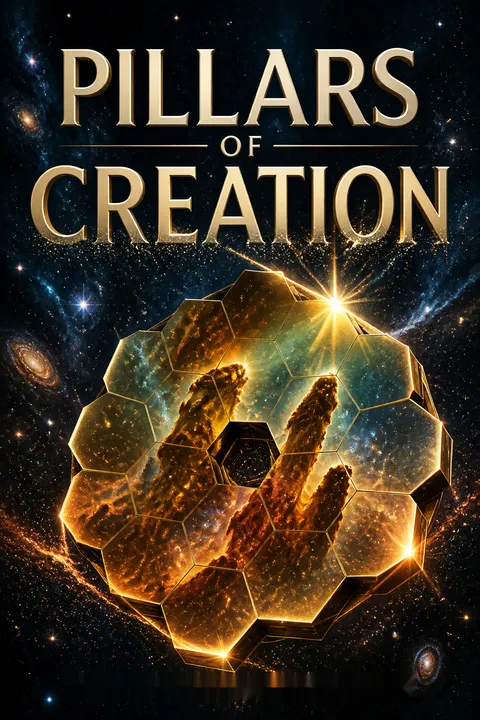


Key Takeaways
Build the next instrument before the current one finishes rewriting the questions
Curiosity and capability coevolve. In astronomy, a new tool does not simply answer old questions more clearly. It can reveal that the questions were too small. Galileo’s telescope exposed moons orbiting Jupiter; later instruments uncovered galaxies beyond the Milky Way. Each discovery created a new horizon and a demand for better equipment.
Planning is part of science. Before Hubble launched, Space Telescope Science Institute director Riccardo Giacconi urged colleagues to begin planning its successor. The James Webb Space Telescope took decades to build, endured delays and budget crises, and finally launched in 2021. Its history shows that scientific progress depends not just on insight, but on sustaining the machinery, funding, and institutional commitment needed to pursue it.
What's striking is how the instrument and the research agenda develop together. This resembles the coevolution of scientific theory and measurement: better tools reveal phenomena that existing concepts cannot neatly accommodate, and new concepts then guide the next tool. The practical lesson is that long-range planning is not a distraction from discovery. It is part of discovery's infrastructure. Yet continuity has a cost. Webb's enormous budget constrained other projects, so commitment to a flagship instrument must be weighed against the diversity of research that could be funded instead.
Infrared vision turns cosmic distance into a record of cosmic history
Farther means earlier. Because light takes time to travel, a distant galaxy appears as it was when its light began the journey. As the universe expands, that light's wavelengths stretch toward the infrared, a shift called redshift. Webb was designed to observe infrared wavelengths, including light from galaxies whose earliest emissions have moved beyond the visible range.
A new view reset expectations. Hubble's Deep Field, made by staring at a tiny patch of sky, revealed thousands of galaxies and sharpened the case for a more powerful successor. Webb's first deep-field image reached fainter objects in about twelve hours than Hubble's comparable image reached in fourteen days. Infrared vision also helps Webb see through the dust clouds that hide forming stars and planetary systems.
A telescope that looks far away is also a historical instrument. That makes astronomy unusual: the past is not reconstructed only from documents or fossils, but arrives continuously as light. The analogy to archaeology is useful, but imperfect. Astronomers receive ancient signals altered by distance, expansion, and intervening matter, so interpretation depends on models as well as observation. Webb's infrared reach expands the archive, but it does not provide an unfiltered picture of cosmic history.
Give first-of-their-kind instruments margin, because ordinary tests cannot prove they will work
Webb could not be tested as a whole. Its sun-facing equipment had to endure heat while its telescope and instruments operated at temperatures hundreds of degrees colder. No ground chamber could reproduce both extremes at once. Engineer Mike Menzel therefore relied on analysis: teams tested each side separately, compared results with mathematical models, and trusted those models to predict how the joined system would behave in space.
Extra margin meant room for the unknown. Webb's 6.5-meter mirror was built from eighteen folding segments, and its five-layer sunshield had to unfold after launch. The mission faced 344 identified single points of failure, any one of which could have ended it. Menzel argued for reserves in fuel, time, and design so unforeseen problems would not immediately become fatal.
This is a vivid case of engineering under irreducible uncertainty. Safety-critical fields such as aviation and medicine also distinguish between testing components and validating a whole system in its real operating environment. The key is not to pretend uncertainty has vanished, but to make it visible and absorbable. Margin is not waste when failure is catastrophic. At the same time, it is hard to justify unlimited reserves in public projects, which is why transparent risk estimates matter as much as technical caution.
Treat the universe as four expanding horizons, not one finished map
Each horizon changes the scale of the question. Webb's scientific program spans four regions: objects in our solar system, stars and planets in the Milky Way, galaxies beyond our own, and the universe's first stars and galaxies. The sequence reflects a long history of widened perspective. Galileo found moons orbiting another planet. William Herschel used large mirrors to probe the depths of the starry realm. Edwin Hubble established that spiral nebulae were distant galaxies.
The final horizon adds time. By studying extremely distant galaxies, Webb investigates earlier stages of cosmic history. The telescope's goals connect nearby questions, such as how planetary systems form, to the broadest one: how the universe developed the structures and elements that make later worlds possible. A horizon is not a wall; it is the current limit of what instruments can reveal.
The four-horizon map is powerful because it prevents astronomy from collapsing into a single spectacle of faraway galaxies. A moon, a forming planet, and a primordial galaxy belong to different scales and demand different observational strategies. This resembles nested levels in biology, where molecules, cells, organisms, and ecosystems require distinct methods while remaining connected. The framework is a guide, not a complete taxonomy: research areas overlap, and a discovery in one domain can reshape questions in another.
Trace solar-system water to learn how planets became potentially habitable
Webb expanded the map of water. Saturn's moon Enceladus was already known to eject water from cracks near its south pole. Webb measured a plume reaching at least 10,000 kilometers into space, roughly twenty times the moon's diameter. Its observations suggested that the plume supplies water across much of the Saturnian system, including the planet's surroundings, rings, and moons.
Unexpected locations complicate the origin story. Webb also detected water being released by some objects in the asteroid belt, a region long regarded as relatively dry. If asteroids held water as the early solar system formed, they may have contributed to the water on Earth alongside comets. Astronomers can use spectroscopy, which identifies matter through its interaction with light, to investigate what these objects contain and how they moved through the solar system.
The search for water links planetary science to questions about habitability without proving that water produces life. It is one ingredient in a much larger chain involving chemistry, energy, and stable environments. Webb's findings also illustrate a strength of wide-field observation: a probe can sample particles directly, while a telescope can survey a much larger region and reveal system-wide effects. Neither method replaces the other. The most reliable picture comes from combining local measurements with broad context.
Treat possible life signals as hypotheses, not headlines
A promising atmosphere is not proof of life. Webb observations of K2-18 b, an exoplanet about 124 light-years away, found strong evidence for methane and likely evidence for carbon dioxide. The planet lies in its star's habitable zone, and researchers considered whether it might have a hydrogen-rich atmosphere above an ocean, a proposed type called a hycean planet.
The most dramatic clue was the weakest. The team reported a tentative possibility of dimethyl sulfide, a molecule associated with life on Earth, but the evidence was far below the level needed to claim a discovery. Atmospheric molecules are inferred by comparing light from a star alone with light filtered through a planet's atmosphere during a transit. And Earth remains the only known example of a living world, a limitation scientists call the n = 1 problem.
This section demonstrates why scientific caution is not a retreat from exciting results. It is what lets an extraordinary claim remain testable. A suspected biosignature must be interpreted alongside planetary chemistry, stellar activity, and possible nonbiological pathways. The Bayesian principle is simple: evidence should change confidence in a claim in proportion to how much more likely that evidence is under one explanation than another. With only one known biosphere, that comparison is especially difficult. Public attention can outrun the evidence, making precise language essential.
Follow cosmic dust to understand how stars manufacture the ingredients of worlds
Dust is building material, not background clutter. Gas and dust gather into clouds, where stars form. When sufficiently massive stars explode as supernovae, they return material to space and can create heavier elements. That enriched material becomes part of later generations of stars, planets, and, ultimately, the chemistry associated with life.
Webb tested whether supernovae supply enough dust. Ori Fox and colleagues used Webb's Mid-Infrared Instrument to examine the remains of supernovae in the Fireworks Galaxy. In one image, the cool dust around Supernova 2004et stood out against hotter surrounding stars. Their analysis of that event and Supernova 2017eaw supported the possibility that supernovae help explain the universe's unexpectedly abundant dust. The PHANGS collaboration also used Webb to study spiral galaxies, producing an extensive public dataset on star-forming structures.
The cosmic dust story makes evolution feel materially concrete: complexity is built from recycled matter, not from ingredients appearing fully formed. The connection to ecological nutrient cycles is suggestive, though astronomical recycling occurs over immense timescales and through very different mechanisms. The evidence also remains cumulative. Two supernova remnants can support a broader account, but cannot alone establish that supernovae explain every dust-rich galaxy. The value of Webb's large surveys is precisely that they let researchers test whether an intriguing example represents a general pattern.
When Webb strains cosmology, improve the models before declaring the universe broken
Unexpected data is a test, not a verdict. Webb found early galaxies that appeared unusually bright or developed, and it detected nitrogen in a galaxy from only about 440 million years after the Big Bang. Such results challenged existing accounts of how quickly stars and galaxies could form. In one case, astronomers proposed that repeated bursts of star formation could explain the nitrogen abundance.
Models change through comparison. Some early claims of exceptionally mature galaxies weakened after follow-up analysis; other surprises gained plausible explanations. Cosmologists had already revised their picture of the universe when observations revealed dark matter and an accelerating expansion associated with dark energy. The book's point is not that the current cosmological model is untouchable, but that anomalies must survive careful measurement and competing explanations before they justify replacing it.
This is a useful distinction between anomaly and refutation. In the philosophy of science, a theory is rarely tested in isolation: measurements, calibration, and auxiliary assumptions are tested with it. That makes premature claims of a broken model tempting but unreliable. Yet the opposite error is possible too. If every troubling observation is absorbed through flexible adjustments, a theory can become difficult to falsify. The productive response is to specify what observations would distinguish rival explanations, then seek independent measurements capable of doing so.
Remember that a Webb image is a scientific translation, not a view through human eyes
Webb does not see visible colors. Its instruments record light, including infrared wavelengths beyond human vision. Digital processing converts measurements into pixels, and image makers assign visible colors to different wavelength filters. Those choices can make structures easier to interpret or create a striking public image, but the resulting colors are not what a human observer would see nearby.
The picture is one form of evidence. Spectra, graphs showing how light varies across wavelengths, can reveal chemical composition more directly than a colorful image. Webb teams choose filters according to the materials they want to study, then produce visualizations from the data. A galaxy image may communicate the scale and shape of a discovery; the associated measurements establish what the image can support scientifically. Understanding both keeps beauty from being mistaken for raw, unprocessed eyesight.
Every scientific image is mediated by choices about measurement, processing, and display. That does not make the image deceptive; it makes its construction part of its meaning. The same principle applies to medical scans, climate maps, and satellite imagery. Good scientific communication pairs visual force with a clear account of what colors encode and what they omit. There is also a real tension: aesthetic presentation helps people care, while visual polish can suggest more certainty than the underlying data warrants.
Analysis
The book's deeper subject is not simply a telescope, but the system that makes observation possible. Its story moves between astronomers asking what lies beyond the visible limit, engineers turning those questions into hardware, and institutions negotiating whether the hardware can be built. Webb's decades-long path reveals that scientific ambition is not a clean sequence of idea, experiment, and answer. It is a social process shaped by budgets, political priorities, technical risk, and the ability of researchers to keep a shared project alive.
The narrative also clarifies that instruments do not passively collect facts. Webb's infrared sensitivity determines which signals it can detect; its filters shape which data astronomers gather; computational pipelines and models determine how raw measurements become interpretable. This mediation does not undermine objectivity. Rather, objectivity is achieved through calibration, cross-checks, independent analysis, and public data that other researchers can scrutinize. The instrument's limitations and design choices belong inside the scientific account, not outside it.
The book's recurring drama is the encounter between surprise and restraint. Rebecca Larson sees a weak signal that others initially miss. Ori Fox's collaborators resist an exciting dust result until it withstands further checks. Possible signs of life around K2-18 b attract headlines while the evidence remains tentative. These episodes make a strong case for scientific patience without reducing discovery to bureaucratic caution. A result can be thrilling and provisional at once.
The most useful tension is between the prestige and cost of a flagship mission. Webb opened observational territory inaccessible to earlier telescopes, but its budget and delays affected other projects. The story therefore resists a simple celebration of technological scale. Great instruments can expand knowledge dramatically, yet a healthy scientific ecosystem also needs smaller, diverse projects and independent routes to test major claims. Webb's achievement is not that it ends uncertainty. It gives uncertainty sharper contours, better evidence, and more consequential questions.
Review Summary
Pillars of Creation is praised for its engaging exploration of the James Webb Space Telescope's development and discoveries. Readers appreciate Panek's accessible writing style, blending scientific concepts with human stories. The book offers insights into the telescope's groundbreaking observations, from our solar system to the early universe. While some found the technical details overwhelming, most reviewers were captivated by the cosmic revelations and the telescope's potential to reshape our understanding of the universe. The book is recommended for space enthusiasts and general readers interested in astronomy.
People Also Read

Glossary
Redshift
Wavelength stretching from expansionRedshift is the increase in the wavelength of light as it travels through an expanding universe. Light from distant galaxies can shift from visible wavelengths into the infrared. Because light takes time to reach Earth, measuring redshift helps astronomers estimate how distant an object is and how early in cosmic history it is being observed.
Spectroscopy
Chemical analysis through lightSpectroscopy separates light into wavelengths and examines patterns of emission or absorption. Different atoms and molecules leave characteristic patterns, allowing astronomers to infer the chemical composition and physical properties of objects too distant to sample directly. Webb uses near-infrared and mid-infrared spectroscopy to study planets, stars, and early galaxies.
Gravitational lensing
Gravity magnifies distant lightGravitational lensing occurs when the mass of a foreground object bends light from a more distant object behind it. A massive galaxy or galaxy cluster can magnify the background source and create multiple images. Astronomers use the effect to study faint early galaxies that might otherwise be too dim to detect.
Standard candle
Known brightness measures distanceA standard candle is an astronomical object whose intrinsic brightness can be estimated or is known to follow a reliable pattern. Comparing that brightness with how bright the object appears from Earth allows astronomers to estimate its distance. Cepheid variable stars are an important example because their pulsation period is related to their intrinsic brightness.
Hycean planet
Hydrogen atmosphere, ocean surfaceA hycean planet is a proposed kind of world with a hydrogen-rich atmosphere and an ocean at its surface. The term combines references to hydrogen and ocean. Such planets are considered possible targets in the search for life-related chemistry, but their existence and habitability require further observation and testing.
n = 1 problem
Only one known living worldThe n = 1 problem describes the severe limit on what can be inferred about life when Earth is the only known inhabited planet. Scientists can investigate conditions that support life as it exists here, but they have only one confirmed example with which to distinguish universal requirements from features unique to Earth.
PHANGS
Survey of nearby spiral galaxiesPHANGS is the project name for Physics at High Angular resolution in Nearby GalaxieS, an international collaboration studying nearby galaxies at high detail. Its Webb observations use infrared data to examine dust, gas, and star-forming structures in spiral galaxies, adding to observations made with other telescopes and making a large body of data available for further research.
The Standard Model of Cosmology
Current account of cosmic historyThe Standard Model of Cosmology is the prevailing framework describing the universe's expansion and large-scale development. It incorporates ordinary matter, dark matter, and dark energy, and is supported by multiple lines of observation. Webb's early-galaxy findings test details of this framework and the models used to explain how cosmic structures formed.
Dithering
Small shifts between exposuresDithering is an observing technique in which a telescope shifts its pointing slightly between exposures. Combining those exposures can reduce the effects of bad pixels, cosmic-ray hits, and other detector artifacts. Webb's ability to use small pointing adjustments also helped it observe moving objects in the solar system.
Download PDF
Download EPUB
.epub digital book format is ideal for reading ebooks on phones, tablets, and e-readers.








