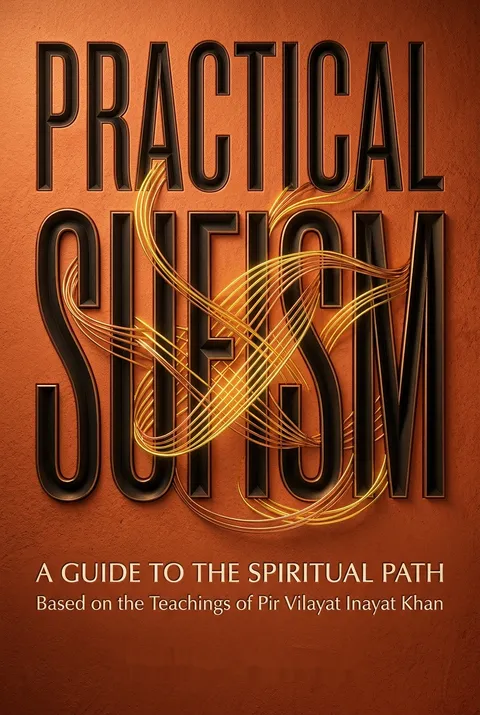


Key Takeaways
Practice Sufism as lifelong apprenticeship, not a set of beliefs.
A wake-up, not a finish line. Gowins begins with a startling sensation of energy passing through his body at age twenty-six. He later treats it as an invitation to examine his life, not proof of spiritual attainment. A vow to serve the world is followed by upheaval, self-scrutiny, and a meeting with Pir Vilayat Inayat Khan, whom he eventually takes as his teacher. The story introduces the book's central claim: spirituality is made real through practice and character, not by adopting impressive ideas.
One path, not one formula. Gowins writes from his own Sufi training, but presents it as a personal route rather than a universal prescription. Meditation, breath, service, and honest self-observation are ways to begin the work, not guarantees of a particular result.
The opening is persuasive because its unusual event matters less than the response it provokes. That distinction keeps spiritual experience from becoming a status symbol. The book also makes a useful choice by presenting a lived apprenticeship instead of an abstract creed. Its limitation is equally important: a meaningful interpretation of an event is not independent evidence about what caused it. The practical value lies in the questions the experience opened, not in asking every reader to accept its metaphysical explanation.
Seek happiness through the soul's love, not a permanent supply of pleasure.
Happiness from within. In this book, happiness is not a steady high, a pleasurable meal, or the satisfaction of finishing a task. It is the soul's natural state: perceiving life as belonging to the being of God and allowing love to flow through changing circumstances. Gowins argues that resentment, guilt, and inadequacy obstruct that flow, while a distorted self-image can make those obstructions hard to see.
Start with what is beautiful. A student too dispirited to meditate was encouraged to spend time with paintings, animals, and natural scenery. Contemplating beauty helped loosen the student's fixation on ugliness. Gowins also recommends balancing the breath, such as counting evenly through an in-breath and an out-breath, as a simple way to cultivate attention and composure.
The distinction between pleasure and a deeper orientation toward life is valuable because it avoids promising constant cheerfulness. The beauty exercise also offers a concrete shift of attention rather than a demand to deny pain. Still, the account rests on a religious premise: that the soul's underlying condition is divine love. Readers need not share that theology to test the practical question beneath it: what habits of attention make care and beauty more available, and which keep distress in the foreground?
Make spiritual practice regular, because belonging alone does not change you.
Practice beats affiliation. Gowins insists that joining an order, attending talks, or speaking fluently about spirituality cannot substitute for doing the work. One basic exercise is to inhale for four counts and exhale for four, first while sitting and then while walking. Its simplicity is deliberate: regular repetition matters more than collecting elaborate techniques.
Change can feel unpleasant. A Muslim student who had prayed five times daily for years found new Sufi exercises unsettling and began feeling inadequate. Gowins encouraged her to continue rather than treating discomfort as proof of failure. He also describes learning through regular contact with a teacher and other students, observing how they behave and absorb their example. Community can support practice, but it cannot do the practice for anyone.
The book's sharpest practical distinction is between identity and behavior: calling oneself a seeker is not the same as sustaining a discipline. Repetition gives attention a reliable home, while a community offers examples that solitary effort cannot provide. Yet imitation has a boundary. Copying a teacher's style can become performance rather than inner change. A useful test is whether practice increases honesty, steadiness, and care in ordinary relationships, not merely fluency in a group's customs.
Treat problems as clues, without declaring every wound self-created.
Look beneath the complaint. Gowins often treats personal distress as a signal to examine what is happening inside. He describes tracing his self-pity through feelings of ineffectiveness and inadequacy to a buried desire to serve. The exercise Shahid, or “The Witness,” is a neutral review of the day's events, often done before sleep. Its purpose is to notice actions and reactions without immediately judging them.
Do not turn insight into blame. Gowins is explicit that not every hardship is self-generated. His friend Michael's cancer was an illness, not evidence of a spiritual failing or hidden wish to suffer. Friends who tried to assign blame were avoiding the uncertainty of sickness. The useful distinction is between external events, which may not be under personal control, and the choices and responses that can still be examined.
This is one of the book's most important safeguards. Self-examination can reveal patterns without implying that people cause their own trauma, illness, or oppression. The witness exercise is especially sound as a method of gathering information before reaching a verdict. Its spiritual framing can become risky if applied carelessly: searching for an inner cause should never replace medical care, practical help, or recognition of another person's responsibility. Reflection is useful when it expands agency, not when it manufactures guilt.
Use embarrassment to expose habits, not to condemn your whole self.
Notice what is hard to see. Gowins calls the path one of embarrassment because spiritual work can reveal selfishness, contempt, or a habit of criticizing others. Muhasaba is the Sufi practice of self-examination and self-questioning. The aim is not to punish oneself, but to see behavior clearly enough to change it. Gowins's practical example is simple: when an unnecessary criticism is about to be voiced, refrain from voicing it.
Make the correction quietly. He warns against turning self-improvement into a public announcement or a performance of humility. He also describes how people can overstate their spiritual progress or underestimate it. In either case, comparison distracts from the next honest task. A flaw becoming visible may mean that attention has improved, not that the person has suddenly become worse.
Embarrassment can be productive when it narrows the gap between self-image and conduct. The instruction to change a specific behavior, rather than rehearse a theory about one's character, keeps the work actionable. This resembles a useful principle of behavior change: observe a pattern, then intervene where it occurs. The caution is that shame can also freeze people or turn self-scrutiny into obsession. The book's best corrective is its insistence that seeing a fault should coexist with recognizing one's dignity.
Commit for the long haul, but keep judgment in your own hands.
Let commitment have weight. Gowins argues that a serious spiritual path cannot be treated like a temporary experiment abandoned as soon as it becomes uncomfortable. He tells a Sufi story about a villager who remains loyal to his deceased teacher even after another sheikh calls that teacher a fraud. The tale dramatizes fidelity, but it is deliberately extreme.
Loyalty has limits. Gowins also warns against fanaticism and spiritual charlatans. He says the student remains responsible for deciding whether to accept instruction, and that a teacher may direct someone toward therapy or a different path. The story is best read as a challenge to casual, consumer-like commitment, not as a command to obey an abusive teacher or defend deception.
Commitment creates enough continuity for a practice to be tested through boredom, doubt, and change. But the villager's loyalty story exposes a real tension: fidelity can preserve a meaningful discipline, or it can protect a harmful authority from scrutiny. The difference depends on whether the relationship permits questions, outside support, and genuine choice. A durable commitment should deepen responsibility, not transfer it wholesale to a teacher. The book's emphasis on student discernment is therefore essential, not a minor qualification.
Surrender separateness through love, not agency through obedience.
The ocean and its waves. Wahdat Al Wujud, or Unity of Existence, is the Sufi idea that distinct beings are not ultimately separate from their source. Gowins explains it through an ocean: individual waves appear separate, yet belong to the same body of water. Fana is the mystical experience of immersion in that unity. Because full immersion would make ordinary activity difficult, spiritual life must also return to the everyday world.
Release what narrows life. Gowins describes quitting smoking after years of resistance. As the addiction weakened, he felt more able to pursue friendships he had avoided. He interprets this as surrender: not being forced by an outside power, but loosening a constriction and becoming receptive to love. In this account, surrender is an inner reorientation, not passivity toward other people.
The ocean metaphor makes a difficult metaphysical claim imaginable without reducing it to a dry definition. It also gives surrender a useful psychological reading: relinquishing a rigid attachment can open attention to neglected relationships. The metaphor should not erase individuality or boundaries, however. A sense of unity is not a reason to tolerate coercion or dissolve personal responsibility. Its strongest ethical implication is increased regard for others, not permission for anyone to claim authority over another person's will.
Find a capable guide before interpreting every inner change alone.
Use a compass, not a substitute self. Gowins argues that a teacher can recognize patterns a student misses and transmit knowledge that cannot be learned from reading alone. In Sufism, Bayat is the ceremony of commitment, often described as “taking hands.” A teacher may assign brief personal practices, while the student remains responsible for carrying them out and deciding whether the guidance is appropriate.
Choose carefully. Gowins distinguishes two broad spiritual orientations: the path of love, drawn strongly to a teacher's presence, and the path of service, drawn to work for people or community. Both can be valid. He warns that spiritual enthusiasm can attract unreliable guides, and that a person may need a therapist before undertaking intensive practice. A sound teacher supports development rather than seeking money, dependence, or personal power.
The guide relationship addresses a genuine problem of introspection: people are often poor judges of their own blind spots. A trusted outside perspective can make practice more accountable, especially when unusual experiences or major changes arise. But spiritual authority is inherently asymmetric, so trust needs safeguards. The book is strongest when it pairs guidance with student responsibility and acknowledges therapy. No teacher should be treated as the sole judge of a student's reality, health, or worth.
Measure progress by steadier practice, not spectacular inner experiences.
Do the retreat, not the fantasy. Gowins recounts a fifteen-day retreat in a small hut, with scheduled meditation, repetitive sacred phrases, simple meals, little conversation, and few distractions. For days he questioned why he had agreed to it. Around the eighth or ninth day, he began to experience a deep calm. He emphasizes that the retreat was not a machine for producing a particular vision or state; expectations could interfere with the work.
Experience is not the scorecard. A senior Sufi once described decades of faithful remembrance without a single dramatic spiritual experience. The practice, not the fireworks, had shaped him. Gowins cautions against treating a rare sensation as proof of special status, or the absence of sensations as evidence of failure. Progress may be subtle and more visible in conduct than in private impressions.
This emphasis protects spiritual practice from becoming a hunt for extraordinary states. A retreat's structure can reduce ordinary distractions, while the participant's lack of control over its outcome is part of the lesson. The account also invites an important distinction between subjective intensity and durable change. A vivid experience may matter deeply, but it is not self-validating. The more grounded measure is whether practice improves discernment and behavior after the retreat ends.
Turn spiritual longing into disciplined creativity instead of buying temporary relief.
Listen to the ache. Gowins describes a persistent inner longing that he tried to cover with sex, drugs, cigarettes, coffee, and fiction. Quitting smoking made the underlying feeling more noticeable. He came to understand it as a spiritual yearning, not a defect that possessions could permanently repair. He does not argue that owning things is wrong; rather, things and status provide only temporary satisfaction and can create further mental clutter.
Make something with the energy. Gowins's woodworking gives the longing a constructive outlet. He describes approaching a valuable piece of wood anxiously, then finding that once work begins, attention shifts from self-consciousness to the act of making. Skill and care still matter, but the result cannot be fully controlled. For him, creativity becomes a disciplined way of participating in something larger than personal reward.
The chapter gives longing a more generous interpretation than simple lack: it may point toward a need for meaning, relation, or creation that consumption cannot satisfy. The woodworking story grounds that idea in a process requiring both competence and openness to an uncertain result. This does not mean every craving hides a spiritual truth, or that material needs are trivial. The useful question is whether a chosen response nourishes lasting engagement or merely quiets discomfort for a moment.
Let spiritual courage shape worldly service, not just private serenity.
There is more than one kind of courage. Gowins recounts the Sufi leader Shamyl's armed resistance to Russian expansion in the Caucasus, alongside the example of Shamyl's pacifist teacher. He uses the contrast to reject the idea that every spiritual person must express goodness through the same public role. In his account, the knight represents honor grounded in the deeper Self, with courage directed toward a real responsibility rather than personal glory.
Sacrifice can reveal what matters. Gowins gave up chess and discovered that what he had relinquished was his need to win, not a beloved pastime. A student who disliked teaching eventually found himself unable to continue it, though Gowins advises consulting a guide before interpreting such changes. Spiritual change may alter work and relationships, but sacrifice is not automatically wise just because it hurts.
The pairing of a fighter and a pacifist is a useful challenge to spiritual stereotypes. It suggests that ethical action depends on context, not a single aesthetic of serenity. The chess story similarly separates an activity from the ego reward attached to it. Yet the book's language of divine duty can be misused to sanctify impulsive choices. Its own call for guidance and discernment matters: courage is not the same as certainty, and sacrifice needs consequences considered.
Face death as a threshold, and choose a practice that fits your life.
Let mortality deepen attention. Gowins describes his friend Michael living with stomach cancer and dying in 1999. Near the end, friends sat with him, silently repeating a remembrance practice on their breath. Gowins experienced the room as peaceful and interpreted Michael's death as a transition rather than an ending. This is the Sufi understanding presented in the book, not a claim that every reader must accept as established fact.
There is no single route. In the final chapter, Gowins refuses to prescribe one next step for everyone. He suggests reading, classes, meditation, and searching for a suitable guide, while urging readers to take their own experience seriously. The path is individual, but not necessarily solitary: practice and counsel can help a person test what feels true and live it responsibly.
The account of Michael gives the book's metaphysics emotional force without turning grief into a tidy lesson. Its value lies in showing how a belief about death can shape the living person's presence with someone who is dying. That belief remains a matter of spiritual interpretation, not something the story can prove for outsiders. The closing counsel to choose an individual path balances the authority of tradition with personal responsibility, though it leaves readers to distinguish intuition from wishful thinking.
Analysis
Practical Sufism is part memoir, part practice guide, and part defense of an experiential spirituality that resists fixed doctrine. Its narrative begins with an unsettling bodily experience, proceeds through vows, personal upheaval, and apprenticeship, then uses the author's life to explain spiritual work. The structure is intentionally associative rather than systematic. That looseness conveys a central point: inner development rarely follows a clean sequence. It also makes the book harder to summarize, since its lessons emerge through recurring stories and images rather than a single formal method.
The most useful thread is the movement from interpretation to practice. An unusual experience, a painful problem, or a newly visible flaw matters only insofar as it leads to more attention, honesty, discipline, or love. Breath exercises, daily review, restraint from gossip, retreat, and creative work give that claim practical form. The author's humor and willingness to describe his own vanity keep spiritual aspiration connected to ordinary human behavior.
The account also has tensions that deserve careful reading. The ideas of a lifetime vow, teacher transmission, prebirth purpose, and consciousness beyond the body can be meaningful within the Sufi worldview, but the stories do not establish them as universal facts. A spiritual community can support change, yet also intensify conformity. The book partly addresses this by warning about fraudulent teachers, allowing that therapy may be needed, and preserving the student's responsibility to judge instruction. Those safeguards should be treated as central.
The strongest contemporary reading treats the book's metaphysics as a lens for practice, not as a demand for assent. Its methods invite self-observation without self-hatred, commitment without passivity, and surrender without abandoning agency. The lasting contribution is less a map to enlightenment than a portrait of apprenticeship: repeat the work, question the self-image, seek trustworthy help, and let spiritual ideals change how one meets other people and the fact of mortality.
Review Summary
The reviews for Practical Sufism are mixed. Some readers appreciate the accessible writing style and practical exercises, finding it helpful for beginners. However, others criticize the lack of historical context and connection to Islam, feeling the book presents an incomplete view of Sufism. The author's personal journey is engaging, but some reviewers wished for more depth on Sufi philosophy and practices. The book's structure and organization are also points of contention, with some finding it liberating and others struggling to grasp key concepts.
Glossary
Wahdat Al Wujud
Unity of existenceA Sufi metaphysical idea, translated as Unity of Existence, in which all created beings are understood as expressions of one ultimate source rather than independently existing realities. Gowins uses an ocean and its waves to explain how distinct forms can appear separate while remaining part of a shared ground of being.
Fana
Absorption in unityA Sufi term for annihilation or dissolution of separate selfhood in the divine reality. In Gowins's explanation, it describes immersion in the unity beneath individual forms. He presents it as a mystical state, not the destruction of the physical person, and notes that ordinary life requires a return to attention to the distinct world.
Bayat
Sufi commitment ceremonyA ceremony of initiation or commitment in which a student joins a Sufi order and takes the teacher's hands. Gowins describes it as a formal expression of a commitment that the student makes inwardly, rather than as a simple change of religious identity. Its significance is tied to entering a relationship of practice and guidance.
Muhasaba
Self-examination practiceA continuing Sufi practice of examining one's actions, motives, and assumptions. Gowins recommends asking what one is doing and looking honestly at the answer without turning the exercise into self-punishment. The purpose is to notice patterns, distinguish self-image from behavior, and become more responsible for one's choices.
Shahid
Neutral daily reviewA practice Gowins calls The Witness. Before sleep, a person reviews the day's events in sequence, observing actions and reactions without judging them. The exercise is intended to reveal patterns and causes that are hard to see while caught up in an event. Its defining quality is neutral attention rather than accusation.
Darood
Phrase paired with breathA word or short phrase held in the mind, often in coordination with breathing, to replace habitual loops of thought. Gowins says it may be a divine name or a simple phrase of calm. In his presentation, the practice helps concentrate attention and can serve as a basic element of Sufi meditation.
Maqaam
Spiritual stationA level or station of spiritual realization or awareness. Gowins uses the term to describe a person's current spiritual position, while stressing that a change in station can unsettle familiar habits and self-understanding. It is not presented as a permanent rank or a reason to compare one's progress with others.
Wadood
Divine attribute of loveA name of God associated in the book with love as a creative force. Gowins presents Wadood as the love through which the universe comes into being and suggests that repeating the name can focus a practitioner on that quality. The term refers to divine love, not merely personal affection or romance.
Ishq
Longing for the BelovedA Sufi term for an intense, enduring love understood as longing for reunion with the divine Beloved. Gowins describes it as a form of spiritual nostalgia, a sense of incompleteness whose object may not be clearly known. It is distinguished from the pursuit of pleasure or reciprocal personal affection.
Dhat
Uncreated ground of beingThe undifferentiated, uncreated state of divine reality described by Sufi metaphysicians as the source from which creation issues. Gowins portrays it as beyond ordinary reason and unaffected by the worlds that emerge from it. His desert image contrasts the darkness beyond a campfire with the illuminated created universe.
Fana-fi
Dissolution in another's beingA contemplative exercise in which a student imagines entering into the qualities and awareness of another being, often a spiritual guide. Gowins describes levels that move from teacher to higher spiritual archetypes. The exercise is meant to expand understanding and help a student imagine qualities of spiritual realization, not to erase personal responsibility.
Download PDF
Download EPUB
.epub digital book format is ideal for reading ebooks on phones, tablets, and e-readers.








