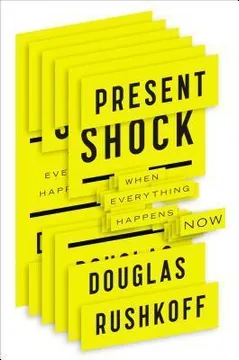


Key Takeaways
Treat the always-on present as a shock, not as mindfulness.
The now is crowded. Douglas Rushkoff calls the condition present shock: a culture organized around live updates and immediate response, where the past and future feel less relevant and everything seems to demand attention now. It is not the calm awareness of the present associated with mindfulness. A hedge fund manager loses trades to faster computers; a partygoer checks whether another party is better; news makes distant disasters feel constantly immediate. The result is often distraction rather than deeper contact with the moment.
Speed is not the whole story. After the 1990s trained people to look toward an ever-accelerating future, the new millennium brought a turn toward current value and real-time information. That turn can help people act without waiting for promised rewards, but it can also weaken planning, sustained attention, and the ability to distinguish urgency from importance.
What's useful here is the distinction between presence and immediacy. Attention research supports the idea that frequent task switching carries costs, while mindfulness practice typically involves sustained attention and deliberate awareness, not simply reacting quickly. The book's diagnosis also raises a practical question: who benefits when every moment feels urgent? Platforms, advertisers, and traders can profit from rapid responses, even when individuals lose the ability to deliberate. Still, the contrast should not be overstated. Real-time information can expose neglected problems and help people coordinate. The problem is not a present focus itself, but a present defined by other people's alerts.
Replace broken grand stories with participatory experiences, not louder spectacle.
Stories guide attention. A conventional plot builds tension around a character, then offers a resolution that can carry a moral or a product pitch. Rushkoff argues that remote controls and interactive media made audiences less willing to remain captive to that structure. Television responded with self-parody, fragmented plots, and reality shows built to provoke immediate reactions. Some work, such as games, offers another route: players make choices and learn through consequences rather than being led toward a single ending.
Participation can organize meaning. In Occupy Wall Street, General Assemblies used facilitated discussion and hand signals to build consensus without reducing every disagreement to a win-or-lose debate. The process was slow and sometimes unwieldy, but it modeled ongoing collective participation. The alternative to old narratives is not necessarily chaos. It can be shared activity that creates meaning through what people do together.
The shift from plot to participation connects to experiential learning: people often understand a system more deeply by making decisions inside it than by receiving a tidy explanation from outside. Games can make consequences visible, while consensus procedures let participants surface disagreements that a slogan would erase. Yet participation is not automatically democratic or wise. A game designer sets the available choices, and a meeting can privilege people with more time or confidence. Linear stories also remain useful for teaching history and coordinating action. The stronger claim is not that stories are obsolete, but that institutions lose credibility when they insist on one-way storytelling after audiences can answer back.
Stop letting digital alerts split one human into several unfinished selves.
Digital identity multiplies. Digiphrenia is the strain created when digital systems treat a person as if they can be present in many places at once. Rushkoff recounts being locked out of his online calendar while traveling, then accepting two speaking engagements that turned out to overlap. His digital presence could receive requests everywhere; his body could only attend one event.
The mismatch can be severe. Drone pilots operate aircraft remotely, then drive home to family life. The book reports that 34 percent experienced burnout and more than one quarter showed clinical distress. Their difficulty is not simply using screens. It is moving between roles whose emotional consequences do not disappear when a mission ends. Computers divide processing among tasks; people instead switch attention, often losing accuracy and continuity.
The useful distinction is between parallel processing and human task switching. A computer can allocate separate resources to simultaneous operations; a person generally shifts attention between demanding tasks, with costs to memory and performance. The drone example makes the issue moral as well as cognitive: physical distance does not guarantee emotional distance, and a work identity can follow someone home. The design question is therefore not how to train people to imitate machines, but which demands deserve concurrency at all. Still, role conflict predates digital media. Technology intensifies it by making availability appear limitless and by obscuring the boundaries that once separated work, home, and rest.
Protect the opportune moment by batching digital time instead of answering every ping.
Two kinds of time matter. Rushkoff uses the Greek terms chronos and kairos. Chronos is clock-measured time, divided into countable units. Kairos is the right moment for a particular action, recognized through context and judgment. Digital systems excel at chronos: each alert and choice arrives as another discrete demand. But the interruptions can prevent people from noticing when a conversation, idea, or task is unfolding well.
Let machines wait. Email is often asynchronous, yet phones turn it into an apparent live conversation. Rushkoff describes a candle maker who stopped interrupting her work for every order and processed messages in a scheduled batch instead. She still sent customers an automatic acknowledgment, while preserving uninterrupted time for making candles. Filtering alerts and grouping routine responses can restore attention without abandoning digital tools.
This is a strong design principle: match the medium's pace to the task rather than assuming every message deserves immediate service. Behavioral research on intermittent rewards helps explain why checking can become compulsive. An occasional valuable message reinforces repeated inbox checks, much as unpredictable rewards can sustain other habits. Batching reduces that loop and protects longer stretches of focused work. The qualification is important: some jobs genuinely involve urgent communication, and delayed responses can shift costs onto colleagues or clients. A useful boundary therefore includes explicit expectations about response times, rather than relying on silence alone.
Match decisions to their real timescale instead of squeezing years into seconds.
Different processes need different clocks. Freeman Dyson's idea of temporal diversity describes survival across several scales, from an individual life to families, nations, cultures, species, and the wider web of life. Rushkoff applies this to society: fashion changes quickly, while infrastructure, governance, and nature change more slowly. Trouble follows when a fast measure governs a slow process, such as short-term polling steering public policy or quarterly returns dictating long-term investment.
Compression can mislead. During the shortened NBA season after a lockout, injuries appeared more frequent per day, but the rate per game had not risen. More games were simply packed into fewer days, leaving less recovery time. Rushkoff calls the harmful compression of long processes into the immediate present overwinding. He contrasts it with spring-loading: deliberate preparation that makes accumulated training or resources available when needed.
Timescale mismatch is a valuable lens for institutions because many failures are not failures of effort, but of measurement. A quarterly metric can be accurate for cash flow and still be a poor proxy for research, public health, or ecological resilience. The NBA example shows why denominators matter: injuries per day and injuries per game answer different questions. The framework also cautions against treating every fast change as progress. Its limitation is that the boundaries between timescales are not always clear, and slow-moving systems can still require rapid intervention. Good governance needs both early warnings and patience for effects that cannot be rushed.
Use money for exchange, not as a shortcut for value that takes time.
Money can store or circulate. Rushkoff distinguishes stored value from flowing exchange. In his account, medieval grain receipts helped local trade because people could spend them, and their value declined over time as grain spoiled or required storage. Later central currencies, lent at interest, rewarded accumulation and required continuing economic expansion. Each kind of money supports different activity, so a tool designed for saving may not revive a community that needs more local transactions.
Leverage compresses the future. Derivatives let investors bet on the changing value of assets, and successive layers can turn investment into wagers on price movements themselves. Household mortgages can make the same promise: pay less now, assuming rising home values will solve the future bill. Local exchange networks, including Greece's tem system, offer a contrasting model that prioritizes trading goods and services within a community.
The distinction between liquidity and stored wealth helps explain why injecting capital does not automatically create local prosperity. Money can move through a system without reaching the people or businesses that need customers. The book's account of medieval currencies is a provocative historical model, though it should not be mistaken for a complete explanation of economic development or a plug-in policy solution. Local currencies can support exchange, but they cannot replace every function of national money, including broad savings and long-distance trade. The durable insight is narrower: financial instruments should be judged by the kind of activity they enable, not by the assumption that all money works the same way.
Test causal links before treating a pattern as an explanation.
Connection is not proof. Fractalnoia is Rushkoff's term for the urge to find meaningful patterns by linking events that occur together, even when the relationship is imagined or weak. He illustrates it through a caller who connects airplane trails, a Japanese tsunami, and a supposed weather-control program into one explanation. Online links make such connections easy to assemble, while a live news feed can make unrelated events seem like cause and effect.
Feedback can amplify error. A company responds to a post, users react to the response, and news outlets report on the reaction. Each loop changes the next one, making it difficult to identify what started the cascade. Pattern recognition remains useful, especially when groups compare perspectives. The discipline is to distinguish a recurring shape from a story that merely feels complete.
The section's central warning aligns with a basic principle of causal inference: co-occurrence is not enough. A credible explanation needs a plausible mechanism, evidence that could distinguish it from alternatives, and willingness to revise when predictions fail. Networked discussion can improve that scrutiny by bringing in diverse expertise, but it can also create echo chambers in which repetition feels like confirmation. The best corrective is not to reject pattern recognition, which is essential in complex systems, but to make uncertainty explicit. A pattern is a hypothesis to investigate, not a verdict that relieves people of investigating.
Reject apocalypse as an excuse to abandon problems already unfolding.
Endings promise relief. Apocalypto names the appeal of an imminent, world-changing ending, whether imagined as a collapse of civilization or a technological leap beyond humanity. Rushkoff visits a former missile silo converted into a stocked family bunker. Its promise is not only survival; it offers a fantasy of finality, a clean break from the demands of ordinary life. Zombie stories and singularity forecasts similarly turn complex uncertainty into a dramatic before and after.
The real risks may lack a finale. Climate change, resource depletion, and institutional failures unfold as existing trends, not as one cinematic event that forces everyone to recognize the same truth. Waiting for collapse can become a way to avoid difficult collective work. The book's response is to reclaim agency in the present: pause the frantic reaction, accept uncertainty, and act on problems that are already visible.
Apocalyptic stories can clarify stakes and motivate preparation, but they also privilege spectacular events over chronic harms. Public health and climate risks often accumulate unevenly, without a single decisive moment that commands attention. The bunker illustrates how the fantasy of personal control can replace efforts to reduce shared vulnerability. A more grounded form of preparedness identifies likely hazards, limits exposure, and strengthens cooperation without assuming that society must end first. The book's call to pause is therefore not passivity. It is a refusal to let dramatic predictions consume the time and attention needed for practical action.
Analysis
Present Shock is best read as a cultural diagnosis rather than a controlled account of how technology changes cognition. Its strongest move is to connect seemingly separate experiences, fragmented television, nonstop alerts, speculative finance, viral feedback, and apocalyptic fantasies, through one temporal claim: tools that privilege the immediate can make people confuse responsiveness with presence. The five named conditions give the book a memorable map, while its stories make abstractions tangible, from the double-booked speaker to the drone operator returning home after combat.
The analysis is most persuasive when Rushkoff distinguishes between processes that unfold at different speeds and between information that should be stored and information whose value expires in a stream. These distinctions travel well beyond media criticism. They help explain why a quarterly measure may distort long-term investment, why an always-open inbox can feel endless, and why rapid public feedback can outpace careful interpretation. The proposed alternatives, asynchronous communication, participatory games, local exchange, and collaborative pattern recognition, are not merely nostalgic refusals of technology. They suggest redesigning systems around human limits.
The book is less secure when it makes broad historical or biological claims, or treats digital media as the primary cause of social change. The examples often illustrate a plausible mechanism without proving its scale, and some speculative claims about rhythms and currencies require more qualification than the argument provides. The author can also romanticize older forms of community or imply that participation naturally produces better judgment. Networks can distribute expertise, but they can distribute misinformation and power asymmetries as well.
That tension does not undo the book's central contribution. Present shock is a useful name for the experience of living amid simultaneous demands while losing the context needed to interpret them. The practical lesson is not to retreat from digital life or worship slowness. It is to choose which processes need speed, which require duration, and which deserve a pause before response.
Review Summary
Reviews of Present Shock are mixed, averaging 3.65/5. Many readers find the core concepts—narrative collapse, digiphrenia, overwinding, fractalnoia, and apocalypto—thought-provoking and timely. However, a recurring criticism is that Rushkoff's writing is disjointed and unfocused, with arguments that rarely build cohesively. Some praise his cultural analysis and interdisciplinary range, while others fault his reliance on anecdote over evidence. The "Overwinding" chapter is frequently highlighted as the strongest. Despite structural weaknesses, most readers acknowledge the book raises important questions about technology's impact on modern life.
Glossary
Present shock
Overload by the immediateA cultural and psychological disorientation produced when live, always-on information makes the immediate moment seem dominant and everything else feel less available. It is not simply faster life, nor mindful attention to the present. It describes a distracted condition in which people react to simultaneous demands while losing context, continuity, and the ability to plan.
Digiphrenia
Digital selves in many placesThe strain created when digital media distribute a person's identity and availability across multiple devices, platforms, and locations, while the physical person remains limited to one place and one stream of attention. This mismatch can produce divided roles, constant interruptions, and difficulty reconciling virtual activity with embodied life.
Chronos
Measured clock timeClock-based, quantitative time, divided into countable units such as minutes, dates, and scheduled appointments. In the book's contrast, digital systems handle chronos particularly well because they organize events as discrete points and choices. Chronos alone cannot identify whether a particular moment is appropriate for a human action.
Kairos
The opportune momentQualitative time: the right or fitting moment for an action, recognized through circumstances rather than read from a clock. A proposal, insight, or conversation may be well timed or poorly timed even when the clock shows the same hour. The concept highlights judgment and context that cannot be reduced to a timestamp.
Overwinding
Compressing too much timeThe attempt to make a short present carry effects that require a much longer process. It can mean forcing rapid returns from long-term investments, compressing recovery into an intense schedule, or expecting an instant experience to deliver a gradual payoff. The result can be stress, depletion, instability, or failure.
Spring-loading
Preparing capacity in advanceA deliberate form of temporal compression in which training, experience, or resources are accumulated beforehand so they can be deployed quickly when needed. Unlike overwinding, it does not demand that complex effects happen instantly. It prepares a system to act in a short window without pretending the necessary preparation took no time.
Fractalnoia
Pattern seeking without evidenceThe impulse to connect events and details into a seemingly coherent pattern, even when the relationships are forced, coincidental, or unsupported. The term draws on fractal self-similarity: recurring patterns can reveal structure in complex systems, but the same expectation can tempt observers to see meaningful connections where no reliable causal link exists.
Temporal diversity
Life across multiple timescalesFreeman Dyson's framework for understanding survival and change across distinct durations. Individuals, families, nations, cultures, species, and the planet operate on different timescales. Rushkoff uses the idea to show why problems arise when a fast-moving measure, such as fashion or quarterly results, governs systems whose consequences unfold much more slowly.
Apocalypto
Longing for decisive endingsRushkoff's term for the attraction of an imminent transformation or catastrophe that promises to end the uncertainty of the present. It includes fantasies of civilizational collapse and technological transcendence. Such narratives can offer a dramatic before and after, but may distract from ongoing problems that require sustained action rather than a final event.
About the Author


Download PDF
Download EPUB
.epub digital book format is ideal for reading ebooks on phones, tablets, and e-readers.








