

Key Takeaways
Treat game-development careers as unstable projects, not permanent jobs
The numbers show churn. In a 2017 survey of about 1,000 game workers, full-time developers reported an average of 2.2 employers over the previous five years. Freelancers reported 3.6. A separate count found more than 1,000 publicly reported jobs lost to studio closures in a single year, likely an incomplete total. These figures put a number on what workers already knew: a job in games can end when a project finishes, a publisher changes strategy, or a quarter needs better-looking finances.
Instability follows people home. Developer Sean McLaughlin described reacting to routine all-hands emails as if a closure might be announced. He kept his desk nearly empty so he could leave quickly. Unlike film crews hired project by project, game studios often advertise long-term careers, making abrupt layoffs especially jarring.
What's striking is the gap between the industry's language of careers and its project-based reality. That mismatch makes ordinary financial planning, from choosing a home to starting a family, unusually difficult. Organizational research often treats predictability as a resource: people can absorb demanding work more readily when they can plan around it. Here, uncertainty is not merely a side effect of creative work. It is an operating condition that employers could acknowledge through clearer contracts, transition support, and honest hiring practices. Not every studio can promise permanent employment, but it can stop selling permanence it cannot provide.
A well-reviewed hit can still fail when executives expect exponential growth
Success has a moving target. Dead Space became a critical hit, and its sequel reportedly sold twice as fast as the first game. Yet EA wanted the franchise to reach an audience of roughly five million before continuing investment. Dead Space 3 added cooperative play and softened the horror to reach more players, but it did not meet that expectation. The series was put on hold, and Visceral had to find another project.
Profit is not enough. The book's cases show how publicly traded publishers often judge a game against the growth shareholders expect, not simply whether it earns money. A title can sell millions, attract praise, and still look like a failure if it does not promise a much larger next release.
This is a familiar tension in public companies: a profitable product can be strategically unattractive if it does not support continued growth. The demand can push teams to broaden a game's audience, but changes made to satisfy a larger market may weaken the qualities that built its audience. This is a portfolio problem as much as a creative one. A publisher that funds only potential blockbusters makes its studios vulnerable to volatility and narrows the kinds of games it can sustain. Still, growth targets are not inherently irrational; the risk lies in treating forecasts as guarantees rather than uncertain bets.
Set a credible production schedule before hiring hundreds of developers
Deadlines shape the game. After the first Epic Mickey sold well, Disney pushed Junction Point to make a sequel quickly and on more platforms. The studio added about 110 people soon after its developers had begun prototyping. The larger team had to work with hurried plans, cultural friction, and a compressed schedule. Epic Mickey 2 launched to poor reviews and sold about 270,000 copies in its early period, compared with roughly 1.3 million for the first game in a similar period.
Work backward, and quality gets squeezed. Disney's financial target shaped the release date, which then shaped staffing and production. Irrational's BioShock Infinite shows the other side: repeated creative overhauls consumed time, and the team relied on late-stage crunch to finish. Experimentation can improve a game, but it needs limits and a production plan that accounts for iteration.
The lesson is not that schedules should be rigid. Creative projects need room to discover what works. The problem is pretending that uncertainty disappears when a publisher chooses a launch date or adds staff. More people can increase output, but they also increase coordination costs, especially when the design is still changing. Project management research distinguishes between uncertainty that can be explored early and work that can be scaled reliably. These studios struggled when leaders treated unresolved design questions as if they were already solved. A credible plan should make uncertainty visible, not hide it beneath a larger headcount.
Build around team chemistry, not assumptions that developers are interchangeable
Two studios did not make one team. During development of The Bureau: XCOM Declassified, 2K assigned work across its California and Australian studios, then shifted leadership and responsibilities repeatedly. The teams were separated by nineteen time zones and had different expectations about the project. 2K even folded the Australian office under the 2K Marin name, a change that many employees experienced as a loss of identity. The developers had been treated as resources that could be combined or reassigned, but collaboration depended on trust, communication, and shared purpose.
The cost was more than friction. XCOM changed direction several times, the hoped-for Richmond project died, and employees left or were laid off. The book contrasts this with Big Huge Games' close-knit combat team, which iterated quickly because designers and animators could test and critique work together.
This account makes organizational culture concrete. A team is not simply a quantity of labor; it is a network of relationships, shared assumptions, and informal knowledge. Those assets are difficult to transfer through an org chart. Distributed work can succeed, but it requires deliberate communication and stable ownership, not just a corporate decision to combine headcounts. The combat team's rapid feedback also illustrates why proximity can matter for work tightly coupled to how a player experiences a game. The nuance is that cohesion can become insularity, so leaders must protect collaboration without confusing familiarity with competence.
Limit scope before ambitious plans turn payroll into a countdown
The scale outran the financing. Former baseball star Curt Schilling wanted 38 Studios to build an online role-playing game that could rival World of Warcraft. The company hired rapidly, offered lavish benefits, and expanded its project before it had secured enough long-term funding. Rhode Island guaranteed a $75 million loan, but court records showed the company received only about $49 million. Its reported monthly spending exceeded $4 million.
A finished game was still not enough. The studio also acquired Big Huge Games, whose Kingdoms of Amalur: Reckoning sold about 1.3 million copies. That result did not produce cash quickly enough to support the much larger online game. When 38 Studios missed loan payments, employees discovered that payroll and health coverage were at risk. The company closed without paying final wages or providing severance.
The failure illustrates a basic financing principle: a large vision needs staged commitments and a credible runway. Hiring, office perks, and relocation support can signal care, but they do not substitute for cash-flow discipline. A loan guarantee may postpone the reckoning without making the business viable. There is also a governance issue: employees were asked to trust leaders who controlled information about the company's finances. Ambition is valuable in creative work, yet it becomes hazardous when success depends on a single extraordinary outcome and no one can challenge the assumptions behind it.
Independence buys creative control, not immunity from financial risk
The indie path has its own cliff edges. After Irrational closed, former developers founded The Molasses Flood and raised about $252,000 on Kickstarter for The Flame in the Flood. The game did not break even at launch. A contract to help make Psychonauts 2 bought the team time, while steady sales and a successful Nintendo Switch release extended the game's life. Later, Google withdrew its funding for their next project, Drake Hollow, forcing the studio to find another publishing arrangement.
Small games can keep finding players. Dodge Roll's Enter the Gungeon also faced long development and intense self-imposed crunch, but updates and new platform releases drove sales over time. Its strongest sales month came in its twenty-fourth month on sale. Gwen Frey left the company to focus on her own game, Kine, choosing creative commitment over a possible future payout.
Digital distribution changes the shape of risk. A small team can reach buyers without the large retail apparatus that once made publishers essential, and a game can earn attention long after launch. But discoverability, contracts, and cash reserves still determine whether a studio survives. Independence transfers more control to creators while also transferring more financial responsibility. It is therefore not a universal remedy for unstable employment. The cases suggest a more useful question: which risks should a team retain for creative freedom, and which should it share with publishers, partners, or other sources of income?
Stop rewarding the person whose exhaustion sets everyone else's pace
Overwork spreads through example. Producer Zach Mumbach had built his reputation at EA by working long hours, beginning with his early days in quality assurance. On Battlefield Hardline, he continued staying late even when no manager required it. Coworkers saw him working and felt pressure to match his pace. Mumbach recognized that the resulting crunch culture could be produced without explicit orders: leaders could hire people inclined to overwork, then let their behavior set the standard.
The personal bill arrived later. After Visceral closed, Mumbach spent time caring for his newborn and realized how absent he had been during his first child's infancy. He left game development for a more predictable job, then later returned to games through a small independent project. His story is not a simple rejection of creative work. It shows how work can consume attention even outside office hours.
This is a classic social-norm problem. Workers infer what is valued not only from policy, but from whose behavior earns status and responsibility. If the person who stays latest becomes the model, a formal no-crunch rule may change little. Leaders must reward sound judgment, sustainable planning, and quality rather than visible sacrifice. Individual choices still matter, as Mumbach acknowledges, but choices are made inside systems of incentives and belonging. A caution is warranted: flexible hours can also hide excessive work, so measuring presence less and workload more is not enough without realistic scope.
Make severance and financial transparency enforceable, not acts of kindness
A shutdown can erase more than a job. When 38 Studios collapsed, employees learned that paychecks, health coverage, and final wages were gone. Some also faced unpaid moving bills or mortgages on homes the company had promised to take over. At other studios, workers received severance and job fairs, but support depended on the employer's choices. The closure of 2K Marin was publicly described as a resource realignment rather than acknowledged as a studio shutdown, leaving former employees feeling their work and community had been erased.
Collective protections address the process. A 2020 survey cited in the book found that 54 percent of responding developers favored unionization. A union cannot make an insolvent company solvent, but bargaining could secure clearer information, severance terms, and a voice in workplace conditions before a crisis arrives.
The distinction between saving a company and protecting its workers matters. A union cannot guarantee that a studio remains open, but it can change who bears the costs of closure and how early workers learn about danger. This is the logic of collective bargaining: individual employees have little leverage over a company-wide decision, while a group can negotiate binding procedures. The argument should not reduce labor protections to a cure-all. Funding failures and weak products remain possible. Yet those limits strengthen the case for specific protections, because they clarify what worker organization can and cannot do.
Let people keep their homes when studios lose their projects
Remote work loosens the industry's geographic grip. Game workers often move across states or countries to find another studio job after a closure. During the COVID-19 pandemic, Bungie and many other companies shifted to remote work, demonstrating that large teams could keep developing games outside a shared office. Moon Studios had already built an entirely virtual workforce of about eighty people across multiple countries, hiring talent without requiring relocation.
Flexibility has trade-offs. Remote work can reduce moving costs and widen access to jobs, especially for people with family or community ties. It can also leave workers isolated and make spontaneous collaboration harder. The book presents remote work as one practical way to soften the impact of volatility, not as a replacement for better management, stable funding, or worker protections.
Geographic mobility is often treated as proof of commitment, but it can function as a hidden hiring filter. Workers with children, caregiving responsibilities, or limited savings may be unable to follow jobs from city to city, regardless of talent. Remote work can broaden the labor pool and reduce the personal cost of a closure. Its limits are real: creative coordination and social connection do not emerge automatically through software. The most durable model is likely hybrid in spirit, even when fully remote in practice: intentional collaboration, clear documentation, and periodic human contact rather than compulsory relocation.
Analysis
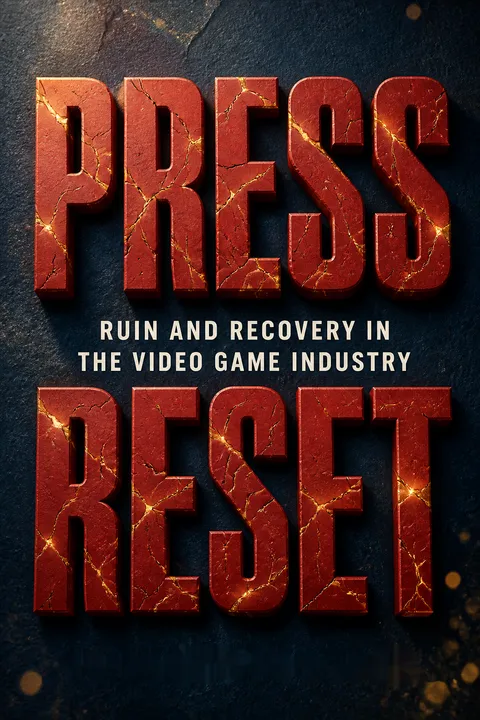
Press Reset argues that the industry's recurring layoffs are not isolated mishaps but consequences of how expensive, uncertain creative work is financed and organized. A studio may spend years discovering what a game should be, then face pressure to scale rapidly, meet a date, or imitate a newly profitable business model. When the project falters, workers bear the shock through lost income, disrupted relationships, and forced relocation. The stories are strongest when they resist a simple villain narrative. Ken Levine's creative method can produce celebrated work and painful rework. Curt Schilling could care personally for employees while making reckless business decisions. Publishers can offer severance in one closure and still create the conditions that make future closures likely.
The book's case studies also show that recovery is not one thing. Some developers start independent studios, some find another publisher, some build specialist contracting firms, and others leave games for work with steadier hours. These are individual adaptations, not evidence that the system is healthy. The most successful recoveries often depend on savings, a partner's income, a timely contract, or luck, resources unavailable to many workers. That makes resilience an inadequate substitute for collective protection.
The proposed remedies address different layers. Unions can improve bargaining power and establish procedures, but they cannot guarantee commercial success. Outsourcing specialists may reduce the cycle of hiring and firing, but can also leave workers dependent on client demand and distant from creative decisions. Remote work reduces relocation burdens, while potentially weakening social connection and informal collaboration. None solves every problem, and their value depends on how they are implemented.
The central insight is therefore institutional: volatility may be unavoidable in hit-driven entertainment, but its human costs are not fixed. Companies can disclose risk, plan staffing around project phases, provide enforceable severance, and make work less dependent on a single office or executive. The book does not offer a blueprint for eliminating failure. It asks who pays when failure happens, and why that burden so often falls on the people with the least power to prevent it.
People Also Read

Glossary
Crunch
Sustained overtime workA period of unusually long or intensive work, often involving nights and weekends, as a game approaches completion. In the book, crunch appears as both explicit scheduling and informal pressure: employees may stay late because leaders do, deadlines are unrealistic, or coworkers fear appearing less committed. It can help finish a project, but it carries significant personal and organizational costs.
Preproduction
Planning and experimentation phaseThe early stage of game development when a team explores the game's design, story, technology, and visual direction before building the full product. It can include prototypes, concept art, and major revisions. The book emphasizes that this phase is inherently uncertain, but excessive experimentation can consume time and money, leaving production and polish compressed against a fixed release date.
Games as a service
Ongoing, revenue-generating gamesA business approach in which a game is designed to keep players engaged and generate revenue over time, rather than relying mainly on a one-time purchase. This can involve updates, online features, and ongoing purchases. In the book, publishers favor this approach because it can produce continuing income, while developers worry that it may require substantial design changes and ongoing support.
Free-to-play
Free entry, paid extrasA model in which players can begin a game without paying, while the company earns money through optional purchases inside it. Mobile games discussed in the book often use timers that slow progress and offer paid ways to skip waiting. The model can attract a broad audience, but its design may prioritize retention and spending over a straightforward paid-game experience.
AAA
Large-budget game productionAn industry label for games made with substantial budgets, large teams, and high production expectations. The term has no single formal definition, but it commonly describes projects backed by major publishers and intended for broad audiences. The book shows how AAA scale can enable ambitious art and technology while increasing costs, coordination demands, and the consequences of a commercial disappointment.
Immersive sim
Games with flexible problem-solvingA kind of game design that gives players several viable ways to overcome obstacles, rather than requiring one prescribed solution. Players might fight, sneak, use tools, or manipulate the environment. Warren Spector and Paul Neurath helped establish this approach in games such as Ultima Underworld and System Shock. The design aim is for different players to make different choices and experience distinct paths.


Download PDF
Download EPUB
.epub digital book format is ideal for reading ebooks on phones, tablets, and e-readers.








