

Key Takeaways
Treat television as persuasion disguised as pleasure, not harmless background noise
Entertainment carries values. Shapiro’s central claim is that television does more than reflect society: it can make particular ways of life feel ordinary, admirable, or laughable. He starts with a Friends episode that presents a lesbian couple raising Ross’s baby as fortunate to have loving parents, then lists similar storylines across popular shows. His point is not simply that television includes controversial subjects. It is that repeated, appealing portrayals can shift what viewers consider normal.
Look behind the screen. Shapiro rejects the familiar advice to switch off television. People enjoy it, and even critics keep watching. Instead, he examines creators, executives, hiring networks, and business incentives, using interviews with figures who made well-known programs. He argues that their politics enter stories deliberately or unconsciously, while entertainment makes the message easier to absorb.
The argument is strongest when it asks readers to notice how stories establish social norms without announcing that they are doing so. Media research often distinguishes agenda-setting, which makes some issues more salient, from persuasion, which changes opinions. A show can influence the first without reliably producing the second. Viewers also interpret stories through family, faith, and prior belief, so exposure is not conversion. The useful habit is attentive viewing, not assuming every sympathetic character is an ideological trap.
Trace the shift from mass broadcasting to youth-targeted narrowcasting
The audience narrowed. Early network leaders such as NBC’s Pat Weaver pursued broad audiences, while advertisers often sponsored entire programs. A later model let networks sell ad slots across shows, giving them more control over content. Shapiro identifies ABC’s push toward young urban viewers as a pivotal change. Executives sold advertisers on the idea that viewers aged 18 to 49 were especially valuable, despite uncertainty about the evidence behind that claim.
Programming followed the pitch. As networks chased younger audiences, they favored sexier, edgier, more urban stories. In the late 1960s and early 1970s, CBS shifted away from rural hits such as The Beverly Hillbillies toward shows including All in the Family and M A S H. Cable later extended the strategy by dividing viewers into niches. Shapiro calls this narrowcasting: directing programs toward selected audience segments rather than trying to reach the public broadly.
Audience segmentation is a standard commercial response to diverse tastes, not inherently a political plot. Yet the metric used to define a valuable audience can shape which lives appear on screen. If advertisers prize a narrow age bracket, the industry may overrepresent that group’s settings and concerns, then mistake its own programming for a portrait of everyone. The key question is not whether targeting is wrong, but who gets classified as valuable, who disappears from the picture, and whether those assumptions are tested against reliable evidence.
Ask who gets hired before blaming the ratings
Access shapes the work. Shapiro argues that television is a small, relationship-driven business where trusted colleagues hire people they already know. Because he sees the industry as overwhelmingly liberal, he argues that this network reproduces a political imbalance. He recounts writing a television pilot after a producer encouraged him, then hearing from an agent that a producer would not work with him because of his political reputation. The story illustrates how a viewpoint can become a career risk before a script is judged.
Evidence has limits. The book combines interviews with executives and artists, reports of conservative performers losing work, and examples of openly hostile comments. Shapiro also concedes that some unsuccessful writers simply lack talent. His broader claim is that conservatives are underrepresented and often stay quiet to protect their prospects. The interviews make the concern concrete, but they do not establish a precise industry-wide rate of discrimination.
Hiring networks matter because creative industries rely on trust, collaboration, and referrals. Those mechanisms can reproduce homogeneity even without a formal blacklist: people choose familiar colleagues, and familiarity often tracks shared social worlds. The book’s interview-based evidence is revealing about perceived risk, but it cannot alone separate political exclusion from ordinary competition or poor work. A stronger test would compare hiring outcomes across similarly qualified candidates while tracking experience, connections, and political disclosure. The concern deserves scrutiny without treating every rejected pitch as proof.
Read sitcom laughter as a lesson about who deserves authority
Comedy assigns status. Shapiro argues that laughter can soften a political message by making the audience feel it before analyzing it. He traces a changing image of the father and the working class: The Honeymooners treated the working-class husband sympathetically; All in the Family made Archie Bunker a comic emblem of prejudice; The Simpsons turned Homer into a foolish, often neglectful father. In each case, the joke helps define whose judgment counts.
Politics can hide in charm. Family Ties illustrates the ambiguity. Creator Gary David Goldberg intended Alex Keaton, a clever young conservative, to represent greed and selfishness. Yet Michael J. Fox made Alex so appealing that many viewers rooted for him. Shapiro argues that sitcoms can transmit values through lovable characters, but also shows that audiences do not always receive the lesson the writers planned.
Comedy is a form of social judgment: laughter can puncture arrogance, expose hypocrisy, and signal which behaviors a group finds acceptable. That makes it politically potent, but not politically predictable. The Alex Keaton example shows why creator intent cannot settle meaning; performance, audience attachment, and cultural context can reverse the intended target. Comedy also needs permission to mock authority, including progressive authority. A viewer can ask both who is being ridiculed and whether the joke gives the target enough humanity to answer back.
In drama, inspect which side gets the sympathetic backstory
Stories steer sympathy. Shapiro argues that drama can make a position feel moral by arranging events so that one character appears humane and another callous. He points to issue-driven medical and legal dramas, and to The West Wing, where the liberal president is typically presented as principled while conservative opponents often appear foolish or cruel. The viewer is not only hearing arguments; the viewer is watching who suffers, who acts, and who gets understood.
The Day After shows television’s reach. ABC’s 1983 nuclear-war film drew about 100 million viewers in a country of roughly 234 million. Its director hoped it would weaken support for Ronald Reagan, while Reagan’s diary described being deeply affected by it. Shapiro uses the episode to illustrate television’s emotional power. He also singles out House as a rare drama that stages serious disagreement with more than one credible position.
Narrative transportation, the psychological experience of becoming absorbed in a story, can make arguments feel personally vivid. A fictional patient or family may move audiences more than an abstract policy table. Yet emotional force does not guarantee durable attitude change, and viewers may remember a scene while rejecting its implied lesson. The book’s own examples reveal this complexity: The Day After affected people with opposing politics, and House’s deliberately difficult protagonist can challenge its audience without offering a tidy moral. Framing deserves inspection, not automatic suspicion.
Ratings measure advertiser value, not simply what viewers want
Viewers are indirect customers. Networks earn much of their money by selling advertising, so total viewers are not the only measure of a program’s value. Shapiro describes the industry’s long preference for viewers aged 18 to 49, a demographic marketed as more attractive to advertisers. He questions that assumption, noting that older viewers may have substantial purchasing power and that audience measurement can be imperfect, especially when people must report what they watched.
The market story is incomplete. Executives often say viewers can change the channel, but Shapiro argues that political alternatives are limited and that decision-makers sometimes keep low-rated shows because they value the work. He cites a 2010 survey in which Republicans’ favorite programs tended to be broad network hits, while Democrats favored more niche titles. He interprets this as evidence that appealing to conservative viewers can help a show succeed, though the survey does not prove what political content caused those preferences.
A rating is a proxy, not a transparent window into demand. It depends on sampling, timing, platform, and the commercial question being asked. The distinction between audience size and audience value is familiar in economics: firms optimize for revenue, not for serving every customer equally. Still, the book sometimes treats imperfect measurement as evidence of deliberate distortion. Better conclusions require comparisons across ad prices, purchasing behavior, viewing habits, and content. The practical lesson is to ask what the metric rewards before accepting the industry’s claim that the market has spoken.
Follow the triangle linking broadcasters, political groups, and regulators
Influence has several routes. Shapiro’s term Celluloid Triangle describes the relationship he sees among television companies, interest groups, and government. Groups pressure networks or appeal to politicians; regulators can threaten rules or licensing consequences; broadcasters seek favorable policy and political access. He points to the FCC’s authority over broadcast licenses, industry efforts to influence standards, and examples of programs being reviewed or changed after organized complaints.
The relationship is not one-way. The book contrasts the industry’s reported willingness to consult some progressive advocacy groups with its hostility toward conservative campaigns. It also describes network-wide initiatives, such as coordinated environmental storylines, and argues that government favors, tax provisions, and cable-market rules benefit large media companies. These cases support a concern about concentrated influence. They do not, by themselves, prove that every consultation or policy decision is a coordinated effort to promote one ideology.
This framework usefully redirects attention from a single writer’s bias to institutional leverage. Interest groups can supply expertise, represent affected communities, or apply pressure; regulators can protect the public or serve political priorities. The democratic question is transparency: who is consulted, who can respond, and what commitments follow? The book’s triangle metaphor captures reciprocal incentives, but it risks making ordinary lobbying look more unified than it is. Mapping specific decisions, participants, and outcomes is more persuasive than assuming that aligned interests always amount to conspiracy.
Children's programming teaches values even when it claims only to build confidence
Children’s shows model a world. Shapiro contrasts early programs such as Howdy Doody, with its patriotic imagery, and Mister Rogers’ Neighborhood, which paired reassurance with clear distinctions between right and wrong, with later emphasis on self-esteem, tolerance, and diversity. He argues that Sesame Street and other publicly supported programs increasingly treated multicultural inclusion as a central lesson. He also criticizes commercial children’s channels for blurring age boundaries and pushing older material toward younger viewers.
The examples vary. The book discusses Sesame Street’s diversity guidance, Nickelodeon’s politically oriented news segments, and ABC Family shows about teen pregnancy and sexuality. It also warns conservatives not to mistake a character’s popularity with gay audiences for evidence that a children’s show itself contains sexual messaging. That qualification matters: children’s programming can carry values, but claims about what a show teaches should be grounded in what it actually depicts.
Children learn social scripts through repeated examples, especially when characters they trust model how to treat others. That makes representation consequential, but it does not make every lesson about inclusion equivalent to political indoctrination. Developmental research also distinguishes age-appropriate exposure from explicit sexual content, a distinction the book sometimes blurs when it groups very different programs together. A useful standard asks what children can understand at a given age, what behavior a story normalizes, and whether adults can discuss it with them. Parents remain important interpreters, not merely gatekeepers.
Enter the medium and widen its voices instead of abandoning it
Withdrawal leaves the field unchanged. Shapiro’s proposed response is not to reject television, but to participate in creating it. He urges conservatives to develop as writers, directors, producers, and executives, while encouraging Hollywood to judge people by their work rather than political identity. He also calls for broader programming that can reach families and viewers across regions and age groups, rather than dividing audiences into narrow niches.
Change the incentives too. The book asks advertisers to question the assumption that younger viewers are always more valuable, and to support entertaining programs that do not scorn traditional family life. It argues for fewer government-created barriers and less dependence on political favors. These recommendations share a premise: programming improves when more people can make it and when success is not measured by a narrow slice of viewers. The goal is representation of competing views, not a conservative version of one-sided television.
The call to enter an institution rather than merely denounce it is strategically sound: talent, capital, and access can alter what gets made. It also treats pluralism as a production problem, not just a viewer’s complaint. But diversity of political identity alone does not guarantee balance or quality, and broad-audience programming can become bland if risk is treated as a threat. The more durable reform combines open hiring, transparent measurement, multiple distribution routes, and editorial independence. Viewers can contribute by rewarding work that is both compelling and intellectually honest.
Analysis
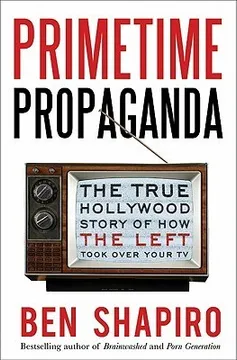
Primetime Propaganda is an investigative polemic about power in popular culture. Its organizing insight is that television’s political character cannot be explained only by the opinions of individual writers. The book follows an institutional chain: advertiser priorities shape audience categories, executives choose which projects to fund, social networks determine who gets hired, and regulators and advocacy groups influence the boundaries of acceptable programming. The result, in Shapiro’s account, is a feedback loop in which a largely liberal creative community treats its own experience as representative, then markets that experience as realism.
The strongest part of the case is its attention to mechanisms. The industry’s reliance on referrals, narrow audience metrics, advertiser incentives, and regulatory relationships gives readers concrete questions to ask of any media institution. Its interviews also reveal that creators sometimes intend to lead audiences, even while publicly describing their work as simple reflection. The examples spanning sitcoms, dramas, children’s shows, and network history make the argument memorable.
The book’s weaknesses are equally important. It is openly partisan, and its catalog of programs often treats liberal themes as evidence of coordinated persuasion while treating conservative themes as neutral or apolitical. Selected interviews and anecdotes illuminate experience but cannot establish how common political discrimination is, or how much television changes belief. Its causal claims also risk conflating representation, exposure, persuasion, and cultural change. Audience members are not empty vessels, and successful shows can be interpreted against their creators’ intentions.
A balanced reading therefore separates three propositions: television creators have political viewpoints; institutions can reproduce those viewpoints through hiring and incentives; and particular programs measurably change viewers’ politics. The first is undeniable, the second plausible and testable, and the third requires stronger causal evidence than the book consistently supplies. Its lasting value is less a final verdict on Hollywood than a media-literacy agenda: examine who makes stories, who funds them, which audiences count, and whose perspective is missing.
Review Summary
Reviews of Primetime Propaganda are mixed, averaging 3.77/5. Many readers, regardless of political affiliation, acknowledge Shapiro's thorough research and extensive industry interviews as strengths. Conservatives largely praise his documentation of Hollywood's liberal bias, while liberal readers often find his homophobic undertones and cherry-picked examples problematic. Several reviewers note the book is more measured and academic than expected, though some criticize it as repetitive and overly long. Most agree it provides an interesting history of television, even if his conclusions remain controversial and ideologically slanted.
Glossary
Celluloid Triangle
Media, government, and groupsShapiro’s name for the mutually influential relationship among television companies, government regulators and politicians, and organized interest groups. In his account, advocacy groups can pressure broadcasters or enlist lawmakers, while media companies seek favorable rules and political access. The term describes a system of reciprocal incentives, not proof that every participant coordinates with the others.
narrowcasting
Targeting specific viewer segmentsProgramming and marketing content for selected audience groups rather than aiming to reach the broadest possible public. The book links narrowcasting to the industry’s focus on viewers considered especially attractive to advertisers, especially younger urban audiences. It argues that this strategy can fragment shared viewing and privilege the lifestyles and political assumptions of the chosen segment.
vanguardism
Art as social leadershipThe belief, as the book uses the term, that cultural creators should lead audiences toward social change rather than simply entertain or reflect existing life. Shapiro connects this impulse to writers and executives who describe television as a tool for challenging convention. He argues that the urge can outlast the original cause and become a continuing push for boundary-breaking content.
market argument
Ratings justify programming choicesThe industry’s defense that programming reflects consumer demand because viewers can choose what to watch. Shapiro challenges this account by arguing that networks sell audiences to advertisers, use imperfect measurements, target selected demographics, and sometimes retain programs for reasons beyond immediate ratings. The term refers to his critique of market demand as a complete explanation for television content.
Family Viewing Hour
Early-evening family programming policyA 1975 industry policy intended to reserve the first hour of prime-time entertainment, and the preceding hour, for programming suitable for general family viewing. The policy became a conflict over who could set standards for broadcast content. Writers and producers challenged it, and a court struck it down, after which the policy did not remain in force.
public interest
Broadcasting’s public-service obligationA phrase in American communications regulation used to justify licensing broadcasters and requiring service to the public. The book describes how its interpretation shifted over time, from attention to broad public and minority audiences toward expectations that television inform or educate viewers. Shapiro argues that the phrase can give government officials leverage over programming, especially when its meaning is disputed.
18-to-49 audience
Advertiser-valued age groupThe demographic category that television executives and advertisers have often treated as especially valuable for selling products. Shapiro traces the category’s influence to efforts to attract younger, more urban viewers, arguing that this focus affected programming and sidelined older or rural audiences. The book disputes the assumption that this age group is always the most profitable target.
Download PDF
Download EPUB
.epub digital book format is ideal for reading ebooks on phones, tablets, and e-readers.








