

Key Takeaways
Measure productivity by what it serves, not how much it produces
Output became the goal. The author describes working about 80 hours a week while juggling a demanding job, wedding plans, and writing. Despite the success he had once wanted, he felt anxious, neglected relationships, and stopped creating. Better scheduling might have made the workload more manageable, but it could not answer the deeper question: what was all that effort for?
Purpose changes the measure. The book does not reject ambition or useful work. It argues that productivity is a means, not a life’s destination. Work earns its place when it supports things worth doing, including connection, creativity, and meaningful contribution. More completed tasks are not proof of a better life if the person completing them is becoming exhausted and disconnected.
The distinction resembles a familiar problem in management: once a measure becomes the target, it can stop measuring what matters. A full calendar is easy to count; closeness, originality, and contribution are harder to quantify. The book’s strongest move is not to condemn efficiency, but to ask what efficiency is serving. Still, purpose cannot replace practical constraints such as income, care obligations, or limited choices. The useful test is not whether every task feels inspiring, but whether the overall pattern of effort supports a life the worker can endorse.
Treat human connection as maintenance, not a reward for finishing work
Isolation carries a cost. The book contrasts the creative reputation of painter Edgar Degas with his lonely private life. Degas believed relationships competed with art, yet he ended his life isolated and increasingly bitter. The contrast challenges the fantasy that great work requires cutting off other people.
Connection need not be elaborate. The author points to humans’ long history of living in close groups and argues that social contact is a basic need, not an optional treat after work is done. A conversation with a friend matters, but even small exchanges with strangers can remind a person that they belong to a human community. Solitude can restore attention; chronic isolation can quietly diminish well-being.
This insight broadens the definition of productive time: a conversation can maintain the conditions that make focused work possible. It also challenges the cult of the solitary genius, which often mistakes visible output for the full cost of producing it. The distinction between solitude and loneliness matters, though. Time alone can be chosen and restorative, while unwanted isolation is not made healthy by calling it independence. The practical question is whether social life is being deliberately shaped or merely postponed until an imaginary period when work is finally finished.
Schedule silence and nature before your attention becomes static
Quiet restores perspective. Explorer Colin O’Brady described reaching an intense state of focus during his solo crossing of Antarctica. The book emphasizes that his preparation included silent meditation, and that he eventually stopped relying on music during the journey. The absence of other voices gave him room to attend to each step and his own thoughts.
Nature offers another kind of reset. In a study described by journalist Florence Williams, researchers compared brain activity among people spending time in a city and in nature. The nature group showed a more relaxed prefrontal cortex after several days. The book also introduces forest bathing, the practice of engaging the senses while among trees. Silence and nature are not magic fixes, but they can interrupt the constant demands of screens and stimulation.
Silence and natural settings both loosen attention from immediate demands, allowing perception to widen beyond the next notification or task. This is a useful counterweight to the idea that every empty moment needs to be filled with input. Yet quiet can also bring difficult thoughts to the surface, and a walk outdoors cannot solve structural pressures such as excessive workloads. The value is more modest and more credible: these practices create conditions for noticing what constant stimulation can hide.
Write down the story in your head before believing it
Thoughts are not verdicts. Psychologist Julia Shaw’s memory experiments, as described in the book, led many participants to accept a fabricated account of a childhood crime. The story used familiar details to make an invented event feel real. The lesson is not that every memory is false, but that confidence alone does not make an interpretation accurate.
Make the inner story visible. Cognitive reappraisal means reconsidering an initial interpretation and finding a more useful, reality-based one. Instead of treating a stressful event as proof that everything is ruined, a person can ask what else the event might mean. The author recommends journaling to get thoughts out of the head and onto a page, then rereading them later, when the immediate emotional charge has eased.
Writing creates distance between an experience and the explanation attached to it. That distance can make self-talk easier to examine, much as a draft becomes easier to revise once it is outside the writer’s head. Reappraisal is most helpful when it broadens interpretation without denying evidence. Forced optimism can become another way to avoid a real problem. A fair practice asks both, “What might I be missing?” and, “What facts still need to be faced?”
Put play back into serious work to keep effort sustainable
Play is more than leisure. The author recounts teacher Timothy Walker’s experience teaching in Finland, where pupils had two hours of recess daily, compared with an average of 27 minutes in the United States. He observed better attention and fewer behavior problems among his students. The chapter also describes research suggesting that playful adults respond to stress differently and can learn effectively through interactive activities.
Bring a lighter approach. Play does not mean treating responsibilities as unimportant. It means allowing curiosity, humor, and experimentation into them. A game, an imaginative approach to a task, or an unstructured afternoon can loosen the pressure to perform perfectly. The author’s memory of beach games and joking on a trip to the Galapagos serves as a reminder that enjoyment can be part of a worthwhile life, not a prize reserved for its end.
Play can change the emotional texture of effort: it invites experimentation where rigid performance invites self-monitoring. That makes the idea relevant to learning, creative work, and relationships, not only recreation. But individual playfulness cannot compensate for institutions that deny people adequate breaks or control over their time. The Finnish classroom example is suggestive, not proof that recess alone caused every difference. The broader point is that sustained attention needs room to loosen, explore, and recover.
Capture creative sparks promptly, then let intuition shape the first draft
Ideas need a physical foothold. Lyricist Bernie Taupin conceived the words for “Rocket Man” while driving, inspired by a story about a homesick astronaut. With no paper nearby, he repeated the lines until he reached home, then wrote them down. The anecdote illustrates the fragile gap between an idea arriving and a person acting on it.
Make before over-explaining. Stan Lee’s publisher dismissed Spider-Man as a poor idea, but Lee found a small opening to put the character before readers. They responded enthusiastically. The chapter argues that intuition is a compass, not a finished map: an initial idea may be imperfect, but making something gives it a chance to develop. Capture the spark, make a rough version, and assess it after it exists.
The approach separates generative judgment from evaluative judgment. Early scrutiny can make a creator optimize for what already seems acceptable, before discovering what the idea can become. A note, sketch, or rough draft preserves possibility without requiring blind faith in its quality. Intuition deserves room, but not permanent authority: it can reflect experience, fear, or bias as easily as insight. The strongest process gives instinct an early turn and evidence the final say.
Give creative ideas sleep, recovery, and enough time to ripen
The mind keeps working offstage. The book describes hypnagogia, the transitional state between wakefulness and sleep, when fragments of logic and imagery can mingle. Thomas Edison, Salvador Dalí, and Albert Einstein are presented as using brief naps to approach this state, with objects designed to wake them as they drifted off. Paul McCartney also recalled waking with the melody that became “Yesterday.”
Some ideas need a longer runway. James Cameron developed the vision for Avatar over decades and waited for filmmaking technology to meet it. The book’s point is not to delay every project, but to distinguish patience from procrastination. Sleep and breaks support recovery; long-term patience can protect a vision from being rushed before its creator has the tools to realize it.
Incubation is a useful counterpoint to the belief that thought improves only through more hours of direct effort. Sleep, breaks, and delayed judgment can give ideas room to recombine, while deliberate practice supplies the material they work with. The danger is turning patience into a refined excuse for never publishing. A helpful distinction is whether waiting is producing learning, development, or readiness, rather than simply protecting the work from criticism.
Explore outside your specialty before success narrows your imagination
New inputs make new connections. Agatha Christie was already a successful mystery writer when she traveled to Iraq and became fascinated by archaeology. She later traveled with archaeologist Max Mallowan, whom she married, and drew on those experiences in novels including Murder on the Orient Express and Murder in Mesopotamia.
Being a beginner has value. Exploration is not merely a holiday from work. Encountering unfamiliar places, skills, and people gives a person material that a narrow routine cannot provide. The book argues that specialization can produce excellence, but it can also make change harder when a field or a person’s interests shift. Exploring a new area may feel like moving backward because expertise is temporarily lost. That temporary uncertainty can widen the range of ideas available to the work already being done.
Exploration functions like cross-training: unfamiliar experiences can supply metaphors, questions, and skills that transfer into a person’s established craft. Christie’s archaeology was not a detour from writing so much as a fresh source for it. Still, exploration is not automatically valuable, and constant novelty can become another form of avoidance. The useful balance is to protect some uninstrumental curiosity, then notice which discoveries genuinely change how existing work can be seen.
Invite peers to challenge your work before ego seals it
Good work needs other eyes. In the 1960s, filmmakers including Steven Spielberg, George Lucas, and Martin Scorsese exchanged ideas and advice before becoming celebrated directors. The book also describes Abraham Lincoln surrounding himself with political rivals and the CIA’s use of Red Teams, groups tasked with searching for weaknesses in an accepted position.
Make dissent useful. The examples show that feedback is not simply praise or criticism. A trusted peer can notice a strength the creator overlooked, identify a flaw, or ask a question that opens a better direction. The author recommends seeking people who understand the work and can speak honestly. They need not agree on everything, but the relationship must make disagreement possible without turning it into a threat to status or identity.
Peer critique is an external check on the mind’s tendency to defend what it has already invested in. It can improve both quality and judgment, especially when dissent is specific and aimed at the work rather than the creator. The essential condition is psychological safety: if disagreement is punished, a group becomes an echo chamber even when it includes talented people. Challenge alone is not wisdom; the most helpful peers combine candor with enough trust to keep revision possible.
Stop working while tomorrow's creativity still has fuel
Do not drain the well. Ernest Hemingway described stopping his writing day while he still knew what would happen next. The unfinished thread gave him a place to restart the following morning. The book connects this practice to a skiing lesson: the final turns before getting on the lift still matter because they shape how a skier begins the next run.
Leave with momentum intact. Working until exhaustion may produce more today, but it can also make tomorrow’s work feel harder to approach. The same principle applies to attention and free time. The author warns that constant busywork can crowd out the idle moments needed to understand why a goal matters. A deliberate stopping point is not laziness; it can preserve both energy and direction.
This is a practical model of pacing rather than a celebration of low effort. A stopping rule protects the next session from the costs of treating attention as unlimited, and an unfinished question can offer an easier entry point than a blank page. The principle is not universal: deadlines and emergencies sometimes require a late finish. But as a default, ending with a little capacity left can make creative work more repeatable than relying on occasional heroic bursts.
Turn unexpected damage into raw material, not merely failure
Plans are not the only route. During production of From Dusk Till Dawn, an explosion damaged a set that the crew still needed. Director Robert Rodriguez saw that the charred remains gave the film a striking look and chose to use them. The accident had created an option that the original plan did not contain.
Adapt without pretending it was easy. The book also discusses Tommy Wiseau, whose intended drama The Room became famous as an unintentional comedy. Its reception was not what he planned, but he eventually accepted the audience’s response rather than hiding the film. These stories do not make every disaster beneficial. They show that a setback can become usable material when a person pauses, releases the demand for the original plan, and looks for what remains possible.
Adaptive creativity turns disruption into information: what has changed, what still matters, and what new possibilities exist? This is more durable than insisting that every bad event is secretly good. Some losses remain losses, and not every damaged project can be salvaged. The useful practice is to separate grief or frustration from the next decision. Once the immediate shock has passed, flexibility can recover choices that rigid attachment to the plan would conceal.
Treat your purpose as a compass that can point somewhere new
A goal is a direction, not a sentence. Writer Neil Gaiman described choosing work by asking whether it moved him toward his chosen mountain, his ambition to become an author. The image offers a way to sort opportunities without assuming every attractive offer belongs on the route.
The route can change. The author recalls leaving a teenage touring band after realizing that the life he had once wanted no longer fit. He had invested years in it, but staying only to avoid wasting that investment would have been the sunk cost fallacy: continuing because of past costs rather than future value. A useful question is whether the path still suits the days a person wants to live. Purpose can guide commitment without forbidding a new direction.
A compass is powerful because it offers orientation without pretending to predict every turn. That makes the metaphor more humane than a rigid life plan: changing direction need not invalidate earlier effort or identity. The counterweight is that temporary frustration can masquerade as a changed purpose. Before leaving a difficult path, it helps to distinguish a genuine mismatch from a hard season. Reflection, honest feedback, and attention to daily life can make that distinction less vulnerable to impulse.
Analysis
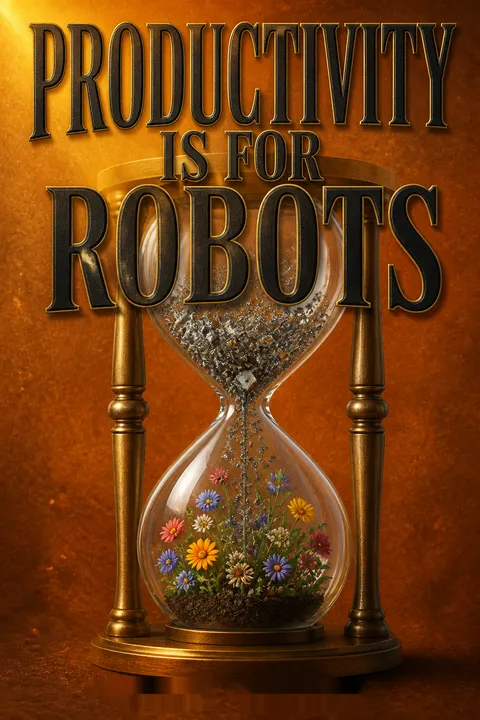
Productivity Is for Robots is a personal essay-driven argument, not a technical manual. Its structure moves from reconnection, through creative practice, to sustained action. The organizing claim is that human effectiveness depends on capacities that efficiency culture treats as distractions: relationship, play, rest, ambiguity, curiosity, and the ability to revise a plan. The author’s burnout story provides the emotional spine. Historical and cultural examples then make the argument memorable, from Degas’s isolation to Christie’s archaeology and Hemingway’s deliberate stopping point.
The book’s most useful distinction is between output and worthwhile output. It does not tell readers to abandon ambition; it asks them to interrogate the purpose behind ambition. Its practical advice is strongest when it changes the shape of work: write down thoughts, preserve creative sparks, stop before exhaustion, seek candid peers, and explore beyond a familiar specialty. Together, these practices describe an alternative to treating every hour as a production unit.
The book’s breadth is also its main limitation. It draws from psychology, neuroscience, biography, and personal anecdote, sometimes giving different kinds of evidence similar rhetorical weight. A striking story can illustrate a principle without proving its generality. For example, accounts of exceptional artists or explorers are memorable, but they cannot establish that silence, nature, or patience has the same effect for everyone. Some readers also face constraints that cannot be solved by mindset or leisure alone.
The strongest reading, then, is neither a rejection of discipline nor a promise that humane habits guarantee success. It is a framework for judging whether the means of work are damaging the ends. Connection, creativity, and flow are not productivity hacks in disguise; they are criteria for deciding what productive effort should make possible. The book’s invitation is to work seriously without making work the whole measure of being human.
Review Summary
Productivity Is For Robots received mixed reviews, with ratings ranging from 2 to 5 stars. Positive reviews praised its engaging storytelling, inspirational anecdotes, and focus on human aspects of productivity. Critics found it repetitive and lacking scientific data. Many readers appreciated the book's message of embracing humanity over robotic efficiency, while others felt it relied too heavily on platitudes. The book's structure, divided into sections on connecting, creating, and finding flow, resonated with some readers. Overall, it sparked reflection on work-life balance and productivity mindsets.
People Also Read





Glossary
Cognitive reappraisal
Reinterpret an emotional responseCognitive reappraisal is the process of reconsidering an initial interpretation of an event and choosing another interpretation that is more useful while remaining consistent with the facts. In the book, it helps people recognize that stressful inner narratives are interpretations, not unquestionable truths, and can change how they respond.
Reticular activating system (RAS)
Filters attention to inputThe book describes the reticular activating system as a network involved in filtering the large amount of incoming sensory information, allowing some signals to receive attention while others are screened out. The author connects this filtering to repeated self-talk: the stories a person dwells on can shape what they notice as relevant evidence.
hypnagogia
Wakefulness-to-sleep transitionHypnagogia is the transitional state experienced while falling asleep. The book presents it as a period in which ordinary logical thought and dreamlike imagery can mingle, potentially producing unexpected associations. Thomas Edison and Salvador Dalí are described as using brief naps and waking cues to access this state for creative ideas.
Logotherapy
Meaning-centered psychotherapyLogotherapy is Viktor Frankl’s approach to psychotherapy, founded on the idea that the search for meaning is a central human motivation. The book presents purpose as a source of resilience and responsibility, particularly through Frankl’s experiences in concentration camps and his belief that meaning can be found in love, courage, and purposeful work.
End of History Illusion
Underestimating future changeThe End of History Illusion is the tendency to recognize that one’s past self changed while assuming one’s present identity is comparatively settled. In the book, this idea explains why people often make long-term plans based on current preferences, despite the likelihood that their interests, beliefs, and circumstances will change.
wabi-sabi
Beauty in imperfectionWabi-sabi is a Japanese aesthetic idea that locates beauty in what is imperfect, incomplete, and impermanent. The book applies it to creative identity: personal quirks and limitations may distinguish someone’s work rather than disqualify it. Miles Davis’s unconventional trumpet style is used to show how perceived weaknesses can become recognizable strengths.
trough of sorrow
Post-startup discouragement phaseThe trough of sorrow is a term associated in the book with an early company’s difficult period after initial excitement and funding, when the work becomes a long stretch of obstacles, costs, and uncertainty. The author applies the image more broadly to ambitious projects, whose initial enthusiasm often fades before the result is achieved.
sunk cost fallacy
Continuing because of past investmentThe sunk cost fallacy is the tendency to continue an activity because of time, money, or effort already invested, even when continuing no longer makes sense. The book applies it to careers, relationships, and creative pursuits. A better decision weighs the path’s future value and fit, rather than treating past investment as a reason to stay.
Red Teams
Groups that test assumptionsRed Teams are groups assigned to challenge an organization’s assumptions and search for weaknesses in its plans or conclusions. The book cites their use in intelligence analysis as an example of deliberately seeking evidence that could disprove a preferred belief. The practice is intended to reduce blind spots before a consequential decision is made.
Download PDF
Download EPUB
.epub digital book format is ideal for reading ebooks on phones, tablets, and e-readers.








