

Key Takeaways
Build a stronger body with 20 to 30 minutes of bodyweight training
A gym is optional. John Powers traces his interest in calisthenics to rugby: as a small teenager, he was often left out of the action, so he began training to become stronger and faster. The book turns that practical starting point into a broad case for using bodyweight movements to build strength, mobility, coordination, and endurance. Calisthenics means exercises that use natural movements and the body's weight as resistance. Many require no equipment, though some, such as pull-ups, need a sturdy bar.
Start with a workable schedule. Powers recommends 20 to 30 minutes of training, three or four times a week. The promise is not a shortcut to a particular physique, but a low-cost way to begin exercising consistently, then build from there.
The appeal is not merely financial. Removing the commute, membership, and equipment can make exercise easier to fit into ordinary life. The rugby story also gives the method a grounded origin: training began as a response to a specific constraint, not as a search for an elaborate system. Still, accessibility should not be confused with universal suitability. A person with pain, a chronic condition, or little recent activity may need adapted movements or professional guidance. The book is most persuasive as an invitation to start, not as a guarantee that the same routine will serve every body.
Let clean movement, not ego, determine how hard you train
Practice before intensity. Powers distinguishes between learning a movement and building muscle through demanding work. He calls the first emphasis nervous system training: repeating a movement with careful form helps the brain and muscles coordinate it more reliably. His suggested early approach uses a small number of repetitions, often one to five, repeated in multiple high-quality sets. The goal is to make the motion controlled and consistent, rather than to exhaust the body.
Form is a progress measure. In the exercise guidance, the author repeatedly advises beginners to start with modest repetitions and add more only while technique holds. A push-up done with a sagging back is not automatically better because it adds reps. Proper posture, a stable core, and controlled movement are the foundation for making an exercise harder safely.
This emphasis treats exercise as a skill as well as a physical stress. That distinction is useful because early improvements can come from coordination and confidence before visible muscle changes appear. It also offers a better way to assess a session than counting repetitions alone: did the movement become more controlled? The caveat is that perfect form is not a single universal pose. Body proportions and mobility differ, so useful technique is better understood as stable, pain-free control through an appropriate range than as identical angles for everyone.
Make familiar exercises harder by changing leverage, range, and balance
Progress without adding plates. Progressive Training is the book's approach to increasing exercise difficulty through changes in position and control, rather than relying only on external weights. A wider or narrower hand position, a longer range of motion, a one-sided variation, or an unstable balance demand can make a familiar movement more challenging. Slower repetitions and brief holds also increase the time muscles spend working.
Earn the next variation. Powers describes a path from easier push-ups toward more demanding forms, including handstand push-ups. The principle is to select a version that can be performed correctly, then build capacity before advancing. His basic plan also uses a simple progression: begin around eight repetitions, work toward twelve, then return to fewer repetitions while adding another set. Difficulty should rise only when sound technique remains.
This is the book's most useful programming insight: resistance is not only a number on a weight stack. Leverage, range, unilateral work, and tempo can all change what a movement demands. The approach also makes progression visible for people training at home. However, the hardest variation is not always the best one. A simple version performed through a comfortable range can be more valuable than a dramatic skill that strains a joint or shifts effort away from the intended muscles. Progression should respond to control and recovery, not to novelty alone.
Give heavily worked muscles time to rebuild before training them hard again
Recovery belongs in the plan. The book explains muscle growth as a cycle of training stress followed by repair. For demanding strength work, Powers recommends leaving roughly 24 to 48 hours before working the same muscle groups intensely again. He suggests alternating harder sessions with lighter movement, such as walking, swimming, or yoga, and taking regular rest from endurance work as well.
Active recovery means easier activity during a recovery period, rather than another hard workout. It can keep movement in the routine without repeating the same intense demand. Sleep matters, too: the author connects rest with the body's repair processes and with better energy and food choices. He also advises paying attention to unusual pain or fatigue, rather than treating every warning sign as a test of willpower.
The important distinction is between being active and being maximally taxed. Recovery is not a failure to train; it is part of the training dose. Alternating effort can also make a long-term routine more tolerable, especially for beginners who may mistake soreness for proof of progress. The book sometimes describes recovery in simplified physiological terms, but its practical point remains sound: repeated hard work without enough rest can undermine consistency. Persistent pain, sharp discomfort, or fatigue that does not ease deserves attention, not another set.
Make exercise stick with small starts, personal rewards, and a simple log
Lower the starting barrier. Powers argues against launching into an extreme routine. He recommends adding manageable changes gradually, choosing activities that feel appealing, and making workouts easier to begin. Music, a partner, visible goals, and small rewards are offered as ways to make the experience more inviting. When motivation is low, the book suggests committing to a short start, since beginning may make it easier to continue.
Record what happens. A training log can track exercises, repetitions, sets, duration, mood, sleep, food, and any aches or breakthroughs. The point is not paperwork for its own sake. A record helps reveal which schedule and exercises are sustainable, shows progress that memory may miss, and gives clues when performance stalls. The author also encourages adjusting a routine when boredom or burnout appears, rather than abandoning exercise altogether.
The book understands that a workout plan competes with habits, time pressure, and the immediate appeal of doing nothing. Small starts address the first hurdle, while a log turns vague impressions into feedback. This resembles a basic principle of behavior design: make the desired action easy to initiate, then notice what supports repetition. Rewards can help, but they work best when they reinforce a routine rather than become its only reason. A log should be useful and brief; if tracking becomes a chore, it can add friction instead of removing it.
Choose nourishing food and sensible portions instead of chasing extreme diets
Build meals from basics. Powers favors a varied diet built around fruits and vegetables, whole grains, lean protein, dairy or other protein sources, and healthy fats. He recommends limiting highly processed foods and large amounts of added sugar. He warns that severe restriction can be difficult to sustain and argues that carbohydrates still have important roles in bodily function, even when someone is trying to lose weight.
Portions count. The book gives concrete visual comparisons, such as a three-ounce serving of meat being about the size of a bar of soap. It also stresses that restaurant-style portions can exceed what a person intends to eat. Water supports normal bodily functions and helps replace fluid lost through sweating, while sleep is presented as part of managing appetite and energy. The practical theme is steady, balanced habits, not a quick cleanse or a banned-food list.
The strongest nutrition advice here is its resistance to all-or-nothing dieting. A pattern built around minimally processed foods and realistic portions is easier to apply than a short-lived list of forbidden ingredients. The book's specific serving targets and calorie explanations should be treated as broad guidance, not individualized prescriptions. Energy needs vary with body size, activity, health, and goals, and some readers need tailored medical or nutrition advice. Its useful contribution is the shift from asking which food group to eliminate toward asking how meals can be more nourishing and manageable.
Combine strength work with steady movement instead of training only one capacity
Fitness has several demands. The book contrasts aerobic exercise, which sustains elevated effort over time, with anaerobic work, which consists of brief, intense efforts. Calisthenics can include both: a controlled set of squats develops strength differently from a fast sequence of jumping jacks or burpees. Powers describes combining these modes as interval training and recommends balancing cardio-focused activity with strength work.
Movement can accumulate. Beginners can start with two or three weekly sessions of 20 to 30 minutes. As conditioning improves, the book suggests adding sessions while varying the work and allowing recovery. It also notes that activity can be divided into shorter periods across a day, with options such as stairs, walking, or household tasks. The central practical idea is to make regular movement part of the week, rather than expecting one exercise style to do everything.
The mixed approach fits the book's larger emphasis on useful, whole-body capability. Strength, stamina, and coordination are related but distinct, so a routine that includes more than one kind of effort can be more balanced than endless repetition of a single movement. Short bouts also make exercise less dependent on finding one uninterrupted block of time. The caution is that intensity should match current capacity. Fast, jumping movements are not automatically superior to lower-impact options, particularly for people with joint symptoms or little training experience.
Expect progress on your own timetable, then raise the challenge gradually
Results are individual. Powers says beginners may notice changes within four to eight weeks, while also emphasizing that fitness, age, genetics, starting ability, and goals affect the pace and shape of progress. People who already train may need longer to see a change, and not everyone will develop the same body. The book's standard is improvement in strength, movement, and health, not matching a particular athlete's physique.
Use plateaus as feedback. If progress slows, the author suggests changing exercises, sets, or repetitions, or adding some cardio, rather than assuming the whole effort has failed. He advises beginning with a challenging version that can be performed correctly for several repetitions, then building over time. The approach asks for patience: master foundational movements before trying advanced skills, and treat consistency as more important than a dramatic first week.
This is a valuable corrective to fitness marketing, which often sells uniform transformations on compressed schedules. The book's promise of visible change within a few weeks is better read as a possibility than a deadline; visual results depend on many factors, and strength or stamina may improve before appearance changes. Measuring several kinds of progress can prevent discouragement when the mirror is slow to respond. Patience does not mean repeating an ineffective plan indefinitely, though. A simple record of effort, recovery, and performance helps distinguish a temporary plateau from a need to adapt.
Analysis
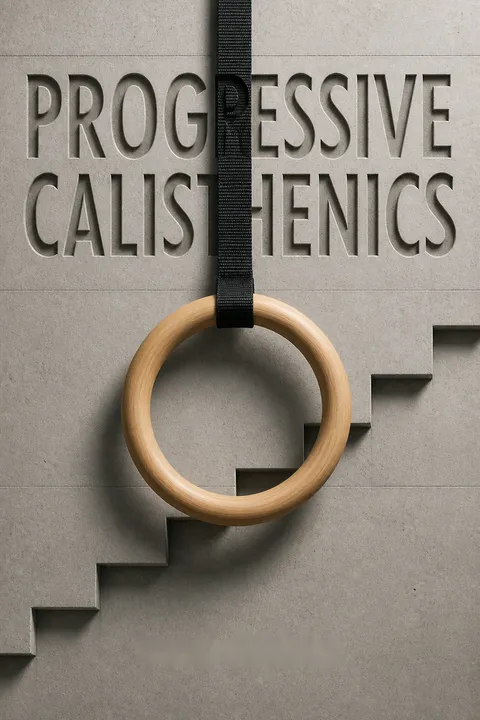
Progressive Calisthenics is best understood as an accessible entry guide, not a precise exercise-science manual. Its central case is compelling: a person can train strength and general fitness without a gym by mastering basic movements and making them progressively more demanding. The book's strongest practical ideas reinforce one another: keep the entry cost low, prioritize controlled technique, progress through variations, and allow recovery. The author's rugby origin gives the method a human scale. Calisthenics began for him as a way to participate more fully, not as an abstract pursuit of an ideal body.
The guide is broad, moving from fitness history and physiology to nutrition, motivation, exercise instructions, and sample programs. That range helps beginners see training as part of daily life, but it also creates unevenness. Some physiological explanations are simplified, and several nutrition and weight-management claims are presented more confidently than the evidence in the text can support. Numbers such as calorie deficits, food servings, and time to visible results should not be mistaken for universal rules. The exercise lists also mix accessible movements with advanced jumps and handstand variations, which require different levels of preparation and carry different risks.
The most durable reading is therefore practical rather than literal. Begin with a movement that can be performed comfortably, repeat it with control, record the work, and raise the demand in small steps. Pair that practice with regular activity, adequate rest, and generally nourishing food. The book's promise is not that bodyweight exercise replaces every training method or suits every person unchanged. It is that a simple, adaptable routine can make physical training possible for people who otherwise see cost, time, or equipment as reasons not to begin.
Review Summary
Progressive Calisthenics receives mixed reviews, with an average rating of 3.49/5. Some praise its informative content, exercise progressions, and nutrition advice, particularly for beginners. Readers appreciate the illustrations and video links. However, critics point out editing issues, contradictory information, and amateurish presentation. The nutrition advice is controversial, with some finding it too general. Overall, the book is seen as a decent starting point for calisthenics, but lacks depth for advanced practitioners and has room for improvement in quality and consistency.
People Also Read


Glossary
Calisthenics
Bodyweight movement trainingExercises that use natural body movements and primarily the body's own weight as resistance. In this book, calisthenics includes movements such as push-ups, squats, lunges, and jumps, with variations intended to develop strength, mobility, coordination, flexibility, and endurance. Some exercises still require a stable surface or bar.
CNS training
Practice for movement coordinationThe book's label for training that emphasizes repeated, technically sound practice so the central nervous system can coordinate muscles more efficiently for a movement. It is contrasted with work aimed more directly at muscle growth through higher-repetition efforts. The author recommends low repetitions and multiple quality sets when learning a skill.
Isometric exercise
Muscle work without joint movementAn exercise in which a person contracts muscles while holding a position, rather than moving through a repeated range. A plank is one example. The book describes holds lasting several seconds or longer and presents them as a way to build strength and muscular endurance with little or no equipment.
Plyometric exercises
Fast, explosive muscle actionsMovements involving a rapid loading or stretch of a muscle followed by a forceful contraction. The book's examples include hopping, jumping, and explosive push-ups. These exercises are intended to develop power and speed, but require preparation and controlled landings because their intensity can increase injury risk.
Progressive Training
Gradually harder exercise variationsThe book's method for increasing the challenge of bodyweight exercise over time. Rather than relying only on added external weight, it changes leverage, range of motion, balance, body position, tempo, or the number of sets and repetitions. Progression depends on maintaining sound technique as the exercise becomes more demanding.
Active recovery
Easy movement between hard effortsA recovery approach that uses lower-intensity activity instead of complete inactivity or another strenuous workout. The book suggests options such as walking, swimming, yoga, and easier exercise variations. Its purpose is to preserve gentle movement while giving heavily trained muscles a break from intense work.
Superset
Alternating different muscle exercisesA sequence in which exercises for different muscle groups are performed in close succession, reducing idle time while allowing one group to rest as another works. The book presents supersets as a way to fit more work into a short session and accumulate fatigue across multiple sets.
Download PDF
Download EPUB
.epub digital book format is ideal for reading ebooks on phones, tablets, and e-readers.








