

Key Takeaways
Treat psychic development as a practiced craft, not an instant gift
A course, not a shortcut. Bernabo presents mediumship and psychic work as skills developed through instruction, repeated practice, and meditation. She estimates that becoming fully developed commonly takes two to five years. Her workbook organizes 17 lessons and 19 guided meditations into a possible weekly sequence, with each two-hour class building experience across different exercises.
Progress at a human pace. Students may begin by receiving impressions while seated, then build confidence delivering them face to face. Bernabo describes allowing newcomers time to learn rather than demanding instant results. Her own training included more than seven years of weekly classes, a reminder that confidence and fluency are gradual achievements, not proof of special talent appearing overnight.
The book's strongest instructional choice is its emphasis on gradual practice rather than a dramatic gift narrative. That approach resembles skill learning in fields such as music, where repeated attempts and feedback matter more than a single impressive performance. The two-to-five-year estimate is the author's experience-based guidance, not a measured benchmark. A clearer way to track progress would be to record impressions before feedback and assess accuracy over many sessions, rather than relying on confidence or memorable successes.
Build consent, protection, and respectful rules into every circle
Set the container first. Before readings, Bernabo recommends clearing and protecting the room and each participant through prayers and visualizations invoking spiritual beings. She also says to ask permission before doing clearing work in someone else's home or business. These practices reflect her spiritual beliefs and form part of the class routine, rather than being presented as optional decoration.
Make expectations explicit. Her suggested groups have two to twelve students, with six preferred, and meet weekly. Ground rules include arriving on time, listening without interruption, respecting differences, and avoiding alcohol or recreational drugs on class day. She also advises against perfume, which she believes can interfere with scent-related impressions. Students are asked to raise interpersonal conflicts privately with the teacher.
The practical value here is the explicit social contract: participants know what behavior is expected, and the teacher takes responsibility for the setting. Consent and respectful turn-taking are useful safeguards in any group where people share vulnerable experiences. The spiritual protection rituals may be meaningful to practitioners, but the book does not establish that they objectively repel harmful entities. A grounded reading separates the ritual's personal significance from the observable value of clear boundaries and a predictable class structure.
Relax first, then report impressions before your reasoning rewrites them
Receive before explaining. Bernabo calls readings from spirit guides mental mediumship: information is experienced internally, perhaps as an image, a word, a bodily sensation, or an unbidden sense of knowing. Because these impressions can feel like ordinary thought, she recommends meditating beforehand and reporting the first impression instead of immediately interpreting or dismissing it. She asks readers to seek permission before beginning a reading.
Build confidence in stages. Beginners can receive messages while seated, then stand to deliver them, and eventually try receiving and communicating in the moment. If an unfamiliar sensation appears, Bernabo suggests noting whether it began before or after the reading and asking for it to be removed afterward. In her account, this helps students distinguish a possible message from their usual physical experience.
Separating the raw impression from its interpretation is a useful discipline, whether the reader understands the source as spiritual or psychological. A brief record made before the recipient responds can preserve what was actually perceived, rather than what memory reshapes after the fact. The book's instruction to trust the first impression should not become a rule that every spontaneous thought is accurate. Curiosity works best with humility: keep the impression, test it against feedback, and allow uncertainty.
Let objects prompt intuition, but build meanings from personal context
Use images as prompts. The lessons use oracle cards, tea leaves, flowers, jewelry, candle wax, and student-created art to generate impressions. Bernabo suggests using several different card decks so students cannot rely only on memorized meanings. In tea-leaf practice, readers study both the cup and the saucer; the cup is divided into time periods across the coming year, while the saucer is treated as information hidden from the person receiving the reading.
Develop a personal symbolic dictionary. This means learning what images and symbols suggest to a particular reader, rather than treating a reference book as the final authority. Bernabo offers examples: water can suggest emotions, and a flower's color or condition can prompt observations about a person's temperament or wellbeing. She encourages readers to explore what a symbol evokes, while delivering difficult interpretations gently.
The exercises turn familiar objects into structured prompts, a creative way to practice noticing details and generating interpretations. The emphasis on personal associations also avoids the false precision of a universal symbol code. Yet flexible interpretation has a cost: almost any image can be made to fit a story after the fact. Specific, pre-recorded observations and recipient feedback help preserve the exercise's imaginative value without confusing a compelling interpretation with a verified fact.
Ask permission and use compassion when reading people, pets, or the dead
Respect the subject. For photographs of living people, Bernabo says the reader should seek permission through that person's higher self. Her exercises use pictures of people and animals, including animals that have died. She describes impressions about personality, memories, wellbeing, and an animal's preferences, while acknowledging that an animal may not choose to communicate. Students are encouraged to be gentle, especially when a pet may have had a difficult past.
Handle grief carefully. Readings about deceased loved ones can bring strong emotions for both the recipient and reader. Bernabo advises compassion, respectful delivery, and having tissues available. She calls communication intended to convey information from deceased people proof of survival. That name describes the purpose of the exercise, not independently established evidence that consciousness continues after death.
The section's clearest ethical contribution is its insistence on consent, restraint, and sensitivity around grief. Those principles matter even for readers who interpret the experience as imagination, memory, or emotional intuition rather than communication with spirits. The spiritual mechanism of obtaining permission through a higher self is not independently testable in the book, so it cannot substitute for ordinary consent when a living person is involved. Grief also makes certainty especially consequential, which favors careful language over dramatic claims.
Blind practice can expose how much familiarity shapes a reading
Remove the identity cues. In a blind reading, the reader does not know who is receiving the message. Bernabo describes seating the reader facing a corner while a separate speaker relays the recipient's responses through simple signals. Another exercise puts students' names in sealed envelopes, which are mixed and opened only after the reading. The anonymity is intended to reduce reliance on what the reader already knows about classmates.
Compare impressions with feedback. Afterward, the reader can learn who the recipient was and check which details fit. The exercise also reveals when a reader may have accidentally read for themself. Bernabo uses these activities to prompt students to consider whether information came from intuition or from conscious familiarity, while maintaining the practice-oriented, exploratory tone of the class.
Anonymity is a meaningful improvement over readings among friends, because it limits some ordinary sources of information. It does not by itself show that impressions come from a paranormal source: the reader may still use vocal cues, broad statements, or chance matches. The exercise becomes more informative when observations are written down in advance and all hits and misses are counted. That modest discipline strengthens the training without requiring participants to abandon their spiritual interpretation.
Treat remote-viewing hits as clues, not conclusive proof
Practice with unknown targets. Bernabo describes remote viewing as trying to perceive a distant or hidden person, place, or object. A beginner's exercise puts a changing item inside an opaque box and asks students to describe its color, shape, texture, or other features. She encourages partial matches as useful practice, rather than making the exercise depend on naming the exact object.
One rescue story. Bernabo recounts being asked to help find a missing dog. In meditation, she pictured a rural-looking area, a dry creek bed, and houses across a street. The owner recognized a nearby reserve and searched in that direction, finding the dog at a house after only a few doors. Bernabo did not identify the house number and says she had little prior practice. The story illustrates a possible useful clue, not a controlled test.
The missing-dog story gives the exercise human stakes: a partial impression may help someone decide where to look. But a successful anecdote cannot show how often similar impressions fail, and the account lacks comparison with alternative search strategies. Treating remote viewing as hypothesis generation preserves its potential practical use while setting a sensible limit on its evidential weight. A record of target descriptions and misses would make repeated practice more revealing than a memorable success alone.
Use pendulums for reflection, never as medical diagnostic devices
Calibrate the movement. Bernabo teaches students to ask a pendulum to indicate yes and no, then check its responses with questions whose answers they believe are certain. She prefers crystal pendulums and describes cleansing and programming them before use. In group exercises, everyone asks the same question and compares results; she notes that learners may get different answers, especially when emotionally invested in an outcome.
Keep health claims in bounds. The book also describes holding a pendulum above the body to look for imbalances and using hands to bring chakra energies into alignment with the heart chakra. Bernabo regards this balancing as a preliminary healing practice. These are spiritual exercises, not established medical tests. The book itself states that it does not provide medical advice or replace consultation with a physician.
Calibration and comparison can teach focus, but agreement among pendulum users does not establish that an answer is medically accurate. The book's own health disclaimer supplies an important boundary: a pendulum reading should not determine whether someone has an illness or needs care. Used as a reflective ritual, the tool may help a participant notice concerns or intentions. Those concerns should then be checked through ordinary clinical assessment, not treated as findings from the pendulum.
Use guided imagery to rehearse release, forgiveness, and self-understanding
A recurring inner landscape. The 19 meditations take participants through imagined forests, rivers, gardens, crystal rooms, and encounters with animals or spiritual beings. Several are designed to help with emotional reflection. One asks the participant to imagine releasing burdens connected to a difficult relationship; another invites a meeting with an inner child and asks what that younger self wants. A forgiveness meditation uses imagined boxes to name feelings and people the participant wants to let go.
Return with something to consider. The meditations often end with a gift or message and encourage journaling about the experience. Bernabo presents the imagery as spiritual healing and energy work. Readers can also approach the scenes as guided imaginative exercises that give feelings a shape and create space for reflection. They do not replace medical or mental-health treatment.
The repeated landscapes make the practices easy to enter, while concrete images such as a river or a difficult road can help participants organize diffuse feelings. Journaling after an exercise can preserve insights that might otherwise fade. The book sometimes describes imagined healing as if it changes energy or health directly, a claim its exercises do not demonstrate. A careful reader can still use the imagery as a reflective practice, while seeking professional help for persistent or serious distress.
Never facilitate trance work while entering trance yourself
The facilitator stays present. Bernabo treats trance mediumship as a more advanced practice and warns teachers to train properly before guiding a group. In her method, participants invite a guide to speak through them, while the facilitator remains alert to supervise. The teacher is specifically told not to enter trance at the same time, because participants rely on that person to manage the exercise.
Close the session deliberately. Bernabo describes helping a participant end the experience by asking the guide to leave, using a gentle hand motion, and explaining before touching the person. The teacher then helps the participant feel settled and closes the area the author associates with the guide's passage. She notes that early attempts may produce little beyond a greeting, and that both participant and guide may need practice.
Whatever explanation participants give the experience, the facilitator's role is a practical safety measure: someone must remain available to notice distress and help end the exercise. Advance instruction, explicit permission before touch, and a clear closing routine support that responsibility. The book's account of a spirit entering and leaving the body is a spiritual interpretation, not a verified mechanism. Keeping the procedure bounded and voluntary makes the lesson more responsible without requiring certainty about that interpretation.
Analysis
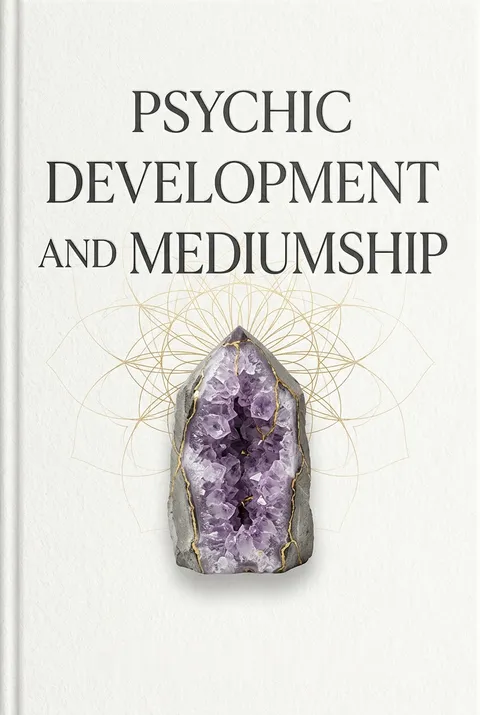
This is best understood as a teaching workbook for a spiritual community, not as a scientific demonstration of psychic abilities. Its structure is unusually practical: class etiquette, room preparation, a repeated meditation, a focused exercise, and feedback. The range of activities, from reading cards and flowers to blind tests and trance work, gives teachers a ready-made curriculum and gives students multiple ways to participate. Its central pedagogical claim is that practice, relaxation, and confidence can be cultivated over time.
The book's value depends partly on the reader's stance toward its metaphysics. Bernabo describes guides, energy fields, chakras, and spirit communication as real. The text, however, offers personal accounts and instructional claims rather than controlled evidence. The missing-dog episode may be meaningful and useful to the people involved, but one successful story cannot establish the reliability of remote viewing. Likewise, a pendulum's movement or a vivid meditation does not independently demonstrate a medical effect or spirit contact.
A fair adaptation preserves both layers: these methods are meaningful within the author's spiritual framework, and many exercises can also be used as imaginative prompts for attention, emotional reflection, and group learning. Contemporary psychology offers a useful caution here. People can experience spontaneous thoughts as external messages, and flexible interpretations can make vague impressions feel more accurate after feedback. Blind procedures, advance notes, and counting misses as carefully as hits help reduce these effects, though they do not settle every question about source.
The book is at its most responsible when it emphasizes gradual learning, consent, compassionate communication, and a trained facilitator. Its health-related exercises need firmer limits: spiritual practices should not be confused with diagnosis or treatment. Readers can engage with the curriculum without accepting every supernatural explanation, while retaining the parts that are valuable as structured practice and personal reflection.
Glossary
Mental Mediumship
Internally received reading impressionsBernabo uses this term for receiving information from a spirit guide within one's own mind and sharing it in a reading. Impressions may appear as images, words, bodily sensations, or a sense of knowing. The author recommends meditation and practice to help students distinguish these impressions from their ordinary thoughts.
Psychometry
Reading impressions from objectsIn the book, psychometry means attempting to receive information about a person by handling an object associated with them, especially a piece of jewelry. Bernabo says students should use an item worn only by its owner to avoid mixing impressions. Readers may report images, emotions, physical sensations, or other associations.
Remote viewing
Perceiving a hidden targetBernabo describes remote viewing as trying to obtain information about something not directly visible, such as an object inside a closed box, a missing item, or a distant location. Her beginner exercise uses a concealed object. The book presents it as a skill to practice, while also recounting an anecdote about locating a lost dog.
Blind readings
Readings without known identityThese exercises conceal the recipient's identity from the reader to reduce reliance on prior knowledge. Bernabo describes using a separate speaker to relay the recipient's reactions or mixing sealed envelopes containing names. The reader learns who the recipient was after the reading and can then compare impressions with feedback.
Trance Mediumship
Speaking while in tranceBernabo uses this term for a practice in which a participant invites a spirit guide to speak through them. She regards it as advanced work requiring prior training and a facilitator who remains alert rather than entering trance. Her procedure includes preparation, supervision, and a deliberate effort to end the session and help the participant settle.
Proof of survival
Messages from deceased peopleIn this book, proof of survival is a mediumship exercise intended to convey information from deceased loved ones to a person receiving a reading. Bernabo recommends a compassionate approach because grief may surface strongly. The term names the practice's spiritual purpose; the workbook does not provide controlled evidence that such messages establish survival after death.
symbolic dictionary
Personal meanings for symbolsBernabo uses this phrase for the reader's developing set of associations between images and meanings. A symbol, such as water in a card or tea-leaf pattern, is interpreted through what it suggests to the reader and the context of the reading, rather than by relying only on memorized definitions. Practice helps build this vocabulary.
Chakra balancing
Aligning energy centersBernabo describes chakra balancing as sensing energy around the body's chakras and adjusting them so their perceived levels match the heart chakra. Her method uses hands held above the body, moving from the heart to other energy centers. She presents it as a spiritual healing practice, not a medical diagnostic method.
Download PDF
Download EPUB
.epub digital book format is ideal for reading ebooks on phones, tablets, and e-readers.








