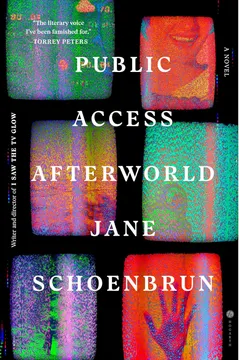


Plot Summary
Prologue
At seventeen, an unnamed narrator is confined with a friend at Saint Thomas, a bleak youth facility where patients are watched and medicated. After rumors spread that the friend attempted suicide over a fictional television show trapped in their mind, a small group gathers after lights-out to hear its episodes.
The narrator remembers the friend as David Sawyer,2 though that is not the name they now choose to use. They record the stories years later because they fear the friend is gone and because the show has lodged in their own mind. The book begins as testimony, but the narrator cannot be sure whether retelling preserves the stories or carries their affliction forward.
The frame turns storytelling into both witness and contagion. Saint Thomas suppresses its patients by controlling their bodies, sleep, and access to the outside, while the nightly episodes create a temporary audience in which the friend can be heard on their own terms. The narrator's uncertainty about the friend's name establishes identity as something neither institutions nor memories can settle cleanly. Recording the episodes is an act of care, but also an admission that the stories have crossed from one mind to another. The reader is therefore placed in the same uneasy position as the patients: listening may preserve someone, yet it may also draw the listener into the same enclosed world.
The Night Analog Died
On June 12, 2009, high-school friends David Sawyer2 and Erin Morrison3 stay up in Erin's3 basement to record the end of analog television. David2 has loved Erin3 for years, but when they kiss after he imagines the future of television, he panics and leaves. Erin,3 alone with the newly useless set, sees a hand-drawn station logo emerge from the static, then a woman washing dishes with spatulas in place of hands.
She records the impossible transmission on VHS. David2 returns to school on Monday expecting to repair their friendship, but Erin3 is missing. He finds her in the basement, alive and staring at the screen, and hears that she believes the broadcast came from a hidden station called Public Access Afterworld.
The kiss and the transmission arrive in the same night, binding emotional risk to technological change without reducing one to a metaphor for the other. David's retreat makes the first fracture in the friendship, while Erin's solitary viewing gives her a private experience he cannot share. Her VHS recording turns perception into evidence, but evidence does not create belief: the image is available to everyone, yet only Erin treats it as a summons. The scene establishes a central asymmetry. David wants life to become dramatic enough to matter, while Erin is already confronting an event that may take her out of ordinary life entirely.
Jim's Basement Tape
David2 uploads Erin's3 recording, but the horror forum dismisses it as a fake until a user named Jim8 contacts him and claims to have tracked similar broadcasts for years. His sample is only a basketball resting in an empty gym, yet Erin3 recognizes it as genuine. David2 and Erin3 meet Jim Davis8 at a diner, where he tells them that television screens connect realities and that Erin3 has been invited to a realm where people can create shows by living inside them.
David2 distrusts the story but follows Erin3 to Jim's8 secluded cabin. There Jim8 orders Erin3 to undress before an old television and a VHS tape. She sees her full name and birth date on its label, realizes Jim8 knew her identity in advance, and escapes with David2 before he can play it.
Jim's authority depends less on proof than on his ability to speak directly to Erin's sense of recognition. David notices the danger but cannot detach Erin from the promise of a larger life, and his skepticism becomes another source of distance between them. The cabin scene makes the mythology coercive in practical terms: Jim's demand for obedience is not an abstract spiritual test but a bodily violation, and the named tape proves that the danger has been personalized. Erin's escape is a rare act of clear self-protection. It also leaves the central question unresolved, making David more vulnerable to Jim's explanations afterward.
The Script Girl Credit
At a highway rest stop after their escape, David2 and Erin3 have sex while Erin3 remains angry that he froze when Jim8 threatened her. She later sees the monster Chimotera,15 a creature from a poster at Jim's8 cabin, and collapses in terror, though David2 sees no attacker.
Back home, David2 discovers that forum members have linked the phrase Public Access Afterworld to a dead weatherman's old broadcast. He returns to Jim8 without telling Erin3 and learns that the labeled tape contains an episode of the sitcom Short Stack, with Erin's3 name oddly credited as its script girl.
Erin3 resents David's2 secrecy and destroys the tape, but her father repairs it. Under pressure from David,2 she watches the episode. After the homecoming dance, she vanishes into a video-store doorway that appears beyond the football field.
The tape's credit recasts Erin's fear as a problem of authorship: she is attached to a story made before her birth, yet the attachment gives her no control over what happens next. David's secrecy and insistence turn care into pressure, especially because he frames the danger as a thrilling opportunity. Erin's choice to watch is therefore neither wholly free nor simply forced; affection and fear of losing David narrow her options. Her disappearance resolves the supernatural question while deepening the ethical one. The story's mechanism works, but the people who claim to understand it have not earned the right to direct Erin's life.
David Builds Afterworld
After Erin3 disappears, David2 becomes the chief interpreter of the broadcasts. He searches static for her messages, builds an online following, and approaches other isolated people whose minds seem linked to television.
Erin's3 transmissions give him names, including Chloe Edmonds,12 a teenager who narrates episodes of an old detective series she has never watched. David2 visits Chloe,12 tells her she may be able to reach Erin,3 and leaves her Erin's3 photograph. Chloe12 disappears soon afterward, but Erin3 does not return.
Over the years David2 recruits more candidates, records their disappearances, and retreats to a desert compound near Los Alamos. He tells himself he is helping them choose, yet he repeatedly sends people toward an unknown destination because he cannot bear to abandon his search.
David converts grief into a system because a system offers tasks where grief offers only helplessness. His methods appear more considerate than Jim's, since he shares information and claims to leave candidates a choice, but his hope for Erin steadily makes each recruit instrumental. Chloe's case teaches him that resemblance to Erin is not enough, yet he continues the same practice. This is not simply fanaticism. David wants his private guilt to acquire a public purpose, and the online audience supplies both witnesses and accomplices. The result is a community built around longing, where belonging is offered through the very danger that has made its members vulnerable.
The Moderator's Red Button
In Austin, Bethany Peters1 takes a night job moderating disturbing videos for GlobalVill, hoping the paycheck will help her become independent. Her queue includes repeated uploads from JulesPublicAccessAfterworld,4 a young person whose videos show self-harm and growing fixation on David Sawyer's2 online game.
Bethany1 recognizes the danger and asks manager Douglas13 to intervene, but he insists that moderators should only apply the site's rules. When Jules4 posts a video swallowing pills, Bethany1 steals a company laptop, retrieves their address, and calls the police.
GlobalVill fires her, then quietly restores her job and raises her pay when executives fear public scrutiny. Bethany1 does not know whether Jules4 survives, but she has crossed the boundary between watching a crisis and taking responsibility for what happens beyond the screen.
Bethany's ethical break is grounded in a specific workplace contradiction: the company sells safety as a value while training moderators to treat urgent distress as a classification problem. Her action is not a confident rescue fantasy. She accepts personal risk because the platform's sanctioned procedures have made inaction feel like the only approved choice. GlobalVill's reversal exposes a second motive beneath its care language: reputation management. Bethany's attention to Jules is also self-recognition, since she knows what it means to use online performance and self-harm to make distress visible. The scene makes her compassionate, but not invulnerable; it begins her own entanglement with the system she tried to resist.
Lubbock's Pink Golf Ball
Bethany1 drives to Lubbock to check that Jules4 is alive and finds them living in the office shed of a rundown mini-golf course. Jules4 believes their final Public Access Afterworld challenge is to narrate a television show, so they show Bethany1 a chaotic story about rebellious golf balls.
Bethany1 recognizes Jules4 from their videos but conceals that she works for GlobalVill. When she finally admits the truth, Jules4 feels watched and betrayed, then drives her out of the shed with golf balls. Bethany1 leaves with Jules's4 handgun by mistake.
David's2 followers abduct Jules4 that night, and David2 tells them they are not the special person he sought. Jules4 volunteers to join the mission to find Bethany1 anyway, hoping to remain close to the only person who made escape feel possible.1
The mini-golf course gives Jules a life that is both materially confined and imaginatively expansive. Their story about golf balls resisting the tunnel beneath the eighteenth hole turns routine humiliation into a fantasy of revolt, but their faith in David's game makes that revolt dependent on another authority. Bethany's concealment repeats the platform's surveillance logic even as her motive is concern. Jules responds not only to the lie but to the fear that someone has been observing their most private attempts to survive. Their later choice to follow David shows how easily rejection can intensify attachment when a person has few other sources of recognition.
Chicago's First Subject
In 1945, at Los Alamos, Willa Fischer5 secretly watches a strange handheld screen that her husband Elliot brought home from the laboratory. Its broadcasts tell her that television draws its stories from another realm.
Willa's5 daughter-like friendship with Rachel Horowitz,6 the rebellious daughter of a scientist, sharpens her suspicion that the lab's Chicago Project is more than a technical experiment. Willa5 sneaks into the facility and finds a vast electrical structure beneath the floor, plus files documenting her entire life as a research subject.
Rachel6 warns that the project requires people like Willa,5 whom the scientists call crooked, to sustain its system. Willa's5 husband confirms that she is being sacrificed, but she escapes into the desert rather than submit. Static figures lead her to a video store, and she enters it.
Willa's discovery joins domestic intimacy to state violence. Elliot's laboratory is not distant from the household; its research has been built through the intimate collection of Willa's medical and personal history. Her social discomfort and obsessive habits, treated by others as private weaknesses, have made her legible to the project as useful material. Rachel offers Willa recognition, but cannot save her from the forces that govern the camp. Willa's flight is both a refusal and a narrowing of choices: the desert offers no safe refuge, only an escape from the husband who has converted marriage into a covert bargain.
The Kombucha Conspiracy
Back in Austin, Bethany1 tries to return to Abel,10 the kind boyfriend whose support once helped her leave Harlingen, but he proposes marriage instead of the clean break she needs. After she runs, she returns to him asking for help and he collapses at dinner, dying as static flickers across his eyes.
At his funeral Bethany1 insists the death was not ordinary, then returns to GlobalVill and meets CEO Anthony Fischer.7 His kindness steadies her until she recognizes it as practiced management.
Bethany1 later brings office kombucha to her friend Lily,11 who tests it for drugs. The drink contains several hallucinogens. Bethany1 realizes GlobalVill has been inducing her symptoms, while news reports accuse her of violence and reveal that Lily,11 her wife Mona, and their baby have been killed.
Bethany's need for independence has repeatedly been mistaken for a need to accept care on someone else's terms. Abel's generosity is real, but it cannot resolve her fear that a safe domestic life will freeze her identity in place. His sudden death turns private instability into evidence of a larger threat, even as the public calls Bethany unstable. The kombucha tests provide material proof, yet the proof arrives alongside devastating loss. This sequence refuses the comforting idea that naming the conspiracy makes a person safe. Bethany gains an explanation while losing the people who might have helped her act on it.
The Austin Siege
Kyle,9 Bethany's1 former colleague and confidant, invites her to dinner, but she notices his photograph with a supposed sister has no shadow where his should be. She forces him to approach the image, then holds him at gunpoint when he will not eat the stew he prepared for her.
Bethany1 takes Kyle9 hostage and drives to GlobalVill to confront Fisch.7 The CEO admits the company has run an experiment on her, targeting her for Screen Sickness, while denying responsibility for Abel's10 death.
Kyle9 attacks Bethany1 and armed employees open fire. Jules4 and David2 arrive during the assault. Jules4 kills security guard Rusty by mistake, then shoots Kyle9 as he threatens Bethany.1 David2 gets her out, and the four flee toward the desert, leaving Douglas13 as their captive.
Bethany's observation of the shadow is a small act of close reading that punctures the polished intimacy Kyle has cultivated. Her response is desperate and dangerous, but it is also an attempt to stop being the only person in the room who is expected to doubt her own perceptions. Fisch's confession confirms the experiment while preserving the company's evasions about its human cost. Jules's mistaken killing of Rusty exposes how quickly a rescue fantasy can turn ordinary workers into collateral damage. The escape does not restore moral clarity; it leaves Bethany alive, implicated, and dependent on people whose methods she cannot fully trust.
Rachel's Desert Testimony
At Patricia's isolated ranch, David2 introduces Bethany1 to Rachel Horowitz,6 now an elderly woman who once loved Willa Fischer.5 Rachel6 explains that the Chicago Project was built after static figures warned that humanity's discovery of electricity had damaged the boundaries between realities.
Television became a barrier that kept other worlds contained, but it needed people with unusually strong electrical currents to power it. These people were sent into Public Access Afterworld. Rachel6 believes Bethany1 may be different, capable of breaking the system rather than simply sustaining it.
She gives Bethany1 an old photograph of Willa5 and asks her to deliver an apology for Rachel's6 failure to protect her at Los Alamos. Bethany1 hears the request but refuses to promise that she will risk herself for David's lost love.3
Rachel's explanation reframes television as infrastructure rather than entertainment, while refusing to make its moral history clean. The system protects one reality by consuming people whose difference has already made them vulnerable to classification and sacrifice. Rachel's apology gives the cosmic account a personal center: a remembered moment when she chose her own safety over Willa's. Bethany's skepticism matters because the people who recruit her are asking her to trust a story that also serves their private grief. Her refusal to promise anything preserves her agency, even as the revelation makes her own body part of a much larger machinery.
Chimotera's Long Bargain
The novel's monster-film franchise reveals another side of Fisch's7 family's work. Chimotera,15 a creature repeatedly killed and revived across decades of sequels, meets Fisch7 in a strange interval between films. Fisch7 offers him continued life in exchange for identifying people who shine through television from another reality.
Chimotera15 becomes an unwilling informant, watching his own world grow more commercial and repetitive while Fisch's7 world appears more vivid. When Chimotera15 sees Bethany's1 signal, he hides the discovery from Fisch7 and briefly crosses into Fisch's7 reality, attacking him in a burst of accumulated rage.
He eventually provides Bethany's1 name, but the exchange clarifies that Fisch7 has used even a fictional monster as a tool in the same extraction system that ensnares human subjects.
Chimotera's repeated resurrections make exploitation legible from the perspective of a being treated as property. Fisch calls their arrangement friendship, but its terms are surveillance and information, and the monster's shrinking creative world mirrors the franchise's commercial recycling. The story does not claim that fictional characters are simply equivalent to human victims. Instead, it uses Chimotera to widen the question of who is permitted a life beyond the function assigned to them. His withheld knowledge of Bethany briefly interrupts Fisch's control, but fear of erasure ultimately draws him back into the bargain.
A Door That Closes
Bethany1 leaves the ranch, unable to decide whether David2 and Rachel6 are telling the truth or using her. After she learns that the news blames her for the deaths at Lily's11 home and at GlobalVill, she calls her parents to say goodbye, then waits at a roadside laundromat.
Jules4 finds her and apologizes for threatening her. Bethany1 agrees to return with Jules4 and David,2 then accepts the drugs their followers provide to hasten Screen Sickness. Locked in a pantry at the desert compound, she begins to summon the video store.
Jules4 enters the room hoping to cross with her. Their presence disrupts the forming gateway, which vanishes. Bethany1 turns Jules4 away and retreats into isolation, determined to attempt the crossing again without anyone beside her.
Bethany's decision is less a heroic conversion than the narrowing of every alternative. She has lost the people who offered ordinary shelter, and the company has turned her into a public threat. Jules's apology offers intimacy, but their wish to accompany Bethany also risks repeating the possessive patterns she has been trying to escape. When Jules enters the pantry, the portal closes, making a supernatural boundary responsive to relational pressure. Bethany's insistence on solitude can seem cold, yet it is her first explicit condition for action. She will not let another person's longing determine what happens to her body.
The Patient Wakes
Bethany's1 second crossing carries her through Captain Video and down into the deepest layer of the system. She awakens strapped to a vibrating therapy table in Public Access Afterworld, where patients' bodies are connected to a giant vessel that collects their television stories.
The orderly routine has kept them unaware that their shows are extracted from them as treatment. Her nameplate first identifies her as David Sawyer,2 then Noah Peters, but both names feel imposed.
Bethany1 realizes she has been moved through borrowed identities and that the hospital is a prison, not a clinic. She begins controlling the electrical disturbances that reach her, leaves her cell at night, and studies the broadcasts for other trapped people, including Erin Morrison3 and Willa.5
The awakening converts the novel's changing protagonists into a single crisis of consciousness. Names that once seemed to anchor identity become labels assigned by an institution, while the patient's apparent freedom to invent stories conceals the extraction that keeps the system functioning. Bethany's power begins not as mastery but as attention: she notices the fake window, the routines, and the other patients whom she had previously treated as background. That attention creates the possibility of solidarity. The hospital's control depends on each person remaining absorbed in an individual show, so noticing others becomes an act of resistance.
The Red Static Breaks
Bethany1 learns to move beyond the edges of her own show, The Wolves of Birmingham, and into other television worlds. She pulls Willa5 from a family sitcom and wakes Chloe,12 then follows Erin's3 signal into the episode of Short Stack tied to Erin's3 childhood trauma.
While the hospital's alarms sound and the Distant Seer hunts through the stories, Bethany1 carries the weakened child-star figure toward a red field of static. She tells him to wake the other patients and get high enough to withstand the shock.
Then she returns to her own broadcast, breaks its boundary, and sends the red static tearing through the vessel that contains the airwaves. Erin3 and Willa5 rise toward the break, while Chloe12 is killed during the chaos. The hospital's containment system shatters.
Bethany's rescue strategy is not to perfect the stories or defeat each antagonist on their own terms. She treats their boundaries as traversable and their conventions as tools, moving between genres until she can reach the people trapped beneath them. Yet liberation carries an irreversible cost: Chloe dies in the collapse, and the red static is not a harmless key but a force that may destroy every world it touches. The climax resists a clean equation between freedom and safety. Bethany chooses to break a system built on coercion, knowing that the damage may exceed her ability to direct or repair it.
Epilogue
Five years later, Willa5 is the first to crawl through a screen into David's2 desert surveillance room. David2 then pulls Erin3 back into the world, where she gasps for air and immediately remembers the harm between them. Bethany1 follows, but she returns with the red static still burning through the monitors.
She vomits onto the floor as the crimson signal spreads beyond the prison that contained it. David2 has finally recovered the friend he spent decades searching for,3 but the reunion arrives alongside a new threat: the force Bethany1 unleashed may now be loose in the world she fought to reach.
The return grants the novel a reunion without offering repair. Erin and David are physically together again, yet the injuries that shaped their separation remain present in her first response to him. Willa's return restores a person erased by a family legacy, but she wakes into a world that has continued without everyone she knew. Bethany's arrival makes the cost of liberation visible: the red static has crossed the boundary that the old system was designed to hold. The ending rejects the comforting structure of a successful rescue followed by safety. The characters get back, but home has become vulnerable to the very force they released.
Analysis
Public Access Afterworld asks what happens when a culture turns attention into both currency and infrastructure. Its screens do not merely show stories. They sort people, record distress, and conceal the labor that keeps entertainment available. GlobalVill's moderators are paid to watch suffering while executives describe their work as community care; David's2 followers mistake algorithmic recruitment for spiritual election; the Chicago Project turns people into components of a system built in the name of public safety. These are not separate abuses. Each depends on making an individual crisis appear manageable, useful, or deserved.
The novel's strongest counterforce is not certainty but attentive recognition. Bethany1 sees Jules4 as a person rather than a flagged video. Rachel6 remembers Willa5 as someone she loved5 rather than a historical subject. Erin's3 transmissions matter because someone listens closely enough to act, even when the signal is incomplete. Yet the book refuses to present recognition as a cure. Bethany's1 rescue attempt kills Chloe,12 the red static escapes containment, and Erin's3 return cannot erase what David2 did. Breaking an oppressive system may be necessary without being clean or safe.
Identity is presented as both self-authorship and a relation to others. Bethany1 names herself against the life imposed on her, but the final story complicates individual autonomy by suggesting that selves can be created, remembered, and sustained through imagination. The novel does not make this a reason to doubt Bethany's1 reality. Rather, it treats storytelling as a form of survival that can become harmful when one person claims ownership of another's story. Its central ethical demand is therefore modest and exacting: listen to what people say about themselves, and do not confuse your need for meaning with their consent.
Review Summary
Public Access Afterworld receives an overall rating of 4.21/5, with readers frequently praising its ambitious world-building, compelling characters, and genre-bending blend of horror, sci-fi, and speculative fiction. Many describe it as a cinematic, immersive experience spanning multiple timelines. Common criticisms include its sprawling 600-page length, lack of clear resolution, and occasionally confusing narrative threads. Fans of surreal, Lynchian storytelling tend to love it, while readers seeking concrete answers often feel unsatisfied. The audiobook, narrated by the author, receives particular praise.
Characters
Bethany Peters
The reluctant receiverBethany is a trans woman who has worked hard to build a life beyond the town and family that once made her feel unwelcome. She is perceptive, funny, and capable of compassion, but she also knows how easily care can become another form of dependence or control. Her years with Abel10 give her stability without resolving her fear of becoming someone else's project. Online video once offered her a place to experiment with identity, and content moderation later puts her on the opposite side of the screen, watching other people's crises. Bethany's central drive is not to be chosen as special. She wants the right to make decisions about her body and future, even when every available choice carries risk.
David Sawyer
The grieving television obsessiveAs a teenager, David is a lonely horror fan who loves Erin3 and dreams of a life with sharper plots than the one he inhabits. His imagination gives him a vocabulary for feelings he cannot express directly, but it also lets him turn real people into characters in a story he hopes to control. He is affectionate, self-conscious, and often passive when another person needs him to act. His fascination with Public Access Afterworld begins as wonder and grief, then gathers an audience that rewards his certainty. David's dependence on narrative is both his refuge and his danger: he seeks meaning through stories, even when the people around him need practical care more than mythology.
Erin Morrison
The first signalErin is David's2 childhood best friend, a high-achieving student whose private life is shaped by anxiety, perfectionism, and a strong appetite for solitude. She approaches the first transmission with more conviction than David2, recording what she sees even when her friends dismiss it. Erin's relationship with David2 is tender and deeply familiar, but their closeness can make it difficult for either to distinguish love from obligation. She wants a future that belongs to her, not one organized around her father's ambitions or David's2 fascination. Her alertness to the emotional costs of their choices gives her a perspective that the more plot-driven characters often overlook.
Jules Estrada
The restless mini-golf keeperJules lives and works at a neglected mini-golf course in Lubbock, where repetitive labor, bullying, and isolation have narrowed their expectations. They use makeup, internet videos, drugs, and imagined stories to shape a self that feels less trapped than their daily life. Jules is funny and inventive, but their fear of being disposable can turn quickly into anger when someone gets close enough to disappoint them. Their online faith in David's2 game offers a promise of escape and recognition. Jules's relationship with Bethany1 is complicated by projection: they see her as a possible rescuer, while she sees Jules as someone who deserves help without becoming her responsibility to possess.
Willa Fischer
The hidden wartime subjectWilla is a scientist's wife and mother living in the constrained community of Los Alamos during the Second World War. She is lonely, self-conscious, and prone to obsessive habits that others interpret as personal weakness. Her need to keep peace in her household often makes her suppress what she notices, even when her instincts tell her that something is wrong. Willa's domestic routines, from cooking to laundry, become the ground on which she discovers the secret experiments around her. She is not defined by conventional maternal certainty or social ease. Her complexity lies in her capacity to love imperfectly while still resisting the people who claim to know what is best for her.
Rachel Horowitz
Willa's defiant confidanteRachel arrives at Los Alamos as a young woman impatient with its rules and its self-important men. She is sharp, irreverent, and willing to speak openly about the project her father has warned her against. Her confidence is partly a defense against the limits placed on women and outsiders, and it sometimes becomes a belief that she can evade consequences more easily than others. Rachel recognizes Willa's5 isolation and offers companionship, but their bond develops under conditions neither woman controls. In later life, Rachel carries a memory of the moment she failed to protect someone she loved5, giving her account of the past the weight of both testimony and unfinished apology.
Anthony Fischer
The polished tech patriarchKnown publicly as Fisch, Anthony Fischer leads GlobalVill with the practiced warmth of a technology executive who understands that trust is an asset. He believes his family has a duty to preserve the world, and he inherits both the technical work and the moral compromises that began at Los Alamos. Fisch is not emotionally empty; guilt and affection complicate his self-image. Yet he repeatedly treats people as experimental subjects when he believes the stakes justify it. His defining contradiction is that he wants to escape his family's legacy while continuing its methods. He can recognize the humanity of those he harms and still proceed with the plan that harms them.
Jim Fischer
Fisch's ruthless brotherJim is Fisch's7 older brother and a more openly predatory operator in the family's work. He delights in manipulation, treats other people as pieces in a game, and mocks his brother's7 attempts to disguise control as duty. His ability to read loneliness makes him effective at recruiting vulnerable people, but he uses that insight without the hesitation Fisch7 sometimes feels. Jim's presence shows that the family's machinery is not driven by one villainous personality. It can be carried forward by people who find domination entertaining.
Kyle
Bethany's false allyKyle works alongside Bethany1 as a content moderator and presents himself as a fellow worker worn down by the platform's disturbing queues. He is lonely, talkative, and genuinely able to recognize the damage the job causes. His bond with Bethany1 grows through shared complaints and late-night conversations, making him seem like a rare source of solidarity. He also carries a family connection to GlobalVill's leadership that he keeps hidden. The gap between his vulnerable manner and his role in the company makes him a study in how intimacy can be recruited into institutional power.
Abel
Bethany's gentle partnerAbel first meets Bethany1 in Austin when she is newly arrived and unsure whether she can support herself. He sees her as the woman she knows herself to be and offers practical help without demanding immediate repayment. His patience becomes part of the safety she needs, but their relationship also settles into routines that Bethany1 experiences as emotionally static. Abel is not cruel or controlling; that is precisely why leaving him is difficult. He represents care that is sincere yet cannot substitute for Bethany's1 own unfinished work of becoming.
Lily
Bethany's first Austin allyLily is a trans woman Bethany1 meets online before moving to Austin. She encourages Bethany1 to leave Harlingen and offers a couch during the precarious first stage of her new life. Years later, Lily has built a home and family of her own, but she remains willing to help an old friend in crisis. Her support is affectionate and practical, though it exists within a household where her wife has different limits and fears. Lily embodies the importance of chosen kin without making friendship a cure for structural insecurity.
Chloe Edmonds
The young detective-story makerChloe is a teenager with chronic conjunctivitis who turns the condition that marks her as an outsider into the name of her online video project. She narrates detective episodes with confidence and detail, using the role of a capable investigator to gain imaginative control over a life in which classmates make her feel exposed. Her work draws David's2 attention because it seems connected to an old television series. Chloe represents the many young people whose private inventions are misread as invitations by adults eager to recruit them into a larger story.
Douglas
The exhausted shift managerDouglas manages the night moderators at GlobalVill and enforces the company's procedures even when they conflict with obvious human need. He is not a visionary executive; he is a tired middle manager trying to protect his position and avoid extra work. His corporate language often replaces moral judgment with workflow. Douglas's presence shows how systems of harm depend not only on powerful leaders but also on ordinary employees trained to pass difficult decisions upward or away.
Emily
David's disciplined lieutenantEmily begins as a formidable moderator on David's2 online horror forum and becomes one of his most committed followers. She is practical, forceful, and skilled at organizing people and logistics. Her military background informs a preference for clear orders, while her loyalty gives David's2 scattered movement structure. Emily's competence helps the group survive, but it also makes her an instrument of its more dangerous decisions. She reflects the appeal of certainty to people who feel the ordinary world has already abandoned them.
Chimotera
The resurrected movie monsterChimotera is a half-human, half-bat creature from a long-running horror-film series, repeatedly revived for new installments. Within the novel's layered worlds, he develops awareness of the bargain that keeps his franchise alive. He is violent by design, yet capable of boredom, longing, and resentment toward the person who treats his existence as intellectual property. His storyline lends a nonhuman perspective to the book's questions about ownership, repetition, and whether a life built to entertain others can ever become one's own.
Plot Devices
Analog static
The signal beneath the screenStatic first appears when analog broadcasting ends and Erin3 perceives images hidden inside the signal. It becomes the medium through which people in different realities send partial transmissions, and later the visible trace of forces that cross the screen barrier. Its changing colors and clarity provide evidence that the boundaries between worlds are weakening. Static also links the novel's intimate experiences to its larger infrastructure: it can be a mysterious message, a symptom, a surveillance channel, or a destructive force. It never has one stable meaning, which keeps characters from knowing whether they are receiving help, being watched, or being drawn into danger.
Public Access Afterworld
A world made from televisionDavid's2 online movement describes Public Access Afterworld as a place where people can enter and create the worlds of television. The truth is more coercive: the realm is part of a system built to contain other realities, and patients' inner lives are extracted as television broadcasts. The promise of becoming a character gives isolated people a reason to participate, while the hidden hospital turns that promise into a cycle of enforced treatment and labor. This device lets the book connect online fandom, mental-health institutions, and entertainment economies without treating them as identical. Each offers imaginative possibility while raising the question of who controls the terms.
Screen Sickness
The body losing its boundariesScreen Sickness is the name David's2 followers give to symptoms associated with prolonged exposure to static and television signals. The reported effects include insomnia, hallucinations, numbness, and a sense of leaving one's body. GlobalVill deliberately intensifies these symptoms in Bethany1 by feeding her a drugged drink and selected videos. The term is useful to the cult and the company for different reasons: one treats it as proof of special access, the other as an experimental outcome. Its ambiguity also leaves Bethany1 unable to distinguish supernatural events from drug effects until she finds concrete evidence of the company's intervention.
Pink Eye TV
A story used as a signalPink Eye TV is the name Jules4 gives the final challenge in David's2 online game, which asks participants to narrate a television show that seems to exist inside their minds. Chloe's12 detective episodes and Jules's4 imagined golf-ball revolt make the challenge a form of amateur storytelling, but the videos also act as signals that reveal connections to broadcasts from other worlds. For the participants, narrating can feel like rehearsing an escape from an unwanted life. For David2, the uploads become a way to identify possible recruits. The device therefore joins creative expression to surveillance, making the act of telling a story both personal and dangerously legible.
The Chicago Project
A screen-built containment systemThe Chicago Project is the wartime program that constructs the machinery beneath television's everyday use. Elliot Fischer helps build the system after contact with static entities, whose terms require people with unusually strong electrical currents to sustain its boundaries. The visible television screen is only its outer layer; the hidden hospital and its therapy tables form a deeper part of the apparatus. The project provides the plot's generational link between Willa5, Rachel6, Fisch7, and Bethany1. Its political logic is brutally familiar: authorities claim to protect the many by classifying a smaller group as necessary fuel, then concealing the cost behind technical language and national security.
Download PDF
Download EPUB
.epub digital book format is ideal for reading ebooks on phones, tablets, and e-readers.








