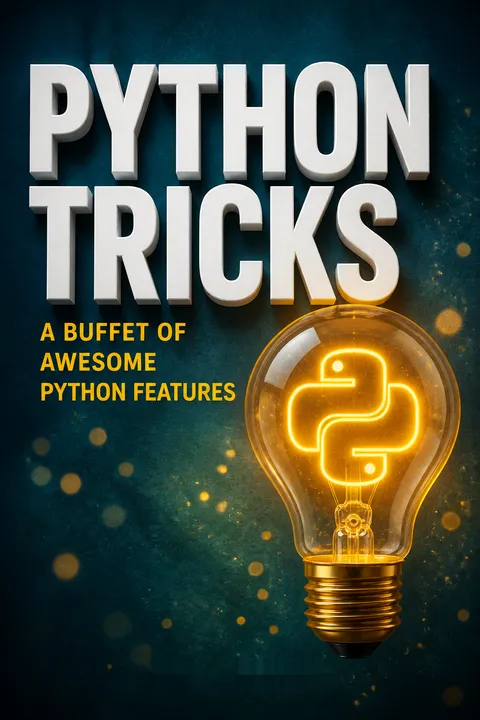


Key Takeaways
Prefer Python's elegant shortcuts only when they clarify the code
Readability is the test. Python offers compact features such as comprehensions, formatted strings, and trailing commas in multiline collections. A trailing comma lets each list or dictionary item occupy its own line, making changes easier to review. But a missing comma between adjacent string literals can silently join them, so concise syntax still deserves attention.
Conventions carry meaning. A leading underscore signals that a name is intended for internal use, while double underscores in a class trigger name mangling to reduce accidental collisions in subclasses. Names surrounded by double underscores are reserved for Python's special methods. For user-provided format strings, the book recommends Template strings as a simpler, safer option; otherwise, it favors formatted string literals in Python 3.6 and later.
The book's strongest organizing principle is not cleverness, but legibility: a feature earns its place when another developer can infer its purpose. That aligns with a broader software design idea, that code is an interface between people as well as a set of instructions for a machine. Compact syntax can reduce clutter, but density is not the same as clarity. The practical test is whether a reader can verify the behavior quickly, including the less obvious edge cases.
Reserve assertions for programmer mistakes, never decisions users can trigger
Assertions check assumptions. An assertion tests a condition that the program expects to be true. In a shop's discount calculation, for example, it can catch an impossible price outside the range from zero to the original price. When the assumption fails, Python raises an AssertionError and points to the failing line, which can make a bug easier to locate.
They are not validation. Python can disable assertions when optimization is enabled. An assertion used to check a user's permissions or input can therefore disappear, creating security or reliability failures. Use explicit conditionals and appropriate exceptions for those cases. Also avoid putting a comma-separated message inside the assertion's parentheses: that creates a nonempty tuple, which is truthy, so the test may never fail.
This distinction separates diagnostic checks from enforceable policy. It is similar to the difference between a warning light used by a mechanic and a lock on a door: one helps locate a defect, while the other must remain effective under operating conditions. Assertions are valuable precisely because they can be treated as development aids, but that makes them unsuitable for guarding boundaries exposed to users or attackers. A small test that confirms a check can fail is a useful safeguard.
Put resource cleanup inside a context, not after successful work
Cleanup must survive failure. A file should close even if writing to it raises an exception. A lock should be released even if the protected work fails. The with statement handles this by entering a context, running the work, and then performing cleanup as execution leaves the context. It packages the reliable try/finally pattern into a more readable form.
The protocol is reusable. An object supports a with block by implementing enter and exit. For simple resource lifecycles, contextlib.contextmanager can provide a generator-based alternative: acquire the resource, yield it for use, and clean it up in a finally block. The same pattern can express other temporary contexts, such as increasing and then restoring an indentation level.
A context manager makes a resource's lifecycle visible at the point of use. That is a useful design property beyond files and locks: the scope of the code communicates when responsibility begins and ends. It also reduces the number of cleanup paths a reader must mentally track. The abstraction is most effective when entering and leaving have clear, paired meanings. If those actions are surprising or unrelated, a with block can conceal complexity rather than clarify it.
Pass behavior as data, but wrap it with disciplined, named abstractions
Functions can travel. Python functions are objects, so they can be assigned to variables, stored in collections, passed into other functions, or returned from them. Nested functions can retain values from their enclosing function; these retained values let a returned function be configured for later use. This is the foundation for callbacks, flexible sorting keys, and decorators.
Decorators add reusable behavior. A decorator takes a callable and returns a callable, often a wrapper that logs arguments, checks access, or changes a result. Multiple decorators apply from the bottom of the stack upward. Wrappers should forward positional and keyword arguments, and functools.wraps preserves the wrapped function's name and documentation. Lambdas are useful for short expressions, such as a sorting key, but a named function is clearer when the logic grows.
First-class functions let a program separate what should happen from the mechanism that triggers it. That separation is central to event-driven systems, plugin designs, and many forms of functional programming. Decorators make cross-cutting behavior reusable, but every wrapper also adds a layer between a caller and the original function. Preserving metadata and keeping wrappers shallow protects debugging and comprehension. The best abstraction removes repetition without making the program's path of execution harder to see.
Give every custom object a useful representation and precise failure vocabulary
Objects should explain themselves. Python calls str for a readable, user-facing description and repr for a more explicit developer-facing representation. If str is absent, Python falls back to repr, so a useful representation helps in logs, debugging sessions, and containers that display their contents. A car object, for instance, is more informative when its representation includes its color and mileage than when it shows only a generic object identifier.
Errors are part of the interface. A custom exception such as NameTooShortError communicates more than a generic ValueError. Related exceptions can inherit from a package-level base class, allowing callers to catch that package's errors without swallowing unrelated failures. Abstract Base Classes can also enforce required methods when a subclass is instantiated, revealing an incomplete implementation earlier than waiting for a missing method to be called.
Representations and exception types are small forms of observability. They help people understand the state of a program when ordinary execution has gone wrong, much as clear labels help operators interpret a complex instrument panel. Good diagnostics also improve an API: callers can respond to a specific failure without knowing every implementation detail. The balance is specificity without needless taxonomy. An exception hierarchy with too many distinctions can become as difficult to learn as the generic errors it was meant to replace.
Match records, shared state, and copying depth to the data's real job
Choose a data shape deliberately. A namedtuple provides immutable fields with readable names and tuple-like memory use; a dictionary is convenient and flexible, while a custom class suits data that needs behavior or controlled attributes. Class variables are shared across instances, unlike instance variables. Assigning to an instance attribute with the same name as a class variable creates a separate value that shadows the shared one.
Copies can still share children. A shallow copy creates a new outer object but reuses references to its contents. A deep copy recursively duplicates nested objects, usually at greater cost. For example, shallow-copying a list of lists leaves the inner lists shared. Use the copy module when copying arbitrary objects, and choose deep copying only when independence throughout the nested structure is actually required.
These choices are really decisions about ownership and invariants. Immutable, named records prevent accidental edits and make field meaning visible; mutable dictionaries trade those protections for flexibility. Copying adds another ownership question: who is allowed to change a nested object, and who should observe that change? Deep copying is not automatically safer, since shared references may be intentional and copying can be expensive. Clear data contracts often matter more than selecting the most elaborate container.
Choose containers by operations, from deque queues to heap-based priorities
Start with the operation. Python's dict is the general-purpose mapping for fast average-case lookup, insertion, and deletion. Sets support efficient membership tests and remove duplicates; Counter adds occurrence counts. For arrays, lists handle mixed objects conveniently, while array.array packs basic values of one type more tightly. Tuples and namedtuples suit immutable grouped data.
Order changes the right tool. Lists work well as stacks when items are added and removed at the end. For queues, collections.deque supports efficient operations at both ends, while removing from the front of a list requires shifting elements. Priority queues retrieve items by priority rather than arrival time: heapq provides the heap operations, and queue.PriorityQueue adds synchronization for concurrent producers and consumers. Begin with a simple structure, then specialize when the requirements justify it.
The book's data-structure tour is a reminder that familiar names can hide consequential implementation details. A list is not a linked list, and using it as a front-removing queue can turn a seemingly harmless choice into repeated work proportional to the queue's size. Complexity labels are useful, but they are not the whole decision: synchronization, memory use, and access patterns matter too. For small workloads, clarity may beat theoretical optimization; for repeated operations at scale, the choice becomes part of the algorithm.
Use lazy iteration to process streams without building needless lists
Iterate over values directly. Python's for loops are designed to visit items, so prefer iterating over a collection rather than manually maintaining an index. Use enumerate when both an index and item are needed, and use comprehensions for straightforward transformations or filtering. A comprehension becomes harder to read when it accumulates several nested loops or conditions.
Generate values on demand. Iterators provide items one at a time; generators make them easier to write with yield, and generator expressions offer a compact form for simple cases. Unlike a list comprehension, a generator expression does not build the full result in advance. Generators can also be chained into a pipeline, such as producing numbers, squaring them, and then changing their signs. Each value moves through the steps without requiring intermediate lists.
Lazy iteration is both a memory strategy and a way to compose processing. It is particularly helpful when a sequence is large, open-ended, or naturally produced in stages. A pipeline can be understood one transformation at a time, much like a sequence of small functions. The trade-off is that generators are consumed as they are read, so they cannot simply be replayed. Materializing the values into a list is sometimes the clearer choice when reuse, inspection, or random access matters.
Treat dictionary keys, defaults, sorting, and merge order as explicit design choices
Lookup behavior is a decision. Use dict.get when a missing key should produce a fallback, or use exception handling when the normal path assumes the key exists. defaultdict is useful when accessing a missing key should create a value automatically. Dictionaries can also map conditions to handler functions, replacing long if chains when the cases are genuinely simple dispatches.
Keys and updates have rules. Equal, hashable values with matching hashes act as the same dictionary key. Since True, 1, and 1.0 compare equally and share a hash, assigning each as a key overwrites the previous value. To sort dictionary items by value, supply a sorting key function. To merge dictionaries, update calls or unpacking can combine them; later sources overwrite earlier values, so order determines the winner.
Dictionaries are more than storage: they encode rules about identity, fallback behavior, and precedence. The True, 1, and 1.0 example exposes a deeper requirement of hash tables: equality and hashing must agree for keys to behave consistently. Dispatch tables are elegant when they make a fixed set of choices easier to inspect, but not every conditional belongs in a mapping. When branches have distinct control flow or side effects, a conventional if statement may communicate the logic better.
Use isolated environments and the REPL to turn language features into working knowledge
Keep projects separate. A virtual environment gives a project its own Python interpreter and installed packages, helping prevent version conflicts with other projects and avoiding routine changes to the global environment. Create the environment, activate it before installing dependencies, and deactivate it when finished.
Investigate while coding. The interpreter's dir function lists names on modules and objects, while help opens their documentation without requiring a browser. Small experiments in the REPL can clarify behavior before it becomes embedded in a larger program. For deeper investigation, dis can display CPython bytecode, the intermediate instructions executed by its virtual machine. The book treats this as a learning aid, not a requirement for everyday programming, and encourages applying new techniques in real code and sharing understanding with peers.
This workflow treats programming knowledge as something tested, not merely read. A short experiment can expose mistaken assumptions cheaply, while isolated environments make experimentation less likely to disrupt other work. Inspecting bytecode can deepen understanding of the implementation, but implementation details may differ across Python versions and are not always stable. The practical skill is knowing when to look under the hood and when a clear, tested use of the public interface is enough.
Analysis
Python Tricks is best read as a practical field guide rather than a linear course. Its short examples range from punctuation and naming conventions to object models, data structures, generators, and CPython internals. The unifying subject is not a single feature: it is how to use Python's built-in protocols and compact syntax to make programs clearer, safer, and less repetitive. That breadth makes compression difficult. A summary that lists only features loses the author's recurring judgment about when not to use them.
The most useful synthesis is a three-part test. First, choose the construct that matches the actual job: deque for a queue, a heap for priority retrieval, a context manager for paired setup and cleanup. Second, understand its failure modes: assertions can be disabled, shallow copies retain shared children, and equal keys can overwrite one another. Third, evaluate the result as communication. A clever lambda, nested comprehension, or dispatch table is not an improvement if a teammate must reverse-engineer it.
The book's examples are especially effective when they reveal behavior through a small surprise, such as a missing comma joining strings or a generator pausing at yield. This is a strong teaching method because it turns syntax into a mental model. The limitation is that some implementation details and version guidance belong to the 2017 context of the book. CPython internals, language guarantees, and preferred APIs can change, so readers should verify current documentation before relying on version-sensitive claims. The durable lesson is less about memorizing tricks than developing enough intuition to recognize a useful feature, test it in isolation, and apply it only when it improves the code's contract with its readers.
Review Summary
Python Tricks is highly praised for its concise yet insightful approach to intermediate and advanced Python topics. Readers appreciate its practical tips, clear explanations, and focus on best practices. Many found it helpful for filling knowledge gaps and improving coding skills. The book's conversational tone and systematic structure make it accessible and enjoyable. While some experienced developers found it less challenging, most agree it's an excellent resource for those looking to deepen their Python expertise and write more idiomatic code.
People Also Read









Glossary
Python Trick
Short example that teachesThe author's term for a concise Python code example used to teach one language feature or provoke a deeper investigation. A trick is not meant to be clever for its own sake. Its purpose is to make behavior concrete, give readers something they can try in an interpreter, and build intuition for writing Python.
context manager
Manages a scoped operationAn object that supports the with statement by providing enter and exit methods. The entry method prepares or acquires something needed for a block, and the exit method handles cleanup when the block ends, including when an exception interrupts it. Files and locks are common examples.
first-class functions
Functions treated as objectsA property of Python functions that allows them to be assigned to variables, stored in data structures, passed as arguments, and returned from other functions. This makes it possible to pass behavior between parts of a program, and underlies techniques such as callbacks, decorators, and higher-order functions.
lexical closure
Function retaining enclosing valuesA function that retains access to values from its enclosing lexical scope, even after the enclosing function has finished. A closure can therefore carry configuration into later calls. For example, a function factory can return an addition function that remembers the number it should add.
decorator
Wraps a callable's behaviorA callable that accepts another callable and returns a callable, commonly a wrapper that adds behavior before or after the original runs. Decorators can provide reusable logging, timing, or access checks. The @ syntax applies a decorator when a function is defined, and functools.wraps preserves useful metadata.
EAFP
Try, then handle failureA Python coding style whose name means 'easier to ask for forgiveness than permission.' Rather than checking in advance whether an operation is safe, code attempts it and handles a relevant exception if it fails. For dictionary lookup, this can avoid checking membership and then performing a second lookup.
Abstract Base Classes
Enforce required subclass methodsClasses defined with Python's abc facilities can declare abstract methods that concrete subclasses are required to implement. Python prevents instantiation of a subclass while abstract methods remain unimplemented, surfacing an incomplete interface earlier than a runtime call to a missing method would.
namedtuple
Immutable named-field tupleA tuple-based record type created with collections.namedtuple. Its fields have readable names as well as positional indexes, and instances are immutable. Namedtuples provide a lightweight alternative to a manually written class when data needs a fixed structure but little or no custom behavior.
shallow copy
Copies only the outer objectA copy that creates a new outer collection but reuses references to the objects it contains. Changing the outer structure does not change the original collection, but mutating a shared nested object can be visible through both. The copy module provides copy.copy for this operation.
deep copy
Recursively copies nested objectsA copy operation that recursively duplicates an object and its contained child objects, producing a more independent structure than a shallow copy. The copy module provides deepcopy. Deep copying can require more time and memory, and is not always appropriate when shared references are intentional.
iterator protocol
Interface for sequential valuesThe Python interface that lets an object participate in iteration. An iterable provides iter to return an iterator, and an iterator provides next to return values one at a time. When no values remain, the iterator raises StopIteration, allowing for loops to end.
generator
Function yielding values over timeA function that uses yield to produce values one at a time while preserving its execution state between values. Calling the function creates a generator object; its body runs as values are requested. When execution ends without another yield, iteration ends with StopIteration.
generator expression
Compact, lazy iterator expressionAn expression with a comprehension-like form that produces values on demand instead of constructing a list immediately. It is useful for simple, temporary iteration and can reduce memory use. Once consumed, a generator expression cannot be restarted, so it is not a replacement for a reusable collection.
hashable
Stable value usable as a keyAn object is hashable if it has a hash value that remains stable during its lifetime and can be compared with other objects. Objects that compare as equal must have the same hash. Hashable objects can be used as dictionary keys and set elements; strings and numbers are common examples.
virtual environment
Isolated project Python setupA Python environment associated with a project that keeps its interpreter and installed dependencies separate from other projects and the global installation. Activating it changes which Python and package-management commands the shell uses, helping prevent dependency-version conflicts and reducing the need for global package installation.
FAQ
What's "Python Tricks: A Buffet of Awesome Python Features" about?
- Overview: "Python Tricks" by Dan Bader is a guide to mastering Python by exploring its advanced features and idiomatic practices. It aims to elevate a Python developer's skills from intermediate to advanced.
- Content Structure: The book is structured into chapters that cover various Python features, including cleaner code patterns, effective functions, object-oriented programming, and data structures.
- Practical Examples: Each chapter includes practical examples and code snippets to illustrate the concepts, making it easier for readers to understand and apply them.
- Community Insights: The book also shares insights from the Python community, including feedback from experienced developers, to provide a well-rounded perspective on Python programming.
Why should I read "Python Tricks: A Buffet of Awesome Python Features"?
- Skill Enhancement: The book is designed to help Python developers become more effective, knowledgeable, and practical in their coding practices.
- Advanced Techniques: It introduces advanced Python features and idioms that can significantly improve code quality and efficiency.
- Real-World Application: The examples and tricks are applicable to real-world scenarios, making it a valuable resource for professional development.
- Community Engagement: Reading the book can also connect you with the broader Python community, as it includes insights and feedback from other developers.
What are the key takeaways of "Python Tricks: A Buffet of Awesome Python Features"?
- Cleaner Code Patterns: Learn how to write cleaner and more maintainable Python code using patterns like context managers and assertions.
- Effective Functions: Understand the power of first-class functions, decorators, and argument unpacking to create more flexible and reusable code.
- Object-Oriented Programming: Gain insights into Python's OOP features, including class and instance variables, abstract base classes, and namedtuples.
- Data Structures and Iteration: Explore Python's built-in data structures and learn how to use iterators, generators, and comprehensions effectively.
How does Dan Bader define a "Python Trick"?
- Teaching Tool: A Python Trick is a short code snippet meant to teach an aspect of Python with a simple illustration.
- Motivational Example: It serves as a motivating example, enabling readers to dig deeper and develop an intuitive understanding of Python.
- Community Origin: The concept started as a series of code screenshots shared on Twitter, which received positive feedback and led to the creation of the book.
- Accessible Learning: The tricks are designed to be accessible and easy to understand, making them suitable for developers looking to enhance their Python skills.
What are some patterns for cleaner Python code mentioned in the book?
- Assertions: Use assertions to automatically detect errors in your programs, making them more reliable and easier to debug.
- Complacent Comma Placement: Adopt a code style that avoids comma placement issues in lists, dicts, or set constants.
- Context Managers: Simplify resource management patterns using the with statement and context managers.
- Underscores and Dunders: Understand the meaning of single and double underscores in variable and method names to write more idiomatic Python code.
How does "Python Tricks" explain the use of decorators?
- Behavior Modification: Decorators allow you to extend and modify the behavior of a callable without permanently changing it.
- Reusable Building Blocks: They define reusable building blocks that can be applied to functions or classes to add functionality like logging or access control.
- Syntax and Stacking: The book explains the @ syntax for decorators and how multiple decorators can be stacked to accumulate their effects.
- Debugging Best Practices: It recommends using functools.wraps to carry over metadata from the undecorated callable to the decorated one for better debugging.
What are the differences between class, instance, and static methods in Python?
- Instance Methods: Require a class instance and can access the instance through the self parameter, allowing them to modify object state.
- Class Methods: Use the @classmethod decorator and take a cls parameter, allowing them to modify class state but not instance state.
- Static Methods: Use the @staticmethod decorator and do not take self or cls parameters, making them independent of class and instance state.
- Use Cases: The book provides examples of when to use each method type, emphasizing their role in communicating developer intent and maintaining code.
How does "Python Tricks" suggest handling dictionary default values?
- Avoid Explicit Checks: Instead of using explicit key in dict checks, use the get() method to provide a default value for missing keys.
- EAFP Principle: Follow the "easier to ask for forgiveness than permission" coding style by using try...except blocks to handle KeyError exceptions.
- Defaultdict Usage: In some cases, the collections.defaultdict class can be helpful for automatically handling missing keys with default values.
- Concise Implementation: The book provides examples of how to implement these techniques concisely and effectively.
What are some advanced string formatting techniques covered in the book?
- Old Style Formatting: Uses the %-operator for simple positional formatting, similar to printf-style functions in C.
- New Style Formatting: Introduced in Python 3, it uses the format() method for more powerful and flexible string formatting.
- Literal String Interpolation: Available in Python 3.6+, it allows embedded Python expressions inside string constants using f-strings.
- Template Strings: A simpler and less powerful mechanism for string formatting, useful for handling user-generated format strings safely.
How does "Python Tricks" explain the use of list comprehensions?
- Syntactic Sugar: List comprehensions are a concise way to create lists by iterating over a collection and applying an expression to each item.
- Template Pattern: The book provides a template pattern for transforming for-loops into list comprehensions and vice versa.
- Filtering Elements: Comprehensions can include conditions to filter elements, allowing for more complex list generation.
- Readability Considerations: While powerful, the book cautions against overusing comprehensions, especially with deep nesting, to maintain code readability.
What are some key quotes from "Python Tricks" and what do they mean?
- "Mastering Python programming isn’t just about grasping the theoretical aspects of the language." This emphasizes the importance of understanding and adopting the conventions and best practices used by the Python community.
- "A book that works like a buffet of awesome Python features (yum!) and keeps motivation levels high." This highlights the book's approach of presenting Python features in an engaging and motivating way.
- "Python’s assert statement is a debugging aid that tests a condition as an internal self-check in your program." This quote underscores the importance of using assertions for debugging and maintaining code reliability.
- "Decorators define reusable building blocks you can apply to a callable to modify its behavior without permanently modifying the callable itself." This explains the power and flexibility of decorators in enhancing code functionality.
How does "Python Tricks" address the use of virtual environments?
- Dependency Isolation: Virtual environments help isolate project dependencies, preventing version conflicts between packages and Python versions.
- Best Practice: The book recommends using virtual environments for all Python projects to keep dependencies separate and avoid headaches.
- Activation and Deactivation: It explains how to create, activate, and deactivate virtual environments to manage project-specific dependencies.
- Security Benefits: Using virtual environments reduces security risks by avoiding the need for superuser permissions when installing packages.
Download PDF
Download EPUB
.epub digital book format is ideal for reading ebooks on phones, tablets, and e-readers.








