

Key Takeaways
Check who benefits before trusting a Wall Street buy rating
Advice has incentives. Analysts may know an industry deeply, but their employers may also seek underwriting work or favor with the companies they cover. That pressure helps explain why, from 1981 to 1984, 86 percent of brokerage recommendations were neutral or buy ratings, while just 14 percent were sell or strong sell recommendations. A bullish consensus can reflect incentives as well as evidence.
Read beyond the chorus. Thornton O'glove recounts how analyst James Chanos questioned Baldwin-United's accounts while many prominent firms supported the company. Baldwin later collapsed into bankruptcy. The lesson is not that contrarians are always right. It is that investors should examine filings themselves, ask what could go wrong, and treat professional opinions as claims to test rather than conclusions to borrow.
The incentive problem is a classic case of principal and agent: investors rely on experts whose employers may have interests beyond investment accuracy. That does not make analyst research worthless. Industry knowledge can reveal competitive dynamics that filings cannot. The stronger approach is to use analysts for questions and context, then verify the claims against primary documents. Chanos's example also invites caution about survivorship bias: a memorable successful skeptic does not prove that skepticism alone predicts failure.
Treat a clean audit as a checkpoint, not a guarantee
An audit has limits. A clean auditor's opinion says the financial statements were judged to conform materially to accounting rules. It does not certify that a company is healthy, that its estimates will prove correct, or that fraud is impossible. O'glove notes that Baldwin-United, Penn Square Bank, and Continental Illinois each received clean opinions shortly before serious failure.
Follow the relationship. The company hires and pays its auditor, and the same accounting firm may seek consulting, tax, or other work from that client. Competition for fees can pressure auditors, even when professional standards require independence. The book also describes cases where auditors changed after disagreements or failed to detect serious problems. Investors should read the opinion, but then inspect the balance sheet, footnotes, and cash generation for themselves.
The important distinction is between assurance and prediction. An audit reduces some information risk, but it is not a forecast of solvency or a guarantee against management deception. This is similar to safety inspections in other fields: they assess specified conditions within a defined scope, not every future hazard. The auditor-client relationship deserves scrutiny, but a failed company does not by itself prove its auditor was negligent. The useful question is what the opinion covers, and what it leaves unresolved.
Compare the shareholder letter with the required filings
Two audiences, two tones. The shareholder letter is designed to explain the year and present management's perspective. Required filings, including annual and quarterly reports, follow more formal disclosure rules and often contain fuller detail. Differential disclosure means that related company documents describe the same business differently or reveal different amounts of information. Contradictions deserve attention.
Put prose beside numbers. International Harvester's 1980 letter celebrated recovery and lower debt, yet the financial statements showed earnings far below the prior year and total debt up by about $948 million. Coleco's management repeatedly forecast strong results that did not arrive. Such examples do not prove deliberate deception: forecasts can simply be wrong. But comparing several years of letters with filings can expose habitual optimism, omitted problems, and claims that the figures do not support.
This is a form of triangulation: confidence rises when independent sources converge, and falls when they do not. The letter can still be useful precisely because it reveals what management wants shareholders to notice. Its omissions, emphases, and changing explanations are evidence about communication strategy, though not proof of wrongdoing. A further safeguard is to compare like with like: periods, business segments, and accounting definitions must match before a discrepancy is treated as meaningful.
Ask how much reported profit comes from repeatable operations
Quality is repeatability. Quality of earnings describes how much reported profit comes from the company's continuing business rather than unusual, nonoperating, or nonrecurring items. Those items can be legitimate and clearly disclosed, yet still offer a poor guide to next year's performance. The classification itself can be debatable: selling property may be exceptional for a manufacturer, but routine for a real estate business.
Sears shows the difference. Sears reported $4.01 per share for 1984, up from $3.80 in 1983. O'glove identified $1.31 per share in 1984 and $0.59 in 1983 from items such as tax benefits, property sales, and inventory accounting effects. Removing those items turned the reported 5 percent increase into an estimated 16 percent decline in operating earnings. Investors should inspect the components, not just the headline.
Repeatability is a practical bridge between accounting and valuation: a dollar of durable operating profit usually supports a different expectation than a dollar from a one-off sale. Yet adjustments require judgment. A so-called unusual item may recur, while a recurring business may still be cyclical. The most defensible analysis shows both reported and adjusted figures, names each adjustment, and applies the same rule across years. That makes the estimate auditable rather than a convenient story.
Judge expense cuts by whether they weaken tomorrow's sales
Costs have a time horizon. A lower expense can lift today's earnings without improving the business. A company may reduce advertising, research, or maintenance to meet short-term targets, but those cuts can damage future demand or competitiveness. Conversely, temporary spending on a new campaign may depress current profit while supporting later sales. The key is to ask what changed, why, and whether the benefit can continue.
Church's Fried Chicken illustrates the upside. The company increased advertising spending sharply in 1984, which reduced current earnings relative to a lower-spending year. At the same time, sales and earnings began to improve, and the author judged that the campaign was starting to pay off. The book also adjusts IBM's results for several lower costs and accounting effects, showing how reported growth can differ from the underlying operating trend.
An expense is not automatically waste, and a cut is not automatically efficiency. The useful distinction is between removing friction and reducing investment in capabilities that generate future value. This resembles the difference between maintenance and capital expenditure: both can look like costs now, but their effects unfold over different periods. Financial statements rarely establish causation on their own, so spending trends should be tested against sales, margins, and management's explanation rather than labeled good or bad in isolation.
Compare tax and shareholder books to expose earnings timing gaps
One business, different measures. Companies may report one set of results to shareholders and calculate taxable income under different rules. A reconciliation in the tax footnotes can show where the two differ, including depreciation, revenue recognition, and investment credits. A widening gap is not proof of misconduct, but it can reveal that reported earnings depend heavily on timing choices.
Watch what gets recognized early. DSC Communications reported earnings of $1.40 per share in 1984, while its tax footnote showed a substantial difference related to revenue recognition. In 1985, the company changed its policy after customer installation plans shifted and later restated earlier results. Wang Laboratories also showed large differences connected with leases and spare parts. These cases make the footnotes worth reading, especially when profits grow faster than the business's cash or taxable income suggests.
A reconciliation is valuable because it makes measurement choices more visible. It also has limits: tax rules and financial reporting rules have different purposes, so a gap alone does not establish that either figure is misleading. Taxable income is not a direct substitute for cash flow. The sharper inquiry is whether timing differences are growing, what assumptions drive them, and whether later business events support the original revenue claims.
Watch receivables and finished goods before forecasts crack
Working capital tells a story. Accounts receivable are amounts customers owe; inventories are goods and materials held for sale or production. Compare both with sales across matching periods. If receivables rise much faster than sales, customers may be paying slowly or the company may be extending generous terms. If finished goods accumulate while sales weaken, products may be stuck in the warehouse or pushed onto retailers.
Commodore gave an early warning. In the first quarter of fiscal 1985, its sales rose 17 percent year over year while receivables grew 34 percent. Later, sales fell 9 percent while inventories rose 56 percent, with finished goods climbing faster than raw materials and work in progress. O'glove calls a pattern where finished goods swell relative to production inputs a negative inventory divergence. Commodore subsequently recorded large inventory write-downs and losses.
These ratios are powerful because they track the conversion of reported sales into collected money and sellable goods. They are not verdicts: seasonal businesses, rapid growth, and supply disruptions can also inflate working capital. The pattern matters more than a single snapshot, and comparisons should account for acquisitions and changes in business mix. Separating raw materials, work in progress, and finished products helps distinguish deliberate preparation for demand from an accumulation of goods customers do not want.
Measure debt against operating cash, not reassuring accounting profits
Debt demands cash. Interest and principal payments must be met even when earnings are weak. Examine short-term and long-term debt, interest expense, and cash generated by operations together. A long-term debt-to-equity ratio alone can miss a growing dependence on short-term borrowing. The book also distinguishes cash flow from operations from looser uses of the phrase cash flow, urging readers to trace where money actually came from and went.
Harvester shows the danger. International Harvester's interest expense rose from about $148 million in 1979 to $289 million in 1980, while its earnings collapsed. The company's borrowing and preferred stock expanded, and its debt ratios deteriorated. Thousand Trails offers another warning: rapid resort expansion and borrowing helped produce a heavily leveraged balance sheet, leaving the company exposed when sales slowed. Debt can magnify growth, but it also magnifies disappointment.
Leverage changes the consequences of ordinary business volatility. When revenue falls, fixed interest costs absorb a larger share of what remains, making weak operations more dangerous than the income statement alone suggests. But no single debt ratio defines safety across every industry. A capital-intensive utility and a software business have different financing needs. Analysis should connect debt maturities, interest costs, cash generation, and the stability of the assets that are expected to support repayment.
Read dividend policy as a clue to management's capital priorities
Payouts are choices. Dividends can reward shareholders and make a stock attractive to income-focused investors. But money distributed cannot also fund research, expansion, debt reduction, or a share repurchase. A high payout is especially concerning when earnings are falling, debt is rising, or the business needs investment. Examine the dividend alongside cash flow and long-term borrowing, not as a standalone sign of strength.
ITT illustrates the trap. The company raised its dividend for many years, even as earnings fluctuated and debt remained substantial. In 1984 it cut the payout sharply, and the stock fell. Avon maintained a large dividend while facing business pressure and rising debt. By contrast, Teledyne's leader Henry Singleton used cash to repurchase shares rather than pay dividends. The book's point is not that buybacks always win, but that every payout policy reflects a capital-allocation decision.
Dividends are a credible signal because they require cash, but their meaning depends on context. A steady payout can impose discipline on management, while an unsustainable one can conceal a refusal to adapt. Repurchases are not automatically superior: they create value only when the price and alternatives make sense. The useful question is whether each dollar retained or distributed serves the company's long-term economics, rather than whether a particular policy is fashionable.
Treat restructuring write-offs as a reset, then demand proof
A big bath resets the baseline. The term describes writing down assets or recognizing restructuring costs in a concentrated period, often after a management change or strategic overhaul. The resulting loss can make later earnings look stronger because old costs have already been charged. That may accompany genuine repair, but the write-off itself does not prove that the business has improved.
Ralston Purina offers a constructive case. After taking large charges and selling weaker operations, new chief executive William Stiritz focused the company on selected businesses, repurchased shares, and pursued acquisitions. Earnings and the stock price improved over the following years. Gulf and Western also sold assets and reorganized after a leadership transition. Investors should examine what was written off, what was sold, how debt changed, and whether later operating performance actually validates the promised reset.
A restructuring is best understood as a testable hypothesis: management claims that sacrificing value now will improve the economics of the remaining business. The accounting charge can clear accumulated problems, but it can also shift costs between periods and create an artificially easy comparison. A sound review tracks operational indicators after the announcement, including margins, cash generation, and returns on investment. The case for a reset is strongest when the strategy and measurable results align.
Analysis
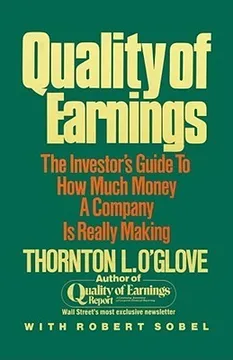
Quality of Earnings is best read as a practical course in skeptical attention. Its core claim is not that financial statements are useless or that management is always deceptive. It is that reported earnings are an output of business activity, estimates, accounting rules, and incentives, and investors need to separate those layers before treating a number as evidence of durable value. The book therefore moves from the people presenting information, analysts and auditors, to the documents themselves, then to earnings composition, working capital, debt, dividends, and restructuring.
Its most enduring analytical move is comparative rather than formulaic. A figure becomes informative when placed beside an earlier period, a second document, another component of the balance sheet, or the cash needed to sustain the business. Receivables rising faster than sales, finished goods accumulating, interest consuming more operating income, or tax and shareholder results diverging are not automatic proof of trouble. They are prompts for investigation. This preserves a useful distinction between a warning signal and a conclusion.
The book's case studies give the method narrative force. International Harvester's optimistic letters conflict with deteriorating finances. Commodore's inventory growth precedes severe losses. Ralston Purina shows how a restructuring can accompany a real strategic renewal. Taken together, these stories teach readers to look for patterns, not merely dramatic anecdotes.
The method has limits. The examples reflect accounting standards and market institutions of the 1980s, and the book's suspicion-first posture can encourage false alarms if readers ignore seasonality, acquisitions, or industry differences. Its numerical adjustments also depend on judgment, particularly when classifying an item as recurring. The best use is therefore disciplined skepticism: preserve reported figures, show adjustments transparently, compare several periods, and ask what evidence would disprove the bearish or bullish interpretation. The result is not a mechanical stock-picking formula, but a more independent way to decide what a company's earnings actually say.
Glossary
Quality of Earnings
Repeatability of reported profitsAn assessment of how much reported income comes from a company's continuing operations and how much depends on unusual items, accounting choices, or temporary conditions. It asks whether earnings are likely to persist and whether they are supported by the underlying business. The term is a lens for judging financial statements, not a single formula or rating.
Differential Disclosure
Different accounts across documentsA meaningful difference in what a company says, or how much detail it provides, across documents such as shareholder letters, annual reports, quarterly reports, and required filings. Comparing these sources can reveal facts emphasized in one place but minimized or omitted in another. A difference is a reason to investigate, not proof that management intended to mislead.
Nonoperating and/or Nonrecurring Income
Profit outside regular operationsIncome or expense that does not arise directly from a company's usual business, or that may not recur in the same way. Examples discussed in the book include investment gains, tax benefits, and profits from selling property. The boundary is judgment-based: an asset sale can be unusual for one company and routine for another.
Cash Flow from Operations
Cash generated by operationsCash produced by a company's operating activity, distinguished from measures that simply add depreciation to reported earnings or mix operating cash with financing and investing flows. O'glove stresses that company presentations may use similar terms differently, so investors should trace the statement's components and verify that the reported measure represents cash from operations.
Full-cost method
Capitalizes exploration costs broadlyAn accounting approach used by some oil and gas companies that capitalizes costs related to finding and developing reserves, including costs associated with unsuccessful efforts. Those costs are recognized against income as reserves are produced and sold. Because fewer costs may be charged immediately than under successful efforts accounting, reported earnings can differ.
Successful efforts
Expenses unsuccessful exploration costsAn oil and gas accounting approach that expenses costs that do not directly lead to successful discoveries, while capitalizing costs associated with successful efforts. Compared with the full-cost method, it generally recognizes more unsuccessful exploration costs sooner. The methods can therefore produce different reported earnings even when companies face similar exploration activity.
Negative inventory divergence
Finished goods outpace inputsA pattern in which finished-goods inventories rise disproportionately compared with raw materials or work in progress, especially when sales do not keep pace. It may indicate that products are accumulating faster than customers are buying them. The pattern is a warning signal that should be interpreted alongside sales trends, seasonality, and production changes.
Big bath
Concentrated restructuring write-offsThe practice of recognizing a large group of write-offs or restructuring costs in one period, often during a management transition or strategic overhaul. By recording costs together, a company may lower current earnings while making future results appear stronger against a reduced baseline. It can accompany genuine repair, so investors must assess subsequent operating performance.
Download PDF
Download EPUB
.epub digital book format is ideal for reading ebooks on phones, tablets, and e-readers.








