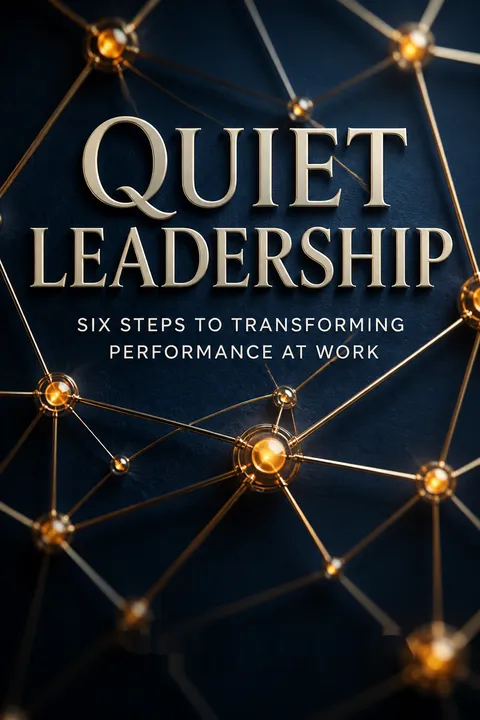


Key Takeaways
Improve employees' thinking instead of supplying their answers
A leadership reset. In 2004, a Singapore call center was losing 40 percent of its staff each year. Managers had introduced performance dashboards, instant feedback, and employee awards, yet neither retention nor results improved much. The author noticed managers hovering over workers and issuing rapid instructions, then proposed changing how leaders spoke with their teams.
Quiet Leadership means helping people think more effectively rather than deciding for them. The premise is that people are more likely to act on conclusions they reach themselves, and a manager cannot reliably guess the right answer for a colleague with a different history and perspective. Instead of prescribing a fix, the leader makes room for the employee to work through the issue.
The shift from answer-giver to thinking partner has a strong parallel in autonomy-supportive leadership: people tend to engage more deeply when they have meaningful control over how they solve a problem. It also offers a practical test for managers: does this conversation leave the employee more capable of handling a similar challenge next time? The approach is not a ban on expertise. Emergencies, clear compliance rules, and genuinely unfamiliar tasks may call for direct instruction. The useful distinction is whether guidance builds the other person's judgment or quietly replaces it.
Treat performance as the visible tip of a deeper thinking system
Look beneath the result. The book uses an iceberg to explain performance: visible actions sit above less visible habits, feelings, and thoughts that shape them. A manager who sees missed targets may focus only on the numbers, while the cause could involve priorities, confidence, or an unexamined assumption. Improving the surface result without exploring its drivers can leave the underlying pattern untouched.
The argument matters because work has shifted from physical and repetitive tasks toward judgment and problem-solving. The author cites a 2005 estimate that 40 percent of employees were knowledge workers, and says the proportion among middle managers and above approached 100 percent. In this setting, performance improvement means improving the quality of people's thinking, not merely tightening process controls.
The iceberg is useful because it directs attention toward mechanisms, not just outcomes. In organizational psychology, this resembles the distinction between lagging indicators, such as quarterly results, and the behaviors and conditions that generate them. Still, performance is not always reducible to an individual's thought patterns. Workload, incentives, unclear authority, and inadequate tools can produce poor results even when someone's thinking is sound. A strong leader investigates both the person's reasoning and the system in which that reasoning has to operate.
Build a new mental route rather than trying to erase an old one
Add a better pathway. The author describes thoughts and habits as mental maps, patterns of connections shaped by repeated experience. A well-used response can become automatic, much like water carving a channel into earth. Trying to suppress a deeply ingrained habit may keep attention fixed on it; building a different response gives the brain another route to use.
The book illustrates this with the author's caution after his young daughter fell on a staircase. The incident made him reach for her hand whenever they approached the stairs. It also points to skill practice: an experienced athlete can perform familiar movements with less conscious effort because those actions have become well learned. To help a new behavior take hold, the author recommends attention, repetition, action, reminders, and positive encouragement.
The focus on building a replacement behavior is more practical than simply demanding that someone stop a habit. It aligns with learning science, where practice and feedback help new responses become more accessible. But the book's claim that old wiring is nearly impossible to undo is too absolute if taken literally. Therapy, exposure, and deliberate practice can alter responses, even if earlier associations remain available. The valuable lesson is not that old patterns are untouchable, but that change usually needs sustained practice of a more useful alternative.
Aim attention at the next useful move, not a failure autopsy
Face forward without denying facts. The book contrasts questions that dwell on blame or causes with questions that help someone choose a way ahead. Instead of asking why a target was missed, a manager might ask what the employee wants to accomplish next time and what could help make that happen. The shift is small in wording but can redirect attention from explanations toward options.
The author argues that repeated focus on a problem can reinforce the thoughts associated with it, while solution-focused conversation helps people imagine a new response. This is not presented as pretending the problem never happened. It means using the facts to plan forward rather than turning the discussion into a long search for fault. The approach is especially aimed at changing personal habits, not diagnosing a broken operational process.
Forward-looking questions can reduce defensiveness and make action easier to identify. They also resemble implementation planning, which turns a broad intention into a workable next step. Yet diagnosis still has a place. If a production failure has a technical cause, skipping root-cause analysis may allow it to recur. The distinction is between studying a process to improve it and repeatedly scrutinizing a person's shortcomings in hopes that insight alone will change behavior. Effective leadership can use both modes without confusing them.
Listen for capability after clearing your own mental static
Notice the listener's filter. At a birthday gathering, Ming says she is unhappy at work and is considering a move into sales. Her relatives and professional friends hear the same words differently: one worries about her health, another thinks about legal issues, and a recruiter sees a potential job lead. Each response reflects the listener's own perspective, not necessarily what Ming needs.
The author calls clear, less biased listening the Clarity of Distance. Four things can cloud it: getting tangled in details, interpreting someone through assumptions, pursuing one's own agenda, and reacting from a personal emotional trigger. Listening for potential means treating the speaker as capable of developing an answer, while noticing when these distractions are steering the conversation.
This model captures a central problem in listening: attention is never entirely neutral. Expectations shape what seems important, and naming a personal agenda can make its influence easier to manage. The commitment to see someone's potential can also counter a manager's stale assumptions about a worker. It should not become forced optimism, however. A person may face real barriers that require resources or intervention. Listening well means holding confidence in someone's capacity alongside curiosity about the constraints they actually face.
Ask permission before getting personal, then define the conversation's purpose
Make the conversation safe to enter. Before raising a sensitive issue, a leader can check whether the person has time and is willing to discuss it. The leader can then explain the purpose, expected length, roles, and intended outcome. The book calls this placing the other person in the conversation: making explicit what is about to happen instead of launching into an ambiguous discussion.
This structure is especially useful when emotions are involved. A manager who wants to discuss a struggling project might say they want to understand the employee's view and see how they can help, rather than opening with a criticism. The same care applies to speaking: be concise, concrete, and considerate. For email, the author recommends brief messages for information and scheduling, while emotionally charged matters are better handled in a live conversation.
Clear framing can lower uncertainty, a major source of threat in difficult conversations. Permission also signals respect for another person's attention, which makes candid discussion more possible. But the request is only meaningful if refusal is genuinely allowed. When a manager asks a subordinate to talk, the power imbalance may make a polite yes feel compulsory. Stating the purpose plainly, allowing a better time, and inviting the employee's priorities help turn a procedural courtesy into real consent.
Ask about someone's thinking, not just the problem they describe
Help the person see their own thought process. The Dance of Insight is the book's method for a useful coaching conversation: establish willingness, make the conversation's purpose clear, ask questions that prompt reflection, and summarize the core of what the person says. A good summary does more than repeat details. It helps the speaker recognize the central issue in their own words.
The author also describes four broad moments around an insight: recognizing a dilemma, reflecting, having a new idea, and feeling ready to act. In one example, Paul is worried that a project is competing with too many priorities. His manager asks how long he has been thinking about it. Paul realizes he needs to rank all his projects, not simply work harder on the one causing immediate stress.
Questions about thinking encourage metacognition, the ability to notice and assess one's own mental process. That can reveal a stuck assumption without the manager having to guess what the employee should realize. The framework's attention to silence is valuable: people need room to consider an answer. Its account of facial expressions and brain waves should be treated more cautiously, though. A faraway look is not a dependable signal of an impending insight. The strongest evidence is what the person says they have understood and intends to do.
Turn insight into a specific action before its energy fades
Convert the idea into a plan. The CREATE model organizes a conversation into three movements: clarify how the person currently understands the issue, generate more than one possible way forward, and use the person's motivation to define an action. The leader can offer suggestions during the options stage, but should leave the choice with the employee.
A sales leader named Sue initially thinks her team needs stronger encouragement. As she reflects, she realizes the team may not understand or support its targets. She considers several ways to involve them, chooses an informal gathering, and commits to arranging it within a set time. The point is to make the next step concrete while the idea is fresh. Writing it down, setting a deadline, or agreeing to report back can help an insight become behavior.
This sequence bridges reflection and execution, a gap familiar in behavioral science. Specific commitments and deadlines reduce the distance between wanting to act and actually acting; asking someone to report back adds a light form of accountability. The model also wisely separates idea generation from choosing a course, which can prevent premature commitment. Still, an energizing insight is not proof that a plan is feasible. Leaders should help check resources, authority, and competing priorities before treating enthusiasm as a reliable forecast of follow-through.
Follow up on what people learned, not only what they completed
Reinforce learning after the conversation. The FEELING model guides follow-up by checking what happened, how the person feels about it, what effort deserves encouragement, what they learned, where that learning could matter again, and what goal comes next. If an employee did not complete the original task, the conversation can still recognize useful effort and identify what the experience revealed, rather than defaulting to blame.
The author sees follow-up as a way to strengthen new habits through attention, repetition, and support. This matters because insight can be vivid but brief. The book cites a 2004 Gallup survey in which 65 percent of US workers reported receiving no workplace recognition in the previous year. Recognition is most useful when specific: it identifies what someone did and why it mattered, rather than offering empty praise.
Follow-up makes learning socially visible and gives a new behavior repeated attention. Specific recognition can help people understand which actions are worth repeating, while a next goal keeps development from ending at a single success. Support should not erase standards, however. If a missed commitment has consequences or affects colleagues, a leader still needs to address that plainly. The strongest follow-up combines respect for the person's learning with clarity about the work, the expected result, and any responsibility that remains.
Analysis
Quiet Leadership is a practical argument about a mismatch: organizations increasingly hire people to think, yet many managers still act as if performance improves mainly through instruction, monitoring, and correction. Its strongest contribution is a disciplined alternative. The manager controls the conditions of a conversation, while the employee does the reasoning. That division can preserve the employee's ownership and make the conversation useful beyond the immediate problem.
The book's opening story gives the argument a concrete target. A call center tried metrics, real-time screens, and recognition awards, but the deeper managerial habit of directing workers remained. The story suggests that an intervention can miss its mark when it treats symptoms while leaving everyday relationships untouched. The six-step approach then turns a broad belief in coaching into repeatable conversational practices: clarify purpose, listen without imposing a diagnosis, ask reflective questions, develop options, and return to the learning.
The neuroscience supplies a memorable rationale, but it is also the book's most vulnerable layer. Its language about mental maps, attention, and plasticity is useful as an accessible metaphor; claims that particular brain waves or neurotransmitters explain the moment of insight are more uncertain than the confident presentation suggests. Modern evidence supports learning-related change in the brain, but it does not establish that a short coaching exchange reliably rewires a habit. The conversational method can stand even when its neural story is treated as a hypothesis rather than a guarantee.
The framework also needs an ethical and operational boundary. Asking questions is not always better than giving information, and a leader cannot coach away inadequate staffing, unclear goals, or broken systems. Used well, the method is neither passive nor evasive. It combines respect for employee agency with attention to results, constraints, and follow-through. Its deepest practical claim is modest but powerful: a leader's most valuable contribution may be improving how another person reasons, rather than demonstrating how quickly the leader can reason for them.
Review Summary
Quiet Leadership receives mixed reviews, with ratings ranging from 1 to 5 stars. Positive reviews praise its insights on brain science and leadership techniques, emphasizing the focus on helping others think better. Critics find the book repetitive, convoluted, and unrealistic in its dialogue examples. Many readers appreciate the practical advice on communication and coaching, while others struggle with implementing the concepts. The book's approach to leadership through improving others' thinking is generally well-received, though some find the methods overly complex.
People Also Read







Glossary
Quiet Leadership
Leadership through better thinkingA leadership approach in which managers improve performance by helping people reason through challenges and develop their own solutions, rather than routinely prescribing answers. The leader shapes the conversation, offers support, and encourages follow-through while leaving the employee responsible for the thinking and decisions.
Maps
Connected patterns of thoughtThe book's term for networks of connections in the brain that represent thoughts, skills, memories, and other learned patterns. New information is understood in relation to existing maps, and repeated or important experiences can strengthen connections. The author uses maps as an accessible shorthand for neural pathways or circuits.
The Clarity of Distance
Clearer listening from perspectiveA model for noticing what interferes with a leader's ability to listen openly. It identifies four common sources of distortion: excessive attention to detail, assumptions about the person, the leader's own agenda, and emotionally charged personal triggers. Recognizing these influences can help the leader return attention to the other person's perspective and potential.
The Dance of Insight
A structure for reflective dialogueA conversational process for helping someone think through a dilemma. The leader checks willingness to go deeper, makes the purpose and context clear, asks questions that prompt reflection, and summarizes the central meaning of the answers. The process repeats as needed, helping the speaker develop insight without the leader taking over the reasoning.
The Four Faces of Insight
Stages around a new realizationThe author's description of four broad phases associated with insight: awareness of a dilemma, reflection, the arrival of a new connection, and readiness to act. The model is meant to help a leader recognize when a person may need space to think and when it is useful to turn an idea into a concrete next step.
CREATE model
A route from thought to actionA framework for a performance conversation that moves from understanding the person's present thinking, to generating possible approaches, to defining a practical action while motivation is available. The leader may contribute ideas during option-building, but the person remains responsible for selecting a useful path and committing to it.
FEELING model
A guide for developmental follow-upA follow-up framework for learning from an action. It directs attention to observable results, the person's emotional response, encouragement, learning, broader implications, and a new goal. Its purpose is not simply to check compliance, but to recognize useful effort and strengthen behaviors the person wants to repeat.
Choose Your Focus
A guide to conversational focusA model that helps people notice the level at which they are thinking about a project or conversation. It distinguishes broad purpose, planning, practical details, problems, and emotionally charged drama. By identifying the current focus, a group or leader can deliberately shift to a level more useful for the task at hand.
FAQ
What's Quiet Leadership about?
- Focus on Thinking: Quiet Leadership by David Rock emphasizes enhancing employees' thinking processes rather than instructing them on tasks.
- Six-Step Framework: It introduces a six-step framework to transform workplace performance through improved thinking.
- Neuroscience Insights: The book integrates neuroscience findings to explain how understanding brain functions can enhance leadership effectiveness.
Why should I read Quiet Leadership?
- Transformative Approach: It offers a fresh perspective on leadership, moving from command-and-control to supportive and empowering methods.
- Versatile Application: The principles are applicable in corporate, coaching, teaching, and parenting contexts.
- Research-Backed: Strategies are grounded in neuroscience, providing a scientific basis for their effectiveness.
What are the key takeaways of Quiet Leadership?
- Empowerment: Leaders should empower team members to think independently, fostering engagement and ownership.
- Solution-Focused: Conversations should be directed towards solutions, creating a positive and productive environment.
- Six Steps Framework: The steps—Think About Thinking, Listen for Potential, Speak with Intent, Dance Toward Insight, Create New Thinking, and Follow Up—are central to improving performance.
What are the Six Steps to Transforming Performance in Quiet Leadership?
- Think About Thinking: Encourage self-directed learning and focus on solutions.
- Listen for Potential: Practice active listening and create a supportive environment.
- Speak with Intent: Communicate with clarity and precision to build trust.
- Dance Toward Insight: Facilitate insights through structured conversations.
- Create New Thinking: Encourage innovative thinking and problem-solving.
- Follow Up: Reinforce learning and growth through continuous feedback.
How does the Dance Toward Insight model work in Quiet Leadership?
- Facilitating Insights: It helps individuals arrive at their own insights without being told what to do.
- Four Key Elements: Permission, Placement, Questioning, and Clarifying create an environment for deep thinking.
- Encouraging Aha Moments: Guides individuals to moments of clarity essential for growth.
What is the CREATE model in Quiet Leadership?
- Structure: Stands for Current Reality, Explore Alternatives, and Tap Their Energy.
- Phases: Assess current reality, explore alternatives, and tap into new insights.
- Application: Guides conversations to enhance thinking and decision-making.
How can I apply the Listen for Potential technique from Quiet Leadership?
- Active Listening: Believe that others have the answers within themselves.
- Encouraging Reflection: Use open-ended questions to help others reflect.
- Supportive Environment: Create a safe space for dialogue and critical thinking.
What is the significance of Speaking with Intent in Quiet Leadership?
- Clarity and Precision: Be succinct and specific to ensure understanding.
- Engaging Conversations: Foster focus and involvement in discussions.
- Building Trust: Clear communication builds trust and rapport.
What are thinking questions in Quiet Leadership?
- Definition: Designed to elicit deeper reflection and self-awareness.
- Examples: Questions like “How long have you been thinking about this?” guide personal insights.
- Impact: Facilitates a shift in perspective, improving performance and engagement.
How does the FEELING model work in Quiet Leadership?
- Components: Facts, Emotions, Encouragement, Learning, Implications, and New Goals.
- Positive Reinforcement: Acknowledges achievements and encourages individuals.
- Long-Term Change: Reflects on learning and sets new goals for continuous improvement.
What are the best quotes from Quiet Leadership and what do they mean?
- “What we think, we become.”: Highlights the power of thoughts in shaping actions and outcomes.
- “Cells that fire together, wire together.”: Emphasizes neuroplasticity and the importance of practice.
- “If you don’t like the way the world is, you change it.”: Encourages proactive change and personal responsibility.
How can I apply the principles of Quiet Leadership in my workplace?
- Implement the Six Steps: Integrate the framework into your leadership style.
- Encourage Open Communication: Foster a safe environment for sharing thoughts.
- Provide Regular Feedback: Use the FEELING model to reinforce positive behaviors.
About the Author

Download PDF
Download EPUB
.epub digital book format is ideal for reading ebooks on phones, tablets, and e-readers.








