

Key Takeaways
Treat nicotine dependence as a condition, not a character flaw
Nicotine changes the loop. Smoking can begin as a deliberate choice, then become a cycle of reward, withdrawal, and relief. Nicotine affects brain systems involved in alertness and pleasure; when its level falls, irritability, fatigue, anxiety, and difficulty concentrating can drive the next cigarette. The book estimates that a pack-a-day smoker takes roughly 70,000 puffs a year, illustrating how deeply the behavior gets woven into ordinary life.
The habit has many parts. Smoking may provide a break, an oral ritual, a social bond, or a way to manage mood, as well as nicotine. Understanding those functions makes quitting a practical problem to solve, not a test of virtue. The author’s own turning point was deciding he did not want smoke around his newborn son.
What's valuable here is the move from blame to explanation. A behavior can be both learned and biologically reinforced, which means responsibility need not depend on pretending the person has unlimited control. That distinction makes room for useful action: identify what smoking does for someone, then find safer ways to meet those needs. The book sometimes uses harsh language about weakness, guilt, and self-respect, which can undermine this humane model. Dependence is difficult enough without making shame part of the treatment plan.
Make quitting your own priority, anchored to a future you want
Build a personal reason. Pressure from a spouse, friend, or doctor may prompt reflection, but the book argues that a lasting quit attempt needs to matter to the smoker. Health, stamina, money, appearance, family, or freedom from planning life around cigarettes can all provide motivation. The author recommends writing down what life after smoking should look like, then listing concrete steps toward it.
Make the future visible. A smoker may discount distant consequences because the cigarette offers an immediate reward. A written picture of a healthier future gives the decision a nearer, more personal target. That does not mean waiting for perfect confidence or an ideal life moment. It means choosing a specific goal and treating quitting as important enough to plan for, while recognizing that the choice belongs to the person quitting.
The emphasis on ownership is a useful corrective to nagging. External pressure can start a conversation, but it rarely substitutes for a reason the person can recognize as their own. Writing down a desired future also translates a vague wish into something easier to remember during a craving. One nuance matters: making quitting the single top priority can feel overwhelming, especially amid other hardships. A personal reason can guide the effort without requiring every other responsibility to disappear.
Plan the first week around your actual routines and risks
Study the pattern first. The book suggests keeping a smoking log: record when each cigarette happens and what is going on. A morning cigarette, a smoke after meals, or one during work breaks can reveal a routine that otherwise feels automatic. Review earlier quit attempts as well. Note what preceded a return to smoking, including stress, social settings, boredom, or the belief that one cigarette would be harmless.
Make a workable plan. Choose a quit date, prepare the home and car, tell supportive people, and decide how to fill high-risk times. Some people stop all at once; others taper or change their routine before quitting. The book does not claim one method fits everyone. Its practical point is to avoid an improvised first week, when withdrawal and familiar cues can make a vague intention harder to follow.
This is a form of self-observation, not self-surveillance for its own sake. Recording behavior exposes the gap between what feels spontaneous and what is patterned, a distinction that can help people intervene at the right moment. Planning also reduces the number of decisions required under pressure. The method should stay flexible: a detailed schedule is helpful when it supports the person, but a rigid plan can become another source of failure anxiety. The best plan is one that anticipates friction without demanding perfection.
Map smoking cues, then change the rooms and rituals around them
Cues acquire meaning. In the book, a trigger is a person, place, activity, or feeling associated with smoking. Coffee, meals, driving, parties, and seeing someone else light up can all prompt a craving. Repeated pairings teach the smoker to expect a cigarette in those moments, even when nicotine withdrawal is not the only force at work.
Change the surroundings. Remove cigarettes, ashtrays, lighters, and other reminders. Clean smoke odors, avoid especially tempting settings during the early quit period, and alter routines linked to smoking. After a meal, for example, the person might get up, walk, call someone, or use gum instead. These are not magic tricks. They create distance between a cue and the familiar response, giving a new routine a chance to take hold.
The environmental view makes quitting less dependent on heroic resistance. If a familiar setting repeatedly prompts an old response, changing the setting can be more reliable than arguing with the urge each time. This is also why a lapse may reveal something useful: it can identify a cue that the plan overlooked. Avoidance has limits, since people cannot permanently escape every social or emotional trigger. The durable aim is not to build a life with no cues, but to practice different responses where possible.
Use clinical tools and human support together, not willpower alone
Reduce the withdrawal burden. Nicotine replacement therapy, or NRT, supplies nicotine without tobacco smoke. The book describes patches, gum, lozenges, sprays, and inhalers, alongside prescription medication available at the time. The purpose is to ease withdrawal while breaking the connection to smoking. Because medications, health conditions, and pregnancy can change what is appropriate, the book advises discussing treatment choices with a doctor and following product instructions.
Add people to the plan. A quitline, counselor, support group, or trusted quitting buddy can provide encouragement and help someone stay engaged when motivation dips. The author favors combining tools rather than searching for one perfect solution. The book dates from 2003, so its medication details and success estimates should not be treated as current guidance. A healthcare professional can explain present-day options and help tailor a plan.
The strongest insight is that quitting can be supported from several directions at once: physical withdrawal, learned behavior, and social context. That framing avoids turning medication into a substitute for effort or treating effort as a substitute for care. It also respects individual variation. The limitation is historical: product availability, recommendations, and evidence have changed since the book appeared. Its enduring contribution is the case for seeking help, not a prescription to follow its specific dosing schedules or medication claims.
Let cravings pass without treating them as orders
An urge is an experience. The book describes cravings as intense but temporary states, strengthened by nicotine dependence and learned associations. A craving can feel compelling without being a command that must be obeyed. The suggested response is to notice what is happening, create a pause, and shift attention through a walk, a call, a drink, a task, or another activity.
Practice a different response. The author also recommends breathing exercises, meditation, and visualization as ways to build calm and focus. These approaches may suit some people and not others; the book explicitly offers no single formula. Their practical value is that they give the smoker something to do while the urge changes, rather than leaving smoking as the only available response. Severe or persistent emotional symptoms deserve professional attention, not just self-help techniques.
Separating an urge from an action is a powerful form of psychological distance. It gives a person room to choose, rather than requiring the craving to vanish before behavior can change. The book's metaphorical language can make this feel accessible, but the point is practical: an uncomfortable feeling is not proof that smoking is necessary. At the same time, the strategy should not minimize withdrawal. A craving can be both temporary and genuinely difficult, which is precisely why pauses, support, and treatment tools matter.
Turn a slip into information, then return to quitting immediately
A lapse is not a verdict. The book warns against treating one cigarette as proof that the entire attempt has failed. That all-or-nothing conclusion can turn a brief slip into a return to regular smoking. Instead, stop the cigarette, discard any remaining tobacco, and resume the quit plan right away.
Learn what happened. Ask what preceded the lapse: a stressful event, a social cue, a familiar ritual, or a thought such as “one will not matter.” The answer can improve the next plan. The book notes that many successful quitters have made several attempts. It frames each smoke-free day, and even each smoke-free period, as worthwhile progress rather than wasted effort. The useful distinction is between understanding a lapse and condemning oneself for it.
This approach resembles learning from a setback instead of letting it define identity. The distinction matters because self-criticism can add distress without revealing what needs to change. Treating a lapse as information preserves agency: the person can identify a weak point, adjust support, and continue. The book's battle language may energize some readers, but it can also make any lapse feel like defeat. A steadier frame is more useful: progress is real, and the next decision is still available.
Replace cigarettes' jobs without letting weight fears run the plan
Replace the function. Cigarettes can fill time, occupy the mouth and hands, mark a break, or seem to control appetite and mood. The book recommends choosing substitute activities in advance: water, sugar-free gum, fruit or vegetables, exercise, conversation, rest, or a rewarding activity. After quitting, the author's example is to redirect saved cigarette money toward something tangible, rather than leaving the lost ritual unfilled.
Keep weight in perspective. Appetite changes and mood shifts can accompany withdrawal, but the book argues that fear of weight gain should not keep someone smoking. It recommends prioritizing quitting, then supporting health with food and physical activity. The author also notes that nicotine may seem to calm or energize, yet those effects can be followed by rebound discomfort. Persistent depression or anxiety should be discussed with a healthcare professional.
Thinking in terms of a cigarette's job is more precise than simply telling someone to stop. A substitute works best when it meets the same immediate need, whether that need is a pause, stimulation, comfort, or a social ritual. The discussion of weight is important because competing health worries can stall change. Still, substitutes should not become a new source of pressure or shame. Early priorities can be modest: stay smoke-free, seek support, and make sustainable health changes at a manageable pace.
Reject safer-tobacco myths and protect the people sharing your air
Different products still carry risk. The book challenges the idea that cigars, pipes, smokeless tobacco, or low-tar cigarettes are safe alternatives. It explains that products differ in how they expose the body, but tobacco still brings health risks, and smokers may compensate for lower nicotine delivery by smoking more or inhaling more deeply. The book's specific medical claims and statistics are from 2003 and should be checked against current medical guidance.
Make the household smoke-free. Secondhand smoke exposes other people, particularly children, to tobacco smoke. The book recommends not smoking around children and keeping homes and cars smoke-free. It gives special urgency to pregnancy: smoking can harm the pregnant person and developing baby, so someone who is pregnant or planning pregnancy should seek prompt clinical help to quit safely.
This takeaway widens the decision beyond individual preference. A household's air and a child's exposure are shared conditions, so smoking has consequences for people who did not choose it. The book also correctly resists the comforting idea that a different tobacco product automatically removes the problem. Its 2003 medical details are not a substitute for current clinical advice, especially in pregnancy. The enduring principle is clear: avoid treating product labels as proof of safety, and involve qualified care when health circumstances are complex.
Analysis
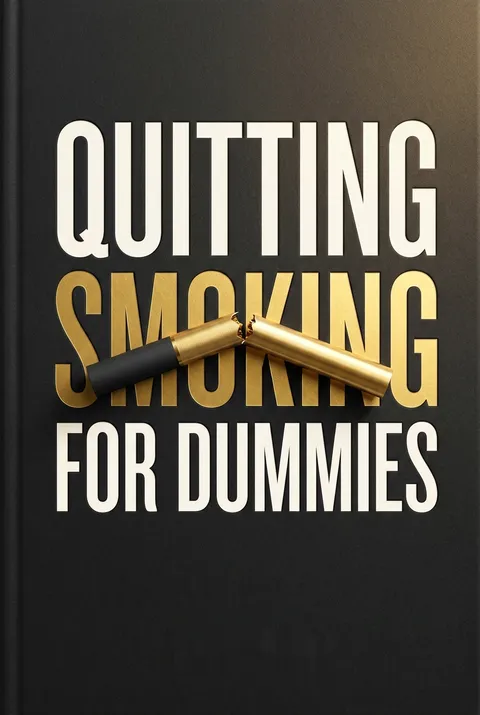
Quitting Smoking for Dummies is a practical health guide with a persuasive, personal voice. Its structure moves from understanding smoking and dependence, through choosing and planning a quit attempt, to maintaining abstinence and addressing particular circumstances. The organizing claim is that lasting change requires more than deciding to stop: people need to understand what smoking provides, anticipate withdrawal and triggers, prepare their environment, and recruit support. Stories, worksheets, and examples make this advice concrete. The author's account of quitting when his son was born gives the abstract case for change a human center.
The book's most useful synthesis is its refusal to make quitting a contest of willpower alone. It treats smoking as biological dependence, learned routine, social behavior, and mood management. That model naturally supports a plural strategy: medical guidance, nicotine replacement or other appropriate treatment, counseling, social support, and adjustments to daily routines. It also offers a constructive account of relapse, encouraging readers to resume rather than interpret a lapse as total failure.
The main limitation is historical. Published in 2003, the book includes treatment details and health statistics that should not be assumed current. The adaptation therefore preserves its broad behavioral lessons while directing readers to clinicians for current medical decisions. A second limitation is tonal. The author's vivid rhetoric can motivate, but appeals to guilt, shame, or heroic self-denial may alienate people already struggling. Dependence is not a moral defect, and motivation need not be built from self-reproach.
The most transferable lesson is consequently both practical and humane: treat quitting as a supported process. Learn the personal pattern, make a plan that fits the person, use qualified help when needed, and treat each smoke-free interval as meaningful progress. Success is not proved by never struggling. It is built by making the next workable choice, repeatedly, with the right tools and support.
Review Summary
Readers find Quitting Smoking For Dummies helpful despite its common information. The book's layout and writing style are praised for their effectiveness in supporting smoking cessation efforts. One reviewer credits the book for their two-week smoke-free period, while another mentions it keeping them on track for five days. Some criticism is directed at the extensive coverage of tobacco history and industry information. Overall, readers appreciate the book's practical approach and recommend it to those considering quitting smoking.
Glossary
Nicotine replacement therapy
Nicotine without tobacco smokeA treatment that supplies nicotine without requiring the person to smoke or use tobacco. The book describes forms such as patches, gum, lozenges, sprays, and inhalers. Their intended role is to reduce withdrawal while the person stops smoking, with use tapered according to product guidance and medical advice. This 2003 book's specific instructions should not replace current professional guidance.
conditioning
Learned cue and responseThe association formed when a behavior repeatedly occurs alongside a rewarding experience or situation. In the book's account, smoking can become linked with meals, coffee, socializing, or relief from anxiety. Once those pairings are learned, the associated setting or activity can itself prompt a desire to smoke, even before the person consciously decides to light up.
neuroadaptation
Brain adjustment to repeated exposureThe book's term for changes in the brain and nervous system after repeated exposure to a substance. In nicotine dependence, the adapted system can react when nicotine is withheld, contributing to withdrawal and renewed cravings. The concept helps explain why stopping can feel difficult even when a smoker understands the harms and sincerely wants to quit.
Principle of Drug Karma
Drug effects reboundThe author's label for the idea that a drug's immediate effects may be followed by an opposite-feeling rebound as the drug wears off. He applies this to nicotine's apparent stimulation or calming effect and the subsequent fatigue, agitation, or craving. It is the author's explanatory phrase, not a treatment protocol or a substitute for clinical assessment.
stinkin' thinkin'
Relapse-enabling thoughtsThe author's informal term for thoughts that excuse a return to smoking or undermine a quit attempt. Examples include believing that one cigarette cannot matter, that quitting can always begin tomorrow, or that a lapse makes further effort pointless. Identifying these thoughts allows a person to challenge them and return attention to the quit plan.
Download PDF
Download EPUB
.epub digital book format is ideal for reading ebooks on phones, tablets, and e-readers.








