

Plot Summary
A Captive Holds Fast
The story opens decades after Raavan’s childhood, with Samichi, a former Mithilan official now serving Lanka, and Khara, her lover and a Lankan officer, interrogating a captured Malayaputra. They need to locate Sita, her husband Ram, Ram’s brother Lakshman, and the soldiers protecting them.
Khara’s conventional torture has failed, so Samichi escalates it with a sickle, disregarding even Khara’s discomfort. Their prisoner’s resistance makes clear how much is at stake: the captors are trying to earn Raavan’s favor by finding the woman his enemies call the Vishnu. The narrative then turns back fifty-six years, to the boy whose choices will lead to this desperate hunt.
The opening places coercion before explanation. Samichi’s deliberate violation of the captive’s body establishes the ethical cost of Raavan’s power before readers know how he acquired it. The scene also makes loyalty unstable: Samichi is pursuing Sita not as a personal enemy, but as a route back into favor with her ruler. By withholding the history, the book makes the reader confront the machinery of violence first, then trace how a gifted child becomes its center.
The Hare and the Goddess
At four, Raavan pins a hare down to study its beating heart. The visiting Kanyakumari, a young girl revered as a living goddess, frees the animal and tells him through her example that he can become better. Her regard reaches a boy accustomed to disgust, especially from his father, the respected sage Vishrava.
Raavan soon cheats to win a veena contest, then confesses after the Kanyakumari’s influence makes him reconsider. Vishrava strikes him and exposes the deformity at his navel, branding him a Naga. Later, when a midwife tries to kill Raavan’s newborn Naga brother, Raavan threatens her with a sword and saves the child. He has found one person to protect, but his father’s rejection has made home unsafe.
The hare is not simply an emblem of innocence: it exposes Raavan’s habit of treating living beings as objects of knowledge and control. The Kanyakumari offers him a different mirror, one that neither condemns nor excuses him. His later defense of Kumbhakarna shows how quickly tenderness can take root when it is directed toward someone who shares his vulnerability. Yet the same scene also reveals the danger in Raavan’s emerging moral code: care for his own can coexist with a frightening ease around violence.
Exiles Find Their Sea
Raavan’s uncle Mareech helps Kaikesi and her sons escape Vishrava’s ashram, where the newborn Kumbhakarna was nearly killed for being a Naga. Mareech explains that Vishrava had ordered the infant’s death if he proved deformed. The family finds no shelter in Kannauj, where relatives disown them, so Raavan leads them east to Vaidyanath.
There, a temple ceremony gives him a rare experience of belonging across caste and status, but the physicians cannot cure Kumbhakarna. Raavan refuses a life of charitable dependence and moves the family to Chilika, where he begins as a dockworker and then a smuggler. His mother’s plea to Vishwamitra secures medicine for both boys, while the sage quietly sees Raavan as a useful future villain.
Exile turns Raavan’s intelligence from a source of prestige into an instrument of survival. His choice to leave the safety of Vaidyanath is not merely impatience; he cannot accept dependence as a permanent identity. The temple briefly suggests a society where difference need not dictate rank, but the family’s return to economic precarity shows how fragile that promise is. Vishwamitra’s decision to sustain Raavan while imagining him as a controllable antagonist adds another pressure: the boy’s life is being shaped by people who believe they understand his purpose better than he does.
The Price of Speed
As a teenage smuggler on Chilika, Raavan notices that Akampana’s neglected ship has a remarkably clean hull. He joins the older smuggler, repairs the vessel, and discovers that a rare Malayaputra material prevents marine growth and lets ships travel far faster than rivals.
Raavan buys the material from Vishwamitra and plans a fleet large enough to dominate trade. Kumbhakarna identifies Governor Krakachabahu’s hidden treasure as the way to finance it. With help from Prahast, Raavan’s men rob the governor’s palace, killing its household and guards.
During their escape, Raavan glimpses the former Kanyakumari among the laborers at a damaged wharf. He tries to turn back, but Kumbhakarna restrains him and promises to find her. The stolen wealth launches Raavan’s rise; the sight renews his private longing.
Raavan’s commercial genius is inseparable from his willingness to convert insight into force. A technical advantage becomes a business empire, and the capital comes from a robbery whose efficiency depends on treating other lives as expendable. His glimpse of the Kanyakumari interrupts that ruthless momentum, but it does not undo it. Instead, desire becomes one more force he tries to command, while Kumbhakarna becomes the person who can restrain him without severing their bond.
Vedavati Has a Name
Kumbhakarna returns to Kalinga and finds the former Kanyakumari living near Vaidyanath. Her name is Vedavati, and she is married to Prithvi, a struggling trader. Raavan travels there and watches her quietly before introducing himself under an alias.
He admires her work with the villagers and landlord Shochikesh, whose check dam depends on her ability to settle disputes. When Vedavati explains that a mother deer can risk herself to save her young, Raavan begins to see compassion as something more complex than weakness.
He gives the village supplies and cardamom, partly to stay near her, but she does not mistake generosity for devotion. Her pregnancy and her loyalty to Prithvi make clear that the life Raavan imagined with her is not hers to grant.
Vedavati’s authority comes from practical trust, not the sacred title she once held. She helps a village cooperate across class divisions by doing the patient work of mediation, while Raavan approaches her through the habits of acquisition: gifts, proximity, and the assumption that wealth can solve any obstacle. Her story of the deer unsettles his preference for the hunter’s perspective. The lesson is not that strength is wrong, but that strength becomes morally legible through what it protects.
A Gift with Conditions
When Raavan asks Vedavati to come to Lanka, she refuses to become the reason he reforms. She tells him that his purpose cannot depend on her presence and urges him to use his formidable abilities for people beyond his own circle.
Raavan kneels before her, accepts her blessing, and gives her a hundi for fifty thousand gold coins to fund public good in the region. For once, the gift is not a bargain for her affection. Shochikesh’s son Sukarman overhears the amount and steals the document to cover gambling debts.
Vedavati and Prithvi refuse to surrender it, even when Sukarman’s associates attack them. Their refusal costs them their lives, and their newborn disappears. Raavan’s first deliberate act of generosity is followed by a catastrophe he cannot control.
Vedavati identifies the danger in Raavan’s dependence more clearly than he does: if his ethical life rests on one beloved person, her absence could collapse it. The hundi marks a real shift because he gives without expecting access or gratitude. Yet the gift also exposes how easily benevolence can be intercepted by corrupt local power. Sukarman’s theft makes the consequences intimate and irreversible, turning Raavan’s attempt at moral change into a test he is not prepared to meet.
Todee Burns
Raavan and Kumbhakarna reach Todee to find Prithvi dead outside the house and Vedavati stabbed inside, her unborn child already delivered but missing. Sukarman and his accomplices are caught with the stolen hundi.
Raavan learns that Sukarman’s men attacked the couple when they would not give up the money; one of them abandoned the baby in the wild. In grief and fury, Raavan kills Shochikesh for failing to protect Vedavati, then orders his soldiers to slaughter the villagers.
He tortures the surviving attackers, while Kumbhakarna kills one of the men who admits what happened to the child. After the funeral, Raavan immerses Vedavati’s remains in the Ganga but keeps the bones of her fingers as a pendant. He rejects the land that failed her and vows to destroy it.
The tragedy reveals how Raavan’s capacity for care can be captured by possessive grief. He punishes the guilty, but then extends punishment to an entire village, confusing vengeance with justice. Kumbhakarna’s distress registers the moral rupture from inside their closest relationship: loyalty can no longer make the violence harmless. The finger bones preserve a tender contact, but they also become a relic around which Raavan can organize hatred. His rejection of the land converts private loss into a political cause.
Karachapa’s Broken Army
Raavan builds his private fleet and militia into Lanka’s chief source of power, then persuades ruler Kubaer to challenge the Sapt Sindhu’s trade commissions. He deliberately provokes Emperor Dashrath and strips the countryside around Karachapa of food, leaving the invading army vulnerable.
Dashrath’s pride drives him to attack along the narrow beach, where Raavan’s long spears, fort archers, and concealed amphibious ships trap the imperial forces in a pincer. Kumbhakarna leads the ships ashore while Raavan holds the landward line.
The Sapt Sindhu army is routed, though Dashrath survives. Raavan imposes punitive trade terms that enrich Lanka and weaken the empire. What he presents as a commercial victory is also a personal assault on the society he blames for Vedavati’s death.
Raavan wins by understanding that an army’s size can become a liability when its movement and supply are manipulated. The battle confirms his strategic brilliance, but its purpose is not reducible to profit: he uses policy to wound an entire political order. This fusion of private grievance and public power is crucial. It lets him describe vengeance as governance, while the scale of the treaty ensures that ordinary traders and households pay for a crime they did not commit.
The Golden Cage
As Raavan takes the Lankan throne and expands control over Indian Ocean trade, Lanka grows rich while the Sapt Sindhu is drained by taxes. Raavan permits the destruction of Mumbadevi’s community when its people refuse his harsh customs duties, then punishes the soldiers who desert rather than the commander responsible.
Kumbhakarna, increasingly troubled by his brother’s rule, meets M’Bakur, a Vayuputra priest who urges him to direct charity toward the poor and help save Raavan’s soul. Kumbhakarna secures funding for a free hospital in Vaidyanath, despite Raavan’s resistance.
Meanwhile, a mysterious plague weakens Lanka, especially its children, and Kumbhakarna’s health remains fragile. Raavan’s wealth grows, but his brother’s efforts to preserve a moral purpose reveal how little that wealth can repair.
The section contrasts two forms of responsibility. Raavan treats order as control and judges success by the reach of his power; Kumbhakarna learns to measure duty by its effect on vulnerable people. M’Bakur’s counsel does not absolve Raavan or endorse suffering as a simple necessity. It gives Kumbhakarna a task within an imperfect world. The plague sharpens the irony: a kingdom can provide material abundance and still fail to protect its people from bodily fragility.
The Bow at Mithila
Invited to Princess Sita’s swayamvar, Raavan hopes that winning her hand will force the Sapt Sindhu to recognize his greatness. In Mithila, he discovers that the event is governed by Vishwamitra and that Ram, the young prince of Ayodhya, is to compete before him.
Raavan interrupts the ceremony, strings Lord Rudra’s bow, and fires at the statue of Mithila’s founder when the assembly refuses to yield. After Ram wins Sita, Raavan attempts to take the city. His siege weapons kill defenders, but Sita’s Bees Quarter lets Mithilans fire from protected windows.
Raavan ignores a warning about the Asuraastra until Ram triggers it. Kumbhakarna shields Raavan from the blast and survives with lasting injury. The Malayaputras release the captured soldiers only after Raavan swears not to attack the Sapt Sindhu.
Mithila defeats Raavan first through restraint and then through design. His expectation that prestige must command obedience makes him interpret procedure as humiliation, and that misreading escalates into a costly siege. Sita’s architecture turns social inclusion into military protection: the poor residents who were given homes become defenders of the city. Kumbhakarna’s sacrifice exposes the emotional asymmetry of their bond, since Raavan’s ambition repeatedly places the brother who loves him in danger.
The Captive Vishnu
Thirteen years after Mithila, Raavan learns that the Malayaputras have chosen Sita as the next Vishnu and decides to seize her for leverage, hoping to secure medicines and punish his old enemies. Vibhishan and Shurpanakha first attempt the kidnapping, but Sita captures them and Lakshman injures Shurpanakha’s nose.
Raavan uses the insult as cover for a second raid. Samichi locates the exiles, and the Lankans overwhelm their camp while Ram and Lakshman are away. Sita fights fiercely, but surrenders when Khara threatens Jatayu; she kills Khara when he begins stabbing the captive.
Once she is aboard the Pushpak, Raavan recognizes Vedavati’s face in hers. Vishwamitra confirms that Sita is Vedavati’s daughter, while Vashishtha sees the kidnapping as the beginning of war.
The final recognition collapses Raavan’s political scheme into the personal history he has never escaped. He intended to use Sita as leverage over the Malayaputras, but her resemblance to Vedavati makes the captive impossible to treat as an abstraction. The two competing sages interpret the same event through their rival missions, while Kumbhakarna’s restraint remains the fragile counterweight to Raavan’s impulse. The book closes not with resolution, but with a war set in motion by the very grief Raavan once tried to turn into purpose.
Analysis
Raavan’s story is built around a distinction between the person he wants to become and the explanations he uses to avoid becoming him. His childhood gives him real reasons to distrust the social order: his father rejects him for being a Naga, his family is driven from its home, and the vulnerable are routinely treated as disposable. Yet those injuries do not dictate one inevitable response. Vedavati shows him that strength can protect, while Raavan repeatedly turns strength into ownership, whether of a ship, a kingdom, or the future he imagines for himself.
The novel’s political conflicts echo this personal pattern. Trade restrictions impoverish communities, and Raavan initially exploits the resulting resentment with genuine strategic insight. But his victory over Dashrath does not repair the system; it replaces one extraction with another. Lanka’s prosperity rests on the impoverishment of the Sapt Sindhu, while its public goods coexist with state violence. The tension between prosperity and justice is not resolved by wealth alone, because Raavan’s rule cannot distinguish a population’s welfare from his own dominance.
Kumbhakarna offers the story’s clearest alternative to Raavan’s logic. He remains loyal without treating loyalty as permission to approve every act. His work to fund a hospital is modest beside an empire, but it directly addresses suffering rather than using suffering as justification for conquest. The brothers’ bond makes this ethical conflict intimate: Kumbhakarna’s love repeatedly preserves Raavan, while also placing limits on what Raavan can do without protest. The ending binds the political plot back to private grief. Raavan’s attempt to capture Sita for leverage becomes more dangerous when he recognizes Vedavati in her face. His old love may restrain him, but it cannot undo the violence already set in motion. The novel closes on this unresolved contradiction: the man who once wanted to earn Vedavati’s respect now holds her daughter captive, with rival visions of India gathering for war.
Review Summary
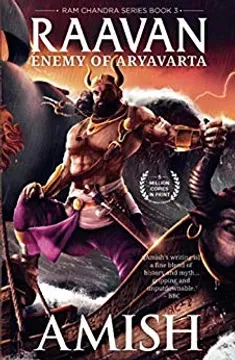
Raavan: Enemy of Aryavarta receives mixed reviews. Many praise Amish's character development, especially of Raavan and Kumbhakarna, and the engaging plot. Readers appreciate the fresh perspective on Raavan's backstory and the book's fast-paced narrative. However, some criticize the departure from traditional mythology and find certain plot elements repetitive or melodramatic. Despite these criticisms, many consider it the strongest entry in the Ram Chandra series, praising its exploration of complex themes and the twist ending.
Characters
Raavan
Brilliant wounded kingA gifted Naga child rejected by his father, Raavan grows into a strategist, trader, musician, and formidable ruler. He is driven by hunger for recognition as much as by a fierce desire to protect the family that remained loyal to him. His extraordinary discipline in business and battle sits beside a volatile appetite for domination, and he often mistakes control for safety. The memory of a young living goddess becomes a private standard against which he measures himself, though he is tempted to make that standard serve his own wants. Raavan’s central conflict is not ignorance of morality, but whether he can govern his violent capacities instead of letting old injuries dictate what he calls justice.
Kumbhakarna
Loyal brother, moral anchorRaavan’s younger brother is a Naga with visible deformities, a large frame, and a gentle temperament. His survival depends on medicines, and his early life teaches him how casually society can condemn the vulnerable. Kumbhakarna admires Raavan’s courage and intelligence, but unlike his brother, he remains alert to the human cost of their choices. His humor softens tense moments, while his patience lets him challenge Raavan without abandoning him. He is not simply a conscience who says no: he seeks practical ways to direct wealth toward care, and struggles to reconcile love for his brother with loyalty to a wider sense of duty.
Vedavati
Village healer and guideOnce revered as a living Kanyakumari, Vedavati builds a quieter authority after leaving that role. In Todee she helps villagers and their landlord cooperate, mediates disputes, and gives practical care rather than relying on the reverence once attached to her title. Her moral intelligence is concrete: she asks what an action protects, what desire motivates it, and whether a person can stand without leaning on another’s approval. She sees Raavan’s capacity for greatness without confusing capacity with virtue. Her warmth is paired with firm boundaries, especially when Raavan tries to make her responsible for his transformation.
Sita
Warrior princess of MithilaPrincess and prime minister of Mithila, Sita is a capable fighter and an administrator attentive to people with little political power. She protects the poor by improving their living conditions, and the Bees Quarter reflects her instinct for practical, inventive solutions. Her authority comes not only from rank but from the trust she earns among citizens and allies. As a warrior, she can act decisively under pressure; as a ruler, she understands that safety and dignity must be designed into ordinary life. Her public responsibilities and personal attachments place her at the meeting point of political conflict and intimate loyalty.
Ram
Exiled Ayodhyan princeThe eldest son of Dashrath, Ram is an exiled prince whose decisions carry consequences beyond his own household. His marriage to Sita binds him to Mithila, while his status as Ayodhya’s heir makes threats against him politically dangerous. He is trained in arms and guided by Vishwamitra, but his choices are constrained by laws governing the use of divine weapons. Ram’s sense of responsibility can require him to accept personal cost, placing him in tension with Raavan’s belief that power should remain unconstrained.
Vishwamitra
Strategist of the MalayaputrasChief of the Malayaputras, Vishwamitra is a formidable sage who combines spiritual authority with political calculation. He believes India needs a new hero and is willing to shape events toward that end, including using Raavan’s ambition as part of a larger design. His confidence in long-range planning can make individuals seem like instruments of history. He also recognizes that a mission pursued for public good may still require morally difficult choices, a conviction that puts him at odds with Vashishtha.
Vashishtha
Ayodhya’s royal sageVashishtha advises Ayodhya’s royal family and is closely connected to the Vayuputras. A thinker and spiritual authority, he opposes Vishwamitra’s methods and holds a different view of who should guide India’s future. Their old friendship has hardened into a long rivalry, but Vashishtha’s concern is not merely personal: he fears the consequences of a plan built around manipulating Raavan and the kingdoms around him.
Kaikesi
Mother in exileRaavan and Kumbhakarna’s mother, Kaikesi, faces the stigma attached to her sons’ Naga bodies and fights to keep them alive. Her dependence on Vishwamitra’s medicines forces her to negotiate with people who hold power over her family. She is loving and resilient, though she can be emotionally demanding and her relationship with Raavan becomes strained as he turns wealth into a substitute for closeness. Her later care for her younger children also reflects a belief in family responsibility that Raavan does not share.
Mareech
Warrior uncle and adviserKaikesi’s brother, Mareech becomes protector and practical guide to the family after Vishrava’s household rejects them. A trained warrior, he helps the children escape and teaches them the necessities of survival. As Raavan grows into a powerful trader, Mareech supports the enterprise and helps manage its expansion. His loyalty is steady, but he is often required to adapt to the scale and severity of his nephew’s ambitions.
Samichi
Lankan officer and spyA former servant of Sita who rises to a position of authority in Mithila, Samichi is disciplined, guarded, and shaped by early abuse. Her bond with the Lankan officer Khara complicates her divided loyalties. She values survival and usefulness, and she understands how information can become power. Her choices make her a pivotal link between Mithila’s political world and Raavan’s operations.
Indrajit
Raavan’s ambitious sonRaavan’s son and heir, Indrajit is physically imposing, disciplined, and proud of the expectations attached to his name. He admires his father but is willing to question a plan he considers foolish, showing a sharper independence than Raavan expects from his followers. His affection for Kumbhakarna also gives him a connection to the gentler side of the family.
Mandodari
Raavan’s wifeMandodari is the pious daughter of a minor noble and Raavan’s wife. Her values and temperament stand apart from the excesses of Lanka’s court, and her marriage places her close to a man whose motives are often more political than intimate. She is a reminder that Raavan’s power reaches into private lives, not only kingdoms and trade.
Kubaer
Lanka’s trader-rulerKubaer is a wealthy and shrewd trader who rules Lanka through negotiation, careful accounting, and an instinct for profit. Others mistake his elaborate tastes and physical softness for weakness, but he understands commercial power well. His caution contrasts with Raavan’s appetite for risk and confrontation, even as the two men’s interests briefly align.
Dashrath
Emperor of the Sapt SindhuThe powerful emperor of the Sapt Sindhu, Dashrath has built his reputation through military victories and expects deference from subordinate rulers. His confidence can become a liability when pride overrides strategic judgment. As Ram’s father, he connects the private lives of the Ayodhyan princes to the wider political consequences of Raavan’s campaigns.
Prithvi
Vedavati’s steadfast husbandA businessman from Balochistan, Prithvi settles near Vaidyanath and struggles with debt after his enterprise fails. He is honest and devoted to Vedavati, valuing a modest life over Raavan’s offer of wealth and advancement. His decency quietly challenges Raavan’s assumption that money and power are the strongest measures of a man.
Vibhishan
Raavan’s cautious half-brotherRaavan’s half-brother is polished, deferential, and eager to prove his usefulness. He favors indirect plans that keep blame away from Lanka, but his judgment does not always match his confidence.
Shurpanakha
Raavan’s bold half-sisterRaavan’s half-sister is beautiful, self-assured, and accustomed to using other people’s assumptions to her advantage. Her confidence can make her underestimate the danger of the schemes she accepts.
Jatayu
Malayaputra captainA Naga captain among Sita’s protectors, Jatayu is a loyal friend who places the safety of others before his own. His courage makes him a trusted ally to Ram and Sita.
M’Bakur
Vayuputra priest and mentorA former warrior turned priest in Damat, M’Bakur speaks with patience and philosophical wit. He helps Kumbhakarna think about responsibility as a practical duty to the poor, rather than as a contest over who is perfectly right.
Plot Devices
Naga medicine
Life tied to treatmentRaavan and Kumbhakarna’s congenital deformities mark them as Nagas in a society that treats such bodies as cursed. Kumbhakarna’s bleeding and pain are dangerous, and Vishwamitra provides medicines that keep both brothers alive. This medical dependence also gives the Malayaputras leverage over Raavan, shaping his business deals, his restraint after defeat, and later his attempt to seize Sita. The medicine turns bodily vulnerability into political pressure, while making the brothers’ survival depend on an authority they do not fully trust.
Cave material
A fleet’s hidden advantageThe rare material from the Malayaputras prevents marine growth on ship hulls when mixed with oil and applied carefully. Raavan discovers its commercial value after noticing the unusual condition of Akampana’s vessel. He uses it to build a fleet faster than rivals can match, then conceals its true use by claiming he needs it for the Pushpak Vimaan. The substance links his rise from smuggler to imperial power with the Malayaputras’ own secret resources.
Vedavati’s finger bones
Grief made into a relicAfter Vedavati’s cremation, Raavan finds the bones of two fingers intact among the remains and keeps them as a pendant. The relic preserves the memory of the one time she held his hand, giving him a private source of comfort and a reminder of the person he hoped to become. Over time, the pendant also binds his grief to his political choices, making it both a token of love and a focus for vengeance.
The Asuraastra
A siege-breaking weaponThe Asuraastra is a devastating weapon that incapacitates through a blast, a green flash, and toxic gas. Its use is restricted under Lord Rudra’s laws, making the threat of firing it both a military danger and a political violation. In the siege of Mithila, Ram triggers the missile to protect the city. Kumbhakarna shields Raavan from the blast, and the weapon leaves him with lasting health problems. Its consequences force Raavan to accept a vow against attacking the Sapt Sindhu.
The Bees Quarter
Housing becomes a defenseSita replaces Mithila’s slums beside the inner fort wall with a four-story honeycomb housing complex. The design gives poor residents secure homes but also creates protected openings onto the killing ground between the city’s walls. During Raavan’s siege, Mithilan defenders fire arrows from these windows, turning Sita’s social improvement project into an unexpected military advantage. The quarter makes the connection between civic design and defense tangible: a city’s poorest residents are not obstacles to its safety, but part of its strength.
Ram Chandra Series
About the Author
Other books by Amish Tripathi





Download PDF
Download EPUB
.epub digital book format is ideal for reading ebooks on phones, tablets, and e-readers.








