

Key Takeaways
Make inclusion a repeated practice, not a polished statement of values.
Exclusion crosses status. Queen Elizabeth II could not deliver a parliamentary speech because of mobility issues, while Harvard professor Henry Louis Gates Jr. was arrested after a neighbor mistook him for a burglar. Rank and achievement did not shield either from exclusion. Sengeh’s own experiences as a Black Sierra Leonean abroad, and as an outsider in his own government, lead him to a practical claim: exclusion can touch anyone, but some people face it more often and with greater consequences.
Make room for difference. Radical inclusion means deliberately and persistently removing barriers that keep people out, including barriers maintained by silence or routine. It does not ask people to become alike. It asks communities to make participation possible because people bring different needs and perspectives. A wheelchair ramp, for example, helps wheelchair users and parents with strollers.
The book’s opening move turns inclusion from a feel-good organizational value into a test of how spaces actually function. That distinction resembles universal design: an accommodation built for people facing a specific barrier can improve access for many others. Yet broad language about everyone experiencing exclusion should not blur unequal exposure. A missed invitation is not equivalent to a discriminatory law or a pattern of racial profiling. The useful question is not simply whether exclusion is universal, but whose exclusion is repeated, institutionalized, and costly.
Name the exclusion, then find the people it makes invisible.
Look beyond intention. As a boy in Bo, Sengeh joined neighborhood football games where his friends chose teams by skill. Their friend Bakarr, whose leg was partly paralyzed by polio, stood watching, and the group did not even notice how thoroughly it excluded him. A new boy eventually invited Bakarr to play. He made strong saves, and the group began choosing him alongside everyone else. The exclusion had not required hatred. It survived because no one questioned the game’s unwritten rules.
Make the pattern visible. Sengeh applies the same scrutiny to schools: who is absent, and what rule, design, habit, or assumption keeps them away? Girls had been outside his childhood football group altogether. Naming who is missing makes an invisible practice discussable, and gives affected people a chance to describe what the barrier means in their lives.
Bakarr’s story shows why benevolent intent is a poor measure of fairness. A group can like someone and still deny them participation because its routines were built around an assumed norm. This is a useful lens for meetings, classrooms, hiring, and public services: examine who is missing before interpreting silence as lack of interest. The story also contains a caution. A single successful invitation does not establish that every activity is accessible. Inclusion may require changes to the rules or environment, not only a more generous invitation.
Listen for lived realities, not just the arguments already in circulation.
Stories reveal what slogans hide. At a meeting in Bombali, school principal Gloria described becoming pregnant at fifteen, losing family support, and finding refuge in a home that helped her return to school. Her account shifted colleagues who had opposed policy change. It also showed Sengeh that the issue reached beyond classrooms to families and communities. Listening to girls affected by the ban complicated his own assumptions: Aminata wanted to continue her education, but said morning sickness made attending class difficult. She was also barred from taking an exam.
Listen without endorsing harm. A young father, Joe, described how his girlfriend left school to care for their baby and said he wished he could give her his place. Sengeh argues that excluding boys as well would multiply the injustice. Listening means making room for difficult perspectives, not allowing victim-blaming to go unchallenged.
These accounts do more than make a policy emotionally legible. They expose different mechanisms of exclusion: lost exams, stigma, family pressure, physical discomfort, and the transfer of care work to young mothers. That variation matters because a policy designed from a single, imagined experience can miss the real needs of the people it is meant to serve. Personal testimony is not a substitute for representative evidence, however. Its strongest use is alongside reliable data, with affected people shaping the questions and the response.
Ask why you, why now, and who else should lead.
Connect purpose to responsibility. Sengeh traces his commitment to education and public service through relatives who taught, worked in government, and helped others even when they could not pay. His biomedical engineering work on prostheses also taught him to involve patients in designing solutions. When he became Sierra Leone’s education minister, his authority gave him a specific opportunity to challenge the ban on pregnant students. The question was not only whether the cause mattered, but whether his role and the moment offered leverage.
Make a shared case. The book draws on Marshall Ganz’s public narrative framework: a story of self explains why someone acts, a story of us builds shared purpose, and a story of now explains urgency. Sengeh also asks who should take the lead. Paul Farmer’s community-based health work showed him that outside experts should build local capacity, then make room for local people to carry the work.
This framing usefully separates moral concern from strategic responsibility. Many people care about an injustice; fewer identify the authority, relationships, and timing that let them act effectively. The added question, who other than me, guards against a familiar failure of advocacy: treating marginalized communities as beneficiaries rather than decision-makers. A personal story can earn attention, but it can also make a campaign revolve around its most powerful spokesperson. The test is whether the story enlarges collective agency, rather than substituting for it.
Build a coalition around shared stakes, not identical beliefs.
Expect allies in surprising places. Sengeh assumed his education ministry colleagues would support his position. Instead, many opposed allowing pregnant girls into school, including his assistant Grace. Grace’s own family history had shaped her view; conversations with her mother and sister eventually changed her mind. The episode taught Sengeh not to confuse closeness or shared values with agreement.
Give people useful roles. Presidential adviser Patrick Muana helped map the people and institutions needed to change the policy. The effort included family members, civil servants, educators, religious leaders, civil society, media, and development partners. International organizations had advocated for change, but their prominence could make the campaign seem externally imposed. Sengeh asked them to support the work without leading it. A task force brought stakeholders together to research the issue and develop a policy position.
Coalitions are stronger when they are designed around complementary capacities, not treated as clubs for people who already agree. One person may supply public legitimacy, another technical evidence, and another access to a resistant community. The decision to let local institutions lead also addresses a real political problem: even a sound reform can lose trust if it appears dictated from outside. Still, coalition-building can create pressure to soften disagreement for the sake of unity. Clear roles and shared commitments help prevent collaboration from erasing the people most affected.
Meet opponents’ fears with evidence before asking them to act.
Prepare for the decision room. The ban had been publicly supported by President Bio, and many cabinet members worried that reversing it would damage the government or conflict with religion and culture. Sengeh obtained the president’s permission to bring his proposal directly to cabinet, then prepared for the objections he had heard in public meetings and private conversations. He presented the regional court’s finding that the ban violated girls’ rights, along with evidence and accounts from affected students, educators, and families.
Make action safer to choose. Sengeh argued that changing the policy could demonstrate responsive leadership, not weakness. He addressed concerns about child protection by pointing to risks girls faced outside school, and challenged the idea that religious or cultural tradition settled the question. After a lengthy debate, the cabinet approved lifting the ban and developing a broader inclusion and school safety policy.
The cabinet debate illustrates that resistance often contains both principle and self-protection. People may fear political fallout, public criticism, or consequences they cannot predict. Addressing those concerns can move a decision without pretending they are more important than the rights at stake. The method is especially powerful when it combines evidence, local testimony, and a credible path to implementation. It also has limits: not every objection is a misunderstanding, and persuasion cannot replace accountability when decision-makers knowingly preserve harmful rules.
A policy opens the door; support makes return possible.
Change the conditions, too. After the ban was lifted, some girls still stayed away because they feared bullying, lacked family support, or needed time to give birth and recover. Deputy minister Emily Gogra visited families and learned that a school’s claim that girls had chosen to miss exams did not tell the whole story. The girls’ parents were worried about how schools would treat them. A legal change had removed one barrier, not every obstacle.
Build practical support. The ministry developed plans to support pregnant students and parent learners, while the organization Girls Plus followed up with registered girls and connected them with local help. Some schools created places for young mothers to breastfeed, and staff helped care for babies while mothers studied. These efforts remained stretched. The point is not that a policy automatically transforms a school, but that implementation needs resources, monitoring, and support for the people expected to make the change real.
A formal right is meaningful only when people can use it without intolerable cost. This is a familiar gap in public policy: rules change faster than staffing, infrastructure, social norms, and frontline practice. The examples here make implementation concrete, from childcare to family engagement. They also show why monitoring should ask more than whether a policy exists. Who returned? Who remained absent, and why? A persistent risk is that care work falls to underfunded organizations or individual teachers. Durable inclusion requires assigning responsibility and resources, not relying on goodwill alone.
People near the boundary can translate between exclusion and belonging.
Some people occupy both sides. While working at IBM, Sengeh helped develop a dataset of African faces for research on emotion recognition. He had seen systems fail to recognize his own smile, and Joy Buolamwini’s work had highlighted how Black faces were underrepresented in such datasets. A colleague, Purity, recognized that she was both a Black woman affected by the technology and a scientist helping build it. Sengeh calls this shifting position the inclusion-exclusion boundary.
Use the position to bridge. People who know an institution from the inside and experience its exclusions themselves may be able to explain the gap to both sides. In schools, teachers who supported pregnant students could help colleagues adapt. In the technology project, Purity and Sengeh helped connect researchers with the people whose faces and emotions the systems needed to recognize.
This idea resists a simple division between insiders who exclude and outsiders who are excluded. People can benefit from a system in one role and be harmed by it in another, giving them a distinctive view of its blind spots. That position can aid translation and design, but it can also impose extra emotional labor on those already affected. Institutions should value such knowledge without making individuals responsible for fixing structural failures on their own. The strongest bridge is backed by authority, resources, and changes to the system itself.
Keep checking who remains outside after the first reform succeeds.
Progress can retreat. Black Harvard students protested after campus police challenged their right to use a public space in 2007. Years later, reports described similar profiling. Sengeh uses the recurrence to show that a promise of reform is not proof that a practice has changed. The same vigilance matters for disability access and for pregnant students, whose formal right to attend school does not guarantee that they can do so safely.
Look for the next barrier. During COVID-19 school closures, Sierra Leone expanded radio lessons, sent solar-powered radios to remote students, and distributed printed materials where radio signals were unavailable. The response reached learners facing different access barriers. The book’s closing example is Aminata, who returned to school after giving birth and planned to sit her senior school exams. Her return signals progress, while the work of finding who is still missing continues.
The book treats reform as maintenance as much as achievement. That is a useful corrective to the public habit of celebrating a law, program, or headline and assuming the problem is solved. Recurrence demands feedback loops: measure who participates, investigate who does not, and make institutions answer for drift. The pandemic example shows how crisis can expose exclusions that routine systems overlook. Yet no single success story, including Aminata’s, can stand in for population-level evidence. Personal outcomes make progress visible; sustained measurement helps determine how widely it has spread.
Analysis
Radical Inclusion is both a memoir of public leadership and a practical account of policy change. Its central case is unusually specific: an education minister challenges a ban on visibly pregnant girls attending school, despite opposition from the president, colleagues, educators, religious figures, and many citizens. That specificity is a strength. The reader sees not only the moral claim, but the mechanics of changing minds and institutions: hearing affected students, responding to fears, preparing for cabinet, reshaping who leads the coalition, and supporting implementation after a vote.
The book’s deepest insight is that exclusion is often maintained by ordinary routines and by people who do not think of themselves as excluding anyone. The football story about Bakarr captures this clearly: a friend can be welcomed socially yet denied a meaningful role. The same distinction scales up to policy, where good intentions cannot repair rules that close access. The book also avoids treating inclusion as a one-time admission. A girl may gain the right to attend and still face stigma, family pressure, health needs, or a school environment that pushes her out.
The seven-part approach is best read as a flexible cycle rather than a formula. Naming the barrier and listening to affected people improve diagnosis; mapping roles and building a coalition create leverage; action changes formal rules; implementation and vigilance determine whether access lasts. The sequence can vary, but none of the functions can safely be skipped.
The account has limits that sharpen, rather than erase, its lessons. Its political success depended on Sengeh’s unusual access to cabinet and the president, resources unavailable to many advocates. Persuasion is valuable, but some exclusions require legal remedies, enforcement, and material investment even when public opinion remains hostile. The narrative itself demonstrates that point: the repeal did not end bullying or make support adequate. Its most transferable message is therefore not that patient dialogue always wins, but that durable change combines listening and persuasion with power, implementation, and continuing scrutiny of who still cannot participate.
People Also Read



Glossary
Radical inclusion
Persistent removal of exclusionA commitment to intentionally and persistently remove barriers that exclude people from education or other shared settings. The idea includes barriers created by policies, infrastructure, social practices, and inaction. It treats inclusion as continuing work toward greater justice, rather than a final condition reached once a group is admitted.
Seven Principles of Radical Inclusion
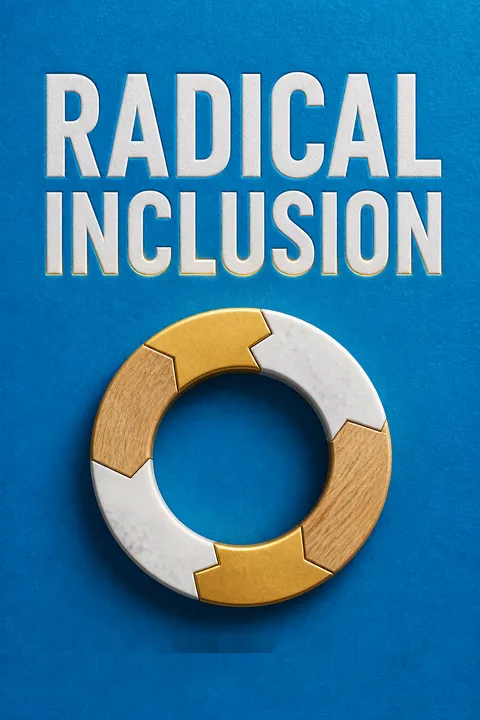
A cycle for social changeThe book’s practical framework for addressing exclusion: identify and name the barrier, listen to understand its effects, clarify one’s role and timing, build a coalition, take sustained action, support people through the resulting change, and look for the next exclusion. The principles are connected but need not be followed in a rigid sequence.
public narrative
Stories that motivate collective actionA framework associated in the book with organizer Marshall Ganz. It connects a story of self, which explains a person’s motivation; a story of us, which builds shared identity and purpose; and a story of now, which explains why action is urgent. Together, these stories can help people understand a cause and see a role for themselves in it.
anatomy of actions
A path from listening to actionA leadership technique Sengeh learned from his coach, Bill Carrier. It begins by listening for what people genuinely care about, then uses conversation to establish commitments to actions and outcomes. Its purpose is to make collaboration explicit, so participants understand what they are working toward and what they have agreed to do.
inclusion-exclusion boundary
A shifting position between rolesSengeh’s description of the changing position people can occupy within systems of inclusion. Someone may be included in one role while excluded in another, or may help create a system that disadvantages a group they also belong to. This position can provide insight into institutional blind spots and help connect affected people with decision-makers.
Equity
The goal of fair opportunityIn the book’s distinction, equity is the condition in which people have fair opportunity to be present, participate, be recognized, and be themselves. Inclusion is the ongoing process used to move toward that condition. Equity is therefore an aim, while inclusion describes the work required to approach it.
Download PDF
Download EPUB
.epub digital book format is ideal for reading ebooks on phones, tablets, and e-readers.








