

Plot Summary
The Blood Mark
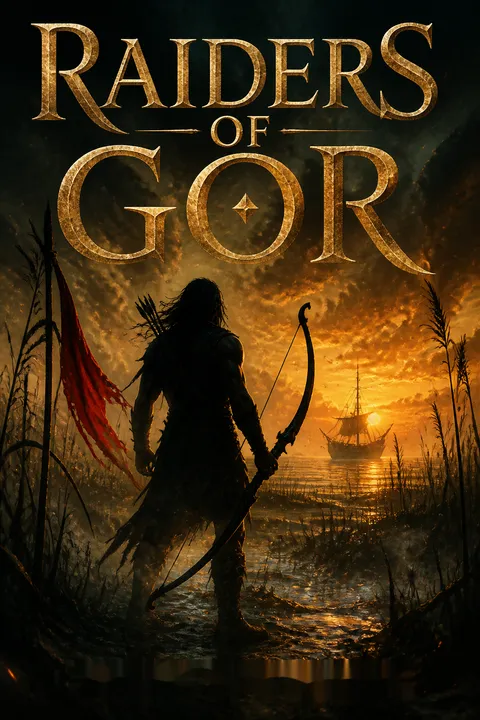
Tarl Cabot, a warrior serving the Priest-Kings, travels through the Vosk delta toward Port Kar to contact its powerful slaver, Samos. He leaves the river barges behind and paddles alone through a maze of reeds, carrying a longbow that Gorean warriors scorn as a peasant weapon. White cloth tied to rence plants first looks like trail marking; a red strip makes its meaning plain: he has crossed a boundary and is unwelcome.
Tarl continues toward the city anyway. Soon marsh-gant calls follow him through the sedge, and a rence girl appears ahead, hunting birds. She studies the armed stranger, decides he is an outlaw bound for Port Kar, and gives a signal. Dozens of rence growers close around his craft and take him prisoner.
The opening makes Tarl's danger a consequence of his purpose, not a random mishap: he needs Port Kar, so he crosses a line whose local meaning he fails to respect. His longbow quietly establishes a conflict between inherited status and practical skill. The rence growers' bird calls turn the landscape into a communication system Tarl cannot read, reversing the usual advantage of the trained warrior. Even before his capture, he is already an outsider twice over, a city-born fighter entering a community that mistrusts Port Kar and a bowman using a weapon his caste dismisses.
A Warrior Begs to Live
On the rence island, Ho-Hak, an escaped galley slave who leads the growers, questions Tarl while the girl who captured him urges punishment. Ho-Hak recognizes the longbow's power, strings it himself, and imagines the growers using similar weapons to resist Port Kar's collectors. The discussion ends when Tarl must choose between being thrown alive to marsh tharlarion or accepting slavery.
Afraid to die, he begs to live. Ho-Hak's disappointment cuts deeper than the bindings: Tarl believes he has betrayed his warrior code and shamed his city. The girl claims him, feeds him by hand, calls him Bosk, and makes him a laboring slave. She says he will be displayed as a festival prize, while Tarl's pride collapses into self-contempt.
Tarl experiences survival not as relief but as evidence against his own heroic self-image. Ho-Hak's judgment matters because he too has endured enslavement, yet refuses to confuse physical captivity with moral surrender. Tarl's choice exposes the gap between an idealized code and the body that fears death. The name Bosk turns that private crisis into a public identity: he is renamed as livestock and made to perform the role he believes he deserves. The scene does not prove that courage is meaningless. It shows how quickly a person can mistake one frightened decision for the whole truth of himself.
Festival Beneath the Nets
Telima works her new slave through long days of rence cutting, collars him with marsh vine, and uses his desire for her to deepen his humiliation. At the festival, she ties him to a pole while the girls inspect him as a prize; later, their courtship dance becomes a spectacle of taunting and display.
Tarl's submission briefly gives way to defiance, but the celebration is shattered when armed men from Port Kar attack the joined islands. Their nets, crossbows, and torches overwhelm the growers. Henrak, a rence headman, directs the raiders, while Ho-Hak fights until the slavers capture him. Tarl pulls Telima through the chaos, then hides with her on a raft beneath reeds as the islands burn and prisoners are loaded onto barges.
The festival first gathers the scattered islands into a rare public community, then makes that gathering easy for the raiders to exploit. Its courtship rituals and Tarl's display as a slave reveal how social customs can be both sustaining and coercive, depending on who controls the scene. Telima's treatment of Tarl is cruel, but the attack abruptly reverses their positions: the woman who held power is now hunted, and the man she shamed becomes her protector. The fire consumes more than huts and stores. It destroys the small world in which their roles seemed fixed, forcing both characters into choices that cannot be managed through performance.
The Bow Turns Back
At dawn, Tarl finds the bodies left behind, including Eechius, the boy who had secretly given him food while he was bound at the festival pole. That small kindness changes his purpose. He retrieves his weapons, and Telima builds a sturdy rence craft while he prepares the longbow.
Together they shadow the six overloaded slaver barges, killing helmsmen and officers and using marsh-gant calls to keep the raiders uncertain about how many attackers surround them. In the night, Tarl turns their confusion into a fight aboard the linked vessels.
By morning the surviving raiders have fled in a punt, leaving the barges under his control. He frees two galley slaves, Thurnock and Clitus, and discovers Ho-Hak among the prisoners. He takes the captured girls, and Telima chooses to join them.
Eechius's gift gives Tarl a motive that is neither abstract honor nor self-preservation: he acts because one child treated him as human when others treated him as property. His response is still violent, and the narrative does not make revenge morally clean. Instead, Tarl's emerging authority is measured by what he does with victory. He frees the chained rowers and refuses to leave Ho-Hak behind, yet repeats the coercive structure of the raid by claiming women as captives. His behavior is a genuine turn, but not a completed transformation. The longbow becomes the instrument through which he can act, while his choices remain compromised.
Surbus Sees the Sea
Bosk and his companions reach Port Kar through guarded canal gates, bringing the rence girls as captives. In a waterfront paga tavern, he watches the pirate captain Surbus terrorize the serving women. When one girl begs Bosk for protection, he refuses, telling himself that her danger is not his concern.
Later, Surbus decides to kill that same slave and pays the tavern keeper for her destruction. Bosk intervenes, kills Surbus in a brief sword fight, and frees the girl, Luma.
Before dawn, he carries the dying Surbus to a rooftop so the pirate can see the sea once more. Luma identifies his last gesture as gratitude. Surbus's men, led by his second-in-command Tab, accept Bosk as their captain, giving him ships, a fortified holding, and a place in Port Kar's brutal politics.
Bosk's first refusal matters as much as his later intervention. He initially imitates Port Kar's indifference, then finds that he cannot sustain it when a particular victim is placed before him again. His mercy is not detached from the city's violence: he kills Surbus and inherits the dead man's power. The rooftop scene complicates Bosk's easy division between monsters and himself. Surbus has been cruel, yet his final attachment to the sea is unmistakably human. Luma's reading of that moment forces Bosk to acknowledge a feeling he had dismissed. The city grants him authority through violence, but its inhabitants also reveal forms of tenderness that his new cynicism cannot explain away.
The Council Under Fire
Bosk takes Surbus's seven ships and earns a seat on Port Kar's Council of Captains, the merchant-pirate body that shares power with five rival Ubars. He builds his household around commerce, using Luma's sharp accounting to grow his wealth, while Thurnock and Clitus become trusted officers. At a council meeting, Henrak announces that the arsenal is burning.
The fire proves to be part of an attack by forces loyal to Henrius Sevarius and his regent, Claudius. As the other captains flee the chamber, Bosk barricades the entrance with furniture and helps drive off the attackers. The council survives, and the attempted coup weakens the Ubars. Samos arrives afterward, but denies sending the note that had seemed to invite Bosk to meet him.
Bosk's rise is built from the skills he once regarded as secondary: attention to trade, an ability to assess people, and the practical strength to organize a defense. The coup makes political legitimacy a physical problem. Whoever controls the council chamber, arsenal, and ships can claim to govern, while the five Ubars' divided authority leaves the city vulnerable. Bosk's leadership is effective but self-interested; he wants a stable city in which his own ventures can prosper. Samos's denied message keeps the larger Priest-King mission at a distance. The moment establishes that Bosk can defend collective institutions without yet believing in them for their own sake.
The Boy in the Sack
Two nights after the coup, Bosk's watch catches Lysias and Henrak carrying a tied sack from Henrius Sevarius's besieged holding. They throw it into a canal where the urts feed. Bosk dives after it, fights off an attacking urt, and pulls out a bound, gagged boy.
He hides the youth in his household rather than hand him to the council, which would likely torture or kill him. Bosk calls him Fish and has him branded and collared as a slave, preserving the disguise while keeping him close.
Fish resists kitchen labor and asks to learn weapons. Bosk permits daily training only if the boy improves his work, and Fish accepts both the punishment and the condition. He conceals his birth name, Henrius, even as he begins to develop the bearing of a leader.
The rescue turns Bosk's earlier violence against the slavers into a test of whether he can protect someone without converting protection into ownership. He saves Henrius, then makes the boy a slave to keep him hidden, reproducing the very system that has injured both of them. Fish's insistence on weapons is an effort to preserve an inner identity that the collar cannot name. Bosk's conditional permission is similarly double-edged: it offers a future while making the youth earn it through obedience. The boy's concealed status creates dramatic irony, but his importance rests less on his claim than on the discipline and courage he chooses to build.
Peace Sold for Chains
After four months of preparing his fleet, Bosk sails as Port Kar's envoy to propose peace to Cos and Tyros. In the throne room, the Ubars reject the offer, reveal plans to unite their fleets against Port Kar, and have Bosk chained for sale. He is sent to row on a Cosian round ship, where he waits until his own vessels arrive to intercept it.
When Cosian ships try to shear the Rena's oars, Bosk takes command, stops the exhausted rowers from being whipped beyond their strength, and lets the attack cripple the ship. His fleet boards and frees him and the galley slaves. Bosk returns to Port Kar, accepts the heavy war galley promised for his mission, and decides to paint his fleet green, turning the rejected peace envoy into a feared pirate.
The mission's failure converts diplomacy into personal injury, but Bosk's answer is not simply revenge. On the Rena, he proves that command can mean restraining violence rather than amplifying it: he recognizes the oar-master's judgment and prevents the rowers from being destroyed by a futile pace. His former status as a captain does not protect him from the slave market, yet it gives him a way to understand the ship's limits and exploit the moment when help arrives. The green fleet marks a shift from conditional commerce to predation. Bosk's morality narrows toward retaliation, even as his conduct toward the rowers shows that he has not wholly abandoned responsibility.
The Treasure Fleet Falls
Bosk builds his attack around a deception: he lets part of his smaller fleet appear frightened, drawing thirty enemy warships away while the rest strike the treasure fleet. The diversion leaves the convoy exposed, and Bosk's ships destroy or disable its remaining escorts before taking the round ships and their cargo.
Among the captives is Vivina, a high-born woman promised as the future companion of Cos's Ubar. Bosk refuses her expectation of ransom and brings her, her maidens, and the treasure back to Port Kar.
In a grand canal procession he displays Vivina at the flagship's prow, turning the failed alliance between Cos and Tyros into a public humiliation. The haul enriches the city and its arsenal, while Bosk receives the Council's highest recognition as a worthy captain.
Bosk's naval victory is won by manipulating attention rather than by matching the enemy ship for ship. He understands that a fleet can be divided by what its commanders believe they see, and his decoy turns apparent weakness into tactical control. Yet the same intelligence serves a punitive public spectacle: Vivina's body becomes a sign of Port Kar's triumph over its rivals. The episode exposes a central contradiction in Bosk's new identity. He can plan with extraordinary discipline and distribute wealth to the city, while treating captives as instruments of status. His success appears to confirm his belief that power is freedom, but it also binds him more tightly to the city's cruelties.
The Feast Turns Cold
At the victory feast, Bosk turns Vivina into a kitchen slave and assigns her use to Fish, who responds to her with gentleness rather than humiliation. He has made her maidens slaves as well, and his officers celebrate the spoils.
His own celebration fractures when Luma says that, for an instant, his face resembled Surbus. Bosk erupts, then discovers Midice and Tab together. Midice admits she loves Tab and never loved Bosk. He lets them leave his service, but the loss strips the triumph of its meaning.
Telima comes to comfort him, wearing again the gold armlet she had hidden. Bosk hears her out, admits his loneliness, and discovers that he loves her. She returns that love, though their bond remains tangled with the master-slave roles they have imposed on each other.
The feast stages power as a substitute for intimacy and then shows how poorly the substitution works. Bosk can award collars, wealth, and public rank, but none of these purchases Midice's love. Her refusal punctures his belief that possession can prevent loss, while Luma's comparison with Surbus makes him confront the resemblance between his conduct and the violence he once despised. Telima's return is not a simple cure. Their affection grows from mutual recognition, but the language and habits of domination remain present in their relationship. The scene's emotional movement is from public abundance to private grief, suggesting that authority can command bodies and still leave the person who wields it profoundly alone.
A Stone for Port Kar
When word arrives that a combined fleet of Cos and Tyros is only hours away, Port Kar begins to empty. Captains flee, residents crowd the canals, and even Bosk's officers urge him to save his ships and treasure. The city has no Home Stone, its people say, so no shared place binds them to defend it. Bosk asks Fish to fetch an ordinary rock, carves Port Kar's initials into it, and declares it the city's Home Stone.
Fish accepts it first; Thurnock, Clitus, Tab, and the others follow. Bosk sends the news through the streets, then carries the stone to the Council of Captains. Thousands turn back from flight and gather to see it. The council had not created the city's belonging. The people make the stone real by choosing to stand behind it.
The Home Stone is not a magical object but a public act of commitment. Bosk cannot prove that Port Kar has a history of unity, so he offers its people a visible, deliberately humble focal point and asks them to decide what it means. Fish's first acceptance matters because the youth has been treated as property and denied a recognized name; he now participates in creating the city's identity. The scene reverses Bosk's earlier idea that a city is merely a source of power and wealth. Port Kar becomes his own not because he owns its ships, but because people choose to defend it together. Belonging is made, not inherited.
The Net Breaks at Sea
Port Kar musters far fewer ships than the forty-two hundred war galleys of Cos and Tyros, so Bosk divides his forces into timed waves. Fast galleys break the enemy's extended lines; paired ships strike from multiple angles; armed round ships form a floating barricade, and later waves approach under sails meant to disguise their purpose.
As the battle spreads across Thassa, the storm season turns the sea into another enemy. Bosk releases captive tarns from cargo holds and rides with armed men suspended beneath them to attack the enemy flagship.
He boards Chenbar's ship, defeats the Ubar of Tyros, and takes him in chains. The opposing fleet turns away, but the storm scatters Port Kar's forces and drives them south. Bosk must ride through the weather toward the city before he can know whether his victory has saved it.
Bosk's plan treats warfare as a problem of perception, timing, and concentration: he cannot dominate the whole sea, so he creates local advantages and forces the enemy to respond to misleading appearances. The captured tarns introduce a risk no calculation can fully absorb, because their fear of open water might undo the tactic before it begins. When Bosk takes Chenbar, the victory is real but incomplete. The weather prevents triumph from becoming immediate security, separating the admiral from his fleet and leaving Port Kar exposed. This is the novel's sharpest challenge to Bosk's confidence in mastery: strategy can shape a battle, but it cannot command the sea or guarantee what happens after it.
The Keep Above Marsh
Bosk and Fish cross the storm on tarnback and reach the besieged holding, where Samos and a dwindling band defend the keep. Bosk finds Telima and Vina bound as bait, then joins the fight against Lysias's men.
Samos fights beside him, and Fish reveals his true identity when he faces Claudius, the regent who tried to control his fate. Fish defeats Claudius in a sword duel. Ho-Hak arrives with the rence growers, now armed with longbows, and their volley breaks the attackers' assault.
Ho-Hak carries Henrak, the man who betrayed the islands and caused Eechius's death, over the wall and into the marsh. Tab's ships return to the harbor, helping drive the remaining rebels from the holding. The survivors regroup as the fleet's return becomes possible and Port Kar's Home Stone remains defended.
The siege resolves conflicts that have been moving on separate tracks. Fish's hidden identity becomes public through action rather than a claim: he confronts Claudius with the skill he demanded permission to learn. Ho-Hak's arrival repays Bosk's earlier rescue, but it also shows that the rence growers have transformed the longbow from an admired curiosity into a means of self-defense. Samos, once an object of suspicion, risks his life beside Bosk. The keep's defense is therefore not won by one heroic figure alone. It depends on people once divided by captivity, resentment, and city loyalties choosing to assist one another.
No Man Is Only Beast
After the fighting, Telima explains that Samos bought her as a child, educated her, then arranged the cruelty that drove her to escape into the marshes. The golden armlet was meant to help Ho-Hak recognize her.
Samos confirms that he also arranged for the rence growers to capture Tarl, hoping enslavement would break his pride and make him understand his own capacity for fear and cruelty. Tarl still refuses to return to the Priest-Kings' service, but he begins to see that shame has not erased his humanity.
Telima stays beside him, and Samos explains that both nobility and baseness coexist in people. Before dawn, Samos tells Tarl that the shipwright Tersites may build a vessel able to sail beyond the known edge of Gor. Tarl and Telima watch the sea as a new, uncertain purpose opens.
Samos's revelation reframes the early captivity as a deliberate test, but it does not make the test ethically harmless. He risked Tarl's life and used Telima's trauma as an instrument, believing that abstract codes could not teach what suffering would. Tarl's answer is not to reclaim a spotless heroic identity. He accepts that fear, cruelty, loyalty, and love can coexist in one person. This is a more demanding form of self-knowledge than either his former idealism or his later cynicism allowed. The proposed ship offers a future without resolving his refusal of service. The ending leaves him human, not purified, and facing a task whose scale may exceed the world he knows.
Analysis
Raiders of Gor follows Tarl Cabot through a sequence of changing names and powers: warrior, captive, Bosk, pirate, admiral, and defender of Port Kar. Each status seems to offer a definitive answer to who he is, but each exposes a new contradiction. His decision to accept slavery rather than die becomes, in his own mind, proof that he is a coward. Later, his wealth and victories persuade him that he has become a creature of power alone. The novel's strongest psychological movement comes when both judgments fail. Tarl can fear death and still act courageously; he can commit cruelty without becoming irredeemable; he can love without controlling another person's response.
The book makes this argument through concrete shifts in social power. Tarl is captured by the rence growers, then takes command of the slavers' barges. He refuses to help a tavern girl, then kills Surbus when the man threatens her life. He treats captives as spoils, while Fish answers Vivina's distress with tenderness. These episodes expose an unstable boundary between protection and possession. The narrative does not ask readers to mistake domination for virtue. Instead, it shows how easily Tarl's fear of helplessness drives him to reproduce the coercion he has suffered and witnessed.
The longbow and the Home Stone provide a counterpoint to that cycle. The bow is dismissed because it belongs to peasants, yet it helps the rence growers defend themselves. The Home Stone begins as an ordinary rock, but becomes meaningful when people choose to rally around it. In both cases, inherited status gives way to shared action. Port Kar's transformation is not a cleansing of its violent history. Its people remain politically divided and morally compromised, but they discover that a city can be more than the sum of its rulers and ships.
The conclusion resists a simple redemption. Tarl does not regain an untouched heroic identity or accept Samos's request to serve the Priest-Kings again. He learns instead that humanity includes cowardice and courage, selfishness and loyalty, cruelty and love. Samos's final distinction between myth and beast names the novel's central problem: perfection and total corruption are both evasions of ordinary responsibility. Tarl and Telima are neither flawless heroes nor irreparable villains. They are people who must choose, repeatedly, what to do with their power and with the parts of themselves they would rather deny.
Review Summary
Raiders of Gor receives mixed reviews, with an average rating of 3.59. Some praise its adventurous plot and character development, while others criticize its treatment of women and excessive exposition. The book marks a turning point in the series, with the protagonist Tarl Cabot undergoing a significant character change. Readers appreciate the naval battles and world-building but note the inconsistent tone and controversial themes. Many consider it a pivotal installment in the Gor series, though opinions vary on its quality compared to earlier books.
Characters
Tarl Cabot, called Bosk
Warrior turned sea captainTarl is a warrior from Ko-ro-ba and a servant of the Priest-Kings, but his journey into Port Kar strips away the certainty he draws from those identities. He is physically capable and strategically sharp, with particular skill in the longbow, yet he is also vulnerable to shame, desire, and the urge to turn pain into power. Calling himself Bosk allows him to inhabit a harsher identity, one suited to Port Kar's commercial and pirate culture. His central psychological struggle is not simply whether he is brave, but whether a single act of fear or cruelty defines him completely. He must learn to hold his ideals and his flaws in the same self without treating either as the whole truth.
Telima
Rence girl with a pastTelima is a skilled hunter and poler from the rence islands, proud of her independence and practiced at reading the dangers of the marsh. Her confidence can turn into cruelty when she has power over someone else, especially when that power touches old injuries she has never spoken about. She is intelligent, observant, and quick to challenge Bosk's self-serving explanations. Her relationship with him is shaped by desire, resentment, and an unstable exchange of authority. Telima is more than a romantic counterweight to Bosk: she is a person whose toughness has been formed by survival, and whose capacity for affection does not erase the damage that shaped her.
Samos
Slaver and hidden strategistSamos is Port Kar's formidable First Slaver and a senior figure among the city's captains. His broad, weathered presence suggests a man accustomed to command, but his real power lies in patience, political intelligence, and his ability to arrange events far beyond his immediate reach. He measures people by what pressure reveals in them, a method that can produce insight while also making him dangerously willing to use others. His connection to the Priest-Kings gives his choices a wider purpose than Port Kar's rivalries, yet he remains deeply invested in the city and its people. He understands human contradiction more clearly than he understands the cost of manipulating it.
Ho-Hak
Rence island leaderHo-Hak is an escaped galley slave who becomes a respected leader among the rence growers. His heavy build and unusually long ears make him physically distinctive, but his defining quality is restraint: he has known brutal captivity without letting it dictate every choice he makes. He dislikes Port Kar because of what its slavers did to him, yet he refuses to let hatred turn the growers into another version of their oppressors. Ho-Hak recognizes the longbow's practical value and sees its potential for collective defense. His calm authority challenges Tarl's assumptions about strength, especially the belief that a warrior's worth depends on never having been afraid.
Fish
Kitchen slave with steelFish is a young, blue-eyed slave boy whose guarded pride survives beneath the collar and kitchen tunic. He resists being reduced to a household role, but he also understands that survival sometimes requires patience and concealed intentions. His request to learn weapons reveals both discipline and a desire to shape his own future. He forms a tender connection with Vina, meeting her distress with a kindness that contrasts with the humiliations surrounding them. Fish is courageous without being invulnerable, and his growth depends on being treated as capable before the world recognizes his status. His relationship with Bosk is marked by an uneasy mixture of protection, authority, and mutual respect.
Thurnock
Peasant bowmanThurnock is a towering peasant with the strength and confidence to draw a great bow. He takes pride in his caste and its association with the Home Stone, refusing the contempt city warriors direct toward peasants. His bluntness and humor make him a steady presence among Bosk's followers, while his loyalty is expressed through action rather than ceremony. He is practical, courageous, and comfortable with his own place in the world.
Clitus
Fisherman and fighting manClitus is a fisherman from Cos who knows the sea, the stars, nets, and tridents. Years at the oar have made him strong, and captivity has not erased his ability to judge people or choose whom to follow. He is quieter than Thurnock but shares his loyalty to Bosk and his readiness to take risks. His bond with Ula grows through the same direct, practical manner with which he approaches work.
Luma
Accountant with clear eyesLuma is a literate woman from the Scribes caste whose unassuming appearance hides an exceptional gift for accounts and business. Bosk relies on her judgment to manage the expanding wealth of his household. She is observant enough to notice the moral cost of his success and courageous enough to name what others would avoid. Her practical intelligence makes her influential, even when the household's hierarchy insists on treating her as property.
Tab
Surbus's seasoned secondTab is a lean, gray-eyed seaman with the rough hands and measured judgment of someone shaped by years on Thassa. He serves as second to Surbus before deciding whom he will follow next. Tab values competence and loyalty more than grand claims, and his ability to command makes him central to Bosk's ships. His relationship with Midice reveals a quieter kind of devotion than the possessive display common in Port Kar.
Midice
Rence beauty and slaveMidice is a dark-haired, athletic rence girl who initially treats Bosk as an object of amusement while he is bound at the festival. Her confidence depends partly on being desired and admired, and she is practiced at using beauty as social leverage. As a captive in Bosk's household, she becomes a favored pleasure slave, but favor cannot manufacture affection. Her choices expose the difference between material comfort, sexual submission, and emotional attachment.
Vivina, later called Vina
Tyrian high-born captiveVivina is a young woman of Kasra, raised for a political future that depends on her connection to the rulers of Cos and Tyros. Her formal bearing and pride reflect a life in which rank has shaped nearly every expectation. When circumstances strip away the status she relies on, her character is tested by unfamiliar vulnerability. Her relationship with Fish brings her into contact with a gentleness that does not depend on rank or political advantage.
Henrak
Rence headman and informantHenrak is a rence grower whose pearl headband marks his standing among the marsh communities. He is proud of the growers' independence and skeptical of efforts to change their established way of life. His decisions are shaped by ambition and the harsh economics of Port Kar's reach into the delta. He serves as a reminder that betrayal can come from inside a threatened community, not only from its formal enemies.
Lysias
Captain tied to SevariusLysias is a bearded officer and captain whose allegiance connects him to Henrius Sevarius and the shifting powers of Port Kar. He is capable, ambitious, and accustomed to acting within a hierarchy where influence is measured in ships, armed men, and political favor. His dealings with the rence delta place him at the intersection of maritime power and local vulnerability. He represents the disciplined face of Port Kar's coercive politics.
Surbus
Pirate captain of Port KarSurbus is a notorious pirate and slaver, recognizable by his missing ear, fierce beard, and narrow eyes. He uses fear as a casual tool and expects those around him to accept violence as part of his authority. His brutality is not presented as a mask concealing a conventionally noble character; rather, the small attachments he retains complicate the easy assumption that a cruel man has no human feeling at all. He establishes the kind of power Bosk is tempted to imitate.
Chenbar
Ubar and naval commanderChenbar, the Ubar of Tyros, is a lean, watchful ruler with the bearing of an experienced commander. He is intelligent, politically confident, and willing to use both diplomacy and military force to advance Tyros's position. Unlike the more impulsive figures around him, he tends to reveal only what serves his purpose. His strategic ability makes him a serious counterpart to Bosk, who shares his talent for reading how people respond under pressure.
Claudius
Regent behind the throneClaudius is a former Tyrian who serves as regent for the house of Sevarius. He is politically calculating and skilled enough with a sword to command respect among Port Kar's armed factions. His influence rests on the difference between formal authority and the power exercised behind it. He treats young Henrius as a political problem to be managed, embodying the danger of guardians who claim to act for someone while pursuing their own control.
Eechius
Kind child of the marshEechius is a young boy from the rence islands whose small act of generosity reaches Tarl when he is isolated and disgraced. He is remembered for an instinctive kindness that asks for no reward. His brief presence gives Tarl a reason to act beyond pride or profit.
Tersites
Disgraced shipwright inventorTersites is a half-blind, erratic shipwright whose unconventional designs have earned him ridicule and exclusion from Port Kar's arsenal. His reputation for madness masks a mind that continues to question the accepted shape of naval technology. He represents the possibility that dismissed ideas may be valuable precisely because they break with tradition.
Sandra
Port Kar dancing slaveSandra is a striking dancer whose skill and ambition make her keenly alert to the rivalries among the men who own or desire her. She wants a favored place in Bosk's household and knows how to perform confidence, flirtation, and submission. Her beauty gives her influence, but that influence remains constrained by her status as a slave.
Thura
Rence girl in Thurnock's careThura is a tall, gray-eyed rence girl whose strength and pride make her a memorable presence among the festival captives. She resists being treated as a lesser person, especially by men who look down on her community. Her relationship with Thurnock develops against the sharp contrast between her former freedom and her new dependence.
Ula
Rence girl with a netUla is a short, dark-haired rence girl who hunts and works among the marsh communities. She is quick to feel anger and wary of men who presume to decide her future. Her bond with Clitus grows through an exchange of strength, caution, and emerging trust.
Plot Devices
The great longbow
Peasant weapon, strategic equalizerTarl's Ka-la-na longbow is introduced as an unusual weapon that Gorean warriors regard as beneath their caste. Its strength and range make it lethal in the open marsh, where Port Kar's barges cannot easily maneuver and their crews struggle to identify the shooter. Ho-Hak recognizes its potential for defending the rence islands, and later the growers acquire bows of their own. The weapon therefore changes both Tarl's immediate odds and the balance of power for a community used to being preyed upon. Its significance lies in practical skill overcoming inherited prejudice, then becoming a means of collective self-defense.
Rence island signals
Marsh communication and concealmentThe rence growers use marsh-gant calls to communicate across channels without revealing their location to strangers. Their floating islands, tethered and rebuilt from woven plant stems, are both homes and vulnerable storehouses. Tarl initially misreads boundary cloth and does not understand the calls, leaving him exposed to capture. Later, Telima's skill with the signals helps Bosk harry the slaver barges while staying hidden among the reeds. The marsh is not empty wilderness but an inhabited landscape whose ecology has become part of its people's defenses. This device gives local knowledge a concrete tactical force.
The Home Stone
A city made through commitmentA Home Stone represents a city's shared identity and the obligation its people feel toward one another. Port Kar lacks one, and its residents use that absence to justify flight when the fleets of Cos and Tyros approach. Bosk takes an ordinary rock, carves the city's initials into it, and offers it as a focus for collective choice. The people make the symbol consequential by turning back from escape and gathering to defend their city. The stone does not erase Port Kar's violence or political divisions; it changes what its inhabitants believe they can be responsible for together.
The green fleet
Camouflage for sea raidingAfter Cos and Tyros reject Bosk's peace mission and imprison him aboard a round ship, his fleet rescues him. He orders his ships painted green, a color difficult to distinguish against sunlit water. The paint gives his fleet a recognizable identity while making it harder for its targets to detect. Bosk then uses that fleet to raid shipping and eventually to attack the treasure convoy. The device marks a turning point from a captain seeking a commercial peace to a pirate who intends to make his own advantage through surprise and force.
The tarn assault
Aerial strike beyond landTarns are powerful war birds, but they resist being taken far from land. During the sea battle, Bosk tests whether captured birds can be ridden over open water, carrying armed men on ropes beneath them. He releases the tarns from cargo holds and leads the dangerous flight toward Chenbar's flagship. The attack bypasses the ship's strong defenses, takes its commander by surprise, and allows Bosk to capture Chenbar. Its success depends on an uncertain encounter between training and animal instinct, making the tactic more than a simple weapon: it is a gamble that no plan can completely control.
Download PDF
Download EPUB
.epub digital book format is ideal for reading ebooks on phones, tablets, and e-readers.








