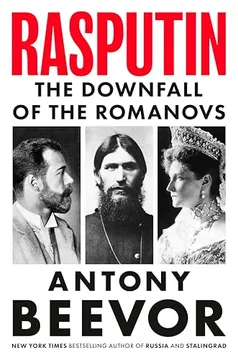


Key Takeaways
Rasputin's legend damaged the Romanovs more than his formal power could.
The story outran the man. Rasputin held no office and commanded no troops, yet his closeness to the imperial family became a public symbol of a court out of touch. Rumors that he was the Empress’s lover, abused the royal daughters, or secretly served Germany were false. Other concerns were not invented: he sought influence, meddled in appointments, and was credibly accused of exploiting women.
Perception became political fact. Officers and members of the elite heard so many tales of corruption and humiliation that, when revolution came, hardly anyone defended the Tsar. Beevor’s argument is not that Rasputin single-handedly destroyed the dynasty. Rather, the man and the myths around him helped make a brittle regime appear morally and politically bankrupt.
What's striking is the gap between formal authority and reputational power. Rasputin could not command the state, but his presence gave opponents a vivid, personal explanation for failures that were otherwise diffuse and difficult to describe. This resembles a reputational cascade: repeated claims become common knowledge, and people act on what they believe others believe. The distinction between false scandal and documented misconduct matters, though. Treating every allegation as propaganda would obscure real abuse; treating every rumor as fact would reproduce the very distortion the book examines.
A private medical crisis gave a Siberian pilgrim access to the throne.
A family’s desperate need. Alexei, the long-awaited heir, had haemophilia, an inherited disorder that could cause dangerous bleeding. His mother, Alexandra, lived in fear that an injury would kill him. Rasputin’s prayers and calming presence coincided with the boy’s recovery from painful episodes, including a severe crisis at Spała in 1912. The doctors had been unable to stop the bleeding by known methods, and Rasputin’s message that the boy would survive arrived as his condition improved.
Relief became conviction. No reliable account proves that Rasputin medically cured Alexei. The timing, his soothing effect, and the parents’ religious interpretation were enough to make Alexandra trust him profoundly. That trust turned a private source of comfort into access to the most powerful household in Russia.
The episode shows how care and explanation can become inseparable under extreme uncertainty. When medicine offers no dependable answer, a person who calms a frightened child may earn trust beyond the immediate moment. Modern discussions of therapeutic relationships recognize that reassurance can affect how distress is experienced, without establishing supernatural healing. The limit is equally important: emotional benefit does not validate every claim or justify political influence. The Romanovs treated an intensely personal experience as evidence about Rasputin’s wider judgment.
Rasputin's charisma fused peasant holiness with appetite, scandal, and performance.
A restless religious outsider. Rasputin began as a Siberian peasant and wandering pilgrim. A strannik was a lay religious traveler who moved between holy places seeking spiritual understanding. Rasputin gathered religious knowledge and impressed some listeners with his intense gaze, direct manner, and ability to make them feel understood. In elite salons, his rough speech and disregard for social formality made him seem like an authentic voice from the people.
Devotion and exploitation coexisted. He spoke of sin, repentance, and spiritual struggle, while pursuing women and, in some cases, using requests for help to pressure or assault them. Investigations found no proof that he belonged to the Khlyst sect, despite persistent accusations. His contradictions were not merely gossip: they helped attract followers, provoke enemies, and make any simple verdict about him inadequate.
Rasputin’s appeal depended partly on crossing boundaries. To a rigid court, his peasant manner could look like unfiltered spiritual truth; to his followers, his attention could feel more intimate than the formal courtesy they received elsewhere. That helps explain charisma without romanticizing it. A compelling persona can create real comfort and still be manipulative or abusive. The book’s portrait is strongest when it resists the convenient choice between saint and fraud, while keeping the power imbalance in view.
Nicholas mistook autocratic firmness for governing, then evaded its consequences.
Authority without responsiveness. In 1895, Nicholas rebuffed local councils that hoped to advise the government, insisting on absolute rule. The following year, more than a thousand people died in a crowd crush at the Khodynka coronation celebration. Though he knew the scale of the disaster, he attended a gala that evening. Visiting victims and offering money later could not erase the impression that the court cared more about ceremony than public grief.
Warnings went unheeded. The Russo-Japanese War ended in humiliating defeat, and troops fired on an unarmed workers’ march in 1905, killing or wounding hundreds. Nicholas accepted a parliament under pressure, then worked to limit its authority. Each crisis showed a ruler who could issue commands but struggled to understand how his actions changed public belief.
Khodynka illustrates a problem familiar in political theory: legitimacy depends not only on possessing authority, but on being seen to respond appropriately when people suffer. The Tsar’s mistake was not simply poor public relations. His distance from ordinary experience made it difficult to grasp why a technically correct gesture could not repair a moral breach. Autocratic systems can act quickly when leaders judge well, but they offer few channels for correcting leaders who do not.
War turned court gossip into a credibility crisis with millions at stake.
A state exposed by war. Russia entered the First World War with a vast army but serious weaknesses in planning and supply. Soldiers lacked rifles, ammunition, and equipment; early campaigns brought enormous losses and retreat. More than five million men were called up in the war’s first five months. In 1915, Nicholas took personal command of the army, linking the monarchy directly to the military outcome.
Rumor filled the information vacuum. Alexandra remained in the capital and became more involved in government while relying on Rasputin’s counsel. Their opposition to some military decisions and her German birth fed unsupported stories that the court was disloyal. Because officials communicated poorly and the government had little credibility, wild claims about treason could sound plausible. Actual administrative failures made the rumors harder to dismiss.
War changes the cost of mistrust. In peacetime, a rumor may damage a reputation; during military crisis, it can weaken confidence in decisions, leadership, and sacrifice. The book shows how material shortages and political suspicion reinforced each other. Still, conspiracy theories should not be mistaken for the cause of military defeat: inadequate preparation and supply were concrete problems. Rumor mattered because it shaped how people interpreted those failures, not because it replaced them.
Replacing competence with personal loyalty made state failure visible in every appointment.
A government in constant motion. In the fifteen months to the end of 1916, Russia had four prime ministers, five ministers of the interior, and three ministers of war. Provincial leadership churned too: thirty-three governors changed in 1915, followed by forty-three in the first nine months of 1916. Observers often blamed Rasputin for each change, but Beevor attributes most direct pressure to Alexandra’s demand for people loyal to her and to Rasputin.
Loyalty became the test. The Empress backed officials such as Alexei Khvostov and Alexander Protopopov despite warnings about their competence and character. Transport and food distribution deteriorated while ministers came and went. Even sensible advice could be ignored if it came from someone deemed an enemy. The result was not simply a bad roster, but a government increasingly unable to coordinate or earn confidence.
The pattern resembles a principal-agent failure: leaders choose advisers for personal trust, then receive information filtered through the same loyalty network. In a crisis, that weakens both expertise and the ability to correct mistakes. Loyalty itself is not a flaw; leaders need trusted colleagues. The danger appears when allegiance substitutes for demonstrated competence and dissent becomes proof of disloyalty. The rapid turnover made this logic visible to the public and to officials inside the system.
False accusations strengthened Rasputin by making every critic look malicious.
A scandal built to persuade. In 1915, a report accused Rasputin of indecent behavior at a Moscow restaurant. Beevor, following Douglas Smith’s research, describes the sensational part of the account as fabricated by senior police official Vladimir Dzhunkovsky, who wanted the Tsar to remove Rasputin. Rasputin may have visited the restaurant, but the alleged display was not true.
A lie helped its target. The account spread through court and political circles, and Alexandra saw it as proof that critics were conspiring against her friend. Her instinct was to defend him, not to ask why his conduct had become a recurring scandal. This response also weakened attention to genuine allegations, including reports that Rasputin pressured women seeking help. A manufactured charge gave the imperial couple a reason to dismiss a much larger body of criticism.
Disinformation can backfire when it confirms a target’s belief that all opposition is hostile. The fabricated detail did not merely injure the accuser’s credibility; it made accurate criticism easier to reject as part of the same campaign. That is why evidence quality is a strategic concern, not just a moral one. Yet skepticism must cut both ways. A false story about one episode does not disprove separate reports of coercion, just as repeated reports do not make every lurid tale true.
Assassinating Rasputin could not assassinate the failures that gave him influence.
A plot that turned violent. In December 1916, Prince Felix Yusupov, Grand Duke Dmitry Pavlovich, and politician Vladimir Purishkevich helped lure Rasputin to the Moika Palace. Their account of the killing is disputed in places. The poison they had prepared did not work as expected, and the plan devolved into shooting. They wrapped his body and threw it into an opening in the frozen river. News of his death prompted public celebrations in Petrograd.
Removing a person solved little. The assassins imagined they were rescuing the monarchy, but they did not repair the war, food shortages, distrust, or political paralysis. Their action also exposed a rupture inside the Romanov family: men close to the dynasty had killed a man the Tsar and Tsaritsa regarded as their friend. Rasputin’s death became a spectacle, not a restoration of authority.
The assassination is a sharp example of person-centered politics: a visible adviser becomes a stand-in for a system’s failures, so removing him feels like a solution. But advisers gain influence because leaders grant access and institutions fail to mediate it. The public’s celebration shows how far legitimacy had already eroded. The conspirators may have been sincere in their patriotism, yet their violence also announced that elite members no longer trusted ordinary political remedies.
By February 1917, soldiers would not defend a throne they no longer trusted.
Protest became revolution. Bread shortages and rising prices helped bring women and workers into the streets in February 1917. Demonstrations grew, and soldiers who had often been used to suppress unrest began refusing orders or joining the crowds. Major revolutionary leaders were absent from Petrograd, yet the protests continued. The Tsar, receiving warnings from Duma leader Mikhail Rodzianko, dismissed them and returned to ordinary routines.
The regime lost cooperation. The army’s withdrawal from the streets mattered more than any formal declaration: the state could no longer count on its armed force to carry out its commands. Nicholas abdicated in early March. The collapse did not result from Rasputin’s murder or a single revolutionary master plan. It followed years of lost trust, wartime hardship, political isolation, and a ruling family unable to respond.
A state is not sustained by orders alone. It depends on people in institutions choosing to carry them out, especially when authority is challenged. The soldiers’ refusal revealed that the monarchy’s coercive power had become unreliable. This does not reduce revolution to a simple collapse of obedience: hunger, war, and social grievances supplied the pressure. But it clarifies why the regime fell so quickly once military compliance disappeared.
Analysis
Beevor’s account treats Rasputin less as a master puppeteer than as a point where several weaknesses in the Romanov system converged. Alexandra’s fear for Alexei gave the peasant a route into the imperial household. Nicholas’s autocratic habits and poor political judgment left the couple isolated from counsel that might have challenged their assumptions. War then made their private loyalties public matters, while military losses and shortages gave rumors a receptive audience.
The book’s most useful distinction is between Rasputin’s actual reach and the image of his reach. He influenced people, advocated for appointments, and sometimes offered political advice, but the Tsar ignored him on important questions. The popular story that Rasputin governed Russia therefore overstates his direct control. Yet the story itself had consequences: it made the court appear compromised, and the government’s efforts to silence discussion only intensified suspicion.
Beevor also builds the narrative from sources that are often interested witnesses. Yusupov and Purishkevich had reasons to portray the murder as heroic; Rasputin’s daughter and Anna Vyrubova had reasons to defend him; police reports could reflect surveillance or political hostility. The book repeatedly places their claims beside diaries, testimony, and competing accounts. That method does not make every disputed episode resolvable, but it teaches readers to separate what happened from what people later needed the event to mean.
The larger lesson is not that one charismatic outsider can topple an empire by himself. Rasputin mattered because the dynasty made him a symbol and because its institutions could not contain the scandal or correct the underlying failures. His murder removed the symbol while leaving the causes intact. The monarchy’s collapse was cumulative: war exposed weakness, rumor translated weakness into betrayal, and the regime’s own allies withdrew their support. The legend accelerated the crisis, but it did not create the crisis from nothing.
Review Summary
Reviews of Rasputin: The Downfall of the Romanovs are largely positive, praising Beevor's engaging writing style and thorough research. Many appreciate his balanced portrayal of Rasputin, stripping away myth while contextualising him as a symptom of imperial Russia's decay rather than its cause. Readers highlight strong characterisation of Nicholas II and Alexandra, and the compelling assassination sequence. Criticisms include an overabundance of secondary characters, occasional lack of depth, and the book's relative brevity. Some note it suits readers with prior knowledge of Russian history rather than complete newcomers.
Glossary
Moujik
Russian peasant manA Russian word for a peasant man, often used in the book to emphasize Rasputin’s low social origins in contrast with the aristocratic Romanovs. The word could carry connotations of roughness or rustic authenticity. Both meanings mattered politically: supporters treated Rasputin’s peasant background as evidence of spiritual closeness to ordinary Russians, while critics used it to portray him as unfit for court.
Strannik
Wandering religious pilgrimA lay religious traveler who moved from monastery to holy site without necessarily following a fixed route or pursuing a formal religious office. Stranniki sought spiritual understanding and depended on local families and monasteries for food and shelter. Rasputin adopted this itinerant way of life after a period of personal religious change, gaining experience, stories, and contacts beyond his Siberian village.
Starets
Venerated spiritual elderA respected spiritual guide or elder in the Russian Orthodox tradition, valued for religious counsel and perceived spiritual insight. Rasputin was often called a starets by his followers, although he was not an ordained priest. The title lent his advice a religious authority that was informal but highly consequential inside the imperial household.
Okhrana
Tsarist secret policeThe security police of the Russian Empire, tasked with monitoring political threats and opposition to the regime. Okhrana agents also followed Rasputin, recording his movements and private behavior. Their reports could provide valuable evidence, but they were produced by an institution with political purposes and should not automatically be treated as neutral accounts.
Stavka
Imperial military headquartersThe headquarters of the Russian armed forces during the First World War. Nicholas moved there after taking command of the army in 1915, leaving Alexandra in Petrograd, where she became more active in political affairs. The distance between the Stavka and the capital helped shape the court’s communications and the rumors surrounding its influence.
Duma
Russian representative assemblyThe State Duma was Russia’s elected legislative assembly, established after the unrest of 1905. It could debate and approve or reject legislation, though Nicholas continued to resist limits on autocratic rule. Its members included both loyal monarchists and critics, and its public attacks on the court became a stage for the dispute over Rasputin’s influence.
Khlyst
Russian mystical religious sectA dissident religious movement in Russia, regarded by the Orthodox establishment as heretical. Its practices were associated with ecstatic worship and, in hostile accounts, sexual rituals. Rasputin was repeatedly accused of belonging to the sect because of his unconventional religious meetings and teachings about sin and repentance. Investigations described in the book found no proof that he was a member.
October Manifesto
1905 political concessionsNicholas II’s 1905 proclamation granting civil liberties and establishing a State Duma with a role in making laws. The manifesto helped defuse a near-revolution, but the Tsar and his allies later tried to restrict the assembly’s influence. Alexandra opposed the concessions, seeing them as a threat to autocracy, while their partial and contested implementation left both reformers and conservatives dissatisfied.
Download PDF
Download EPUB
.epub digital book format is ideal for reading ebooks on phones, tablets, and e-readers.








