

Key Takeaways
Design the learning environment for variability, not an imaginary standard student.
Build access in early. Universal Design for Learning, or UDL, is a framework for designing learning experiences that anticipate differences among learners instead of waiting for individuals to request fixes. It adapts the logic of accessible buildings, where features such as curb cuts help wheelchair users, travelers with luggage, and parents with strollers. In the 1990s, CAST brought this design mindset into education, recognizing that students vary in how they stay interested, take in information, and demonstrate what they know.
Move barriers out of the learner. A student who struggles with a single-format lecture is not necessarily the problem; the course may be designed too narrowly. UDL does not mean creating a custom course for every student. It means planning useful choices before a particular student needs them.
The powerful shift here is from asking who needs special treatment to asking which features of the environment make participation unnecessarily difficult. That move aligns with human-factors engineering, which treats errors as clues about system design rather than proof of individual inadequacy. It also protects privacy: students can benefit without disclosing diagnoses or personal circumstances. The approach is strongest when broad design and individual accommodation remain complementary. A well-designed course can remove many barriers, but no universal template will anticipate every person's needs.
Build learning around students' scattered minutes, not only classroom hours.
Time is a barrier. Fatimah, a working parent and community-college student, spends much of her week driving between work, school, family, and other obligations. Captions let her study video without sound, while audio study guides let her review during a commute. Her main obstacle is not distance from campus or a declared disability. It is finding time.
Meet learners in small windows. The book calls brief, need-driven phone sessions micro-moments: short bursts of activity in which people look up information or complete a task. It cites a 2014 survey reporting that 86 percent of undergraduates owned smartphones, a figure that rose in later surveys. These numbers are historical, not current estimates, but they illustrate the opportunity: mobile-friendly materials can make learning possible in otherwise unusable pockets of time.
Designing for fragmented schedules recognizes that learning competes with paid work, caregiving, transport, and fatigue. In that sense, access is also a question of time allocation, not merely disability compliance. Still, a phone is not a guarantee of dependable connectivity, a large screen, or an interruption-free setting. Mobile access should expand the routes into learning, not become the only route. The most robust design lets students move between formats and devices without losing their place or having to reconstruct the course.
Find the recurring snag, then add one useful route through it.
Start where effort repeats. A pinch point is a part of a course or service where people regularly ask the same question, make the same mistake, or need another explanation. Rather than redesigning everything, identify one such spot and add one more way through it. A math instructor, for example, paired written worked problems with brief videos showing the steps in real time.
Grow by stages. The book sketches a practical sequence: use about 20 minutes to add one targeted resource; over roughly 20 days, map fuller text and media routes through a course; over roughly 20 months, collect usage and outcome data to decide what to improve next. The numbers are a planning device, not a deadline. The point is to make inclusive design manageable and iterative.
This is an unusually practical answer to the paralysis that large reforms can create. In software development, teams often learn by releasing a small, usable version, observing behavior, and refining it. The same logic makes course redesign less speculative: recurring confusion identifies where a change might matter most. The caution is that frequently asked questions do not reveal every barrier. Students who quietly disengage or never enroll may be missing from the feedback. Usage data, student conversations, and attention to who remains absent should inform the next iteration.
Offer choices tied to the goal, not a forced parade of formats.
Choice is the point. UDL makes room for varied ways to sustain interest, encounter information, and show learning. It does not require every student to consume every format. A teacher introducing To Kill a Mockingbird gave students access to audio as well as print, used film scenes to establish context, and invited research on historical events connected to the novel. These options supported the unit's goals of understanding and analysis.
Keep the target steady. If the goal is to analyze a text, students still need to demonstrate analysis. If the goal is to learn close reading in print, a film cannot replace that work. The format should vary only when the format itself is not part of the skill being assessed. Choices are useful when they lead to the same meaningful learning target.
This distinction separates inclusive design from simply adding multimedia. A menu of routes can give learners agency while preserving a shared intellectual destination. It also avoids treating preferences as fixed learning styles: a student may choose audio while commuting and print when annotating at a desk. Too many options, however, can create decision fatigue, especially when directions are unclear. A small set of well-explained alternatives is often more usable than an open-ended invitation to invent any format.
Test the intended skill, not reading speed, format fluency, or test stamina.
Check what the assessment measures. Construct relevance asks whether a task tests the knowledge or skill it is supposed to test, rather than unrelated abilities. A math word problem meant to measure mathematical reasoning can also test reading fluency. A timed biology essay can add handwriting, memory, organization, and pressure to the measure of biology knowledge.
Make objectives observable. State what students should do, how success will be measured, and what level of performance counts as adequate. When the format is not itself an objective, consider allowing another way to demonstrate the same skill and use shared criteria to assess both. When the format is the skill, as in learning a writing convention, keep it. Flexibility should remove irrelevant obstacles, not erase genuine course requirements.
This is a question of measurement validity as much as fairness. An assessment can produce precise scores while measuring a muddled combination of abilities. Clear objectives help instructors distinguish essential difficulty from accidental difficulty, a distinction that strengthens rather than weakens academic standards. Yet different response formats can introduce their own inequities: a video may reward access to equipment or editing skills. Shared rubrics, reasonable limits on options, and checks that each route tests the same learning target are therefore essential.
Make UDL a team practice, not another burden on one instructor.
Spread the design work. UDL affects courses, technology, libraries, and student services, so a lone disability-services professional cannot carry it across a campus. A useful team can include disability-support staff, faculty-development specialists, instructional designers, librarians, technology staff, and faculty members. Their different roles help turn a design principle into usable materials, tools, and support.
Build continuity. The book proposes a staged approach: first, let the team learn and agree on how to work; next, support a small faculty group in trying changes; then invite new participants and let experienced faculty mentor them. One suggested early target is for at least 5 percent of faculty to pilot a strategy. The number is a starting goal, not proof of campuswide adoption. Senior leaders can sponsor the effort and provide time or resources.
This is a socio-technical problem: outcomes depend on people, tools, policies, and routines working together. A team can make inclusive design part of ordinary support instead of relying on an unusually committed instructor. It also distributes institutional memory when personnel change. The risk is that a committee can become a meeting about intention rather than a source of implementation. Clear responsibilities, protected time, visible pilot projects, and authority to resolve barriers give collaboration a practical purpose.
Treat legal compliance as a floor, and build access before requests arrive.
Do not wait to be asked. In the United States and Canada, accessibility duties arise from laws and policies, though requirements differ by jurisdiction. UDL itself is not a universal legal mandate for higher education. The book describes cases in which institutions had to address inaccessible websites, course systems, library resources, or event information. In the Atlantic Cape Community College settlement, accessible instructional materials had to be available to students with disabilities at the same time as to other students.
Shift responsibility upstream. Waiting for an individual request can force students to disclose personal information and can leave them behind while a fix is arranged. Designing access in advance can reduce that burden. Legal obligations matter, but leading with fear of lawsuits often alienates colleagues; showing how a design improves access for many learners can build broader commitment.
The civil-rights frame clarifies why access is not simply a customer-service favor. It also exposes a weakness in request-only systems: the people least able or willing to disclose are least likely to receive help. Proactive design addresses that asymmetry. At the same time, legal compliance and inclusive teaching are related but not identical. A course may satisfy technical accessibility standards while remaining confusing or pedagogically narrow. Institutions need both: compliance that protects rights, and thoughtful design that makes participation genuinely workable.
Scale what works with evidence until inclusive design becomes ordinary campus operations.
Expand in widening circles. Start with one assignment, then a program or department, then a modality such as online learning, and finally campuswide systems. Online courses make barriers visible in learning platforms, publisher materials, and instructor-created content. The book advises testing these tools, involving support specialists, and considering accessibility when purchasing technology rather than treating it as a later repair.
Move from project to practice. The University of Cincinnati's model describes three phases: compliance, when gaps are identified and addressed; commitment, when units assign resources; and culture, when inclusive design becomes routine. Track indicators such as course persistence, return enrollment, student satisfaction, and resource use. These measures help show whether a change is useful and where further work is needed.
The institutional sequence is persuasive because it links a moral commitment to budgets, procurement, training, and repeatable work. Measurement can help advocates compete for scarce attention and resources. However, better course outcomes after a change do not by themselves prove that the change caused them; student populations and course conditions may also shift. Retention should not become the sole test of inclusion, either. Pair quantitative indicators with student accounts, examine who benefits, and preserve individual accommodations where broad design is not enough.
Analysis
The book's central achievement is a change in the unit of attention. Instead of treating access as an exceptional adjustment made after a student identifies a need, it treats access as a property of the learning environment, designed before the class begins. This reframing joins disability rights to everyday teaching practice without reducing either to the other. A caption can be an accommodation, a study aid, or a way to follow a video in a noisy room. Its value depends on the interaction, not on a fixed category of user.
The plus-one approach gives this ethical argument operational force. It answers the predictable institutional objection that universal design demands a wholesale rebuild by directing effort toward recurring bottlenecks. This resembles continuous improvement in engineering: identify failure points, make a bounded change, observe the result, and revise. The method also recognizes that higher education is distributed work. Course accessibility can depend on instructional designers, platform vendors, libraries, purchasing rules, and student-facing offices, not only on an instructor's goodwill.
The mobile-learning frame is rhetorically smart because it makes access relevant to students whose constraints are not visible. But it needs careful handling. Phone ownership does not establish reliable bandwidth, digital fluency, or time to learn effectively in short bursts. Nor should convenience become a rationale for turning education into fragmented content consumption. Mobile options work best as additional routes into sustained learning, not as substitutes for concentration, dialogue, or academic challenge.
Finally, evidence of improved persistence or satisfaction should be treated as a reason to investigate, not as automatic proof of causation. Inclusive design is most credible when institutions evaluate learning outcomes, student experience, workload, and differences among student groups together. The book's strongest practical message is therefore not that one design solves every barrier. It is that institutions can stop reproducing preventable barriers, learn from each intervention, and reserve individualized accommodations for needs that broad design cannot meet.
Review Summary
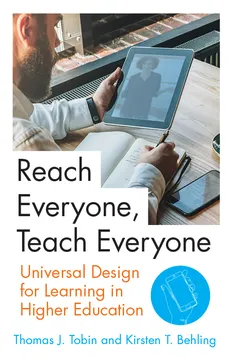
Reviews for Reach Everyone, Teach Everyone are largely positive, with readers praising its practical, accessible introduction to Universal Design for Learning (UDL) in higher education. The "plus-one" approach is frequently highlighted as a standout, actionable strategy. Reviewers appreciate its relevance for faculty, administrators, and staff alike, noting its clear writing and useful chapter structure. Some criticisms include repetitiveness, outdated technology references, lack of racial equity discussion, and an imbalance toward convincing readers of UDL's importance rather than providing enough classroom-ready strategies.
Glossary
Universal Design for Learning
Proactive learning designA framework for designing learning experiences around variability among students. It encourages multiple ways to sustain engagement, access information, and demonstrate learning, while keeping course goals clear. The aim is to reduce avoidable barriers through advance design, rather than relying only on individual accommodations after a student encounters difficulty.
Plus-one approach
Add one useful optionA practical method for applying UDL incrementally. Instead of trying to create every possible format or redesign an entire course at once, an instructor identifies a troublesome interaction and adds one meaningful route for students to access information, stay engaged, or demonstrate learning. The change can be evaluated and refined when the course is taught again.
Pinch points
Recurring trouble spotsPlaces in a course or service interaction where learners repeatedly ask the same questions, misunderstand instructions, perform poorly, or request another explanation. Pinch points provide concrete starting places for redesign because they reveal where existing materials or processes are not working smoothly for many participants.
Construct relevance
Measure the intended skillThe degree to which an assessment measures the knowledge or ability it is meant to measure, rather than unrelated demands. For example, a math problem intended to assess mathematical reasoning may also require substantial reading fluency. Identifying irrelevant demands can help instructors offer different response formats without changing the learning objective.
Micro-moments
Brief, need-driven phone sessionsShort bursts of mobile-device use in which people seek information or complete a task prompted by an immediate need. The book applies this concept to learning: students may use brief periods throughout a busy day to review course material, provided resources are accessible and useful on the devices and connections available to them.
Compliance, Commitment, Culture
Stages of campus adoptionA three-stage model for institutional accessibility work. Compliance identifies gaps and addresses legal obligations. Commitment assigns resources and responsibility for continuing improvements. Culture describes the point at which inclusive design becomes an ordinary feature of how the institution creates courses, services, and other interactions.
Download PDF
Download EPUB
.epub digital book format is ideal for reading ebooks on phones, tablets, and e-readers.








