

Key Takeaways
Rebellion becomes a market engine when it sells distinction.
The sneaker made the point. In 2003, Adbusters began selling its own running shoe, presenting the product as a way to challenge Nike. But offering a competing shoe, including one marketed as ethically made, is still marketplace competition. The book sees the same pattern in hippies choosing Volkswagen Beetles to reject conformity, then embracing SUVs that promised a different kind of rebel freedom. Punk and skate styles, too, created markets for alternative shoes and clothing.
No sellout required. The authors call this the Rebel Sell: rebellion can fuel consumer capitalism by giving people new ways to distinguish themselves through what they buy. Consumers need not be hypocrites. A business can profit from genuine values, including ethical production, without threatening the larger economic system.
What's useful here is the distinction between a product's message and its economic effect. A purchase can express a real concern, such as safer working conditions, while still functioning as a purchase in a competitive market. That does not make the concern meaningless. It does mean that symbolic opposition should not be mistaken for structural change. The argument is strongest when it asks what an action actually changes, and weaker if it implies that commercial success erases every political or cultural effect a movement may have.
Stop treating every market, school, or norm as one repressive machine.
A total theory takes hold. The book traces countercultural thinking to a powerful postwar fear: that mass media and social conformity could turn ordinary people into instruments of tyranny. Marxist accounts of ideology, Freud's model of instinctual repression, and interpretations of Nazism helped make society seem like a single system that manufactures desires and disciplines dissent. Stanley Milgram's obedience experiments, in which many participants followed instructions to deliver what they believed were painful shocks, seemed to reinforce the fear.
The theory protects itself. When rebellion is absorbed into popular culture, countercultural critics can call it co-optation. When it is suppressed, they can call that repression. Either outcome then appears to confirm the theory. The authors argue that this makes the idea difficult to test and diverts attention from specific institutions, inequalities, and policies that can be changed.
The book's historical account explains why suspicion of conformity carries moral force: mass participation in wrongdoing is not an imaginary danger. Its criticism is directed at turning that warning into a universal explanation. A useful test for any grand theory is whether it identifies evidence that could prove it wrong. Still, the opposite error deserves attention too. Institutions can reinforce one another and reproduce unequal power, even without a single mastermind or unified plan. A sound analysis can reject the all-controlling system without assuming that social structures are harmless.
Track status races, not just shopping, to understand consumerism.
Some goods are positional. A material good can be produced in greater quantities; a positional good gains value from its relative scarcity. Status, desirable locations, and exclusive taste work this way. Drawing on economist Thorstein Veblen, the authors argue that consumption often becomes competitive: each person tries to improve their standing, but widespread imitation erases the advantage. Two doctors may buy expensive cars to appear successful, only to find that the new standard forces both to spend more.
Growth changes the contest. The book cites a rough threshold of about US$10,000 in GDP per person, above which additional growth may no longer raise average happiness. In wealthy societies, it argues, spending increasingly goes toward positional goods. SUV purchases illustrate the trap: each buyer may seek protection, but larger vehicles make the road more dangerous for others, pushing the competition onward.
This account turns consumerism from a story about foolish individuals into a coordination problem. The same logic appears whenever people compete for scarce attention, prestige, or access: each choice can be reasonable locally while the collective result is costly. The distinction between material and positional value is especially clarifying. However, the happiness threshold is a rough claim from research available to the book, not a universal law. Nor is every expensive purchase a status bid. The model is most useful for identifying situations where private gains depend on keeping others relatively behind.
Cool turns nonconformity into a fast-moving status contest.
Rebellion marks a club. The book treats cool not as a mysterious quality or simply an advertising trick, but as a status hierarchy built around distinction. A Burberry plaid could signal refined taste while few people recognized it. Once the pattern spread widely, its exclusivity weakened. Countercultural styles work similarly: a look begins among innovators, spreads through early adopters, and loses its status value as the wider public adopts it.
Advertising follows desire. The authors reject the idea that marketers can freely program consumers. They describe advertising as more effective when it works on desires people already have, such as wanting recognition or belonging. Brands can also reduce the risk of buying an unfamiliar product by signaling consistent quality. But when a brand sells an identity as well as a product, it can intensify the competition to look distinctive.
The account makes fashion legible as social communication: a style signals membership to some people and difference from others. That helps explain why a look can lose appeal precisely when it becomes popular. The authors also avoid treating every consumer as a passive victim of advertising, which is a valuable corrective. The limitation is that existing desires are not formed in isolation. Marketing, peer groups, and institutions can shape what people learn to want, even if they do not simply implant desires on command.
Distinguish principled dissent from self-serving rule-breaking.
Rules can make cooperation work. A queue, a traffic signal, or a turn-taking convention limits individual freedom, yet helps prevent a scramble that would leave everyone worse off. The prisoner’s dilemma illustrates the problem: two people may each have an incentive to betray the other, even though both would prefer a result in which neither does. Shared rules can change those incentives and make cooperation safer.
Disobedience has different purposes. The authors distinguish dissent, which challenges a rule believed to be unjust and accepts the consequences, from deviance, which breaks rules for private advantage. Martin Luther King Jr.'s civil disobedience is contrasted with stunts that merely flout conventions. Harold Garfinkel's breaching experiments, in which people deliberately violated ordinary expectations, showed how strongly everyday interactions depend on shared norms.
This distinction helps prevent the word rebellion from turning into a moral blank cheque. It also recognizes that ordinary courtesy and predictable behavior make trust possible among strangers. Yet the test cannot be applied mechanically. Rules can coordinate cooperation while also protecting an unfair arrangement, and people who benefit from a rule may label opposition to it deviant. The important question is not whether a rule is enforced, but whose interests it serves, whether those affected can contest it, and whether its burdens are fairly shared.
Use binding rules to stop races no individual can win.
Private restraint is not enough. When each person benefits from doing what others refrain from doing, voluntary virtue can leave the group worse off. The book compares these situations to arms races: a person or company may act defensively, yet the combined result is escalating costs. School clothing competition is one example. The Long Beach school district reported a 33 percent drop in a range of discipline offenses after introducing uniforms, although the book notes that evidence about long-term effects was incomplete.
Change the incentives. The authors favor practical institutional measures over appeals to personal purity. They point to gun-control rules as a way to limit an arms race, and tradable pollution permits as a way to make polluters bear more of the costs their emissions impose on others. The aim is not to eliminate individual choice, but to prevent one person's choices from imposing unmanaged costs on everyone else.
The arms-control analogy is powerful because it explains why cooperation may require enforceable limits, not just better intentions. It also shifts debate from judging individual character to designing rules that change incentives. That shift can make policy more realistic. But rules are not self-justifying: uniform requirements can burden some students, and permit systems depend on sound limits and fair enforcement. Institutional solutions need evidence, public oversight, and attention to who pays. The alternative to ineffective private virtue is not automatic faith in regulation, but accountable collective design.
Treat uniforms and standards as tools, not automatic oppression.
Sameness can serve a purpose. Uniforms can identify a group, support a shared task, or reduce visible competition. The book describes students who wore school uniforms and still expressed individuality through accessories, hairstyles, and small alterations. The clothing rules limited some choices, but students said they reduced daily pressure and strengthened school solidarity. Uniforms do not erase differences; they can narrow the arena in which people compete.
Standards also help people coordinate. A shared keyboard layout, computer protocol, or set of fast-food ordering conventions makes it easier to interact with others. These benefits are called network externalities: a product or standard becomes more useful as more people use it. The authors also describe newer suburban homes assembled from mass-produced components but offered with extensive customization, challenging the idea that mass production must mean identical products.
This section breaks a false choice between complete uniformity and unbounded self-expression. Shared standards can free attention for other activities, and a common format can make cooperation possible across large groups. The authors are also right that standardization need not prevent variation. Still, coordination can lock people into inferior standards, and uniforms can enforce status distinctions as well as reduce them. The practical issue is therefore not whether sameness is good or bad in itself, but whether a standard solves a real coordination problem without imposing avoidable costs.
Test alternative claims instead of mistaking exoticism for evidence.
Difference is not proof. The authors argue that countercultural critics often romanticize non-Western cultures as escapes from modernity. They point to the ecological speech commonly attributed to Chief Seattle, which was written by screenwriter Ted Perry in 1972, and to the assumption that Indigenous societies shared one uniform relationship with nature. The book stresses that Native cultures were varied, not a single idealized alternative.
Medicine needs the same scrutiny. Traditional Western medicine once relied on humors, just as other traditions developed systems involving energies or bodily balances. The authors argue that modern medicine's success came from testing causal explanations and treatments, not from being Western by nature. Alternative therapies may be comforting or useful in particular ways, but cultural origin is not evidence that a treatment works. The authors warn that markets can profit from presenting unproven treatments as a purer alternative.
The central lesson is epistemic rather than cultural: respect for a tradition does not require accepting every empirical claim made in its name. The fabricated Seattle speech also shows how easily outsiders can turn real communities into symbols for their own ideals. That critique is important, but it should not become a reason to dismiss local knowledge or assume that established medicine is beyond institutional bias. A fair standard asks what evidence supports a claim, who bears the risk when it fails, and whether people can make an informed choice.
Trade can standardize storefronts while expanding what people can choose.
Sameness has several causes. Global trade can make cities look more alike as familiar chains and products spread. But the book argues that this does not prove a single corporate system is dictating taste. Trade can also bring unfamiliar goods into local markets. The authors report that the average North American supermarket's selection grew from about 8,000 items in 1970 to 30,000, illustrating how a more uniform retail landscape can coexist with a wider range of products.
Consumers also choose standards. Corn displaced less productive crops such as sumpweed long before modern capitalism, the book notes, because farmers preferred a more useful crop. Network effects likewise encourage people to adopt widely shared languages, technologies, and cultural products. These choices can reduce diversity, but the authors argue that consumers may value lower prices, convenience, or compatibility more than preserving every alternative.
This account resists the easy assumption that every cultural convergence is imposed from above. It is possible for a market to make a place look more familiar while giving residents more options than they previously had. That distinction matters in debates about globalization. At the same time, observed consumer preference does not settle whether choices are genuinely free: income, public policy, and the disappearance of alternatives all shape the menu. The strongest analysis examines both what people select and what conditions made those selections available.
Make global harms everyone's responsibility through enforceable public rules.
Pluralism needs institutions. In a large society, people disagree about what makes life worthwhile, so no single lifestyle ideal can guide everyone. Markets help coordinate different preferences, while democratic institutions can address failures that private exchange leaves unresolved. The book's example is pollution: because the atmosphere is shared, a polluter can impose costs on others without paying them. Tradable permits or other enforceable rules can make more of those costs part of the decision.
Choose reform over withdrawal. The authors oppose treating government as powerless or trade as the root of every problem. They argue for identifying specific failures, such as pollution, monopoly, or harmful advertising to children, and using policy to correct them. Global harms require agreements broad enough to bind the people and firms causing them. Individual ethical choices may help, but they cannot substitute for rules that apply to everyone.
The book's political conclusion is that practical reform is not a timid substitute for justice. Where people face shared costs and conflicting interests, democratic rules can achieve outcomes that private goodwill cannot. The emphasis on pluralism also explains why a single utopian blueprint is unlikely to command lasting agreement. The challenge is to keep institutional reform democratic rather than technocratic: policy can be captured, poorly designed, or distributed unfairly. The relevant question is not whether to use collective power, but how to make it answerable to those who live under its rules.
Analysis
The book's most useful move is to replace the familiar story of a unified system manipulating passive consumers with an account of people pursuing status, security, and convenience under imperfect rules. Its examples make the alternative memorable: the anti-Nike sneaker competes for customers, the SUV arms race can arise from defensive choices, and the queue works because each person accepts a small constraint that protects everyone from a rush. These cases connect cultural criticism to incentives and collective action, giving readers a way to ask what a protest, purchase, or policy changes in practice.
That strength comes with a risk of overcorrection. Heath and Potter are persuasive when they criticize the idea that every unpleasant feature of modern life is evidence of one all-encompassing ideology. They are less persuasive when market outcomes are treated as straightforward expressions of consumer preference. Preferences are shaped by income, advertising, infrastructure, and the options institutions make available. A choice can be voluntary in a narrow sense and still occur within an unequal set of alternatives. Similarly, culture may not dictate economic institutions, but it can affect which policies people consider legitimate and whose claims receive attention.
The book also sometimes compresses different levels of analysis. A commercial market can absorb a rebellious style without nullifying the movement's influence on identities or public debate. Conversely, a dramatic cultural gesture may matter to participants while having little measurable effect on wages, law, or pollution. Separating those outcomes is more useful than declaring rebellion either revolutionary or pointless.
The lasting challenge is methodological: replace claims about a single hidden system with testable accounts of specific mechanisms, while refusing to confuse market success with social justice. The book's best practical lesson is not to trust markets or governments automatically. It is to identify who benefits, who bears the cost, and what rule could align private incentives with shared interests. That approach preserves the authors' case for reform while leaving room to criticize the institutions that reform must confront.
Review Summary
The Rebel Sell challenges the effectiveness of counterculture movements, arguing they reinforce consumer capitalism rather than subvert it. While some readers found the book thought-provoking and appreciated its critique of counterculture ideologies, others criticized its sloppy arguments and smug tone. The authors posit that real social change comes through legislation and institutional reform, not individual acts of rebellion. Many readers felt the book offered valuable insights, even if they disagreed with some of its conclusions.
People Also Read









Glossary
The Rebel Sell
Rebellion marketed as distinctionThe book's central idea that countercultural rebellion can strengthen consumer capitalism rather than threaten it. Rebel styles and values help people distinguish themselves from the mainstream, creating new markets. Once a style spreads, its distinction fades, encouraging another round of innovation and consumption.
countercultural idea
Culture as a system of repressionA political theory that treats mainstream culture and social institutions as an integrated system that imposes conformity, represses authentic desires, and sustains existing power. It sees cultural rejection and personal transformation as more fundamental than reforming specific laws or institutions.
co-optation
Resistance absorbed by the mainstreamThe process by which a dominant system adopts the symbols or styles of dissent, strips them of their oppositional meaning, and sells them as products. The book argues that this explanation can make countercultural theory unfalsifiable, since both suppression and commercial popularity may be taken as evidence of the system's power.
competitive consumption
Spending to improve relative standingConsumption driven by competition with other people for status, distinction, or access to scarce advantages. An individual may rationally spend more to gain or protect standing, but if others do the same, everyone can end up spending more without improving their relative position.
positional goods
Goods valued by relative scarcityGoods whose value depends substantially on being scarce or having them before, or instead of, other people. Examples include social status, exclusive taste, desirable locations, and access to limited spaces. Increasing general wealth does not necessarily make these goods more available, because their value depends on relative position.
collective action problem
Private incentives undermine shared gainsA situation in which people share an interest in an outcome but each person has an incentive to act in a way that undermines it. The result can be worse for everyone, even when no one intends harm. The book uses queues, arms races, and pollution to illustrate why shared rules may be needed.
dissent and deviance
Principled protest versus private advantageThe book's distinction between challenging a rule because it is judged unjust and breaking a rule for self-interested reasons. Dissent is presented as a principled objection that can include accepting penalties; deviance describes rule-breaking aimed at personal benefit. The distinction can be difficult to apply because people may misread their own motives.
network externalities
Value rises with wider adoptionBenefits that a product or standard creates for other users when more people adopt it. A fax machine is useful only if others have one, and a shared computer protocol lets different users communicate. These benefits can make common standards attractive, though they may also lock people into an inferior option.
technocracy
Rule justified through technical expertiseThe form of society criticized by countercultural thinkers, in which governing institutions justify their decisions by appealing to technical experts and scientific knowledge. In that critique, technical efficiency becomes a model for organizing politics, education, work, and personal life. Heath and Potter challenge the idea that this amounts to one total system.
uniform diversity
Similar settings, many available choicesA condition in which places may look increasingly alike while their residents can access a wider variety of goods and cultural influences. The book uses globalization and expanded supermarket selections to show how visible sameness can coexist with increased choice.
appropriate technology
Technology designed for local needsA movement advocating technologies that are simple, decentralized, affordable, repairable, and suited to small-scale or community use. Supporters present them as more humane and environmentally responsible than centralized industrial systems. The book questions whether these qualities can reliably coexist or remain beneficial when everyone adopts the same technology.
deep ecology
Nature has value beyond human useAn environmental philosophy that gives intrinsic value to nonhuman life and treats humans as one part of an interconnected ecological whole. It criticizes environmental damage as evidence of a deeper problem in humanity's relationship with nature. The book contrasts this view with reforms that address specific incentives and pollution costs.
tradable pollution permits
Marketable limits on emissionsA regulatory system in which firms must hold permits for specified emissions, and those permits can be bought or sold. The total permitted pollution can be limited while firms choose how to reduce or pay for emissions. The book presents permits as a way to make polluters bear more of the costs they impose on others.
Milgram's obedience experiments
Tests of obedience to authorityExperiments in which participants believed they were administering increasingly severe electric shocks to another person when instructed by an authority figure. The shocks were not real, and the apparent victim was an actor. The results were widely interpreted as evidence that ordinary people may follow harmful orders, though the book situates that interpretation within postwar fears about conformity.
Garfinkel's breaching experiments
Deliberate violations of social expectationsSociological exercises in which students intentionally broke ordinary social conventions, then recorded how others reacted. In one example, students acted like formal boarders in their own homes. The resulting confusion and anger illustrated how everyday interaction relies on shared expectations that people actively maintain.
FAQ
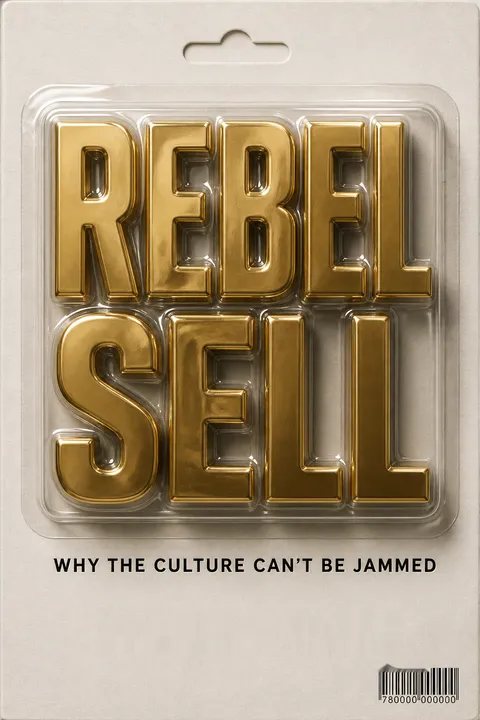
What's Rebel Sell: Why The Culture Can't Be Jammed about?
- Cultural Critique Focus: The book critiques the idea that counterculture effectively resists consumer capitalism, arguing that it often gets co-opted by the system it opposes.
- Counterculture vs. Capitalism: Authors Joseph Heath and Andrew Potter assert that countercultural movements historically reinforce capitalism by creating new markets for alternative products.
- Consumerism Analysis: It explores how consumerism is driven by a desire for distinction rather than conformity, suggesting that the quest for status fuels competitive consumption.
Why should I read Rebel Sell?
- Challenging Assumptions: The book provides a fresh perspective on consumer culture and countercultural movements, challenging widely held beliefs about rebellion and conformity.
- Understanding Modern Society: It helps readers understand the complexities of consumer behavior and the dynamics of cultural resistance in contemporary society.
- Critical Thinking: Encourages critical thinking about the relationship between culture, identity, and capitalism, making it relevant for anyone interested in social theory or cultural studies.
What are the key takeaways of Rebel Sell?
- Counterculture is Not Subversive: The authors argue that countercultural movements often serve to reinforce consumer capitalism rather than undermine it.
- Consumerism as Competition: The book posits that consumer behavior is driven by a desire for social distinction, leading to competitive consumption rather than mere conformity.
- Rejection of Total Ideology: Heath and Potter emphasize the need to disentangle social justice from countercultural critiques, advocating for practical reforms over symbolic acts of rebellion.
What are the best quotes from Rebel Sell and what do they mean?
- “Adbusters did not sell out...”: Highlights the idea that countercultural movements like Adbusters are not truly oppositional to capitalism; they are part of it.
- “Having fun is not subversive...”: Critiques the notion that personal pleasure and hedonism can lead to meaningful social change, suggesting that serious political action is necessary.
- “The culture cannot be jammed...”: Underscores the argument that society is too complex to be reduced to a single system or culture, making traditional forms of rebellion ineffective.
How do Heath and Potter define counterculture in Rebel Sell?
- Counterculture as Myth: Describes counterculture as a myth suggesting individuals must reject mainstream society to be authentic, arguing this belief is flawed.
- Historical Context: Traces the origins of countercultural thinking back to the 1960s, showing its influence on contemporary leftist politics and social movements.
- Rebellion vs. Reform: Emphasizes that countercultural rebellion often distracts from practical reforms that could lead to genuine social justice.
What is the authors' view on consumerism in Rebel Sell?
- Consumerism as Distinction: Argues that consumerism is driven by a desire for social distinction rather than a need to conform, challenging the idea that consumers are merely passive victims of advertising.
- Competitive Consumption: Explains that individuals engage in competitive consumption to signal their status, leading to a cycle of consumption that does not necessarily enhance happiness.
- Crisis of Overproduction Myth: Debunks the myth of overproduction in capitalism, asserting that supply and demand are inherently balanced in a market economy.
How do the authors view the relationship between counterculture and capitalism in Rebel Sell?
- Interconnectedness: Argue that counterculture and capitalism are not oppositional forces; rather, they are intertwined, with countercultural movements often becoming commodified.
- Cultural Co-optation: Discuss how mainstream culture absorbs countercultural elements, turning them into marketable products that ultimately reinforce the capitalist system.
- Failure of Rebellion: Contend that attempts to rebel against capitalism through counterculture have historically failed to produce meaningful change, as they often lead to new forms of consumerism.
How does Rebel Sell address the concept of "cool"?
- Cool as Status: Discusses "cool" as a central status hierarchy in contemporary society, where being cool is about distinction and nonconformity.
- Predictability of Choices: Argues that consumer choices related to cool are predictable, as individuals seek to align with what is currently deemed cool by their peers.
- Cultural Influence: Highlights how cool is shaped by cultural trends and peer influence, suggesting that what is considered cool is often a reflection of broader societal values.
What solutions do Heath and Potter propose in Rebel Sell?
- Legislative Changes: Advocate for policy measures that address the root causes of consumerism, such as reducing the tax-deductibility of advertising.
- Progressive Income Taxation: Suggest implementing more progressive income taxes to curb excessive consumption driven by status competition.
- Collective Action Initiatives: Emphasize the importance of collective action in addressing social issues, arguing for institutional change over individual lifestyle choices.
How does Rebel Sell challenge traditional views of rebellion?
- Rebellion as Commodity: Challenges the notion that rebellion is inherently subversive, arguing that it often becomes commodified and sold back to consumers.
- Authenticity vs. Marketing: Questions the authenticity of countercultural movements, suggesting that what is marketed as authentic rebellion is often just another product.
- Need for Genuine Change: Calls for a reevaluation of what genuine rebellion looks like, emphasizing the need for actions that truly disrupt the status quo.
How does Rebel Sell relate to globalization?
- Globalization and Homogenization: Discusses how globalization contributes to cultural homogenization, where local cultures are increasingly influenced by global consumer trends.
- Consumer Preferences: Argues that globalization allows for a greater diversity of consumer choices, even as it leads to uniformity in cultural expressions.
- Cultural Exchange: Posits that while globalization can lead to homogenization, it also facilitates cultural exchange, allowing for the blending of different cultural practices and consumer goods.
What is the significance of the title The Rebel Sell?
- Dual Meaning: Plays on the idea of rebellion against consumer culture while also critiquing how that rebellion is commodified and sold back to consumers.
- Cultural Commentary: Reflects the argument that countercultural rebellion has become a marketing tool, where the act of being a rebel is itself a product to be consumed.
- Invitation to Rethink: Invites readers to reconsider their understanding of rebellion and consumerism, prompting a critical examination of their own consumption habits.
Download PDF
Download EPUB
.epub digital book format is ideal for reading ebooks on phones, tablets, and e-readers.








