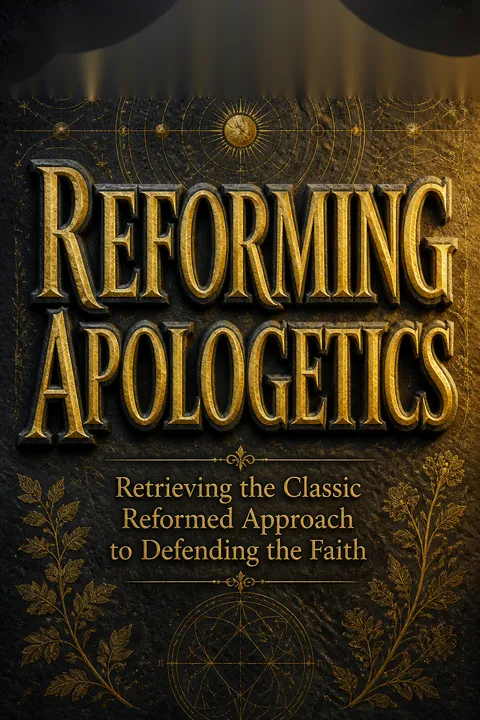


Key Takeaways
Use both of God's books: creation reveals God, while Scripture identifies salvation.
Two sources, distinct roles. The book of nature means God’s disclosure through creation, human conscience, and the order of the world. Scripture is the clearer, saving revelation of God in Christ. Reformed confessions such as the Belgic and Westminster affirm that nature displays God’s power and goodness and leaves people accountable, while also denying that nature provides the knowledge needed for salvation.
Read them together. Fesko argues that Scripture should guide interpretation of nature, not replace attention to it. Natural theology, meaning reasoned knowledge of God drawn from creation, can support moral reflection and the defense of faith. But it cannot supply the gospel. Nature and Scripture are complementary witnesses, with Scripture holding priority.
The two-book model resists a false choice between treating the world as religiously silent and treating nature as a substitute for Scripture. Its strongest feature is the asymmetry: both sources matter, but they do not answer the same questions. That distinction also offers a useful discipline for public argument. Observations about the world can be shared and examined, while claims about redemption require the particular story and authority of Scripture. The account is most persuasive when it avoids making every natural observation carry a theological conclusion it cannot independently establish.
Treat common moral principles as shared evidence, not infallible consensus.
A shared moral inheritance. Common notions are basic knowledge God inscribes in human beings, including awareness of God and broad distinctions between right and wrong. Reformed theologians connected them to Paul’s description of Gentiles who show the law’s work written on their hearts. Anthony Burgess and Francis Turretin distinguish basic principles from conclusions drawn in particular cases.
Fall distorts application. The principles remain, but people suppress them or reason badly from them. People may condemn deception in general yet excuse it when it benefits them. This shared moral awareness can support ethical argument and expose inconsistency, but it does not make people morally reliable or give them saving knowledge. Scripture clarifies and corrects what conscience and reason grasp imperfectly.
This account locates disagreement not only in different information but also in how people use what they know. That is a productive model for moral dialogue: begin with a principle both parties can recognize, then examine the reasoning that leads to a disputed conclusion. It also cautions against assuming that apparent agreement settles the issue. A community can share moral language while applying it selectively, and a principle can be widely recognized without being universally understood in the same way.
Read Calvin historically: he used natural law, classical learning, and causal arguments.
More than a slogan. Fesko challenges the image of Calvin as rejecting natural theology or scholastic reasoning. Calvin read Romans 1 and 2 as teaching that people possess natural knowledge of God and moral rightness. He used the Stoic idea of preconceptions, called prolēpsis, to describe basic ideas implanted in human beings, and connected this inward knowledge to what creation reveals.
Nature supplies evidence. Calvin also reasoned from the world’s order and effects toward their Creator, and he treated Paul’s use of Greek poets at Athens as a legitimate appeal to truth found outside Scripture. This does not mean Calvin thought nature could save. He emphasized sin’s distortion of knowledge and Scripture’s need to guide people toward God as redeemer.
The historical correction matters because appeals to a revered figure can become shortcuts that settle arguments before the evidence is read. Fesko’s case is strongest when it distinguishes Calvin’s actual use of natural knowledge from later claims about what a properly Reformed theologian must say. It also suggests a broader historiographical lesson: continuity is rarely sameness. Calvin shares methods and categories with earlier thinkers, yet he gives different weight to conscience, sin, and Scripture.
Let reason clarify faith, but never appoint it faith's ultimate judge.
Faith is the starting commitment. Fesko disputes the claim that Thomas Aquinas built theology on autonomous reason. Aquinas begins the Summa Theologica with sacred doctrine grounded in divine revelation. His arguments for God’s existence do not function as a ladder from neutral reason to faith. They show that rational discussion about God is possible and help answer objections or clarify claims already held in faith.
Reason remains useful. Aquinas reasons from effects in the world toward their cause, while acknowledging that these effects do not reveal God fully. He also says the fall damages human reason. Reformed theologians could therefore borrow parts of his treatment of natural law and argument while rejecting other theological commitments. The book presents scholasticism chiefly as a method of orderly questioning and response, not a fixed package of doctrines.
The distinction between a method and a worldview is important well beyond theology. A procedure for testing arguments does not by itself dictate the answer, just as a courtroom process can serve competing parties. Fesko’s historical account usefully complicates the familiar opposition between faith and reason. Still, showing that Aquinas begins from revelation does not settle whether every argument he makes is sound. Historical context can correct caricature, but each argument still needs evaluation on its own terms.
Reject exhaustive worldview demands; Scripture guides life without cataloguing every discipline.
A particular theory, not every worldview. Historic worldview theory, or HWT, treats a worldview as a comprehensive system built from a single starting principle, often with rival systems assumed to be incompatible. Fesko traces this approach through German idealism and its later use by James Orr, Abraham Kuyper, and Cornelius Van Til. He argues that its strongest forms leave too little room for shared human knowledge.
The Bible has a stated scope. Scripture directs belief about God and the duties owed to God, but it is not an encyclopedia of medicine, mathematics, art, or history. Fesko points to the Covenant Code’s parallels with Hammurabi’s laws and to Paul’s use of Greek poets as examples of shared knowledge. Christians can learn from others without accepting their entire outlook.
A framework can be comprehensive in its implications without containing every piece of information relevant to life. That distinction helps prevent a common category error: treating a religious text’s authority as proof that it supplies technical instructions on every subject. Fesko’s challenge to totalizing systems is compelling, especially where those systems turn disagreement into evidence that no common ground exists. The caution is that shared ideas do not automatically have shared meanings, so dialogue still requires careful attention to context and assumptions.
Use the TAG as one tool, and test claims against the world.
A presuppositional argument. The transcendental argument for the existence of God, or TAG, argues that some feature of experience, such as rational thought, requires God as its necessary condition. Van Til used this approach to argue that Christian theism makes reality intelligible. Fesko does not dismiss the TAG, but rejects treating it as a magic solution that makes other arguments unnecessary.
Coherence must meet reality. An argument may show that a worldview fits together, but its claims must also correspond to the world. Fesko therefore defends evidence from nature and history alongside transcendental reasoning. Van Til himself allowed evidence and traditional arguments when properly framed, though some followers have minimized them. The book’s practical recommendation is a varied apologetic, not reliance on one philosophical technique.
The distinction between coherence and correspondence captures two different tests: whether beliefs fit together, and whether they accurately describe what exists. Either test can fail on its own. A neat system can be detached from reality, while isolated facts can be interpreted without a larger account of meaning. Combining the tests makes the argument more robust. The TAG’s usefulness will also vary with the audience: a person who rejects its assumptions may be better engaged first through concrete evidence or a specific moral claim.
Distinguish between genuine opposition and distinctions that describe one coherent reality.
Two things need not be two worlds. Fesko challenges accusations that historic Reformed theology becomes dualistic whenever it distinguishes body from soul, nature from grace, or natural from supernatural revelation. A genuine dualism, in his account, pits two principles against each other in an irreconcilable conflict. A distinction can instead describe different aspects or roles within a unified reality.
Test the charge. Thomas Aquinas, for example, treats human beings as body and soul together, not as a soul trapped in an inferior body. Reformed theologians likewise distinguish common grace from special grace without making them rival powers. Fesko argues that critics such as Herman Dooyeweerd often treat distinctions as separations and misread the historical sources. The label dualism needs evidence, not merely the observation that two categories exist.
This is a valuable argument about conceptual precision. Many theoretical disputes turn on whether a distinction is merely analytical or implies a hierarchy, conflict, or separation. Asking what the categories actually do can prevent a label from doing the work of an argument. At the same time, a distinction can still conceal a practical hierarchy even when its proponent denies separation. The proper test is not the terminology alone, but how the account explains dependence, interaction, and value.
Use apologetics to answer objections, clarify truth, and strengthen believers.
Arguments have bounded aims. Fesko identifies three purposes for apologetics: answering intellectual objections, clarifying Christian claims, and encouraging believers. Arguments may remove confusion, correct a historical claim, or help Christians understand why their beliefs are coherent. They can also defend the church against false teaching and, as early Christian apologists did, argue for civil tolerance.
Persuasion is not conversion. In this Reformed account, fallen people may understand arguments and evidence but will not be spiritually reconciled to God by reasoning alone. Conversion requires the Spirit’s work. That limit does not make evidence pointless: if the faith’s historical claims were shown to be false, belief would be undermined. Apologetics can serve evangelism, but it cannot guarantee its outcome.
Setting realistic goals protects apologetics from two opposite disappointments: expecting argument to produce conversion, or dismissing argument because it cannot. The book’s account separates intellectual comprehension from trust, a distinction that helps explain why people can understand a claim and still resist it. It also makes apologetics useful within the believing community, where careful argument can refine understanding even without an external opponent. The distinction should not become an excuse to ignore whether arguments are persuasive or well supported.
Treat knowing as covenantal love and growth, not mere information gathering.
Knowledge has a relationship. Fesko calls this covenant epistemology: knowing is shaped by the relationship between God and human beings, and by whether people submit to divine authority. In the creation account, Adam receives commands that call for trust and obedience. The biblical link between knowledge, law, and love means that knowing God is more than collecting accurate propositions.
Knowledge has a destination. The book also gives knowledge an eschatological goal, meaning an end toward which history moves. Human beings were meant to grow toward life with God, and Fesko presents Jesus as the last Adam who fulfills the failed human vocation. In this account, right knowledge changes the knower, forming love and obedience. After the fall, sin distorts this relation, and restoration depends on Christ and the Spirit.
This view joins questions of truth to questions of purpose and character. It challenges the idea that knowing is a detached activity, like accumulating facts in a storage room. In ethics and education, knowledge often shapes what people notice, value, and do; this account makes that formative dimension central. Its distinctive theological claim is that knowledge reaches its proper end in communion with God. That claim does not erase the need to distinguish factual accuracy from moral response, but it explains why the two matter together.
Defend faith with humility: shared human knowledge makes real dialogue possible.
The fall does not erase humanity. Fesko argues that believers and unbelievers retain a shared human nature and knowledge of the created world. Paul’s address in Athens uses ideas from Greek poets while redirecting them toward the biblical God. The book also notes that Cain’s descendants developed skills in city-building, herding, music, and metalworking. These examples make room for learning from people outside the faith.
Use evidence without superiority. Christians can appeal to nature, conscience, history, and common moral understanding, while letting Scripture correct their interpretation. They should not confuse spiritual knowledge with expertise in every field, or claim a uniquely Christian answer where Scripture is silent. The recommended posture is prepared, clear, and respectful: evidence can support the defense of faith, while humility acknowledges both human limits and shared gifts.
Humility here is not reluctance to make claims. It is a disciplined refusal to claim more than the evidence or one’s competence permits. That posture can improve dialogue because it allows genuine agreement, disagreement, and correction without surrendering conviction. It also guards against treating religious commitment as automatic expertise in science, history, or the arts. The account is especially useful in plural settings, where credibility depends not only on confidence but on accurately representing what others know and what remains uncertain.
Analysis
Fesko’s central achievement is historical as much as apologetic. He contests the familiar story that Reformed theology once rejected natural theology, only to be compromised by later scholastic thinkers. His archive of confessions and theologians instead presents natural revelation and common notions as durable parts of the tradition. The practical consequence is significant: apologetics need not choose between scriptural authority and public evidence. It can begin from faith while still reasoning about a world that believers and nonbelievers inhabit together.
The book is also a study in how inherited philosophical fashions can shape theological disputes without being recognized as imports. Fesko argues that totalizing worldviews and exclusive starting points owe more to modern idealist habits than to the confessional sources they claim to defend. His readings of Calvin, Aquinas, and Van Til are strongest when they restore context and distinguish an author’s method from later uses of that method. The resulting picture is not a simple endorsement of classical proofs: reason is real but damaged, natural knowledge is genuine but nonsaving, and evidence matters without being sufficient to convert.
A useful pressure point remains. Historical precedent establishes that a theological practice belongs within a tradition, but it does not by itself establish that every version of the practice is true or effective. The book’s own distinctions provide the means to assess that question: separate shared principles from disputed conclusions, coherence from correspondence, and comprehension from trust. That standard also applies to its critique of Van Til and Dooyeweerd. Correcting their historical readings does not eliminate their concerns about autonomy, suppression, or the way arguments depend on prior commitments. Instead, it places those concerns in a less absolute frame.
The book’s lasting practical contribution is a more modest and more versatile apologetic. Christians can use creation, conscience, historical evidence, and Scripture together, while remaining clear about each source’s reach. That approach avoids both intellectual retreat and the ambition to make Scripture answer every technical question. It makes persuasion a serious task, but not a substitute for conversion, and makes humility part of intellectual accuracy rather than a retreat from conviction.
Review Summary
Glossary
Light of nature
Natural knowledge of GodThe light of nature is God-given knowledge available through human nature, conscience, reason, and the created world. In the Reformed sources discussed by Fesko, it includes awareness of God, basic moral understanding, and the capacity to reason about creation. It is real but damaged by sin, and it does not provide saving knowledge of Christ.
Common notions
Shared basic principlesCommon notions are basic ideas or principles understood by human beings because they are created in God’s image. They include general awareness of God and elementary moral judgments. Reformed theologians distinguish these principles from the conclusions people draw from them, which can be distorted by sin, custom, or faulty reasoning.
Natural theology
Knowledge of God from natureNatural theology is knowledge of God drawn from natural revelation through reason, conscience, and observation of the created order. Fesko presents it as a legitimate but limited form of theological knowledge. It can support moral judgment and arguments about God’s existence, but it cannot reveal the gospel or provide the knowledge necessary for salvation.
Historic worldview theory (HWT)
A totalizing worldview systemHistoric worldview theory is the particular modern theory that a worldview forms an exhaustive system, derives from a central principle, and stands in fundamental incompatibility with rival systems. Fesko traces its intellectual roots to German idealism. He distinguishes this theory from the more ordinary use of worldview to mean a general outlook on life.
Transcendental argument for the existence of God (TAG)
God as knowledge’s preconditionThe TAG argues that some feature of experience, such as rational thought or the intelligibility of the world, requires God as its necessary condition. Van Til used it to argue that Christian theism best explains reality. Fesko regards it as useful, but argues that it should accompany evidence and other arguments rather than replace them.
Scholastic method
Structured theological debateThe scholastic method is an academic way of examining authoritative texts and disputed questions. It typically states a question, presents objections, offers a reasoned answer, and replies to the objections. Fesko argues that this method does not dictate a particular theology or make reason equal to revelation; it is a tool used by different traditions.
Covenant epistemology
Knowing within relationshipCovenant epistemology describes knowledge in the context of the relationship between God and humanity. In Fesko’s account, knowing involves response to divine revelation through trust, love, and obedience, not merely possession of information. Its goal is formative and eschatological: the knower is meant to grow toward faithful life with God.
Download PDF
Download EPUB
.epub digital book format is ideal for reading ebooks on phones, tablets, and e-readers.








