

Key Takeaways
Treat discovery itself as an invention, not merely the result of science.
The method can be the breakthrough. In 2009, mathematician Tim Gowers invited the public to help solve a difficult problem on his blog. Over 37 days, 27 participants posted about 800 comments, adding up to more than 170,000 words. They reached a solution to the original problem and a harder version, though months of further work remained to complete the proof.
Better processes multiply insight. The project matters not just for its mathematical result, but because it showed how online discussion could accelerate a kind of work usually done by individuals or small teams. Nielsen compares this possibility to the rise of modern scientific methods: a better way to discover can make advances that once demanded rare genius more attainable.
The key shift is from celebrating isolated breakthroughs to improving the machinery that produces them. That changes how progress is measured: a method that helps many teams make discoveries may matter more than any one result. Yet speed and volume are not sufficient measures of success. A fast collaboration can still generate errors, or leave its reasoning difficult to verify. The Polymath example is especially persuasive because mathematical arguments can be scrutinized step by step, making collective work unusually visible and testable.
Build routes that bring overlooked expertise to the problem at hand.
Find the person who finds it easy. Microexpertise is narrow, specialized knowledge that can make one part of a difficult problem manageable. InnoCentive connected ASSET India, which needed a reliable solar-powered wireless router for training centers, with Zacary Brown, a software engineer whose amateur radio and solar-power interests fit the challenge. A $20,000 prize attracted 27 proposed solutions, and Brown won.
Make luck repeatable. Nielsen calls the systematic creation of such useful encounters designed serendipity. In the Kasparov versus the World chess match, young champion Irina Krush coordinated ideas from grandmasters and anonymous forum contributors. One key move came from Yasha, a junior player who was not an elite expert. The collaboration could use each contributor's particular strength when the position made it relevant.
This is a compelling account of expertise as a resource that is often hidden by job titles and institutional boundaries. A useful system makes capability discoverable, rather than assuming that the most credentialed person has every answer. The challenge is that matching systems can only route attention using signals they can observe. If those signals favor familiar credentials, visible popularity, or easy-to-measure skills, unusual expertise may remain invisible. Good collaboration design therefore needs both broad access and ways for overlooked contributors to demonstrate what they can do.
Make large collaborations modular, reusable, and rewarding to enter.
Lower the cost of joining. Open source projects scale by dividing work into manageable pieces, welcoming small contributions, and letting people build on earlier work. When Linux outgrew Linus Torvalds's capacity to review every change, the project delegated decisions to trusted lieutenants and strengthened its modular structure. Firefox's issue tracker similarly gives contributors discrete bugs or feature requests instead of one giant conversation.
Let progress travel. The shared body of reusable work is an information commons: knowledge and materials that others can access and improve. In a MathWorks programming contest, entrants could reuse one another's code and see scores immediately. For a CD-packing task, the best solution improved dramatically through many submissions, with the final program filling the disc far more closely than early attempts.
These design choices work together. Modularity makes participation manageable, reuse preserves earlier effort, and visible feedback helps people choose where to contribute. The broader lesson is that collaboration is not simply a matter of putting more people in a room; it requires infrastructure that prevents their attention from being swallowed by the whole project. But modularity has limits. The failed Million Penguins novel showed that when every sentence depends on the whole story, dividing the work into independent pieces can damage coherence. The task itself must permit decomposition.
Crowds need shared standards to turn scattered insight into reliable knowledge.
Discussion can make decisions worse. In experiments by Garold Stasser and William Titus, students received incomplete information about candidates for student government. Each group collectively held enough facts to identify the best candidate, but discussion often reinforced the group's initial preference instead. In one version, support for the best candidate fell from 25 percent to 20 percent, while support for a worse choice rose from 61 percent to 75 percent.
Agree on how to judge. Nielsen calls a shared praxis the common body of knowledge and methods that lets participants assess claims and resolve disagreements. Mathematics, programming, and much of science have strong shared standards for evaluating evidence and reasoning. Where basic values differ, as in politics or art, disagreement may persist even after everyone has heard the same information.
The distinction helps explain why more communication does not automatically produce better collective judgment. Groups often repeat information everyone already knows, while unique evidence receives less attention. Shared standards can correct this by giving participants a common way to evaluate claims. Still, agreement on method is not the same as certainty or neutrality. Scientific fields can share rules of evidence while disagreeing about interpretation, and political choices often involve values that evidence alone cannot settle. The practical task is to distinguish factual disputes from genuine conflicts of priorities.
Open data lets outsiders ask questions its collectors never imagined.
Release the raw material for discovery. The Sloan Digital Sky Survey mapped hundreds of thousands of galaxies and made its data available online after a limited period for the project team. Researchers outside the collaboration could then pose questions the original collectors had not prioritized. By searching the survey, astronomers identified new dwarf galaxies and a candidate pair of orbiting supermassive black holes. A map assembled for one purpose became a resource for many inquiries.
Connections hide in accumulated knowledge. Information scientist Don Swanson used medical literature databases to connect migraines with magnesium deficiency through multiple links between conditions. The connection was later tested in clinical trials. In both cases, the new insight came not from collecting every fact anew, but from seeing existing information in a different combination.
Open data changes who gets to formulate the research question. That is a deeper shift than simply making results easier to inspect: the data can be reinterpreted by people with different interests, tools, and expertise. Yet a data release is not automatically useful. Without clear documentation, shared formats, and information about how measurements were made, a dataset may be technically public but practically unreadable. Open access also needs safeguards when data could expose private or sensitive information. The value lies in making knowledge reusable, not merely visible.
Pair machine-scale pattern finding with human judgment and curiosity.
Let each kind of intelligence do its strength. Data-driven intelligence is the ability to extract patterns from data at a scale people cannot manage unaided. Google and the US Centers for Disease Control built a model from search queries that tracked influenza-like illness. Against the 2007-08 CDC data, it achieved 97 percent agreement, offering a faster signal than reports that arrived one to two weeks later. The method was useful, though it tracked flu-like symptoms better than confirmed influenza.
Combine computation and judgment. In a freestyle chess tournament, teams joining human players with computers defeated stronger standalone computer systems. The winning team used ordinary chess software well, showing that results depend not just on raw computational power, but on how people direct it. The emerging data web could give such tools a far richer foundation of connected knowledge.
The strongest vision here is not a contest between human and machine, but a division of cognitive labor. Computers can search enormous datasets; people can notice when a pattern is interesting, questionable, or worth pursuing. The flu example also illustrates a central risk: a model can fit the data it was trained to track while measuring a nearby phenomenon rather than the target itself. Prediction is valuable, but it should not be mistaken for explanation. Human review, clear limits, and continued validation make computational discovery more trustworthy.
Invite citizens into research when their attention can do real scientific work.
Participation can produce discoveries. Galaxy Zoo asked volunteers to classify images of galaxies, a task humans then performed more accurately than available computer programs. More than 200,000 people made over 150 million classifications. Volunteer Hanny van Arkel spotted an unusual blue object near a galaxy, prompting follow-up observations and research into what became known as Hanny's Voorwerp. Other volunteers helped identify green pea galaxies, a rare class of compact, rapidly star-forming galaxies.
Some tasks demand more than clicking. Foldit turned protein-structure prediction into a game. Players manipulated protein models, learned strategies from one another, and shared scripts. In international prediction contests, they performed near the level of expert teams on some challenges and better than fully automated submissions. These projects let volunteers contribute labor, observation, and problem-solving, not just enthusiasm.
Citizen science is most powerful when the public is part of the knowledge-making process, rather than an audience for science or a source of unpaid routine labor. The examples also show that meaningful participation can include a path from simple tasks toward deeper expertise. That path requires good training, feedback, and recognition. Volunteer findings still need professional scrutiny and careful follow-up, as the Voorwerp story demonstrates. Broad participation can expand a field's capacity, but it does not eliminate the need for methods that test whether an observation is real and an interpretation sound.
Make openness pay, or scientists will rationally keep knowledge private.
Good intentions cannot beat bad incentives. Scientists are rewarded mainly for papers, grants, and career advancement, not for sharing data, code, or useful online resources. The quantum-computing qwiki had enthusiastic supporters but few contributors; many researchers saw no career benefit in maintaining it. Individual scientists who share without reciprocal participation can spend time and help competitors while gaining little themselves.
Change the rewards collectively. Scientific journals once helped make publication a route to reputation and employment. Nielsen argues that modern science needs comparable incentives for sharing other forms of knowledge. Grant agencies can require open access or data release, while citation systems could recognize useful datasets, code, and tools. The cycle is to record contributions, measure their use, and make that impact count in professional evaluation.
This argument treats openness as an institutional design problem, not a test of personal virtue. That matters because people respond to the reward structures around them, especially in competitive careers. Requirements can establish a common baseline, while recognition can make sustained, high-quality sharing professionally worthwhile. But metrics are imperfect proxies. If citations or downloads become targets, contributors may optimize for attention rather than reliability or reuse. Evaluation needs qualitative judgment alongside measurement, and policies should fund the labor of documenting and maintaining resources, not merely demand that they exist.
Give the public both access to science and channels to question it.
Access creates new bridges. The physics preprint archive arXiv lets anyone read many current research papers for free, while science blogs can explain research and bring expert scrutiny into public view. In the Simon Singh case, bloggers examined evidence cited by the British Chiropractic Association and showed that it did not support the claims being made. Online discussion made technical criticism available beyond formal legal proceedings.
Information alone does not settle public choices. Resistance to polio vaccination in Nigeria and the drop in MMR vaccination in the United Kingdom show how fears and distrust can overpower scientific evidence, with serious consequences for disease spread. Nielsen argues that society needs institutions connecting science to public debate and policy. Access matters, but so do communication, credibility, and public participation in decisions.
The public role of science cannot be reduced to distributing papers. People need ways to understand evidence, question claims, and see how uncertainty affects decisions. Open discussion can expose weak arguments quickly, but it can also amplify misleading claims when technical speculation is mistaken for settled knowledge. This makes trusted intermediaries and clear explanations essential. Public engagement is not a substitute for evidence, nor should experts be expected to resolve every value conflict. Its purpose is to make scientific reasoning available to society while keeping the reasoning itself open to scrutiny.
Analysis
The book's central argument is that the internet changes science most profoundly when it changes the organization of knowledge, attention, and reward. Its examples are deliberately varied: a mass mathematical collaboration, open source software, astronomy databases, citizen-science projects, and scientific publishing. Together they describe a system in which people and machines contribute at different scales, and previously isolated insights can be connected. The book's strongest contribution is to make collaboration concrete. It does not romanticize crowds as inherently wise. It identifies mechanisms that matter: task structure, accessible contributions, reuse, signals of progress, and common standards for evaluating claims. The account also makes a persuasive institutional point. Scientists may value openness in principle while acting defensively in a career system that rewards papers and grants. That tension is not a moral failing; it is a coordination problem. Policy mandates can set expectations, and reputational incentives can make contributions visible. The book is particularly sharp in showing why unilateral openness often disappoints: many benefits appear only when others participate too.
The argument is less complete on governance. The same networks that circulate useful data can concentrate attention, reward popular topics, or expose material that should remain private. A collaboration can also meet its chosen benchmark while missing a more important question. Shared standards help participants agree about progress, but the standards themselves deserve scrutiny, especially when research affects people who do not control its data or goals. Openness therefore needs accountability, privacy protections, and explicit attention to who benefits.
The book's enduring insight is not that every scientific task should be crowdsourced or made public. It is that discovery has become a design problem. Researchers, funders, and institutions can decide what work to expose, how to route expertise, how to preserve evidence, and what kinds of contribution deserve recognition. Those choices shape the boundaries of what a community can know. Networked science succeeds when its tools expand intellectual reach without confusing more participation, more data, or faster publication with better understanding.
Review Summary
Reinventing Discovery receives generally positive reviews, praised for its exploration of open science and collaborative research. Readers appreciate Nielsen's insights on leveraging technology for scientific advancement and his vision for a more open, networked approach to discovery. Some find the book repetitive or lacking in certain areas, but many consider it a thought-provoking read on the future of scientific collaboration. Criticisms include occasional overreliance on specific examples and a need for more diverse perspectives from different scientific fields.
People Also Read









Glossary
architecture of attention
Routing scarce expertiseThe structure of tools and practices that guides participants toward problems where their knowledge is useful. It may include task design, filters, categories, and indicators of progress. Its purpose is not to make everyone follow everything, but to help a large collaboration use limited attention effectively and connect expertise to problems at the right moment.
designed serendipity
Engineered useful encountersThe deliberate creation of conditions that make unexpected but valuable connections more likely. In online collaboration, a broad and diverse group can expose a problem to someone with a precise skill or insight the original researchers lack. Serendipity is not eliminated; systems make its occurrence less dependent on chance encounters.
microexpertise
Narrow specialized knowledgeA person's unusually strong knowledge or skill in a limited part of a broader subject. A chess contributor may understand one opening unusually well, even if they are far weaker than a champion overall. Large collaborations can draw on these small pockets of expertise when their tools make the relevant problem visible to the right contributor.
conversational critical mass
Self-stimulating idea exchangeA condition in which contributions repeatedly spark further ideas, making a collaboration productive without relying on a single person to generate every next step. It depends on enough participants, cognitive diversity, and a way to share and develop ideas. The term describes a qualitative change in discussion, not simply a high number of comments.
shared praxis
Common standards for reasoningA body of shared knowledge, methods, and standards that lets collaborators evaluate claims and settle at least some disagreements. Mathematical proof and experimental evidence can provide such common ground in many scientific fields. Without it, participants may disagree over basic values or criteria, making it difficult to combine individual insights into a result the group accepts.
data-driven intelligence
Finding patterns in dataThe use of computational methods to extract patterns or useful relationships from datasets too large for people to analyze directly. Examples include correlating search queries with reports of illness and scanning astronomical surveys for unusual objects. It is a specialized capability that complements human judgment, rather than a general-purpose substitute for human thought.
data web
Linked machine-readable knowledgeA proposed network of scientific data that is openly available, connected across sources, and structured so computers can process it. Linked data could support searches and inferences across fields instead of leaving information in isolated databases. The book treats the idea as an emerging direction, not a completed system or a single agreed technology.
information commons
Reusable shared knowledgeA body of information that people can access and build upon, such as published scientific results or openly available software. In open source projects, contributors can reuse and modify earlier work rather than starting from scratch. A richer commons makes later contributions more productive, provided that reuse is accompanied by suitable credit and reliable documentation.
citation-measurement-reward cycle
Recognition for shared workA proposed way to encourage scientists to share forms of knowledge beyond papers. Contributions such as datasets, code, and preprints are cited, their use is measured, and that impact is considered in professional evaluation. The cycle aims to make sharing beneficial to individual careers as well as to the scientific community, while recognizing that metrics alone cannot judge quality.
Stasser-Titus experiments
Studies of hidden informationA set of group-decision experiments by psychologists Garold Stasser and William Titus. Participants received incomplete information about candidates, while the group collectively had enough facts to choose the strongest candidate. Groups often focused on information members already shared and failed to surface unique evidence, sometimes becoming less accurate after discussion.
FAQ
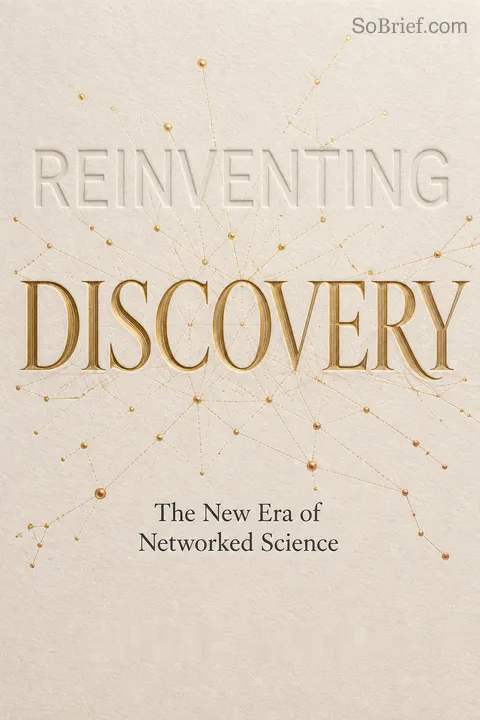
What's Reinventing Discovery: The New Era of Networked Science about?
- Networked Science Focus: The book explores how online tools and platforms are revolutionizing scientific research, moving away from traditional methods to more collaborative and open approaches.
- Collective Intelligence: It emphasizes the power of collective intelligence, where both professionals and amateurs contribute to scientific discoveries through online collaboration.
- Cultural Shift: Michael Nielsen argues for a cultural change in the scientific community towards openness and sharing, which is essential for leveraging the full potential of networked science.
Why should I read Reinventing Discovery by Michael Nielsen?
- Modern Science Insights: The book provides a comprehensive overview of how technology is reshaping scientific inquiry, making it essential for anyone interested in the future of science.
- Real-World Examples: Nielsen uses compelling case studies, such as the Polymath Project and Galaxy Zoo, to illustrate the practical applications of networked science.
- Visionary Perspective: It offers a forward-looking perspective on how open science and data sharing can accelerate discoveries, relevant for scientists, policymakers, and the general public.
What are the key takeaways of Reinventing Discovery?
- Discovery Transformation: The book argues that scientific discovery will change more in the next twenty years than it has in the past 300 years.
- Open Science Importance: Nielsen emphasizes the need for a more open approach to science, advocating for data sharing and collaboration across disciplines.
- Collective Intelligence Power: The author highlights how online tools can harness collective intelligence, allowing diverse groups to tackle complex scientific problems more effectively.
What are the best quotes from Reinventing Discovery and what do they mean?
- Internet's Impact: "The internet is clearly the revolutionary technology of this generation of astronomer," highlighting the transformative impact of the internet on scientific research.
- Reinventing Discovery: "We are reinventing discovery, and the result will be a new era of networked science," encapsulating the book's central theme of collaborative efforts leveraging technology.
- Potential of Open Data: "If we could do that, cutting out the slow and expensive X-ray diffraction step, we’d go from knowing the shape of 60,000 proteins to knowing the shape of millions," illustrating the potential of open data and collaborative tools.
How does Reinventing Discovery define collective intelligence?
- Enhanced Problem-Solving: Collective intelligence is described as the enhanced problem-solving ability that emerges when groups collaborate using online tools.
- Cognitive Amplifiers: These tools act as cognitive amplifiers, enabling individuals to contribute their unique insights and expertise to a shared goal.
- Success Examples: Nielsen provides examples, such as the Polymath Project, to illustrate how collective intelligence can lead to significant advancements in knowledge.
What role does online collaboration play in scientific discovery according to Reinventing Discovery?
- Increased Efficiency: Online collaboration allows scientists to work together across geographical boundaries, speeding up the discovery process and enhancing productivity.
- Diverse Expertise: It enables the pooling of diverse knowledge and skills, leading to innovative solutions that might not be possible through individual efforts.
- Real-Time Feedback: Online platforms facilitate immediate feedback and discussion, fostering an environment where ideas can be rapidly tested and refined.
What is citizen science as described in Reinventing Discovery?
- Public Participation: Citizen science involves engaging non-professionals in scientific research, allowing them to contribute to data collection and analysis.
- Empowerment of Amateurs: The book highlights how citizen science empowers individuals to participate in scientific inquiry, breaking down traditional barriers.
- Successful Projects: Examples like Galaxy Zoo and Foldit demonstrate the potential for collective intelligence to yield valuable scientific insights.
How does Reinventing Discovery address the challenges of data sharing in science?
- Cultural Resistance: The book discusses the reluctance of scientists to share data due to concerns about competition and potential loss of intellectual property.
- Need for Open Data: Nielsen advocates for a cultural shift towards open data, emphasizing that sharing data can lead to greater scientific advancements.
- Successful Models: Projects like the SDSS and the Human Genome Project are cited as examples of how open data can benefit the scientific community.
What is the significance of the term "data-driven intelligence" in Reinventing Discovery?
- Extracting Data Meaning: Data-driven intelligence refers to the ability of computers to analyze vast amounts of data to find patterns and insights that humans might miss.
- Complementary to Humans: The book argues that data-driven intelligence can work alongside human intelligence, enhancing our ability to solve complex problems.
- Scientific Examples: Nielsen cites examples like Google Flu Trends, demonstrating how data-driven intelligence can lead to significant scientific discoveries.
How does Reinventing Discovery suggest we incentivize open science?
- Reputation Economy: The author proposes expanding the scientific reputation economy to include contributions beyond traditional papers, such as data sharing and code development.
- Grant Agency Policies: Advocates for grant agencies to implement policies requiring open data sharing and public engagement to compel scientists to adopt open practices.
- Community Engagement: Encouraging scientists to participate in open science initiatives can help shift cultural norms towards collaboration and knowledge sharing.
What is the Polymath Project mentioned in Reinventing Discovery?
- Collaborative Problem Solving: The Polymath Project is an online initiative where mathematicians collaborate to solve complex problems collectively.
- Open Invitation: Initiated by mathematician Tim Gowers, it invited anyone to contribute ideas and solutions through a blog.
- Success Story: Within 37 days, the project solved the original problem and tackled a more complex issue, illustrating the potential of collective intelligence.
How does Reinventing Discovery address the future of scientific research?
- Open Science Movement: The book envisions a future where scientific research is more open and collaborative, with data shared freely among researchers.
- Technological Integration: Nielsen predicts that advancements in technology will continue to enhance our ability to analyze and interpret vast amounts of data.
- Collective Problem Solving: The future of science will increasingly rely on collective intelligence, enabling diverse groups to tackle complex challenges more effectively.
Download PDF
Download EPUB
.epub digital book format is ideal for reading ebooks on phones, tablets, and e-readers.








