

Key Takeaways
Treat resistance as information before calling it disobedience
A spook can reveal both partners. Blake recalls riding a young Arabian who fixated on a patch of ground. She searched for danger, then realized the horse was startled by the shadow of his rider. The moment exposed how quickly a rider’s fear can join a horse’s and make confusion look like proof of danger.
Listen before correcting. A horse’s behavior may signal fear, unclear cues, discomfort, or pain. In the story of Sage, a mare with obvious ulcer symptoms, training did not fix the physical problem. Blake argues for checking soundness, tack, and health before labeling resistance a bad habit. Listening does not mean accepting dangerous behavior; it means finding out what is driving it before choosing a response.
The distinction between behavior and its cause is central to good diagnosis, whether the subject is an animal, a child, or a colleague. A visible reaction is evidence, but it is not yet an explanation. That stance can prevent a common error: punishing the very signal that could identify a problem. It also asks for restraint from the observer, who may prefer a quick story about stubbornness to an inconvenient medical or relational cause. The caution is useful in both directions: not every refusal proves pain, but apparent compliance does not prove comfort.
Build every ride around relaxed, forward rhythm
The foundation is a balance. Blake uses “relaxed and forward” to describe movement that is both calm and purposeful. Relaxation without energy can become dullness; energy without relaxation becomes tension. Dressage begins by finding their balance, not by chasing advanced movements or a polished outline. The goal is a horse that moves with rhythm and uses its body freely.
Return to the basics. Blake’s favorite lesson, which she jokingly calls Walk Detention, was an entire clinic spent at the walk. She first felt embarrassed, then noticed the horse responding to small shifts of her seat. The slow pace revealed balance and communication she had been missing. For her, the walk is not a waiting room before the trot. It is where the partnership starts and where a rider can reset a ride that has gone sour.
Rhythm gives the pair a practical reference point when emotions or technique become messy. In motor learning, a stable pattern can make it easier to notice small changes and adjust without overreacting. Blake’s emphasis on the walk also counters the assumption that progress means moving faster or attempting harder movements. There is a limit, however: calm movement alone does not establish that a horse is sound, comfortable, or correctly trained. Rhythm is a useful diagnostic foundation, not a substitute for skilled instruction or veterinary care.
Use your breath to settle the conversation before cueing
The body speaks first. Blake treats breathing as both a calming tool and a cue. Shallow breaths often accompany tight shoulders, a clenched jaw, and restrictive hands. A horse can feel those changes through the rider’s body, while the rider may mistake the resulting tension for a problem caused solely by the horse.
Slow the moment down. During a veterinary visit, a large, nervous horse was held tightly by a new technician. Blake stood nearby and took several slow, audible breaths. The horse lowered his head as the vet gave an injection. Her point is not that breath replaces safe handling or professional judgment, but that it can help a human become calmer and offer a less alarming presence. When a ride speeds up mentally, she recommends breathing in rhythm with the horse and returning attention to physical sensation.
Breath offers a low-cost way to interrupt a feedback loop: one partner tenses, the other reads tension, and both escalate. Similar principles appear in performance coaching, where deliberate exhalation can help an athlete recover attention under pressure. The equestrian version is especially compelling because a rider’s breathing is embodied rather than merely verbal. Still, one calming episode is not proof that breath alone caused the horse’s response. The lesson is best understood as an accessible aid that supports, rather than replaces, competent handling and training.
Ask clearly, wait, then reward the smallest honest try
Timing changes the lesson. Blake describes a rider who asks a horse to move forward, then quickly increases pressure before the horse has time to answer. If the horse begins to respond just as the rider escalates, the correction can feel like punishment for trying. The horse may then hesitate or anticipate the wrong cue.
Make the answer visible. Give a clear request, breathe while the horse processes it, and acknowledge even a small improvement. A reward can be a softened rein, a relaxed leg, a kind word, or a break. If a correction is needed, make it brief and understandable, then return to a lighter cue. The point is not to avoid boundaries. It is to avoid nagging, conflicting signals, and pressure that continues after the horse has answered.
This is a precise account of how feedback can accidentally teach the wrong association. In learning theory, timing matters because an animal links consequences to the behavior occurring at that moment, not necessarily to the handler’s intended message. The practical advice is also humane: reinforce approximation, then refine it. That does not mean praising every response indiscriminately. The handler still needs a clear criterion and consistent boundaries. Without them, encouragement can become noise just as easily as repeated correction can.
Make trust a daily deposit, not a dramatic breakthrough
Experience accumulates both ways. Blake imagines a horse and rider keeping separate accounts of their history together. A patient ride, a fair correction, or a moment of fear handled well can add confidence. Confusion, pain, and repeated conflict can spend it. The rider cannot erase a horse’s past, but can build new experiences that make cooperation more likely.
Consistency matters more than heroics. Blake calls a rough guideline the Twenty Year Rule: a horse and rider tend to benefit when their combined experience gives them enough knowledge to support each other. It is not a literal qualification. A green horse paired with an inexperienced rider may need professional help, while an experienced horse can give a novice steadiness. End each session in a better place than it began, even if the achievement is small.
The account metaphor makes long-term learning easier to picture: relationships are shaped by repeated interactions, not a single spectacular success. It also avoids assigning all responsibility to either horse or rider. In attachment and trust research, predictability and repair after disruption are often as important as warmth. The metaphor should not be mistaken for a measurable ledger, though. Experiences do not all carry equal weight, and temperament, health, and context matter. Its value is as a prompt to ask whether today’s interaction increased safety or depleted it.
Give the horse time to warm before demanding advanced work
Preparation is part of training. Blake recommends beginning with a generous walk, then adding stretching movement and transitions before asking for more focused work. Her example of a dressage massage warm-up includes about ten minutes of free walking, roughly ten minutes of stretching at trot and canter, a walk break, a working phase, and a gradual cool-down. The sequence is adaptable, not a fixed recipe.
Warm up both partners. The book notes that joint fluids need movement and time to warm, and cites a ten to twenty minute period for horses. Blake repeatedly connects this physical preparation to mental readiness: a relaxed horse is more able to respond, while a rushed start can create resistance. If movement remains uncomfortable or irregular, the answer is not to push through. Reassess the horse’s soundness and seek qualified advice.
A warm-up is often treated as administrative time before the real work. Blake reframes it as a physiological and attentional transition, a view shared across sports and rehabilitation. Gradual loading can prepare tissues while giving the athlete a chance to notice how the body feels that day. The exact duration should remain responsive to the individual horse, its age, condition, weather, and workload. The strongest principle is not a stopwatch target but a progressive start that does not confuse stiffness or discomfort with unwillingness.
Use groundwork and play to build cooperation without force
The relationship starts on the ground. Blake’s Horse Agility exercises use obstacles, such as a tarp or hoop, as prompts for communication. The handler asks from a little distance with posture, breath, and a loose lead rather than dragging the horse through. The obstacle is not a pass-or-fail test. The aim is for the horse to understand, try, and remain mentally present.
Notice the quiet signals. Blake discusses “calming signals,” a term associated with canine behavior that she applies to horse body language, including looking away, yawning, or lowering the head. These actions may indicate pressure or an attempt to settle. A pause, softer body language, or a smaller request can prevent a conversation from turning into a tug of war. Playful work can make this practice less pressured and more varied.
Groundwork creates a setting where people can observe communication without also managing balance in the saddle. That makes it a useful low-stakes laboratory for attention, timing, and mutual adjustment. The obstacle itself matters less than whether the horse remains engaged and has room to respond. Body-language interpretation still requires humility: a yawn or glance away can have more than one cause. The safest approach is to treat such signals as reasons to observe and adjust, not as a complete diagnosis of the horse’s emotional state.
Change the exercise before repetition turns attention into numbness
Rote answers are not conversation. A horse can repeat a familiar movement without being mentally engaged. Blake compares routine groundwork to memorized classroom phrases: useful for starting, but dull if nothing develops beyond the primer. She suggests having several ways to ask for a task, including quiet, nonverbal cues, and rewarding genuine attention rather than speed alone.
Creativity serves the fundamentals. In the arena, repetitive correction can teach a horse that every effort is insufficient. Blake recommends changing the exercise, taking a break, or riding with more room and fewer demands. Her own lessons sometimes depart from the usual routine to restore curiosity. The goal is not novelty for its own sake. It is to keep the horse responsive while preserving rhythm, clarity, and a reason to participate.
This insight connects to a basic problem in instruction: repetition can stabilize a skill, but it can also produce mindless performance if feedback and challenge disappear. Good practice varies the task while keeping its purpose recognizable. That balance matters with horses because novelty can also unsettle them. Creativity should therefore be scaled to the individual, not imposed as entertainment. A small change in direction or cue may be enough to renew attention without turning the session into a parade of confusing surprises.
Protect the partner with helmets, health checks, and permission to stop
Safety is part of respect. Blake came to wear a helmet on every ride after considering her responsibility for other people at her barn. A visit to a young woman living with severe consequences from a riding accident made the risk personal. Her argument is simple: horses can fall or react unexpectedly in any discipline, so a rider should not reserve protection for obviously dangerous situations.
Do not train over pain. The book also urges riders to investigate health problems before correcting behavior. Blake cites high ulcer rates, including a claim that more than half of scoped horses with ulcers showed no symptoms. These figures are presented as reasons for awareness, not as a diagnosis. Persistent changes in behavior call for veterinary assessment. On an unusually anxious or unwell day, staying on the ground can be sound judgment, not surrender.
The safety argument is strongest when it treats risk as a feature of the activity rather than a test of courage. Protective equipment and medical assessment do not eliminate danger, but they reduce avoidable exposure and help distinguish training issues from health concerns. The nursing-home story gives that abstract risk a human shape without pretending that every accident has the same outcome. A useful qualification is that statistics vary by population and diagnostic method. Awareness should motivate careful assessment, not encourage owners to diagnose ulcers by behavior alone.
Measure success by partnership, not by ribbons or a perfect horse
The ride is not for sale. Blake values competition because it asks horse and rider to work together in public, but she rejects ribbons as the final measure. A small year-end show taught her to recognize a rider’s composure and care even when the horse’s performance was rough. She also argues that dressage is useful beyond elite competition: its principles can help ordinary, rescue, older, or mixed-breed horses become more balanced and responsive.
Choose a workable ambition. Success might mean learning a better transition, enjoying the barn, or watching a horse move freely in turnout. A rider does not need an Olympic prospect to have meaningful work. The relationship still demands time, money, and attention, so goals should match real priorities. Horses are powerful but vulnerable, and their working lives are finite. Gratitude is not a substitute for care; it is a reason to give that care consistently.
This account of success broadens achievement without dismissing skill or competition. It distinguishes external ranking from the quality of the process, a distinction familiar in education and craft: outcomes matter, but they cannot fully represent learning, care, or collaboration. The rescue-horse emphasis also challenges a market logic in which the answer to limitation is always buying a more capable partner. At the same time, affirming every partnership should not obscure welfare standards. Love is meaningful when it becomes practical responsibility, not merely a flattering story about devotion.
Analysis
This book is less a single argument than a repeated lesson approached from many angles: a horse is not a machine to operate but a perceptive partner whose body registers the rider’s cues, habits, and emotional state. The collection’s blog-like structure suits that claim. Stories about a spook, a clinic, a rescue horse, a painful medical condition, and a difficult lesson make the abstract principles concrete, then return to the same practical anchor: restore rhythm, reduce confusion, and listen before escalating.
The work’s distinctive strength is its refusal to separate technical riding from character. Patience, humor, humility, and consistency are not decorative virtues here; they shape the physical quality of the ride. The horse becomes a kind of feedback instrument, exposing where a rider’s stated intention diverges from bodily behavior. This makes the book unusually useful to readers who already know that good riding requires technique but have not understood why more effort can produce worse results.
Its recurring advice can sound absolute, especially when it treats the horse’s response as a reliable account of the rider’s request. That is a powerful corrective to human arrogance, but not a complete theory of behavior. Pain, fear, past handling, environment, and individual temperament can complicate any inference. The strongest reading is not that the horse is always right about every cause, but that the horse’s response deserves investigation rather than dismissal.
The book also carries a clear ethical position: safety equipment, veterinary attention, fair training, and soundness come before performance. Its practical ideal is not passive permissiveness. It is clear leadership without chronic pressure, with correction that is brief, proportionate, and followed by release. The result is a humane account of horsemanship in which progress is measured not only by what a horse can do, but by whether the horse remains willing and able to do it.
Review Summary
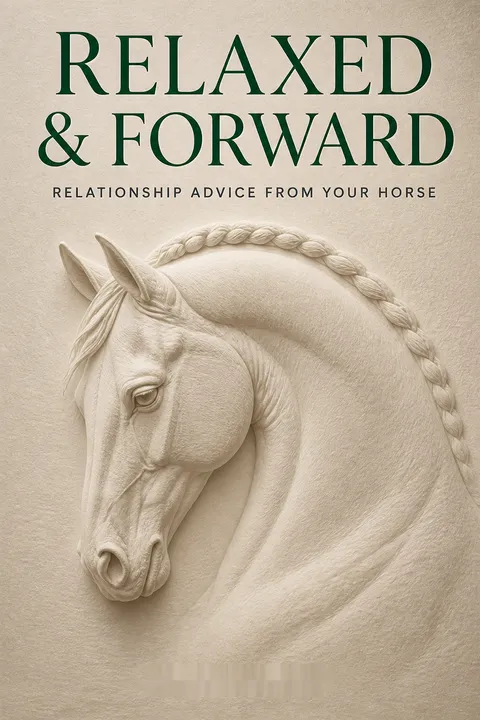
Relaxed & Forward receives high praise from readers for its insightful essays on the human-horse relationship. Reviewers appreciate the author's compassionate approach, emphasis on breathing, and practical advice applicable to all riding styles. The book offers valuable perspectives on improving communication with horses and developing patience. Some readers note repetition due to the book's origin as blog posts, but most find it inspiring and transformative. Many describe it as a must-read for riders seeking to deepen their connection with horses.
Glossary
Relaxed and Forward
Calm, purposeful movementBlake’s central description of good basic movement: the horse travels with rhythm and energy while remaining supple and mentally settled. Neither ingredient should erase the other. Relaxation without forward motion can become dullness, while forward motion without relaxation becomes tense or hurried. This balance is presented as the foundation for more advanced work and a practical way to reset a troubled ride.
Walk Detention
A lesson spent walkingBlake’s humorous name for being asked to remain at the walk during a riding lesson. What first felt like a punishment revealed how much the horse could respond to the rider’s seat and intention at a slow pace. The term represents using the walk as real training, not merely as a transition between faster gaits.
As-If Rule
Treat behavior as meaningfulBlake’s principle of responding to what a horse’s behavior communicates, even when the horse’s history or exact motivation is unknown. If a horse behaves as though a situation is frightening or confusing, the rider should begin with that experience as real and choose a patient, safer approach. The rule also applies to human behavior, since a rider’s visible tension can shape how the horse responds.
Twenty Year Rule
Combine experience for supportA rough horsemanship heuristic that a horse and rider benefit when their combined experience provides enough knowledge and steadiness to support the partnership. An experienced horse may help a novice, while an experienced rider can guide a green horse. It is not a literal requirement or guarantee. Blake uses it to highlight the risks of pairing two inexperienced partners without additional help.
Horse Agility
Groundwork through obstaclesA groundwork activity in which a handler guides a horse through obstacles, such as a tarp or hoop, using body position, breath, and light cues rather than pulling the horse through. The emphasis is on attention, confidence, and cooperation, not speed or passing a test. Blake presents it as a playful way to practice communication that can also inform riding.
Calming signals
Signals that reduce pressureA term Blake draws from dog-behavior writing and applies to horse body language. Examples discussed include looking away, yawning, lowering the head, or stretching down. These actions may communicate stress, an effort to settle, or a wish to avoid conflict. The rider is encouraged to notice them and adjust, while recognizing that an individual signal may have multiple causes.
Dressage massage
A gradual, supple warm-upBlake’s metaphor for riding that helps the horse move comfortably through a progressive warm-up and training session. It begins with free, rhythmic movement, adds stretching and transitions, and includes breaks and a gradual cool-down. The aim is for the horse to feel better prepared and more supple, rather than being hurried into demanding work.
Humor Deficit Disorder
Over-serious riding habitsBlake’s playful label for riding dominated by anxious self-talk, constant correction, and excessive seriousness. She argues that this mindset can stiffen the rider, disrupt rhythm, and make learning less pleasant for both partners. Humor is not offered as a replacement for sound training. It is a way to recover perspective, soften tension, and remain able to respond constructively to mistakes.
Download PDF
Download EPUB
.epub digital book format is ideal for reading ebooks on phones, tablets, and e-readers.








