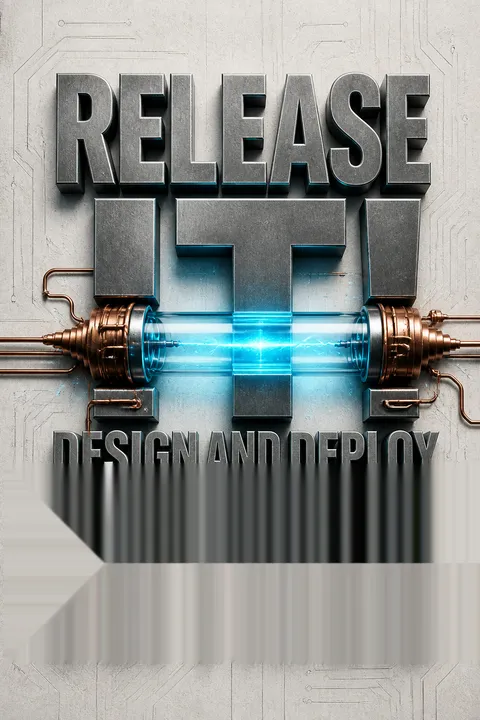


Key Takeaways
Design for years in production, not days in QA
Production is the real test. Passing QA shows that software can meet specified conditions in a controlled setting. It does not show that the system can withstand years of changing traffic, faulty dependencies, messy data, and unexpected user behavior. The book treats software as a product that must be designed for operation, not just for feature completion. Its car analogy is practical: a polished design that fails on the road is worse than a less glamorous one that keeps working.
Architecture spends real money. A retailer losing $3,000 per minute to downtime would lose about $1 million over five years of monthly releases, each causing five minutes offline. A $50,000 investment in downtime-free deployment could prevent that loss. The larger point is that decisions made to save development time can create recurring costs in operations, lost sales, and reputation.
What's striking is how the book turns reliability into a lifecycle-cost question rather than a technical luxury. That reframing helps teams compare a small upfront engineering investment with recurring losses that otherwise hide in separate budgets. It also invites a useful distinction: uptime is not the same as value. A system can be available yet slow, insecure, or unable to complete the transaction users need. The strongest production measures therefore track completed customer work and its economic effect, not just whether machines are switched on.
Stop small faults from crossing service boundaries
One defect became an airline outage. After a routine database failover, an airline's flight-search service began failing. A JDBC statement-close operation threw an exception, preventing the code from closing its database connection. Repeated calls leaked the connection pool until request threads had nowhere to go. The service's callers used remote calls with no timeout, so their own threads also waited indefinitely. Kiosks and phone check-in systems stopped working, contributing to a three-hour outage and a much longer passenger backlog.
Trace the chain, not just the first bug. The book distinguishes a fault, an incorrect internal condition, from an error, visible wrong behavior, and a failure, when the system no longer serves its users. A fault becomes disastrous when coupling lets it spread. Connection limits, timeouts, separate service groups, or asynchronous messaging could each have contained this incident.
The airline story illustrates a central idea in safety engineering: major accidents rarely have one sufficient cause. A coding defect mattered, but so did an exhausted pool, an unbounded remote wait, and the absence of isolation. This perspective makes postmortems more useful because it shifts attention from finding a person to blame toward finding barriers that were missing. The nuance is that adding barriers has costs and can reduce functionality. Teams need to decide which functions must survive and which can safely become unavailable.
Put time limits on every remote call and resource wait
Silence consumes capacity. A fast connection refusal lets a caller respond quickly. A connection that accepts a request and then never answers can hold a thread for minutes or indefinitely. In one example, a firewall discarded idle TCP connections without telling the endpoints. The operating systems kept retransmitting, and writes could wait 20 to 30 minutes before failing. Reads could wait forever. At a web service, enough blocked threads can make a running process indistinguishable from a dead one.
Bound every wait. Set connection and response timeouts on network calls, and limit how long threads wait for pooled resources or locks. Timeouts let a system recover control, but they need error handling and a defined response. Immediate retries can worsen overload by repeating work against a still-troubled dependency; queued, delayed retries are often safer when the work can wait.
A timeout is more than a defensive setting. It is a limit on how much one dependency may borrow from another system's finite attention. This connects naturally to queueing theory: as work waits longer, it occupies resources longer, leaving less capacity for new work. The difficult design question is not simply how long to wait, but which deadline governs the whole transaction. Nested calls need compatible budgets, or an inner operation may continue consuming resources after its caller has already given up.
Degrade selectively when demand outruns capacity
Contain overload deliberately. A circuit breaker records repeated failures and temporarily stops calls to a troubled dependency, allowing it time to recover. A bulkhead partitions resources so one function or customer group cannot consume all available capacity. Fail-fast behavior rejects work that cannot be completed promptly, while load shedding refuses excess requests near the system's edge. Back pressure slows producers when a finite queue is full, particularly within a controlled system boundary.
Choose what can be lost. These patterns preserve useful service by making failure smaller, not by promising that nothing will fail. A retailer might keep browsing available while temporarily disabling delivery estimates. A system should decide with business stakeholders whether orders can proceed without checking inventory or payment. Unbounded queues and infinite waits merely postpone the decision until the whole service is impaired.
These mechanisms resemble protective devices in other engineering fields: fuses sacrifice a component to protect a building, and ship compartments prevent one breach from sinking the vessel. Their value lies in explicitly choosing the failure boundary. Yet graceful degradation is not automatically graceful to customers. Returning stale information, accepting unverified orders, or shedding requests can create business or safety risks. The relevant question is therefore not only how to keep the system responsive, but which reduced mode remains truthful and acceptable.
Build observability and operator controls into the system
Make the system legible. Logs, metrics, health checks, and external synthetic transactions help distinguish a process that exists from a service that actually works. Useful signals include completed business transactions, queue depth, response times, connection-pool waits, cache health, and dependency failures. Production also differs from a developer's machine: servers may have multiple network interfaces, changing identities, separate administrative networks, and configuration that must not be embedded in the application image.
Give operators safe levers. During a holiday retail outage, the front end had thousands of request threads while a delivery scheduler could handle only about 25 concurrent requests. Runtime visibility exposed the blockage. Engineers reduced the relevant connection pool and restarted that component, restoring traffic without rebooting the entire site. Good controls make actions such as disabling an integration or adjusting a pool possible, while safeguards prevent automation from removing too much capacity too quickly.
Transparency is a form of organizational memory. Metrics reveal patterns humans cannot retain unaided, while clear logs and status indicators help people reason under pressure. Control matters just as much: diagnosis without a safe way to intervene leaves operators watching the failure unfold. This is a socio-technical design problem, because confusing controls can provoke mistakes even when the underlying software is sound. A useful limit is to expose operational mechanisms without burying teams in dashboards; every metric should help answer a question or guide a decision.
Make deployment a routine feature, not a midnight campaign
Release in small, reversible steps. One deployment described in the book involved more than 40 people over 24 hours and was estimated to cost about $100,000. It still failed user acceptance testing because production data differed from QA. The alternative is an automated build pipeline that tests and deploys small changes, uses a canary group or staged rollout, and can stop or reverse a bad release before it reaches everyone.
Design for coexistence. Zero-downtime deployment means old and new versions may run together. Database changes should expand first, allowing both versions to work, then contract after the old code is gone. For large document migrations, the trickle, then batch approach upgrades records as they are used, followed by a background pass over untouched records. Versioned web assets and compatibility checks help prevent browsers from mixing old code with new files.
Frequent deployment is often presented as a speed tactic, but its deeper benefit is smaller uncertainty. When each change is narrow, a failure has fewer plausible causes and a rollback affects less work. This resembles the logic of controlled experiments: isolate a change, observe its effect, and adjust. The trade-off is real. Staged releases and compatibility code add engineering work, and some regulated or safety-critical systems cannot move at the same cadence as a consumer website. Frequency should follow the cost of delay and the cost of error.
Keep services compatible so teams can change independently
Treat interfaces as promises. A service provider cannot assume every consumer will deploy at the same time. Additive changes, such as optional fields, are usually safer than removing fields or making previously optional data mandatory. Consumer-owned contract tests can check both that outgoing requests fit a provider's expectations and that the consumer handles the range of responses the provider allows. If a breaking change is unavoidable, support old and new versions side by side while consumers migrate.
Preserve room to adapt. Modular boundaries, loose clusters, and explicit context reduce hidden dependencies. A service that issues its own identifier, or passes a URL that carries context, can serve more callers than one hard-coded to a single owner or database. But microservices are not a cure-all: each adds operating, monitoring, and coordination costs. Choose boundaries that support independent change, and retire services that no longer justify their complexity.
Compatibility is a practical expression of reciprocity between teams. A provider that absorbs more of the migration burden gives its consumers room to plan, while contract tests make assumptions visible before they become outages. The design principle also connects to option value: modular boundaries are valuable because they make future substitutions or removals possible, even when those changes never happen. Still, compatibility can turn into permanent support for accidental behavior. A service needs a deliberate deprecation policy, evidence about actual use, and a credible way to end support.
Treat security as an operational property, not a final review
Assume boundaries are porous. The book's security survey covers injection attacks, stolen sessions, cross-site scripting, broken access control, exposed secrets, and vulnerable dependencies. Use parameterized database queries instead of building SQL from strings, escape untrusted content before rendering it, and authorize access to each resource on every request. A URL or a successful login is not proof that a caller may access every object.
Limit the damage. Encrypt sensitive data in transit and at rest, keep credentials outside ordinary application files, patch dependencies, and run services with only the privileges they need. Internal APIs also require authentication because a supposedly trusted network can be breached. Security depends on repeatable operations: knowing which libraries were built into a release, rotating secrets, and being able to redeploy patched software quickly.
The security argument fits the book's wider resilience model: a breach is not just a perimeter failure, but a chain of weak assumptions about input, identity, dependencies, and permissions. Least privilege limits the damage when prevention fails, much as bulkheads contain operational faults. There is also a human-factors lesson: security controls that are hard to configure or deploy invite workarounds. Strong policy matters, but usable defaults and rapid patch pipelines determine whether that policy survives contact with routine work.
Test resilience by safely breaking the whole system
Observe behavior under stress. Chaos engineering is the practice of deliberately injecting faults into a distributed system to learn whether it continues meeting its essential requirements. Netflix's Chaos Monkey randomly terminated instances so teams could verify that services recovered. Other experiments introduce latency or failed service calls. These tests target interactions that small QA environments often miss, such as retry storms, cascading failures, and recovery loads that overwhelm a database.
Make experiments safe and informative. Start with a specific hypothesis about user-visible behavior, reliable monitoring, request tracing, a limited blast radius, and a recovery plan. Faults should be correlated with their effects so teams can see what protected a request or caused it to fail. The book also extends the idea to people: a planned absence drill can reveal undocumented procedures that depend on one employee.
The method addresses a measurement problem: a system that has not failed recently may be robust, or it may simply have avoided the conditions that reveal weakness. Controlled disruption creates evidence about the difference. This links chaos testing to experimental science and high-reliability practice, where teams rehearse responses before rare emergencies. The caution is essential: experiments can harm customers if the hypothesis, safeguards, or abort mechanism are weak. Randomness is useful for discovery, but targeted tests are needed once the obvious vulnerabilities have been repaired.
Analysis
Release It! is best understood as a book about designing a system's capacity to recover, not as a checklist for preventing every defect. Its recurring stories make a structural argument: incidents grow when faults encounter unbounded waits, shared bottlenecks, hidden dependencies, and inadequate feedback. That approach is more durable than a catalog of technologies because it asks engineers to reason about how damage travels.
The narrative moves outward from code to operations, infrastructure, security, deployment, organizational structure, and experimentation. This widening frame matters. A database exception can become an airline outage; a marketing offer can overwhelm a delivery service; a typo in an administrative tool can disable a cloud platform. In each case, the effective system includes people, automation, contracts, data, and networks. Reliability therefore cannot belong to operations alone, nor can it be certified by QA in isolation.
The book's strongest practical insight is that failures should be bounded and observable. Timeouts, resource limits, circuit breakers, bulkheads, health checks, staged releases, and controlled experiments are different ways of limiting consequences and improving feedback. The same logic applies to teams: smaller autonomous groups and compatible interfaces reduce the need for coordinated releases. The challenge is that every safeguard adds complexity. A circuit breaker can conceal a failing dependency, a cache can serve stale data, and aggressive load shedding can reject legitimate customers. Resilience is not maximized by accumulating patterns, but by matching them to business priorities and making their behavior visible.
The book also distinguishes technical efficiency from organizational adaptability. Fully utilized teams, tightly coordinated releases, and highly specialized platforms can appear economical while making change slow and failure costly. Contemporary reliability engineering adds a useful complement: explicit service-level objectives and error budgets can help organizations decide how much risk and release speed are acceptable. Such measures do not replace the book's judgment-centered approach. They make its trade-offs discussable, connecting user experience, operational risk, and financial value in a shared decision process. The lasting lesson is to design not for an imaginary fault-free environment, but for a system that can detect trouble, limit its reach, and recover without requiring a heroic human at 3 a.m.
People Also Read









Glossary
Circuit Breaker
Stops calls to unhealthy dependenciesA protective wrapper around an operation, often a call to another service. It records failures and, after a threshold is reached, stops making the call for a period. It can then permit a trial call to check whether the dependency has recovered. While open, it may fail quickly or use an agreed fallback.
Bulkheads
Partitions capacity to contain damageA design technique that divides resources into separate compartments so one failure or overloaded function cannot consume the capacity needed by everything else. Partitions can be made between servers, thread pools, service groups, or customer classes. The goal is to preserve critical or partial functionality when another compartment fails.
Steady State
Balances resource growth and cleanupA system condition in which resources that accumulate, such as database rows, log files, or cached objects, are also removed or recycled at a sufficient rate. Without a cleanup mechanism, finite storage and memory eventually fill, increasing latency or causing failures. The concept discourages recurring manual cleanup as normal operations.
Test Harness
Simulates unreliable dependenciesA separate test service that imitates the remote side of an integration point while deliberately producing abnormal behavior. It can refuse or delay connections, send malformed responses, or stop responding entirely. Unlike a typical mock, it can exercise network and protocol failures that do not fit the application's ordinary interface.
Recovery-Oriented Computing
Designs systems for rapid recoveryAn approach to system design that assumes hardware and software failures cannot be eliminated and that complete prediction of failure modes is impossible. It emphasizes surviving failures, restoring service quickly, and reducing dependence on error-free human action. The book applies this outlook through runtime visibility, fine-grained controls, and recovery without restarting an entire system.
trickle, then batch
Migrate data gradually, then finishA migration strategy for changing stored documents or records without taking the service offline. New code upgrades older data when users access it, spreading the work across normal requests. After active data has been converted and old code is gone, a background batch process migrates remaining records, which can then be cleaned up.
Conway's Law
System design mirrors communicationThe observation that organizations tend to produce software structures resembling the ways their members communicate. Teams with separate responsibilities and limited communication often create corresponding boundaries or dependencies in their systems. The book also treats the idea as a design lever: organizing communication deliberately can help produce a desired software architecture.
Chaos engineering
Experiments with controlled failuresA practice of deliberately injecting faults into a distributed system to learn whether it maintains essential behavior under disruption. Experiments can terminate instances, add latency, or fail service calls. Effective practice requires a clear hypothesis, adequate monitoring, a limited blast radius, and a plan to restore normal operation.
Download PDF
Download EPUB
.epub digital book format is ideal for reading ebooks on phones, tablets, and e-readers.








