

Key Takeaways
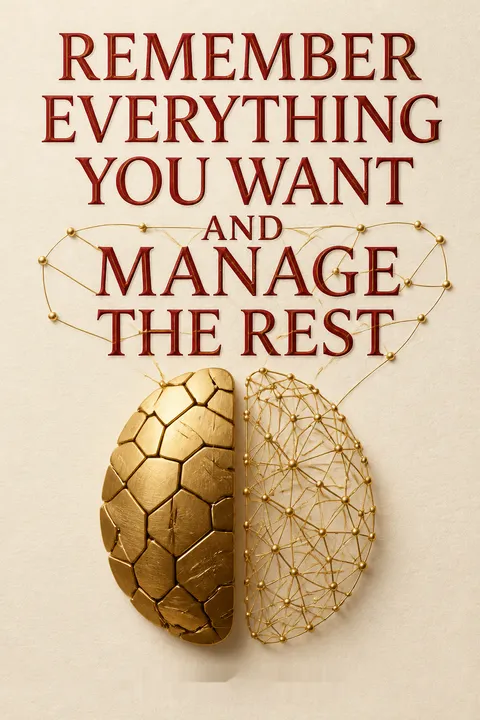
Remember deliberately, then let searchable systems hold what need not stay in memory.
Memory has stages. Information first registers briefly through the senses. Attention lets some of it enter short-term memory, where it fades quickly unless actively maintained. To become a more durable memory, it must be encoded, often by connecting it to knowledge already held. The case of H.M., who retained ordinary intelligence after brain surgery but could no longer form lasting new memories, illustrates that short-term holding and long-term learning are not the same process.
Three points can fail. A memory may never form because attention wandered, it may be encoded without useful cues, or it may become difficult to retrieve because it has not been recalled. Sachs distinguishes losing information from being unable to access it: returning to the setting where an intention began can sometimes restore the missing cue.
The useful shift is from treating memory as a container to treating it as a process with separate bottlenecks. That makes troubleshooting more precise: an unremembered action may need stronger attention at the moment, while an inaccessible fact may need better cues or retrieval practice. The framing also supports sensible offloading. Remembering everything is not a practical standard; remembering what matters and maintaining reliable ways to find the rest is a more realistic form of cognitive competence.
Name routine actions and stop task-switching when the details matter.
Autopilot leaves few traces. Repeated actions, such as locking a door or switching off a stove, can become so automatic that a person performs them without forming a clear memory of doing so. Briefly naming the action while performing it, and looking directly at the relevant object, makes the moment more distinctive. Keeping keys or other commonly misplaced objects in one consistent location reduces the need to remember where they were dropped.
Multitasking is switching. Attention-demanding tasks compete for limited mental capacity. A phone conversation while driving, for example, can impair performance even when the driver uses a hands-free device. Sachs cites research reporting roughly four times the crash risk for drivers on a phone, a risk comparable to driving at a blood alcohol level of 0.08 percent. The practical rule is to give important actions undivided attention.
This advice links memory to safety and design, not merely to study technique. Naming a routine action works like a small signal that distinguishes it from the many similar repetitions around it. A fixed place for possessions is an environmental solution, reducing dependence on attention in the first place. The caution is that deliberate checking can become burdensome for people prone to compulsive checking; a single attentive action and a stable routine are more useful than repeatedly seeking certainty.
Work in bounded focus intervals, then recover before attention collapses.
Set a finish line. Sachs recommends time-boxing: choosing a fixed period for one task, working without avoidable interruption, then stopping for a short break. Twenty minutes is a suggested starting point, not a universal optimum. Difficult reading may become less productive after 10 to 20 minutes, while another task may sustain attention longer. A timer, a written list for distracting thoughts, and silenced alerts can protect the interval.
Recovery supports learning. Short-term stress can sharpen attention, but prolonged stress can interfere with memory formation and recall. Sleep, by contrast, helps consolidate newly learned material. The book describes experiments in which a night of sleep improved performance on a motor task by about 20 percent, and raised the share of participants who noticed a hidden pattern from roughly 25 percent to 60 percent. These findings make rest part of learning, not a reward after it.
Time-boxing is a form of workload design: it makes an intimidating task finite and gives interruptions a place to wait. That can reduce the frustration that otherwise sends attention toward easier distractions. The sleep examples also counter the familiar tendency to treat studying time as the only productive time. Still, fixed intervals should serve the learner rather than become a productivity ritual. Attention varies by person, task, and health, so the interval needs adjustment rather than obedience.
Connect, picture, explain, retrieve, and organize facts instead of repeating them blindly.
Make information meaningful. Sachs groups six memory-building moves under the acronym AVECPO: association, visualization, elaboration, combining visual and verbal information, practice recall, and organization. Association links new material to something already known. Visualization gives it an image; elaboration adds explanation or context. For example, a new name can become easier to recall when it is connected to a familiar sound or feature.
Create more than one route. A diagram paired with words can clarify a process, while categories or a timeline can make a large set easier to navigate. Chunking means grouping separate bits into meaningful units, such as treating a long string of digits as a few familiar groups. The point is not to decorate every fact. It is to create useful structure and cues so the information can be understood and found again.
These techniques converge on a powerful principle: durable learning benefits from several meaningful routes to the same idea. A verbal explanation, a visual representation, and a place in a larger structure can each cue recall. The framework is most useful when selected with the material in mind. A vivid image can help with arbitrary details, but it cannot replace understanding a complex argument. Likewise, organization helps only when its categories reflect relationships that actually matter.
Use vivid mental locations to make arbitrary lists navigable.
Turn items into scenes. The Link System connects each item in a list to the next through an interacting mental image. A list of errands might become a short chain of exaggerated scenes, rather than a string of words to repeat. The method is flexible, but recalling a later item requires moving through the earlier links, so it is best suited to shorter lists.
Give each idea a place. The Method of Loci stores information at ordered locations along a familiar route, such as rooms in a home. To recall a speech, a learner mentally walks the route and retrieves an idea at each stop. Ancient Roman speakers used this approach to organize long speeches, and modern memory competitors use it for ordered material. Number systems can also turn digits into images. Sachs notes a 2006 record of 67,890 digits of pi, an extreme demonstration rather than an everyday target.
Spatial memory offers a useful scaffold because places and routes are often easier to revisit mentally than abstract sequences. The method also makes omissions visible: a speaker can move from location to location and notice a blank. Its strength comes with a tradeoff. Elaborate images and palaces take time to build, and details can interfere if a route is reused too soon. For an ordinary short list, a simple cue or written note may be the more efficient tool.
Test yourself at expanding intervals; rereading mostly creates familiarity.
Retrieve before reviewing. Active recall means trying to produce information from memory before looking back at the source. Sachs recommends writing questions while studying, taking a brief break, answering from memory, and then checking the result. Research described in the book finds that rereading can look effective on an immediate test, while recall practice better protects information over time. Short-answer prompts are particularly useful because they require the learner to generate an answer rather than recognize it among options.
Space the encounters. SPRIT is Sachs's name for Spaced Review Increasing Time Intervals. After learning, a person reviews soon, then allows increasingly longer gaps, such as a day, two days, several days, and then weeks. The Leitner Box System applies a related idea to flash cards: cards answered correctly move to less frequent review, while missed cards return to frequent practice.
Recall practice is more diagnostic than rereading because it exposes the difference between recognizing an idea and being able to retrieve it. That distinction matters in exams, conversations, and real work, where the source is not always available. Spacing also distributes effort toward material that remains difficult. The intervals in the book are sensible examples, not a precise prescription for every learner or subject. The key is to attempt retrieval, check accuracy, and return to weak material before it disappears from easy access.
Read nonfiction with questions, recitation, and a compact map of ideas.
Read on a mission. SQ3R is a five-step reading method: Survey a text, Question what it might answer, Read to address those questions, Recite the answers from memory, and Review them. Before opening a chapter, a reader can turn headings into questions or write down what they hope to learn. After reading, answering those questions without looking back helps distinguish understanding from mere exposure.
Compress the chapter. Sachs recommends turning the important answers into a mind map, a visual summary with a central topic and branches for major ideas. A map should preserve the structure needed to recall the chapter, not reproduce every sentence. A few main branches and concise keywords are usually more useful than a crowded page. A hierarchical outline can serve the same purpose, particularly when the original text already has sections and subheadings.
This method changes reading from a passive intake activity into a cycle of prediction, comprehension, and retrieval. The questions give attention a target, while the summary makes the reader decide what deserves to survive. That compression is also a test of interpretation: if a chapter cannot be reduced to a coherent map or outline, its structure may not yet be understood. The approach works best when the questions reflect the reader's actual purpose, rather than simply converting every heading into a mechanical prompt.
Learn language words in the direction you need to speak.
Practice the harder direction. For active conversation, Sachs recommends studying from a native-language cue to the foreign-language word, because producing the word is harder than recognizing its meaning. For reading comprehension alone, foreign-to-native practice may be more efficient. He advises focusing each flash card on one meaning in context rather than loading it with every possible translation.
Add a sound bridge when needed. The Keyword Method connects a foreign word's sound to a familiar, concrete image, then links that image to the word's meaning. Sachs's Enhanced Keyword Method adds a specific place or object as another cue. These techniques are best reserved for words that resist ordinary practice. He also warns against initially studying many semantically similar words together, since close neighbors can be confused; a story or spaced practice can separate them.
The choice of practice direction is a reminder that learning should resemble the task it is meant to support. Someone preparing to speak needs productive recall, not only recognition. Mnemonic sound bridges can lower the initial barrier, especially for unfamiliar vocabulary, but fluency requires the bridge to become unnecessary through repeated use. The advice to separate similar words also reflects a broader learning tension: categories help organize knowledge, yet tightly similar items can compete during early acquisition.
Tag sources by subject and project, then archive what deserves permanence.
Make information findable. A bookmark stores a pointer to an online item, while a personal library can preserve the item itself, its citation details, and notes. Sachs recommends tags for subjects and project labels for the work in which a source is being used. Consistent naming matters: using several different tags for the same topic makes later searches less reliable. Collections can group sources by project without creating separate copies of an item.
Keep what matters. A bookmark may be enough for casual browsing, but research often requires a saved copy, bibliographic information, and annotations. The book describes Diigo for bookmarking and tagging, and Zotero for collecting sources, organizing them, and generating citations. Those particular tools may change, but the workflow remains useful: collect broadly, identify what warrants preservation, and keep the durable record with its source information.
This is a practical answer to the limits of human recall: a person does not need to memorize every useful source if the source can be reliably retrieved. Tags act like flexible subject indexes, while collections preserve the context in which a source matters. That distinction prevents one item from being trapped in a single folder. The system can still become cluttered, however. Archiving everything recreates the original information overload, so a useful library needs selection as well as storage.
Turn notes into concise outlines that can test your understanding.
Summarize in your own words. Sachs advises reading a paragraph or section before highlighting, then identifying its central idea and supporting details. An outline arranges those ideas hierarchically, allowing details to be hidden beneath headings. Collapsing the outline turns its headings into prompts: try to explain a section, then reveal the notes to check what was missed. A mind map offers a more visual alternative, especially when relationships between concepts matter.
Separate source from response. Notes can include questions, ideas, and comments, but these should be distinguishable from the author's claims. Digital annotations make it possible to search or export highlights, while external outlines can combine material from different sources. The book's summarizing advice is to remove trivial and repeated details, group examples under a broader category, and state the main idea plainly rather than copying whole passages.
A good note is not a miniature duplicate of the source. It is a retrieval device and an interpretation, shaped to help the reader reconstruct the important argument. Separating one's own comments from the source also preserves intellectual honesty, especially when notes later feed into writing. Digital tools make capture cheap, which can encourage indiscriminate highlighting. The discipline lies in deciding what is central, what supports it, and what can safely be left behind.
Analysis
The book's central contribution is a practical division of cognitive labor. Attention selects what enters; encoding gives it connections and cues; retrieval strengthens access; and external systems preserve material that need not remain in biological memory. This makes the title's promise more disciplined than literal total recall. The goal is not to store everything, but to remember deliberately and to build dependable ways of finding the rest. Its strongest advice is procedural rather than spectacular. A reader can apply active recall, spaced reviews, questions, visual organization, and consistent digital filing without becoming a memory athlete. The mnemonic techniques are compelling because they make arbitrary material concrete, but they are tools for particular jobs, not substitutes for understanding. A mental palace can help retain an ordered list; it cannot establish whether the list is relevant or true.
The book also treats learning as embodied. Distraction, chronic stress, and insufficient sleep are not side issues; they affect whether information is attended to and consolidated. Its time-boxing proposal makes this insight operational by giving focused work a boundary and recovery a place in the schedule. The advice is strongest when offered as experimentation, since attention spans and task demands differ.
The work's broad scope is both an asset and a limitation. It moves from memory science to mnemonics, reading methods, and digital libraries, offering a whole workflow for a lifelong learner. But the software examples and some quantitative claims reflect the book's 2013 setting and should not be mistaken for timeless guidance. Its durable lesson is the architecture underneath those tools: capture selectively, label consistently, summarize actively, and review through retrieval. The most effective personal system is not the most elaborate one. It is the smallest system that reliably connects a question to an answer, a source to its context, and new information to knowledge already in use.
Review Summary
Remember Everything You Want and Manage the Rest receives mostly positive reviews for its comprehensive memory techniques and organizational strategies. Readers appreciate the practical tips, examples, and software recommendations. Many find it especially useful for students and those needing to memorize large amounts of information. Some reviewers note the book can be dense and overwhelming at times. The sections on mind mapping, flashcards, and digital information management are frequently highlighted as valuable. While some content may be outdated, most reviewers find the core principles and techniques highly beneficial for improving memory and learning.
People Also Read






Glossary
AVECPO
Six memory-building movesSachs's acronym for six ways to strengthen memory: association, visualization, elaboration, combining visual and verbal information, practice recall, and organization. The elements help make information meaningful, connect it to existing knowledge, and provide cues for later retrieval. It is presented as a practical set of building blocks, not as a fixed sequence that every learner must follow.
Chunking
Grouping bits into unitsChunking combines separate pieces of information into larger units that are meaningful to the learner. A string of nine digits, for example, may be easier to hold as three familiar groups than as nine separate items. The grouping reduces the number of units being actively maintained, while depending on knowledge that makes each group recognizable.
Link System
Chaining images in sequenceA mnemonic technique for remembering a list by connecting each item to the next through a vivid mental image or scene. The first item cues the second, which cues the third, and so on. It is easy to create without preparation, but retrieving an item deep in a long chain requires moving through the preceding links.
Method of Loci
Placing ideas along a routeA mnemonic system that stores information at ordered locations along a familiar or imagined route. The learner mentally revisits the route to retrieve items in sequence. A route through rooms in a home can hold speech points or facts, with each location serving as a cue. The method has a long history in speech preparation and memory training.
Keyword Method
Linking word sounds to meaningsA mnemonic technique often used for vocabulary. The learner finds a familiar word that sounds like part of the unfamiliar word, visualizes it, and combines that image with the word's meaning. The resulting scene links pronunciation and meaning. It is most useful for difficult words and does not remove the need to practice pronunciation or recall.
Enhanced Keyword Method
Adding a specific place cueSachs's adaptation of the Keyword Method for learning foreign-language words. The learner chooses a specific object or location associated with the native-language meaning, then connects it to a sound-alike image for the foreign word. The extra place-based cue is intended to make the association more distinctive, particularly when learning words that are difficult to retain.
SPRIT
Reviews with growing intervalsSachs's abbreviation for Spaced Review Increasing Time Intervals. The learner practices recall after a short delay, then repeats reviews with progressively longer gaps, adjusting the schedule to the material and the learner. Its purpose is to maintain access to important information while spending less time reviewing material that is already easy to recall.
Leitner Box System
Sorting cards by recall successA paper flash-card method that uses several compartments to control review frequency. New or incorrectly answered cards remain in the frequently reviewed compartment. Correctly answered cards move to compartments reviewed less often, while missed cards return to the first compartment. The arrangement helps learners allocate practice toward facts they have not yet learned securely.
SQ3R
A five-step reading methodA structured approach to reading nonfiction: Survey the material, formulate Questions, Read to answer them, Recite the answers from memory, and Review. The method encourages active reading by giving the reader specific questions to pursue, then checks comprehension through recall rather than relying only on rereading.
Time-boxing
Working within a chosen intervalA focus strategy in which a person sets a defined period for one task, works with as few interruptions as possible, and takes a break when the interval ends. The length can vary by task and individual. Sachs suggests starting near 20 minutes for difficult work and adjusting based on sustainable attention.
Phonetic Number System
Turning digits into word soundsA mnemonic system that assigns consonant sounds to digits, then uses those sounds to form words or phrases that can be pictured. To remember a number, the learner recalls the word and translates its consonants back into digits. With prepared images for digit pairs, the system can support longer numbers and dates.
Dominic System
Encoding numbers as people and actionsA number-memorization system associated with memory champion Dominic O'Brien. Digit pairs are converted into letters and then assigned to familiar people, each with a characteristic action. Combining a person and action produces an image representing several digits. The system takes preparation to build but can be combined with a route of locations for long sequences.
Download PDF
Download EPUB
.epub digital book format is ideal for reading ebooks on phones, tablets, and e-readers.








