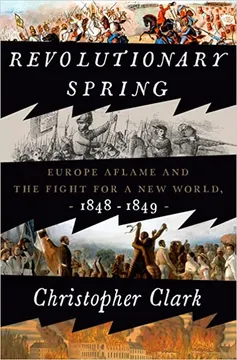


Key Takeaways
Treat 1848 as Europe's unfinished revolution, not a string of national failures
One continental upheaval. In February and March, regimes shook or fell from Palermo and Paris to Vienna, Berlin, Pest, and Milan. The events were connected, but not a single coordinated campaign. News crossed borders quickly; local grievances and political conditions shaped what happened in each place. The revolutions moved through a first burst of success, a summer of internal conflict, and an autumn of counterattacks that continued into 1849.
Defeat did not erase change. Constitutions, parliaments, political movements, and new habits of government emerged from the upheaval. Later national histories often recast these connected events as separate stories of failure. Clark instead follows people and ideas into and out of 1848, showing how a lost revolution could still alter Europe.
The book’s continental frame corrects a familiar distortion: national histories make a simultaneous crisis look like several unrelated episodes. Its account also resists the opposite mistake of treating Europe as one uniform revolutionary actor. Shared news and overlapping pressures created connection, while local institutions determined the outcome. This is a useful model for studying transnational movements: look for common timing and exchange without assuming a common plan or identical goals.
Read poverty as tinder, not a mechanical cause of revolution
A crisis with several layers. The Social Question was the period’s broad debate about poverty, unemployment, public health, industrial work, and inequality. In the 1840s, potato blight and poor grain harvests drove up food prices just as commercial and industrial contraction reduced work. In Prussia, an estimated 50 to 60 percent of the population lived at subsistence level. Ireland lost about 1.1 million people to famine and disease.
Distress did not dictate revolt. Hungry people often became inactive or focused on local grievances rather than joining a political movement. In Jerez, officials and bakers shared the cost of discounted bread, helping contain unrest. Elsewhere, governments refused relief or relied on repression. The same broad crisis produced different outcomes because political choices and local power relations shaped who could endure it.
This account avoids the seductive but weak formula that misery automatically produces revolution. Deprivation can intensify grievance, but it can also exhaust people and narrow their attention to survival. The Jerez example clarifies that famine is partly an administrative problem: storage, prices, relief, and access determine how scarcity is experienced. The wider lesson is to ask not only who suffers, but what institutions allow suffering to become coordinated political action.
Watch political deadlock turn local crowds into continental cascades
Triggers were often improvised. In Palermo, a printer posted a notice announcing a revolt on 12 January 1848, despite there being no real revolutionary committee or settled plan. The announcement drew curious crowds; clashes followed, and the uprising began. In Paris, the government’s ban on a political banquet became a focal point for a wider protest over voting rights and public assembly. Neither episode was simply the execution of a secret plan.
Cities connected the crowds. Newspapers, cafés, squares, and clubs carried news and turned scattered grievances into shared public events. Readers across Europe followed reports from Sicily, Switzerland, and France before their own revolutions broke out. Yet this was not a domino chain: a common European political culture met very different local tensions, producing distinct uprisings.
The book presents revolution as a meeting between long-building instability and short, unpredictable triggers. A banned banquet, a posted notice, or a shot in a crowd can matter because people already share information, grievances, and expectations. This resembles a cascade, but not a mechanical one: a signal travels only where local conditions make it meaningful. The distinction matters whenever public unrest appears sudden. What looks like an explosion may be a threshold crossing.
Street power can topple rulers, but cannot settle who represents the people
The street opened the door. In Paris, the Provisional Government emerged amid fighting through hurried negotiations at two newspaper offices and public acclamation in the streets. In Milan, municipal leaders claimed authority after the Austrian administration transferred control of policing. In Wallachia, a planned movement helped form a provisional government. There was no single route from uprising to government, and no settled rule for who could speak for the people.
Parliaments raised the next dispute. Across Europe, new assemblies and constitutions promised representative government. Yet the elections often returned moderate or conservative majorities, disappointing radicals who wanted social transformation as well as political rights. Assemblies also had to contend with monarchs, armies, clubs, and crowds. A parliament could claim legitimacy without controlling force, while a street movement could claim popular authority without agreeing on a durable government.
The distinction between legitimacy and capacity is central here. A crowd may force a ruler to retreat, but it cannot by itself administer a city, collect revenue, or settle competing claims to representation. Conversely, an elected assembly may possess a formal mandate while lacking control over soldiers or public trust. The revolutions expose a recurring institutional problem: political systems need channels for participation that are credible to people outside the chamber as well as inside it.
Pair political liberty with social rights or coalitions fracture
Freedom meant different things. Liberals emphasized constitutions, elections, and civil liberties. Radicals also asked what freedom meant to people without work or food. In Paris, the National Workshops offered temporary public employment after the February Revolution. They enrolled about 100,000 men, but their costs and purpose became fiercely disputed. When the government ordered them closed in June, unemployed workers returned to the streets.
The split turned violent. The June Days killed at least 3,000 insurgents as the republic’s leaders crushed a revolt by people whose support had helped make the revolution possible. Fear of property loss and disorder pushed many liberals toward the authorities. In Vienna, workers’ protests outside the city were treated as criminal disorder even while demonstrations inside it were celebrated as political action. The same revolution contained both movements, but its leaders could not reconcile them.
The conflict was not simply a clash between virtuous workers and selfish liberals. Public work schemes raised real questions about cost, taxation, and who should pay for unemployment relief. But treating those questions as secondary made the coalition brittle. The account suggests that political rights cannot substitute for material security, while also showing that social policy without broad consent can deepen resentment. Durable reform requires institutions that can negotiate distribution, not merely proclaim unity.
Make emancipation real in daily life, not merely law
Legal freedom arrived unevenly. In France, abolitionist Victor Schoelcher helped secure a decree ending slavery in the colonies. But enslaved people in Martinique rebelled and claimed freedom before the decree arrived; the local governor then acted without waiting for Paris. In Wallachia, a June 1848 proclamation freed privately owned Roma, but the revolution’s collapse allowed the order to be revoked. Formal emancipation did not instantly remove coercive labour relations or social dependence.
Other exclusions persisted. Women worked, wrote, organized, and fought during the upheavals, yet no European parliament enfranchised them. Jews saw constitutional promises of equality alongside anti-Jewish attacks and reversals of reform. These struggles were related, but they did not merge into one universal emancipation. The gap between a legal declaration and lived freedom remained wide.
The section distinguishes a change in legal status from a change in social power. A decree can open the door, but people still need control over work, residence, safety, education, and political voice. The cases also caution against treating emancipation as one indivisible process: race, gender, religion, and class carried different histories and faced different institutions. The strongest reading is neither cynical nor celebratory. Law mattered, but its promise depended on enforcement and material autonomy.
National belonging can unite against empire and fracture neighbours
Nations had to be made legible. Patriots built national feeling through language, newspapers, schools, songs, costumes, and stories of the past. Many people moved among regional, religious, dynastic, and linguistic identities rather than inheriting one fixed national label. In the Habsburg lands, these identities could overlap or compete.
Galicia showed the danger. In 1846, Polish nobles tried to recruit peasants for an uprising against Austria by promising an end to feudal burdens. Many peasants distrusted their landlords, who benefited from the system they promised to abolish; some attacked the insurgents instead. In 1848, Croat and Magyar national projects collided over political control and language. Nationalism could unite people against empire, but it could not automatically create solidarity across social or ethnic divides.
National identity works as a powerful coordination tool because it links private lives to a larger story of shared destiny. The same tool also draws boundaries: who belongs, whose language governs, and whose past counts. Galicia makes the credibility problem vivid. A political elite cannot recruit a population merely by invoking national brotherhood when daily power relations say otherwise. The section is strongest when it treats nations as real forces without pretending they are ancient, seamless, or internally equal.
Counter-revolutionaries prevail by learning, coordinating, and splitting opponents
The old powers adapted. In Paris, officials prepared for conspiratorial street fighting but initially misread the broader mobilization. Across Europe, however, governments watched the uprisings, restored troops, and learned where their opponents were vulnerable. The Habsburg monarchy could shift its attention among Vienna, Italy, Hungary, and the Slavic regions. In Hungary, Russian troops later joined Austrian forces to end the independence war.
Political division helped. Liberals feared radical violence; national movements mistrusted one another; rural grievances weakened urban coalitions. Some rulers also conceded constitutions or reforms before a revolt could grow, as in the Netherlands and Piedmont. Counter-revolution was not only brute force. It combined military superiority, international cooperation, selective concessions, and the ability to exploit divisions that the revolutionaries had not resolved.
The book’s explanation is stronger than the idea that reaction simply returned because it was stronger. Counter-revolutionaries observed, adapted, and exploited a political landscape in which revolutionary groups had different aims and little shared command. Yet outcomes were not predetermined: pre-emptive reform sometimes prevented a violent break, while delayed concessions invited one. The practical insight is that movements need coordination across institutions and social groups, not just courage at the moment of confrontation.
Defeat still remakes states, politics, and the people who carry ideas abroad
The aftermath was not a return to before. Several constitutions outlived the revolutions, including those of Denmark, the Netherlands, and Switzerland; the Piedmontese Statuto later became the constitution of unified Italy. Governments expanded administrative capacity, policing, and public investment. Former radicals entered state institutions, including in France, where ex-revolutionaries served as regional officials. Even counter-revolutionary states adopted methods and reforms shaped by the upheaval.
People carried the arguments. Exiles moved between Europe, the Americas, and the Ottoman Empire, bringing ideas into new local debates. Their influence was selective, not a simple export of a European model. The revolutions left no clean victory scene or common settlement. Their legacy is better measured in altered institutions, political vocabularies, and future possibilities than by asking whether 1848 won or lost.
This is a persuasive account of historical consequence without a triumphalist ending. Defeat can change the state that defeats a movement: constitutions, administrative routines, and personnel may survive in altered form. Exile also shows that ideas travel through people and relationships, not as intact packages. One caveat is that institutional survival can obscure who paid the price for stabilization. The book’s own emphasis on exclusion keeps the legacy from being reduced to a story of successful modernization.
Analysis
The book’s central achievement is to make simultaneity historically meaningful without turning it into a domino theory. Events from Palermo to Paris to Vienna were neither centrally planned nor independent. They arose from overlapping economic shocks, political deadlocks, shared repertoires of protest, and fast-moving reports, then diverged according to local institutions and social divisions. This is a model of contingent connection: events become mutually legible before they become mutually coordinated.
A second strength is the separation of three political clocks. Long-term structural pressures, such as land insecurity or industrial precarity, did not by themselves produce revolution. Medium-term political dynamics, including blocked reform, collapsing consensus, and the appearance of a unifying issue, made action thinkable. Short-term triggers, such as a banned banquet or a clash with troops, converted possibility into crowds and barricades. This layered causation avoids both economic determinism and the opposite error of treating a revolution as an accident.
The account also reframes defeat. The insurgents lost control, but the upheavals altered constitutions, administrative practice, political organization, and the terms of debate. Counter-revolution was not simply restoration: it learned to combine force with selective concessions, infrastructure, and a more capable state. That makes the book’s implicit lesson uncomfortable but useful. A movement may win the street and still lose the institutions that determine what follows.
The narrative’s European focus is strongest when it shows that national identity was at once an engine of mobilization and a source of fragmentation. The same patriotic language could oppose dynastic rule, obscure class conflicts, or authorize one people’s dominance over another. The global chapters add an important caution: news travelled widely, but effects were locally filtered. The result is a history less interested in a single verdict than in the mechanisms that turn shared hope into rival sovereignties, and rival sovereignties into new political orders.
Review Summary
Reviews of Revolutionary Spring are largely positive, praising Clark's sweeping, meticulously researched account of the 1848 European revolutions. Readers admire his pan-European perspective, balanced analysis, and ability to draw contemporary parallels, particularly to the Arab Spring. Many note the book's ambitious scope and density, finding it rewarding but challenging, especially for casual readers. The sheer volume of names, places, and simultaneous events can overwhelm, yet most agree it stands as the definitive single-volume treatment of the subject. Clark's prose is generally considered clear, witty, and authoritative, if occasionally dense.
Glossary
Social Question
Debates about social distressA nineteenth-century umbrella term for interconnected problems such as poverty, unemployment, public health, child labour, housing, industrial work, and social inequality. It was both a set of material conditions and a way of framing them. Conservatives, liberals, and radicals disagreed over whether distress arose from individual behaviour, insufficient reform, or the structure of the economic system.
National Workshops
Public employment reliefA French government programme created after the February Revolution of 1848 to provide work to unemployed men. It was distinct from Louis Blanc’s proposed cooperative organization of labour. The workshops enrolled about 100,000 workers, became politically contentious, and were closed in June 1848. The resulting anger helped precipitate the June Days uprising in Paris.
Sonderbund
Catholic cantonal military leagueAn alliance formed in 1845 by seven conservative Catholic cantons in Switzerland. Its creation followed disputes over religious policy and the authority of the federal government. The liberal cantons defeated the Sonderbund in a brief war in November 1847. The conflict became a European test of whether the post-1815 political order could contain liberal and national movements.
Statuto Albertino
Piedmontese constitutional charterThe constitution granted by King Charles Albert of Piedmont-Sardinia on 4 March 1848. It recognized civil liberties and established a two-chamber parliament, while preserving extensive executive authority for the king. Created under pressure from revolutionary unrest, it later became the constitution of the unified Italian kingdom and remained in force, with amendments, until 1946.
Proclamation of Islaz
Wallachian revolutionary programmeA twenty-two-point programme read aloud at Islaz on 21 June 1848 and adopted as the basis of the Wallachian revolution. It called for political and legal reforms, equality before the law, the abolition of inherited privileges, and the emancipation of peasants through compensated land transfer. The document became a constitutional programme for the revolutionary government.
Academic Legion
Viennese student militiaAn armed organization formed by students in Vienna after the March Revolution of 1848. It helped maintain security, participated in political mobilization, and became a significant centre of radical influence. The government’s attempt to dissolve it in May helped trigger a renewed uprising, after which the Legion and the National Guard assumed control of much of the city’s defence.
Moral economy
Community norms of fairnessA way to understand popular protest as a defence of customary expectations about fair prices, access to food, labour obligations, and local rights. In the revolutions’ prehistory, food riots and land protests often aimed to restore these expectations rather than overthrow a political system. Such protests could have political consequences even when their immediate motives were local.
Vésuviennes
Fictional women’s militiaA supposed Parisian women’s militia publicized in 1848 after a satirical recruiting poster announced that women should share military duties if they were to receive citizenship rights. The Vésuviennes never existed as an organization. Press caricatures turned them into a comic figure, illustrating both the visibility of women in revolutionary life and the limits of male accounts of their participation.
Download PDF
Download EPUB
.epub digital book format is ideal for reading ebooks on phones, tablets, and e-readers.








