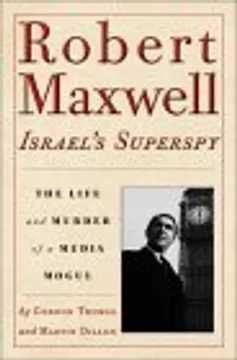


Key Takeaways
Read Maxwell's self-invention as a business tool, not harmless theater.
A life repeatedly renamed. Born into poverty in a Jewish village in Central Europe, Maxwell survived the Holocaust and built a new identity in Britain. During the war he served with distinction and received the Military Cross. He also told increasingly elaborate stories about resistance work, torture, and escape, though the book says some claims could not be true. He changed names several times before settling on Robert Maxwell, then cultivated an image of a tireless, worldly tycoon.
The performance had a purpose. Maxwell's self-promotion drew people toward him, while his invented history helped him control what they thought they knew. The book presents his appetite for publicity and secrecy as complementary, not contradictory: the public legend made his private dealings harder to question.
What's striking is how reinvention serves both as mobility and as insulation. Social psychology describes impression management as the work of shaping how others interpret a person; Maxwell made that work unusually deliberate, turning biography into a kind of business infrastructure. His wartime record also matters: genuine courage and false embellishment can coexist, which makes simple verdicts about character inadequate. The caution is that the book's psychological portrait often infers motives from anecdotes. A compelling pattern is not the same as proof that every boast was strategically planned.
Celebrity gave Maxwell access that conventional intelligence officers could not buy.
Fame became his cover. The authors describe Maxwell as an unusually valuable Mossad asset, a nonprofessional operative whose business dealings and celebrity opened doors across the Soviet Bloc. His publishing contacts connected him to scientists and political leaders; his reputation brought him invitations, audiences, and confidences. The book says he reported information about Soviet leadership, military thinking, and the changing prospects for Jewish emigration.
Access served more than one cause. Maxwell used relationships with figures such as KGB chief Vladimir Kryuchkov and Soviet leader Mikhail Gorbachev to pursue business opportunities and, according to the authors, gather intelligence for Israel. He also helped promote the release and migration of Soviet Jews. His value lay less in covert tradecraft than in being welcomed where Israeli officials could not easily go.
This account highlights a durable intelligence principle: social access can be more informative than technical collection when the goal is to understand what decision-makers believe. Brokers, publishers, and diplomats often see networks from the inside because their ordinary roles give them a reason to be present. Yet access is not the same as reliable knowledge. A charismatic intermediary may misread flattery as trust, or report only what suits his own interests. The book's account is most persuasive when it links Maxwell's documented relationships to specific information, and less so when private conversations are reconstructed from memory.
A database sold as software can quietly become an intelligence collection system.
Promis had a second alleged function. Promis was software designed to connect large databases and help users find patterns across information. The book says Israeli intelligence official Rafi Eitan obtained a copy from the US Justice Department through a false identity, then had programmers modify it and add a concealed access feature, called a trapdoor. That feature allegedly let Israeli intelligence monitor information entered by customers.
Maxwell became its salesman. Through companies connected to his publishing and technology businesses, he marketed Promis to governments, intelligence services, banks, and security agencies. The authors say sales reached more than $500 million. Separate congressional findings and litigation supported serious claims that the Justice Department mishandled Inslaw's software. The specific story of a hidden Israeli access mechanism is a further claim, not an equally established finding.
The episode is an early illustration of a problem now familiar in cybersecurity: software can be both a useful product and a channel for surveillance. That dual use makes ownership, audit access, and independent code review matters of national security, not just procurement. The distinction between the documented Inslaw dispute and the alleged trapdoor is essential. A government committee's criticism of a software theft does not, by itself, verify every later claim about intelligence exploitation. The book brings those stories together compellingly, but their evidence does not carry equal weight.
Follow the contracts: Maxwell blurred publishing, intelligence, and political influence.
Connections opened secure doors. The authors describe Maxwell paying former US Senator John Tower as a consultant, with a fee beginning at $200,000 a year. Tower's political standing helped arrange access to US officials and defense facilities. Maxwell then presented Promis to the Sandia National Laboratories, part of the country's nuclear weapons complex. The book argues that his commercial pitch also served Israeli intelligence interests.
The oversight trail is troubling. FBI records show an investigation into Maxwell's software activities, but many details remain redacted. The book says the inquiry stalled after the National Security Agency did not pursue the matter. It also alleges that Maxwell's network reached sensitive US facilities, though the full nature and consequences of any installation are not established in the available record.
The episode is a case study in conflicts of interest: a private consultant can become a gatekeeper between political power, commercial sales, and national security. Governance systems usually assume that disclosure and review can expose such conflicts, but those safeguards weaken when agencies themselves control the relevant records. At the same time, secrecy is not proof of a successful penetration. Redactions may conceal sensitive details, but they also limit what outside investigators can responsibly conclude. The sound lesson is to trace who authorized a contract, who benefited, and what independent checks were actually performed.
Opaque corporate networks can turn political transition into private criminal infrastructure.
Bulgaria became Maxwell's financial laboratory. The authors describe a secret arrangement with Bulgarian leaders and intelligence officials that gave Maxwell extraordinary freedom to invest and operate. Under a project called Neva, Bulgarian agents allegedly stole Western technology, Maxwell-linked companies reengineered it, and the products were resold across Eastern Europe. Shell companies and banks helped move the proceeds beyond Bulgaria.
Business and crime converged. Maxwell's companies also provided channels for money laundering and access to emerging criminal figures, including Simeon Mogilevich and Ivo Janchev. The book portrays Maxwell as a connector among former Communist officials, secret services, and organized crime. It estimates that billions were plundered from Bulgaria during and after this period, while acknowledging that records were destroyed or disappeared.
Political transitions create a distinctive governance risk: officials who once controlled state assets may retain the networks and information needed to privatize them for personal gain. The book's account suggests that corporate complexity can make this transfer hard to see, especially when companies, banks, and intelligence services overlap. That mechanism is more broadly persuasive than every claim about who directed each transaction. In a setting with shredded records and anonymous sources, estimates and attributions need particular caution. The useful question is not only who owned a company, but who controlled its money, information, and political protection.
Spectacular growth concealed debt, until Maxwell put employees' pensions at risk.
The empire was leveraged beyond safety. Maxwell publicly claimed enormous wealth, but the book contrasts his paper assets with roughly £2.2 billion in debts across 44 banks. By 1991, annual repayments had reached about £415 million. He kept creditors reassured with forecasts, complex company structures, and the appearance of constant deal-making, even as loans came due and the value of his shares fell.
Workers became his emergency fund. Maxwell used pension assets belonging to roughly 24,000 employees as collateral and drew on the funds to support his businesses. As creditors demanded repayment, he sought fresh money and pledged shares already promised elsewhere. The resulting collapse left employees exposed to losses and triggered investigations into the missing pension funds.
Maxwell's collapse shows how leverage can turn a private gamble into a public injury. The problem was not debt alone, but opacity: creditors and executives could not reliably see which assets had already been pledged, while workers had little power over the pension funds placed at risk. This resembles a principal-agent failure, where managers control resources on behalf of people who cannot monitor their use. The banks also had incentives to keep lending rather than force an early reckoning. A full explanation therefore includes both Maxwell's deception and the institutions that tolerated it.
An intelligence asset can become dangerous when survival demands threaten secrecy.
Maxwell's leverage changed direction. After his finances deteriorated, the authors say he asked Mossad to help raise about £400 million and threatened to expose what he knew if it refused. His position was especially dangerous after the failed 1991 coup against Gorbachev: Maxwell had relationships with Kryuchkov, the imprisoned KGB chief, and feared that records of their dealings might implicate him or Israel.
The authors allege an internal decision to silence him. They describe a small group of Israeli intelligence officers concluding that Maxwell had become a threat. On 5 November 1991, he disappeared from his yacht, the Lady Ghislaine, while it sailed near the Canary Islands. His body was recovered from the Atlantic. The book presents this as a Mossad assassination, but the claim depends heavily on former intelligence sources and contested testimony.
The underlying institutional dilemma is credible even if the alleged solution remains unproved. Intelligence agencies recruit people for access, but valuable assets also accumulate knowledge, dependencies, and private interests. When an asset becomes unpredictable, the agency faces pressure to protect both operations and its own reputation. That is a classic principal-agent problem with unusually high stakes. The book's account should still be treated as an allegation, not a settled historical finding. A dramatic sequence of motive, opportunity, and death can justify investigation without establishing who acted or why.
Treat Maxwell's death as unresolved: flawed autopsies cannot establish assassination.
The forensic record was badly compromised. The first autopsy in the Canary Islands concluded heart failure, but the examination lacked important toxicology and other tests. The body was then partially embalmed. At a second autopsy in Israel, pathologists found that several major organs, including the heart and stomach, were unavailable for examination. They recorded injuries, including damage to shoulder muscles and a mark behind the ear, but could not determine exactly how they occurred.
The experts did not prove murder. Israeli state pathologist Yehuda Hiss described the injuries as compatible with an involuntary fall into the sea. British pathologist Iain West considered drowning the most likely cause of death, while saying homicide could not be ruled out. The authors interpret the mark and circumstances as evidence of a covert killing, but no preserved toxicology result established the alleged poison.
Forensic conclusions depend on the chain of evidence: how quickly a body is examined, what samples are preserved, and whether specialists can test competing explanations. Here, embalming and missing organs sharply reduced what later pathologists could know. That procedural failure supports concern about the investigation, but it cannot identify a killer. The distinction matters because uncertainty invites stories that feel complete precisely where evidence is weakest. The most defensible conclusion is narrower: the death's circumstances were inadequately investigated, and the available pathology could not settle whether it was accidental, intentional, or criminal.
Separate documented financial abuse from the book's unproven murder claim.
The evidence has different strengths. Maxwell's debt, company dealings, and misuse of employee pension funds are supported by financial records and public investigations. The book also presents extensive interviews, some with intelligence officials and some anonymous, along with claims about Mossad, the KGB, organized crime, and the yacht's final voyage. Those accounts vary in how directly they can be checked.
Keep the categories distinct. The authors connect Maxwell's commercial empire, intelligence work, and criminal associations into one sweeping explanation. Some links are supported by documents or named witnesses; others rely on recollection, inference, or sources who cannot be identified. The central claim that Mossad killed Maxwell remains disputed and was not conclusively established by the autopsies or by a criminal trial.
This distinction is not a way to dismiss the book. It is how a reader can preserve its strongest insights without inheriting its weakest certainty. Historical inquiry often combines documents, testimony, and inference, but each source type answers different questions. Financial records can establish a transfer; an anonymous witness may suggest its purpose; neither automatically proves an assassination plot. The narrative's breadth makes it memorable, yet breadth can create an illusion that every connection is equally verified. A disciplined reader can accept the documented misconduct, take the intelligence allegations seriously, and leave the murder verdict open.
Analysis
This is a hybrid of biography, espionage history, and investigative true crime. Its narrative engine is a striking contradiction: Robert Maxwell appears at once as refugee, decorated soldier, media celebrity, Israeli intelligence asset, financial fraudster, and suspected murder victim. The story gains force because the same habits recur across those roles. He cultivated access, controlled information, borrowed against confidence, and treated ordinary limits as obstacles for other people.
The strongest through-line is the way commercial networks can acquire political and intelligence functions. Maxwell's publishing, software, banking, and Eastern European ventures were not separate worlds in the authors' account. They created routes into institutions and across borders. The Promis episode makes this especially vivid: a tool for organizing information becomes valuable precisely because the organization using it may not know who else can see the data.
The account is most secure when it describes visible financial conduct, corporate structures, and the pension-fund crisis. It becomes less secure as it moves from those records to secret intelligence operations and the claim that Mossad arranged Maxwell's death. The authors draw on extensive interviews, including anonymous sources, but their central assassination theory lacks conclusive forensic confirmation. The autopsies were compromised, which makes certainty harder, not easier.
That evidentiary imbalance is part of the book's value and its limitation. It maps a world in which intelligence agencies, corporate actors, politicians, and criminals may share infrastructure, but a map of connections is not proof that every line represents coordination. The most useful reading is therefore twofold: take the documented abuses seriously, and test the more dramatic claims against the quality and independence of their evidence. Maxwell's life shows how power accumulates when money, publicity, and secrecy reinforce one another. His death shows how poorly investigated uncertainty can keep that power's story unresolved.
Review Summary
Reviews of Robert Maxwell, Israel's Superspy are generally positive, averaging 3.9 out of 5 stars. Readers praise its depth and research into Maxwell's complex life as a media mogul, Mossad operative, and international power broker. The writing style is noted as occasionally sensationalistic, and some critics point out factual errors and a lack of source notes. The book's central claim — that Mossad assassinated Maxwell — is disputed by some reviewers, who suggest suicide or other actors as more plausible explanations.
Glossary
kidon
Mossad covert action unitThe book uses kidon, Hebrew for bayonet, for a Mossad unit assigned to covert operations, including assassinations. Its members are described as receiving specialized training in surveillance, disguise, weapons, and clandestine movement. The authors allege that a kidon team killed Maxwell, but the death was never conclusively established as an assassination.
Promis
Database integration softwarePromis, short for Prosecutor's Management Information Systems, was software developed by Inslaw to connect information across databases and help users manage cases or intelligence. The book says Israeli officials obtained and modified a version, then marketed it internationally. Its account of a concealed feature that let Israeli intelligence monitor users is an allegation distinct from the documented dispute over the software's acquisition.
sayanim
Diaspora logistical helpersSayanim were volunteers in Jewish communities outside Israel who, according to the book, provided practical assistance to Mossad agents. A helper might arrange a vehicle, lodging, banking services, or medical care. The authors describe them as a dispersed support network, not necessarily as trained intelligence officers or participants who knew the full details of an operation.
Neva
Bulgarian technology theft projectNeva was the name the book gives to a Bulgarian operation for acquiring Western technology through the country's secret service. Stolen designs or equipment were allegedly transferred to companies associated with Maxwell, reengineered, and sold across Eastern Europe. The project is presented as both an intelligence operation and a profit-making scheme involving officials and intermediaries.
LAKAM
Israeli scientific liaison bureauLAKAM was Israel's Bureau of Scientific Liaison, described in the book as an organization for obtaining scientific and technological information. Rafi Eitan led the bureau and pursued access to sensitive foreign technology, including the US-developed Promis software. The account presents LAKAM as separate from Mossad, though the agencies and their personnel sometimes worked toward overlapping intelligence goals.
Download PDF
Download EPUB
.epub digital book format is ideal for reading ebooks on phones, tablets, and e-readers.








