

Key Takeaways
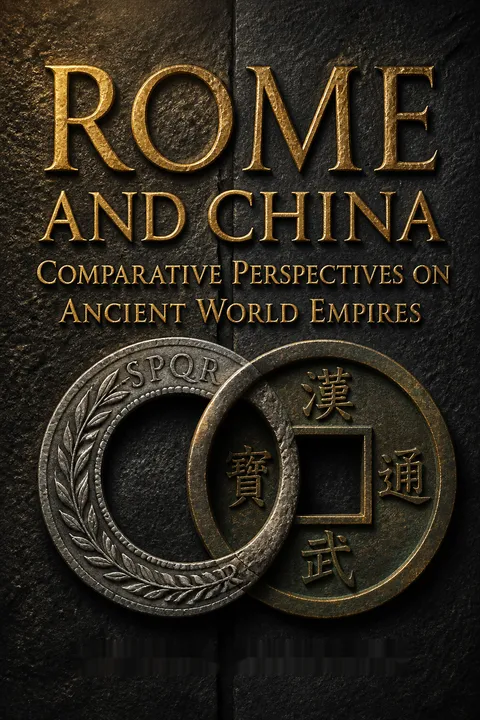
Compare Rome and China to separate shared imperial patterns from causes of difference.
Two distant giants. Around the beginning of the Common Era, Rome and Han China each ruled about four million square kilometers. Their subjects may have accounted for roughly half of humanity. Yet the empires barely knew one another. Chinese accounts imagined Rome as a faraway realm of strange customs; Roman writers passed along similarly fanciful tales about China.
Comparison reveals causes. The book uses these parallel empires as a test: which features arose in both large states, and which depended on local conditions? Both developed vast administrations, professional armies, standardized money, and imperial claims to rule the world. Their differences in military organization, law, political culture, and currency help explain why similar starting points did not produce identical histories.
What's striking is that comparison here is not a contest to name a winner. It is a way to make familiar institutions visible as choices rather than inevitabilities. That approach resembles controlled comparison in political science: cases with shared features help isolate which conditions matter. The method also has limits. Two cases cannot establish universal laws, and the surviving records are uneven. The strongest conclusions are therefore about plausible mechanisms, not proof that one factor alone determined either empire's fate.
Track how war built Qin bureaucracy while Rome relied on allies and citizens.
Different pressures, different states. In China, centuries of intense warfare among similarly powerful states rewarded governments that could extract soldiers, labor, and taxes directly. Qin's reforms divided territory into administrative districts, registered households, imposed shared responsibility for reporting crimes, and linked military service to rank and rewards. The state reached deep into everyday life because survival depended on mobilizing resources at scale.
Rome widened its base. The Republic faced serious wars, but it often expanded its strength by building alliances, extending citizenship, and settling colonies in conquered territory. Local elites retained substantial control, while Rome relied on their cooperation rather than a large central bureaucracy. Its victories did not initially require Qin-style administrative penetration. Later Roman crises changed that balance and drove rapid bureaucratic expansion.
The contrast connects military history to state capacity: governments build the institutions that solve their most urgent coordination problems. Qin's system made people legible to the state, while Roman alliances multiplied the pool of available troops without equally expanding central administration. Neither model was simply more efficient in every setting. Alliances can preserve local autonomy but depend on loyalty; direct administration can mobilize resources but invites resistance. War explains institutional pressure, not every political choice made in response.
Treat reunification and fragmentation as outcomes to explain, not civilizational destinies.
A long convergence. Rome and Qin-Han China followed surprisingly parallel paths from regional states to empires, then through political crises, frontier pressures, and the rise of successor regimes. Their institutional differences narrowed over time. By late antiquity, Roman government had developed a larger bureaucracy and a clearer separation between civilian and military administration, features that made it more comparable to Han institutions.
Then the paths split. After the sixth century, China repeatedly restored empire-wide rule, while western Eurasia developed a durable system of competing states. Scheidel estimates that the Chinese core was politically united for 936 of the previous 2,220 years, while the Roman western core was united for roughly 350 of 1,998 years, with no comparable unity for the following sixteen centuries. These figures frame a question, not a complete explanation.
The central analytic gain is temporal: similarities at one point do not guarantee similar trajectories afterward. Administrative inheritance, geography, military organization, and relations between rulers and local elites all offer possible mechanisms for the divergence. Yet the book properly treats the explanation as unfinished. Comparing one Chinese and one western European case risks turning a historical pattern into a cultural stereotype. The figures also depend on how the relevant political cores and periods are defined, so they should guide inquiry rather than end it.
Read imperial law as a negotiated instrument of coercion, not a rights guarantee.
Law restrained and empowered. Qin and Han rulers used law to organize labor, taxes, and punishment, while thinkers argued over whether clear rules could limit arbitrary decisions. In one Han case, the official Zhang Shizhi insisted that a commoner who startled the emperor's horses receive the penalty prescribed by law, not a heavier one demanded in anger. The emperor accepted the ruling, but sovereign power had no formal institutional check.
Rome changed gradually. Republican legal traditions gave citizens and elites procedures that did not map neatly onto monarchy. Under the emperors, public authorities increasingly controlled trials and punishment, but change was gradual and uneven. In both empires, critics could appeal to precedent, public order, or the ruler's responsibilities. Such arguments could temper coercion, but they did not amount to equal protection or an enforceable limit on imperial power.
This account avoids two easy mistakes: treating law as either a shield for the weak or a mere disguise for force. Rules can make punishment more predictable while still serving the state's need to extract resources and suppress threats. That distinction echoes modern debates about legality and the rule of law, where consistent procedures do not automatically guarantee fair outcomes. The comparison also warns against judging institutions by written codes alone. Actual practice depended on who controlled courts, who could petition, and whose suffering counted.
Court outsiders gained leverage by controlling access to rulers, not formal office.
Intimacy became influence. Eunuchs could serve as trusted attendants because their dependence on the ruler made them appear less like independent political rivals. In China, eunuchs instructed princes, managed palace routines, and controlled access to the emperor. Their proximity sometimes made them powerful intermediaries between the court, officials, and imperial women. The early Han story of Zhao Gao, who helped manipulate succession at the end of the Qin dynasty, became a lasting warning about their influence.
Rome followed a different timetable. Imperial freedmen performed influential administrative roles under early emperors, while eunuchs became especially prominent in the later eastern Roman court. In both settings, women at court could form alliances with these insiders, particularly when a young ruler or regent created a struggle over succession and access.
The chapter's useful shift is from anatomy to institutional position. Eunuchs' influence rested less on a mysterious personal quality than on control of information, access, and daily routines around a secluded ruler. Similar dynamics appear in modern organizations whenever gatekeepers can filter what leaders see, though the historical stakes and structures differ sharply. The argument also needs a careful boundary: court histories were often written by officials who resented eunuchs and women. Their accounts illuminate political conflict, but their villains may be shaped by elite prejudice.
See tribute and trade as linked machinery for concentrating agrarian surplus.
Empire gathered resources. Rome and Han China drew wealth from many local communities and concentrated it in the hands of rulers, armies, and urban elites. Most production came from peasants, whose obligations included taxes, rents, and sometimes labor service. Because imperial governments had few officials on the ground, they depended on local landowners and other intermediaries to collect revenue, leaving room for leakage and private gain.
Markets made tribute usable. Grain or goods collected as taxes did not necessarily match what the state needed. Exchange helped turn surplus into money, supplies, and distant luxuries. The process linked coercion and commerce, even when aristocrats condemned merchants or foreign luxuries as corrupting. Military campaigns were expensive, so rulers also sometimes preferred gifts, negotiated access, or frontier trade to costly war.
The chapter unsettles the tidy opposition between an empire ruled by force and an economy driven by markets. Markets could help states and elites convert agricultural surplus into usable resources, even when political rhetoric distrusted commerce. This resembles the broader idea that institutions shape markets rather than simply suppress or liberate them. Still, a large empire was not necessarily an integrated economy. Slow transport, uneven local conditions, and limited state reach meant that commercial exchange varied greatly across regions.
Notice whom imperial gifts reached: village households in Han, urban crowds in Rome.
Han gifts reached outward. Emperors awarded ranks that carried social status and legal privileges, issued pardons, helped people facing famine or flood, and provided gifts to the aged. These practices made imperial generosity visible in rural communities, where households and farming sustained the state. Powerful local families also distributed food, supported neighbors, and organized public works, especially as central authority weakened.
Roman gifts staged the city. Roman rulers and elites funded buildings, games, and other public benefits in urban settings. The emperor might appear in person, turning the event into a public encounter as well as a material gift. The contrast reflects two political worlds: Han authority was organized around registered rural households and a secluded ruler, while Roman elite giving was closely tied to cities and their visible public life.
Gifts were political technology, not just kindness. They made authority tangible, created obligations, and showed who could claim to provide for a community. The contrast also reveals how public life depends on physical settings: a city square, a festival, or a village gathering can shape who sees a ruler and who counts as a beneficiary. But records of benefaction are often self-promotional. A gift's appearance in a source may tell as much about the donor's claim to legitimacy as about the recipient's actual relief.
Bronze Han cash and Roman precious metals reveal different monetary constraints.
Two monetary paths. Han China built its currency mainly on bronze cash, while Roman money increasingly relied on silver and gold coin. The Han state produced more than 28 billion wuzhu coins from 112 BCE to the end of the Western Han, a massive output that helped establish a common currency. Gold circulated as bullion, but the evidence for its total use is uncertain, and silver was relatively scarce.
Metal value still mattered. Scheidel challenges the view that Han coins were merely tokens accepted by state decree. Their weights and metal content mattered to users, and attempts to issue heavily overvalued coins under Wudi and Wang Mang failed. Roman authorities also struggled to make debased money retain its official value. The chapter concludes, cautiously, that Rome was probably more monetized, while emphasizing that credit and other forms of money complicate any simple comparison.
This comparison shows how material supply and political choices can reinforce each other. Abundant bronze and a powerful mint helped China sustain mass circulation, while Mediterranean access to precious metals supported high-value coinage. Yet money stocks are not the same as economic activity: coins can be hoarded, lost, or used mainly for taxes, and credit can support exchange without appearing in surviving coin counts. The estimate that Rome was more monetized is therefore a reasoned hypothesis, not a direct measurement of prosperity or living standards.
Analysis
The volume's strongest achievement is to make comparison causal without pretending that Rome and China were interchangeable. Its chapters repeatedly connect institutional form to the pressures that sustained it. Prolonged warfare among competing Chinese states encouraged direct registration and extraction. Rome's expanding alliances and citizen body offered another route to military scale. These distinct beginnings mattered, but did not freeze either empire in place: crisis could remake institutions, as late Roman administrative changes demonstrate.
The book also brings political economy into arenas often treated separately. Law, court access, gifts, tribute, and money all concern the allocation of power and resources. Han ranks and pardons made imperial authority tangible to rural households; Roman benefactions made elite standing visible in urban spaces. Coinage likewise joined material constraints to political ambition. The recurring pattern is not simply a strong state, but a state negotiating with armies, local elites, and the populations whose labor kept it alive.
The most consequential question is why the two regions diverged after late antiquity. The volume assembles possible mechanisms, including institutional inheritance, frontier pressures, ecology, and relations between central rulers and local elites, but does not reduce the outcome to a single cause. That restraint is intellectually valuable. The comparison is asymmetrical in its evidence, its chapters differ in emphasis, and two macroregions cannot represent every premodern society. Nor does later political unity by itself prove superior capacity or social welfare. The book is best read as a research program: use paired histories to identify mechanisms, test them against other cases, and resist treating either European fragmentation or Chinese reunification as an ancient inevitability.
Review Summary
The reviews of Rome and China give it a middling 3.47 out of 5. Readers acknowledge its ambitious and informative comparisons between ancient Rome and Han China, covering military institutions, legal systems, gender roles, trade, philanthropy, and coinage. However, reviewers consistently note that the writing is dense, technical, and inaccessible to general readers, being clearly aimed at academic specialists. While some found the content rewarding after significant effort, most agree it reads more like conference proceedings than an engaging historical narrative.
Glossary
Great Convergence
Early imperial parallel developmentScheidel's label for the long period in which Roman and Qin-Han state formation developed along broadly parallel lines. Across the first millennium BCE and the first half of the first millennium CE, both regions saw large territorial states, imperial administration, professional forces, and comparable pressures on rulers and local elites. The term describes a pattern, not identical institutions or direct contact.
First Great Divergence
Post-antique political splitScheidel's term for the divergence that began around the sixth century CE, as China repeatedly restored empire-wide rule while western Eurasia developed a durable system of competing states. It distinguishes this earlier political divergence from the better-known modern economic divergence associated with the West's industrial-era growth. The causes remain open to comparative investigation.
Tributary empire
Empire extracting agricultural surplusA political system that gathers resources from subject populations and surrounding peoples through taxes, rents, labor obligations, and negotiated tribute. In this volume, the term also highlights how states and elites converted agricultural surplus into military supplies, money, and luxury goods. Markets could facilitate that conversion, even where elite political language distrusted trade.
Euergetism
Elite gifts to public lifeA pattern of public benefaction in the Greek and Roman worlds, in which rulers or wealthy elites funded civic buildings, games, and other benefits. Such gifts supported communities but also advertised the donor's status and claim to authority. The chapter contrasts this urban, public-facing practice with Han imperial gifts directed more often toward rural households.
Metallism
Money valued by metal contentA theory of money that emphasizes the market value of its material, such as the gold, silver, or bronze contained in a coin. The monetary chapter uses the term to examine whether people accepted coins according to intrinsic value or official face value. Its evidence suggests that both Roman and Han users cared about metal content, though the balance varied.
Nominalism
Money valued by assigned denominationA theory of money that treats its value as distinct from the value of its material and dependent on official denomination or acceptance. The chapter evaluates this idea against Chinese coins whose weights and metal quality varied, as well as failed attempts to issue highly overvalued token currencies. It argues that Han money cannot be understood as purely nominal.
About the Author

Download PDF
Download EPUB
.epub digital book format is ideal for reading ebooks on phones, tablets, and e-readers.








