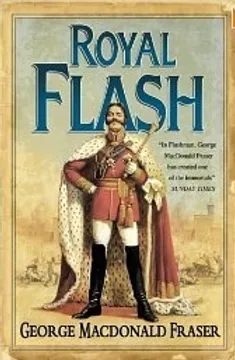


Plot Summary
The Raided Clubroom
In 1842, Harry Flashman is celebrated in London for bravery he privately knows he never showed in Afghanistan. When police raid a gambling club, he escapes by hiding, then runs again after another fugitive identifies him. He slips into a carriage belonging to Rosanna James, a beautiful army wife, and she protects him from the police despite the protests of her companion, a Prussian named Otto.
Flashman insults Otto as the carriage leaves, earning a threat he barely takes seriously. He begins an affair with Rosanna, whose appetite and temper overwhelm him. When he refuses her advances one night, she attacks him, and he flees her house bruised and furious.
Flashman’s public courage and private cowardice are established as competing versions of the same man. His reputation grants him protection, but his instincts are still to deceive, flee, and exploit whoever is nearby. Rosanna, by contrast, refuses the passive role expected of a respectable wife: she chooses her lovers, shields a stranger, and turns intimacy into a contest of wills. Their meeting begins as an escape from police, but Flashman’s casual insult to Otto plants a more consequential danger than either man yet understands.
Bismarck Takes the Measure
A month later, Flashman meets Otto again at a country gathering hosted by Tom Perceval. The Prussian gives him a humiliating lesson in horsemanship, crowding him at a narrow jump until Flashman must pull away to avoid a collision. At supper, Flashman retaliates by provoking Otto into testing English boxing against retired champion John Gully.
Gully first makes the confident Prussian miss every punch, then lands blows when Otto ignores the rules and throws him to the floor. Gully wins, but feels ashamed of having hurt a guest. Otto accepts the humiliation with grim composure and promises to answer it through German swordplay. Flashman leaves satisfied, not realizing how long the slight will remain in Otto’s mind.
The contest is less a sporting episode than a collision between rival codes. Gully treats boxing as craft and fair play; Otto treats defeat as a problem to outlast, even when rules become inconvenient. Flashman sees only a chance to embarrass an arrogant stranger, but his intervention gives Otto a personal grievance and a reason to remember him. The scene also distinguishes the men’s forms of courage: Gully’s is disciplined and humane, Otto’s relentless, while Flashman’s talent lies in arranging risks for other people.
Lola's London Unmasking
The following year, Flashman spots Rosanna rehearsing at Her Majesty’s Theatre under the invented name Lola Montez, advertised as a Spanish dancer. To avenge their ugly parting, he tells Lord Ranelagh, an aristocrat she once rejected, that the supposed Spaniard is an Irish woman using a false identity.
Ranelagh waits through her acclaimed performance, then exposes her before the fashionable audience. The crowd turns from applause to abuse, and the theatre dismisses her.
Lola leaves London, but not the public eye: reports reach Flashman of her scandals across Europe and, eventually, her extraordinary influence at the Bavarian court. Years later, she is Countess of Landsfeld, a royal favorite with political power, and Flashman has reason to regret that he once mistook her for a brief, finished affair.
Flashman’s revenge succeeds in the narrowest sense and fails as a way of controlling Lola’s life. He uses an aristocrat’s contempt for her to turn a performance into public punishment, but humiliation does not extinguish her ambition. The contrast is revealing: Flashman thinks in private scores and immediate comforts, while Lola repeatedly converts scandal into movement, attention, and access to power. Her rise also changes the meaning of their first affair. What he remembers as a conquest becomes an encounter with someone whose appetite for freedom exceeds his ability to categorize her.
Munich's Velvet Trap
In 1847, Flashman returns to London hoping to rest, only to face his disapproving in-laws and pressure to help introduce his wife Elspeth’s unmarried sisters to society. A letter from Lola offers travel money and asks him to come to Munich for a delicate service.
He accepts the escape from family obligations and reaches Bavaria, where the former dancer holds court beside King Ludwig. Her young associate Rudolf von Starnberg escorts Flashman to a lavish gathering. After drinking heavily, Flashman believes he has gone to bed with Baroness Pechman, but Starnberg and police officers arrest him.
A magistrate threatens him with years in prison for assault and public indecency, while Lola refuses to help. Starnberg then reveals that the charges are leverage: Flashman must cooperate with his unseen employers.
The invitation works because it appeals to Flashman’s ordinary motives: money, curiosity, escape from domestic discomfort, and the hope of sexual pleasure. The trap does not need to overcome his judgment so much as give his appetites a plausible excuse to ignore it. The fabricated legal case then reverses his usual relation to power. A man accustomed to bluffing his way past authority discovers that status and reputation cannot protect him when the authorities themselves are instruments of coercion.
The Prince's Substitute
Starnberg takes Flashman to a remote castle, where Otto von Bismarck explains the service. The Danish Prince Carl Gustaf is due to marry Duchess Irma of Strackenz, a small state divided between Danish and German loyalties.
Bismarck claims the prince has a sexually transmitted disease and cannot wed on schedule; postponement, he argues, could ignite political unrest. Flashman’s resemblance to the prince offers a solution. He must impersonate Carl Gustaf through the wedding, then yield to the real prince after a staged hunting accident.
Bismarck promises ten thousand pounds and safe passage, but makes refusal a death sentence. Flashman bargains for more, fails, and agrees to the original price. He believes the plan is outrageous, yet sees no safer way to survive.
Bismarck treats personal identity as a political resource: a face, a marriage, and a believable public performance can be arranged to stabilize one faction while weakening another. Flashman’s body becomes valuable precisely because he has no political convictions of his own. He agrees not through belief in Bismarck’s vision, but through a calculation made under threat. The gap between these motives drives the plot: Bismarck sees a historical instrument, while Flashman sees a dangerous job whose promised payment may be the only reason to endure it.
A Face Made Royal
Bismarck’s men shave Flashman’s head and remove his whiskers, revealing a likeness close enough to alarm him. To match Carl Gustaf’s two dueling scars, the fencing expert de Gautet cuts his scalp with a German student’s sword.
Flashman’s wounds heal while he spends a month learning the prince’s family history, habits, gestures, and German mannerisms; his Danish remains poor. At a country mansion, Bismarck’s allies remove the real prince and place Flashman in his rooms.
The prince’s physician briefly mistakes him for Carl Gustaf, then spots the fresh scars. A salve disguises them, and the physician accepts the substitution. For the first time, Flashman sees that the impersonation may actually work, which makes the danger feel more immediate, not less.
The preparation makes impersonation a physical and psychological discipline rather than a clever disguise. Flashman is trained through repetition until the borrowed gestures begin to feel automatic, while the scars turn his body into a document altered to match someone else’s history. His successful deception of the physician gives him confidence, but also narrows his freedom: once others accept the performance, he must continue it convincingly. The scene asks how much of a public self is habit, and how quickly a person can be made to inhabit another man’s expectations.
The Bridegroom's Double
Flashman crosses into Strackenz to a reception of cheering crowds, Danish flags, and political unease. He avoids signing a public order releasing prisoners by demanding a review first, and a child’s gift at the town hall draws an unexpected tenderness from him.
The next day, he marries Duchess Irma in a crowded cathedral. During the reception, Erik Hansen, Carl Gustaf’s boyhood friend, recognizes something wrong in the man before him. Flashman follows Starnberg’s rehearsed greeting, and Hansen’s suspicion fades rather than becoming an accusation.
With the ceremony complete, Flashman and Irma leave for the hunting lodge at Strelhow. He has passed the first public test, but the encounter proves that the disguise depends on more than matching faces.
The public ceremonies make the false identity socially real: crowds, officials, and ritual confirm what the body alone cannot establish. Flashman’s refusal to release prisoners is an improvised act of caution, but his kindness to the lame child hints at a moral responsiveness that his self-image usually suppresses. Hansen’s near-recognition exposes the limit of Bismarck’s meticulous preparation. Intimate memory can detect discrepancies that formal observers miss, so Flashman’s safety depends on managing relationships as carefully as costume and gesture.
The Honeymoon's Hidden Knife
At Strelhow, Flashman’s drunken, forceful first night with Irma gives way to a surprisingly affectionate marriage; she becomes attentive, and he enjoys the luxuries of royal life. After ten days, de Gautet lures him into the Jotun hills and fires at his back.
The pistol misfires, allowing Flashman to knock him unconscious and bind him. Under torture, de Gautet admits the prince never had the disease Bismarck described.
Bismarck intends to kill Flashman, plant coded papers identifying him as a British agent, and use the resulting outrage to provoke disorder and justify German intervention. The real Carl Gustaf is imprisoned in Jotunberg, where his body can be hidden in the lake. Flashman now knows the promised safe passage and reward were lies.
The apparent honeymoon gives Flashman a glimpse of the life his impersonation could have made permanent, but intimacy cannot make the political arrangement secure. His discovery comes through violence, and the supposedly indispensable pawn learns he was always meant to be disposable. The forged disease and forged evidence expose Bismarck’s method: manufacture a crisis, then present the crisis as proof that force is necessary. Flashman’s self-preservation now has an unexpected consequence, because escaping death may also prevent a manufactured international conflict.
The Sons of the Volsungs
Flashman flees through the woods after pushing the wounded de Gautet from a cliff. Armed members of the Sons of the Volsungs capture him and bring him to Major Sapten, Dr Grundvig, and Hansen. Flashman first claims to be Carl Gustaf, but Hansen recognizes that his Danish speech and scars are wrong. He then invents the name Thomas Arnold and a wife and child held hostage, framing himself as a coerced British officer.
Sapten doubts him but accepts that no other explanation fits the impossible resemblance. When Flashman reveals the prince’s location, the group decides to rescue him before Bismarck’s men can dispose of him. Hansen volunteers to swim into Jotunberg, and Flashman agrees to go with him under threat of execution if he refuses.
Flashman’s lie is both a survival tactic and a distorted confession. He invents a family to give his cooperation a respectable motive, but the tale persuades because he truly has been forced into a political crime. Sapten’s willingness to act on an unbelievable story reflects a hard distinction between certainty and urgency: waiting for proof could cost the prince his life. Flashman does not become brave so much as trapped between dangers, yet his consent places him inside a rescue attempt whose purpose exceeds his own escape.
The Lake of Jotunberg
After greasing themselves against the cold, Flashman and Hansen cross the dark lake toward Jotunberg. Hansen climbs first toward a ruined landing, where Rudi kills him with a knife. Flashman is hauled from the water and disarmed. Rudi learns that the Sons plan to storm the castle, then takes Flashman below ground to the real Carl Gustaf, chained beside a shaft that drains into the lake.
The prince’s shock at seeing his double is matched by fury at his captors. Rudi reveals that he expects the prince to die and invites Flashman to join him in taking control of Strackenz during the European revolutions. If they eliminate the Sons and return as the prince, he argues, they could seize the duchy’s wealth and power.
The castle turns the story’s central likeness into a literal doubling of captivity: the real prince is chained, while Flashman is captured by the same men who have been using his freedom as a tool. Hansen’s death removes the emotional bridge between the impostor and the Danish heir, leaving Flashman face to face with the human cost of the plot. Rudi’s proposal is persuasive only within his own moral world, where danger is a game and loyalty a temporary arrangement. Flashman’s instinct is still survival, but he has learned that Rudi’s bargains end in disposal.
The Sewer Escape
Flashman pretends to accept Rudi’s plan, then smashes a bottle over his head and releases the drawbridge. The Sons storm the causeway as the castle garrison rushes to defend it. Rudi, wounded but conscious, intercepts Flashman and forces him into a sabre fight. Flashman survives by retreating through the dungeon, but Rudi’s thrown sword sends him sliding down the sloped floor and into the shaft.
He plunges through its dark passage into the lake, nearly drowns, then claws his way onto the rocks. By the time he reaches the hall again, the Sons have killed the defenders. Carl Gustaf is alive and freed, though the rescuers treat Flashman as an awkward survivor rather than a hero.
The climax gives Flashman no clean heroic transformation. He acts decisively when Rudi’s proposal threatens to repeat the original conspiracy, but his escape from the shaft depends on panic, physical luck, and refusal to surrender. The castle’s hidden drain, designed as a route for disposing of prisoners, becomes an accidental path back to life. His survival does not earn uncomplicated gratitude; the rescuers still regard him through the lens of his earlier imposture. The book’s idea of courage remains unsentimental: action happens, even when the actor is terrified.
A Crown in the Saddlebags
Sapten insists that Flashman leave Strackenz quickly, while the restored Carl Gustaf thanks him without offering a reward. Angry at being discarded after risking his life, Flashman rides back to the palace. He reassures Irma that a plot against her has been crushed, asks her to keep her rooms guarded, and sends the palace sentries away from the clock tower by claiming her safety is at greater risk.
Once alone, he opens the treasury and packs the crowns, jewels, and insignia into a valise. He tells officials he is riding to Jotunberg, then turns south toward Prussia. Carrying the stolen regalia, he hides from pursuers, falls gravely ill after his icy swims, and eventually reaches Munich by train.
Flashman’s theft is revenge, payment, and self-authored escape at once. The prince and Sapten offer moral closure, but not the material recognition Flashman believes his ordeal deserves; he answers their rejection with a crime that makes the state’s symbols portable. His performance of concern for Irma is especially revealing: he can imitate royal responsibility well enough to deceive guards, yet uses that authority to strip the palace. The scene refuses a simple conversion to virtue. Flashman’s rescue of Carl Gustaf matters, but it does not erase his self-interest.
Lola's Last Fare
In Munich, Flashman learns that revolution has driven King Ludwig to expel Lola, and finds her walking calmly through a hostile crowd toward her carriage. He begs her to take him out of the city. Lola agrees to help, though she remains guarded, then gradually restores their old intimacy as they travel toward a village railway station.
After spending the night together, she leaves before he wakes, taking the valise of Strackenz jewels and leaving him only enough money to continue his journey. Flashman returns to London poorer than he arrived in Germany, wounded and furious, but alive. In old age he admits that Lola’s story outlasted his resentment, and that his unlikely German adventure later inspired a popular romance.
The final reversal makes Lola and Flashman moral mirrors without making them identical. Each has survived by reading other people’s appetites, and each assumes the other can be used before being discarded. Lola’s theft answers Flashman’s own theft with a sharper version of his logic, while her small travel allowance preserves a trace of practical mercy. His homecoming resolves the immediate danger but not the self-dramatizing myth of heroism. The old narrator can laugh at his humiliation because time has softened the scorekeeping that governed his younger self.
Analysis
Royal Flash turns an international plot into a test of what people will believe when appearance, ritual, and reputation agree. Flashman can pass as a prince because his face is unusually close to Carl Gustaf’s, but success also requires crowds, officials, and courtiers to accept the story that the ceremony tells them. Hansen’s unease shows the limit of spectacle: shared memory can detect a mismatch that public performance conceals. Bismarck understands that identity is politically useful when it can be made legible to an audience.
The novel’s treatment of courage is equally pointed. Flashman repeatedly acts while terrified, yet rarely for noble reasons. He survives through escape, deceit, improvisation, and a keen eye for advantage. Those traits do not make him virtuous, but they complicate the easy division between cowardice and action. His rescue of Carl Gustaf emerges from coercion and self-preservation, then becomes a real intervention with consequences beyond him. The story grants practical action moral weight without pretending it purifies the actor.
Lola and Flashman are bound by a more intimate version of the same contest. Both treat charm as leverage and expect other people to be useful; each misjudges the other at crucial moments. Lola’s final theft is not a sudden moral lesson but an answer in the language Flashman himself understands. Meanwhile, Bismarck’s large political ambition and Flashman’s small personal appetites intersect through coincidence, likeness, and coercion. History, in this comic vision, is not only made by great plans. It is also diverted by vanity, bad luck, fear, and the unplanned choices of people who would rather be somewhere else.
Review Summary
Most reviewers rate Royal Flash as a step down from the first Flashman book, though still highly entertaining. Common praise highlights Fraser's witty historical fiction, Flashman's refreshingly honest self-awareness as an anti-hero, and the humor woven throughout. Critics note that Flashman feels more passive here—kidnapped and coerced rather than driving events through his own flaws. The fictional setting of Strackenz disappointed some fans who prefer real historical backdrops. The portrayals of Bismarck and Lola Montez were widely enjoyed, and most readers eagerly anticipate continuing the series.
Characters
Harry Flashman
Coward in a hero's uniformFlashman is a handsome British cavalry officer whose public reputation rests on heroic stories that conceal his instinct for self-preservation. He is vain, sexually opportunistic, quick with languages, and unusually good at reading immediate danger. His most reliable skills are improvisation and performance, not courage or loyalty. He often describes himself as a scoundrel, but his self-mockery is also a way to control how others judge him. Beneath the boastful appetite for drink, women, and comfort lies a sharp observer who understands how power works when it threatens him.
Otto von Bismarck
Prussian architect of powerBismarck is a forceful Prussian landowner and politician whose intellect is matched by appetite for authority. He sees political disorder not as a tragedy to avoid at any cost, but as a condition that can be shaped toward national aims. His confidence makes him compelling to followers and dangerous to opponents; he plans in detail, yet assumes that people can be reduced to useful functions. Flashman irritates him because he combines unexpected abilities with a reputation Bismarck can exploit. His manner joins physical presence, strategic patience, and a contempt for those who do not share his scale of ambition.
Lola Montez, born Rosanna James
Restless royal adventuressLola is an Irish-born performer whose beauty, nerve, and volatile humor make her difficult to dismiss or contain. She dislikes the narrow expectations placed on women and repeatedly seeks a life with more movement, pleasure, and influence. Her boldness can become cruelty, especially when anger or wounded pride takes command, but she is also observant and capable of practical generosity. Flashman remembers her through desire and grievance, yet her life exceeds his account of their affair. She understands that attention can be converted into power, and that a person who refuses to show fear can alter the behavior of a crowd.
Rudolf von Starnberg
Dangerous young accompliceRudi is an Austrian officer and Lola’s charming, self-assured associate. He is quick with a joke, adept at reading a room, and far more dangerous than his youthful manner suggests. Unlike Flashman, he appears to relish risk for its own sake; danger gives him energy rather than merely forcing him to act. His easy sociability does not imply warmth or restraint. Rudi treats other people’s fear as entertainment and sees political upheaval as an opening for personal adventure. His ability to move between polished manners and violence makes him an unsettling counterpart to Flashman’s own talent for performance.
Duchess Irma
Reserved young sovereignIrma is the young ruler of Strackenz, raised to embody the continuity and dignity of her small state. Her composure can appear cold, and she expects those around her to respect her authority. She is protective of her public position and quick to view political dissent as a threat to order. Beneath her ceremonial control is a young woman confronting a marriage arranged for state interests, with little practice in expressing uncertainty. Irma’s self-command is not simple vanity; it is part of the role she has been taught to inhabit, and it shapes the way she approaches both affection and political responsibility.
Prince Carl Gustaf
Danish heir in waitingCarl Gustaf is a Danish prince expected to marry Irma and become consort in a state divided between Danish and German loyalties. He is described as amiable and comparatively uncomplicated, but he also possesses a strong sense of personal dignity. His familiar habits and history become the material of Flashman’s impersonation, making the prince both a person and a public identity others can imitate. Carl Gustaf’s royal position does not make him omnipotent: the political plans surrounding him are shaped by ministers and strategists who treat dynastic marriage as an instrument of state.
Major Sapten
Danish loyalist organizerSapten is a practical, weathered leader among the Sons of the Volsungs, a clandestine group concerned with Strackenz’s independence. He distrusts easy explanations and weighs people by what their actions can prove. His hard decisions arise from urgency rather than theatrical cruelty, though he is willing to threaten Flashman when the prince’s life is at stake. Sapten’s realism makes him a counterweight to more emotional members of the group.
Erik Hansen
Prince's childhood confidantHansen is Carl Gustaf’s longtime friend and a Danish official whose loyalty is personal as well as political. He knows the prince through shared history, not merely through public appearance, which makes him attentive to small discrepancies others overlook. His commitment to his friend gives him a willingness to accept danger that Flashman finds difficult to understand. Hansen represents the intimate knowledge that cannot be reproduced by costume alone.
Dr Per Grundvig
Principled provincial physicianGrundvig is a Strackenz physician involved with the nationalist resistance. He is compassionate, cautious, and troubled by the human cost of political violence, yet he does not retreat from responsibility when events demand action. His sympathy for Flashman’s predicament sets him apart from the group’s more punitive instincts. He tries to reconcile moral concern with the practical need to protect his duchy.
Elspeth Flashman
Beautiful, wealthy wifeElspeth is Flashman’s beautiful wife, financially supported by her wealthy Scottish family. She is affectionate in her own fashion, socially ambitious, and often more interested in family arrangements than in her husband’s wandering life. Her apparent innocence coexists with a strong sense of status and a capacity to manage the household’s resources. Flashman’s attachment to her persists despite their unconventional marriage.
Speedicut
Old school companionSpeedicut is Flashman’s former schoolmate and companion in London’s unruly social world. He enjoys provocation and spectacle, often mistaking trouble for entertainment. Unlike Flashman, he can show physical courage when a situation turns serious. Their friendship mixes genuine familiarity with Flashman’s habitual willingness to leave others holding the consequences.
John Gully
Old champion of the ringGully is a celebrated retired prizefighter who has become a prosperous businessman and public figure. His quiet manner conceals exceptional skill and deep professional pride. He values fairness and carries the burden of having injured an opponent, even when that opponent has behaved badly. Gully’s presence gives the country gathering an older sporting code grounded in discipline rather than display.
Baron de Gautet
Polished sabre fighterDe Gautet is a disciplined swordsman in Bismarck’s circle, outwardly controlled and professionally courteous. He is an expert rider and fighter whose calm manner makes his capacity for violence harder to read. He regards political work as a matter of execution, not sentiment, and carries himself like a man accustomed to being obeyed.
Detchard
Wary legal strategistDetchard is a Danish minister secretly aligned with Bismarck’s operation. He manages the practical arrangements around the prince’s travel and impersonation, relying on preparation and precise knowledge of people and places. His reserve makes him seem less flamboyant than the other conspirators, but his administrative competence is essential to political schemes.
Kraftstein
Prussian muscle for hireKraftstein is a massive Prussian enforcer in Bismarck’s circle. He communicates more through physical presence than conversation and carries out orders without visible hesitation. His strength makes him an immediate threat to anyone who resists the conspiracy.
Bersonin
Quiet training tacticianBersonin is one of the men assigned to prepare Flashman for his borrowed identity. Taciturn and methodical, he teaches details of Carl Gustaf’s history and manner. His patience reflects the painstaking work required to make a political deception convincing.
Lord Ranelagh
Snobbish stage accuserRanelagh is a fashionable aristocrat with a cultivated sense of superiority and a history of resentment toward Lola. He cares deeply about social rank and enjoys the power that public reputation gives him. Flashman turns those traits to his own purpose by offering him a chance to settle an old slight.
Baroness Pechman
Munich court socialiteBaroness Pechman is a wealthy woman in Lola’s Munich circle, married to a former police commissioner. She moves comfortably among the court’s formal entertainments and enjoys the indulgences of elite society. Her presence becomes part of the precarious social world Flashman enters in Munich.
Dr Ostred
Prince's attending physicianOstred is Carl Gustaf’s physician, a careful and nervous professional caught in the machinery of the impersonation. His medical knowledge gives him a chance to notice physical details that casual observers miss. He is conscientious, but his position leaves him dependent on the powerful men directing events.
Adolf Schwerin
Anxious chief ministerSchwerin is Strackenz’s chief minister, an aging official devoted to the duchy and protective of Irma. He worries about political stability and treats the arranged marriage as a safeguard for his small state. His paternal manner reflects both sincere affection and a governing class’s desire to keep public unrest under control.
Plot Devices
The Doppelganger
A face becomes a state toolFlashman’s near-exact resemblance to Prince Carl Gustaf makes impersonation possible. Bismarck’s scheme depends on more than facial similarity: shaving, matching scars, rehearsed gestures, and detailed lessons in the prince’s life must persuade people who know him. The resemblance generates both the novel’s central political deception and its repeated question of identity. A body can be made to support a public role, but intimate memory and personal habits remain harder to counterfeit.
The Manufactured Charge
Legal danger enforces obedienceIn Munich, fabricated accusations make Flashman believe he can be imprisoned for years unless he cooperates. The threat is effective because it turns ordinary legal process into a weapon and exploits his damaged reputation as a drunken, sexually reckless officer. It also foreshadows Bismarck’s wider method: create a convincing public explanation that can make private violence appear legitimate. Flashman’s fear of a court and scandal is as useful to his captors as physical confinement.
The Strackenz Marriage
A wedding masks political conflictIrma’s marriage to a Danish prince has significance beyond the couple. Strackenz is divided between Danish and German loyalties, and the marriage is expected to reassure one faction while keeping the duchy stable. Bismarck treats the ceremony as a lever in a much larger struggle over German unity. Its public rituals give the impersonation credibility, while the divided loyalties surrounding the duchy make any scandal potentially explosive.
The Scarred Head
A wound authenticates the disguiseCarl Gustaf’s dueling scars are an identifying feature that could expose Flashman, so Bismarck’s men reproduce them with a sword. The scars are both physical evidence and a brutal form of costume: they make the substitute resemble the prince’s past as well as his face. Their placement later gives Hansen grounds to distrust the impostor. The detail shows how a tiny bodily difference can outweigh elaborate preparation when someone possesses personal knowledge.
Jotunberg's Drain
A death shaft becomes an escapeThe castle’s sloped stone pit feeds into a narrow shaft that empties beneath the lake. Bismarck’s men use the hidden passage as a way to dispose of the captive prince without leaving a body behind. During the fighting, Flashman slips into it and survives the plunge into the water. The same piece of architecture that makes the prince’s disappearance possible becomes the improbable route by which Flashman escapes the castle.
Download PDF
Download EPUB
.epub digital book format is ideal for reading ebooks on phones, tablets, and e-readers.








