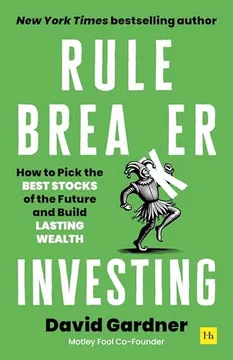


Key Takeaways
The fortune is made by holding winners through their ugliest years
Patience gets tested. In 1998, David Gardner and his brother picked Starbucks for Lisa Ling on The View. Six weeks later, the stock was down 33%, and the audience booed. By the following summer it had recovered, and over the decades that followed it multiplied many times over. Nvidia makes the same lesson more dramatic: Gardner first recommended it in 2005, and by the end of 2024 its split-adjusted share price represented more than 800 times the original cost. But the ride included crashes and years of stagnation. A winner, in this approach, is a business that keeps developing, not a share price that rises smoothly.
The narrative exposes a behavioral trap: people often mistake a painful short-term price move for evidence that a business has failed. Long-horizon investing can counter this impulse, but patience is not proof of sound judgment. A deteriorating business does not become a good holding merely because its owner refuses to sell. The useful discipline is to separate volatility in the quote from evidence about the company, then keep checking that evidence. The Starbucks story is memorable because it makes the social pressure to quit visible, not because every fallen stock recovers.
Let a handful of exceptional gains outweigh a long list of misses
Returns are uneven. Gardner compares stock picking to baseball: Babe Ruth struck out 1,330 times, yet his home runs mattered far more than any one failure. In 389 monthly recommendations, Gardner says 63 fell by at least half, while the 63rd-best performer had gained 402% at the time of his accounting. One especially successful pick, Tesla, had risen 125-fold. His target of 60% accuracy means aiming for 60% of picks to beat the S&P 500, not avoiding losses or achieving perfect predictions. The underlying strategy accepts that losses are limited to the money invested, while successful companies can keep compounding.
This is a power-law view of investing: a small number of outsized outcomes can dominate a portfolio's result. Venture capital uses similar mathematics, accepting many failures in search of a few transformative successes. The crucial distinction is that a high potential payoff does not make every speculative bet sensible; position size and diversification determine whether an investor can survive long enough to benefit. The author's record is also a selected historical case, not a forecast. A reader should focus on the payoff structure, not assume the same hit rate or winners are reproducible.
Put fresh money behind business strength, not a falling share price
Past prices are sunk costs. Gardner argues against adding to a losing investment simply to lower its average purchase price or recover the original outlay. Each new dollar should be judged by its likely future return, independent of what the investor paid before. He contrasts three disappointing 2007 picks, down 77%, 82%, and 92%, with Chipotle, which had risen 4,875% by the time of writing. The outlier could overwhelm the losses, but only for an investor who held it. The practical test is whether the business still merits capital, not whether the stock looks cheaper than it once did. Adding to an established winner is not automatically wise either; the business case must still hold.
This advice targets both anchoring, the tendency to treat a purchase price as a meaningful reference point, and the sunk-cost fallacy, which makes past spending feel like a reason to continue. It also resembles momentum investing, because fresh capital flows toward stocks that have risen. The book's distinction is that the decision should rest on business quality and future prospects, not the chart alone. A falling price can create genuine value when fundamentals remain intact, so direction is evidence to investigate, not a verdict.
Give investments years, and stop letting headlines choose your holding period
Short-term noise shrinks perspective. Gardner sets three years as a minimum holding period and says decades are better suited to the strategy. He tells of a television anchor who questioned whether cloud-computing stocks were still attractive after a single down day. That reaction treats daily movement as decisive. Gardner instead likens the market's long-term rise to a favorable wind: repeated setbacks are part of the journey, not a reliable signal to jump out. He also urges investors to avoid obsessing over forecasts of interest rates, oil prices, or recessions. The book cites historical market returns near 10% annually, while stressing that individual years can be sharply negative.
A longer horizon can reduce the temptation to trade on noise, and it gives business growth time to show up in results. It does not remove risk: an investor's actual time horizon matters, especially when money is needed for near-term expenses. The analogy between market volatility and a ride that ends higher is useful for broad markets, but individual companies can fail permanently. A sound version of patience therefore pairs low trading frequency with regular examination of whether the investment thesis remains credible.
Seek companies that matter, lead an emerging market, and resist imitation
Look for consequential novelty. Gardner's first stock-selection signal is a company near the front of an important, growing industry. His Snap Test asks whether customers would notice if the business disappeared. His Cola Test asks whether it has a clear equivalent competitor. Together, Snap Cola describes a consequential company with unusually singular positioning. Amazon began as an online bookseller, then expanded into areas such as cloud computing; Nvidia moved from graphics chips into data centers and artificial intelligence. The tests are filters, not guarantees. A novel idea is not enough: the company needs a real market, customers who care, and an advantage that can endure as competitors arrive.
These tests help investors distinguish technological novelty from economic significance. Innovation matters when it solves an important problem, attracts adoption, and creates a defensible position. The strategy also echoes market-creation thinking: a firm can earn unusual returns when it defines a category before rivals understand its potential. Yet being first is not the same as being best, and the absence of an obvious rival may signal a market too small to matter. The strongest evidence is not a bold founder's claim, but sustained customer use and a business model that keeps working.
Judge purpose, leadership, and customer devotion beyond the spreadsheet
Intangibles shape outcomes. The book urges investors to look for a purpose beyond profit, a genuine concern for employees and other stakeholders, capable leadership, and a culture that supports good work. It also treats brand loyalty as an economic asset: in a crowded toothpaste aisle, a familiar brand simplifies choice. Companies such as Patagonia and Amazon illustrate how a clear identity can draw customers and employees. Yet these qualities are difficult to measure on financial statements, which means investors must investigate management actions, customer behavior, and company culture rather than rely only on ratios. A compelling mission is evidence to examine, not a substitute for a viable business.
This focus recognizes that organizations are social systems, not just collections of financial outputs. Trust, employee commitment, and customer habits can reinforce one another, creating advantages that accounting statements capture imperfectly. Purpose can also be used as marketing language while practices contradict it. For investors, the productive question is whether stated values predict observable behavior: product quality, retention, responsible decisions, and durable customer demand. Qualitative judgment can reveal information that a spreadsheet misses, but it should be tested against concrete results rather than treated as a special license to ignore them.
Treat new highs and claims of overvaluation as reasons to investigate
Expensive can mean excellent. Gardner favors companies whose stocks have already risen strongly, arguing that investors often cross them off precisely when demand is validating the business. Several of his biggest winners, including Amazon, Apple, and Nvidia, were selected after substantial price increases. He also treats the label overvalued as a prompt to look for qualities traditional metrics may miss, such as brand, leadership, culture, and innovation. The approach does not claim that every rising stock is sound or that price is irrelevant. It asks investors to examine the company's future potential rather than assume that a past increase has exhausted it.
This challenges the instinct to equate a low share price with a bargain and a high one with danger. Momentum can reflect improving expectations, but it can also become excessive, particularly when enthusiasm outruns business performance. The book's strongest insight is not that overvaluation is a buy signal, but that simple valuation ratios can omit important sources of future value. That makes qualitative analysis more necessary, not less. A high price deserves a rigorous explanation of how future growth could support it, along with a willingness to admit when the explanation no longer fits.
Start small across many stocks, then let evidence determine their size
Build a fair starting line. Gardner recommends keeping any new stock to no more than 5% of the portfolio, implying at least 20 positions for a stock-focused portfolio. Give investments roughly equal starting amounts, so an early guess does not dominate the outcome. Fractional shares make this easier for smaller investors. For a volatile company that feels difficult to buy all at once, his buying-in-thirds method spreads the purchase over several dates. He acknowledges that delaying investment can reduce returns when markets rise, so the method mainly helps investors who would otherwise stay out. Diversified index funds can also fill gaps when an investor lacks enough well-researched stock ideas.
This framework manages both financial exposure and emotional exposure. Small initial positions make it easier to tolerate volatility without abandoning a whole portfolio after one mistake. Diversification cannot prevent losses, and owning many stocks does not replace research, but it reduces dependence on one forecast. Buying in stages is a behavioral tool rather than a return-enhancing trick: historical markets tend to reward being invested sooner. The decision should therefore balance expected opportunity cost against the real risk that fear will prevent the investor from starting.
Make your portfolio express its purpose and your real tolerance for risk
Name what the money serves. A portfolio might aim at long-term growth, income, a child's financial education, or another purpose. Gardner distinguishes a flexible Odyssey portfolio, which receives new contributions, from a Phoenix portfolio, built from a fixed sum that may need to provide income. He also recommends setting a sleep number: the largest share any one holding may reach before its volatility disturbs the investor's sleep. His own AOL position once grew to about 80% of his portfolio, a risk he says reflected his age, temperament, and entrepreneurial wealth. That is a personal example, not a target. Naming the portfolio's purpose can help prevent panic or speculation from taking control.
Purpose can act as a behavioral commitment device: it makes a portfolio easier to evaluate against the life it is meant to support. The sleep-number idea similarly translates abstract risk tolerance into a limit an investor can actually use. Both require honesty. Someone may claim to welcome volatility until a large loss threatens a home purchase or retirement income. Risk capacity, the ability to bear a loss, is not identical to risk appetite, the willingness to endure one. A portfolio should reflect both.
Review each quarter, and sell when the business case or better use changes
Stay engaged without constant trading. Gardner recommends a quarterly portfolio review and says attention should follow position size: the largest holdings deserve the closest study, while very small ones can receive less time. His Five-and-Three framework records five developments that would confirm an investment thesis and three that could undermine it. This makes reviews forward-looking rather than focused on the purchase price. He generally sells when a better use for the money appears, when a business no longer fits the original case, or when a position exceeds the investor's comfort limit. The goal is not never to sell, but to avoid reflexive selling, arbitrary price targets, and routine rebalancing that trims successful holdings.
Scheduled reviews can create a useful middle ground between neglect and compulsive monitoring. Writing down what would change an investor's mind also counters hindsight bias, the tendency to revise the original thesis after results arrive. The framework's optimistic tilt is energizing, but three risks should be meaningful enough to challenge the investment, not token warnings. Quarterly attention is a cadence, not a promise that every decision can wait three months; fraud, a broken business model, or urgent personal cash needs can require faster action.
Analysis
Rule Breaker Investing is an argument about investor behavior as much as stock selection. Its core claim is that finding a rare, fast-growing business is insufficient if fear, anchoring, or impatience pushes the owner out before compounding has time to work. Gardner therefore links three layers: habits that govern decisions, traits that help identify companies, and portfolio principles that manage risk and attention. The book's lively anecdotes make this architecture memorable. Lisa Ling's Starbucks pick dramatizes the social discomfort of holding a stock after a sudden loss; Nvidia supplies the harder lesson that enormous returns can coexist with punishing drawdowns.
The approach is strongest when it challenges familiar mental shortcuts. A falling price is not automatically a bargain, a rising price is not automatically exhausted, and a famous company's accounting ratios cannot fully describe its culture or customer loyalty. The focus on human judgment also recognizes that businesses are built by people and adopted by customers, not by spreadsheets alone. The portfolio advice adds a practical counterweight to the ambition of finding outsized winners: begin with limited positions, diversify, and decide in advance what level of concentration is tolerable.
Its central tension is that a strategy built around exceptional winners can look obvious only in hindsight. The book's celebrated picks demonstrate what successful selection and patience can achieve, but they cannot establish how reliably a reader can find comparable companies ahead of time. The same emphasis on holding winners can become stubbornness when a business deteriorates, while faith in intangible qualities can make a high valuation difficult to falsify. Quarterly reviews and written investment theses help, but do not eliminate those risks.
The most durable lesson is therefore not to imitate a list of famous stocks. It is to adopt a process that allows upside to compound while containing the damage of being wrong: examine the business, size positions modestly, accept that some picks will fail, and keep testing the reasons for ownership. This is an active, conviction-driven alternative to market indexing, but the book itself allows index funds as a sensible foundation or supplement for investors who lack the time, confidence, or risk capacity to manage individual stocks.
Review Summary
Rule Breaker Investing receives strong praise for its accessible, engaging writing style and unconventional investment philosophy. Readers appreciate Gardner's optimistic, long-term approach — buying high-quality "top dog" companies and letting winners run. Many find it transformative, particularly beginners and growth-oriented investors. Critics note it can feel promotional toward Motley Fool and lacks depth on valuation. The fictional vignettes receive mixed reactions. Overall, it's considered an enjoyable, quick read that challenges traditional "buy low, sell high" thinking with fresh, thought-provoking perspectives.
Glossary
100-bagger
A hundredfold gainA stock that rises to at least 100 times its original value. Gardner uses such outcomes to illustrate the potential asymmetry of stock returns: losses on a position cannot exceed the invested amount, but a successful company can continue growing for years. The term describes a historical result, not a forecast or a promised outcome.
Snap Cola
Importance plus singularityA shorthand for two tests of a promising company. The Snap Test asks whether customers would notice or care if the company disappeared. The Cola Test asks whether the company has a clear equivalent competitor. A company that passes both appears important to its market and unusually differentiated, though neither test guarantees future success.
Rowboat Syndrome
Backward-looking market timingA pattern in which investors focus on recent market movement, wait for a dip, enter after prices have risen, and then sell after a decline. The metaphor describes how attention fixed on the past can lead people to buy high and sell low. Gardner contrasts this behavior with holding investments through market cycles.
sleep number
Maximum comfortable position sizeThe largest percentage of a portfolio an investor is willing to let any one holding reach while still feeling able to tolerate the risk. It is personal rather than universal, and may reflect time horizon, financial circumstances, and emotional comfort. A successful stock can grow beyond its original allocation, making this limit useful for portfolio decisions.
buying in thirds
Staged stock purchasesA way to build a position by dividing the intended investment into three parts and buying at separate dates, such as monthly or quarterly. The method can make a volatile purchase easier to begin, but it may sacrifice returns if the stock rises during the delay. Its main value is behavioral, not a guarantee of a better entry price.
Five-and-Three framework
Five thesis checks, three risksA review method that records five favorable developments an investor expects to see and three adverse developments that could weaken the investment case. The green flags test whether the original thesis is progressing; the red flags identify reasons to reconsider ownership. Gardner uses the framework to focus attention on future business evidence rather than past share prices.
Odyssey portfolios
Portfolios receiving new contributionsGardner's label for portfolios that receive new money regularly, typically from someone earning and saving income. Their ongoing contributions allow the investor to keep adding capital over time. The name contrasts with a Phoenix portfolio, which begins with a fixed pool of money and may need to fund withdrawals.
Phoenix portfolios
Fixed-sum portfolios funding withdrawalsGardner's label for portfolios built from a lump sum when no new contributions are expected, often because the investor is retired and may draw income from the assets. Their purpose can make selling successful holdings reasonable, even when a growth-focused investor might prefer to keep holding. The term emphasizes that portfolio strategy depends on the money's job.
Download PDF
Download EPUB
.epub digital book format is ideal for reading ebooks on phones, tablets, and e-readers.








