Key Takeaways
1. The Enduring Paradox of Russian Identity
It is in many ways a European country, yet it is too large, too close to us, and too strange to fit into any comfortable pigeonholes.
A unique blend. Russian history is defined by a persistent tension between its European aspirations and its distinct, often authoritarian, path. This paradox stems from its vast Eurasian geography, which exposed it to both Western and Eastern influences, creating a culture that is simultaneously familiar and alien to its European neighbors. The "Good Russia" (Tolstoy, Tchaikovsky) and "Bad Russia" (Tsars, Stalin) are inextricably linked by the arduous task of state-building and defense on open plains.
Geopolitical crucible. Russia's flat, open frontiers to both east and west meant constant threats of invasion, fostering a deep-seated longing for security. This vulnerability, coupled with internal feuding among strongmen, necessitated the creation of a coherent and powerful polity. The resulting state, often seen as harsh and domineering, was a direct response to these existential challenges, prioritizing collective survival over individual liberties.
A recurring theme. This fundamental tension—between external pressures and internal dynamics—has shaped Russia's identity throughout its history. It has led to a unique blend of cultural borrowing and fierce self-assertion, making Russia a perpetual enigma on the world stage. The struggle to reconcile its European identity with its distinct historical experience continues to define its trajectory.
2. Security and Unity Forged in Vulnerability
Whatever else they may have wanted, Russians have always longed for security from terrifying and murderous assaults across the flat open frontiers to east and west.
Early foundations. The first Rus state emerged from a need for peace and security among warring East Slav tribes, who invited Varangian (Viking) rulers to bring order. Kiev became the capital, establishing a semi-circle of fortresses against nomadic raids. This early period saw the intermingling of Varangians and Slavs, forming a common language and culture, but also a marked social hierarchy where princes and their armed retinues held sway.
Mongol catalyst. The Mongol invasion in the 13th century, facilitated by Rus princely disunity, brought immense destruction but also inadvertently laid the groundwork for a more unified state. The Golden Horde, while imposing heavy tribute, restrained internal feuding and established a sophisticated administrative system for taxation and communication. Moscow, by cooperating with the Mongols and adopting their governance practices, strategically positioned itself as the favored principality, learning crucial lessons in centralized control and resource mobilization.
Muscovy's rise. The experience under Mongol overlordship, coupled with the eventual decline of the Golden Horde, allowed Muscovy to consolidate its power. It absorbed neighboring principalities, created a service-based land tenure system (pomestia) to build its army, and asserted its independence. This era cemented the idea that a strong, centralized ruler was essential for defending the vast, exposed territories and preventing internal chaos, a lesson deeply ingrained in the Russian psyche.
3. Orthodoxy: A Double-Edged Sword for State Power
This was a crucial moment: from then on, Moscow became the centre of Russian Orthodox Christianity, though at times contested by Kievan Metropolitans with Lithuanian backing.
Spiritual bedrock. The adoption of Byzantine Christianity by Prince Vladimir in 988 was a pivotal moment, offering a monotheistic religion that condemned blood feuds and justified princely authority. The Church became a powerful institution for disseminating moral concepts and law, providing a sense of unity and identity for the nascent Rus state. Its close ties with Byzantium initially offered cultural and commercial benefits, but also isolated it from Latin Christianity after the 11th-century schism.
The Third Rome. With the fall of Byzantium in 1453 and the Moscow Metropolitanate's relocation, the Russian Orthodox Church began to see Muscovy as the successor to Rome and Byzantium—the "Third Rome." This grandiose vision, articulated by figures like Filofei of Pskov, imbued the Muscovite ruler with a universal religious mission, making him the champion and protector of true-believing Christians. This narrative provided immense legitimacy for the Tsar's expanding power and territorial claims.
Internal conflict. However, this spiritual authority also created a potential rival to secular power. The Church, with its wealth and moral claims, could challenge the Tsar, as seen in Filofei's warning against land expropriation. Later, Patriarch Nikon's reforms in the 17th century, aimed at aligning Russian practices with ancient Greek rites, sparked the Old Belief schism. This deep division within Orthodoxy demonstrated how religious authority, while unifying, could also become a source of profound internal dissent, with Old Believers rejecting the "Antichrist" state for abandoning traditional Russian ways.
4. The Autocratic State and its Tacit Social Contracts
Here we see one of the recurring themes of Russian history: the ordinary people welcome a strong ruler because he can defend them both from external aggressors and from their own internal strongmen, who exploit them and sometimes fight one another, unleashing destructive warfare in which everyone suffers.
The Tsar's compact. The Muscovite polity was built on a tacit compact: the Tsar's symbolic omnipotence was accepted by the boyar elite in exchange for stability, internal peace, and their dominance over other social orders. This arrangement, born from the chaos of princely feuding and external threats, meant that power was often mediated through personal relationships rather than stable institutions, making the ruler's will paramount. Ivan IV, despite his cruelty, was seen by many as combating internal strongmen for the sake of the state.
Serfdom's role. The system of serfdom, which tied peasants to the land and their lords, was a direct consequence of the state's need to mobilize resources for its military commitments. While imposing heavy burdens and restricting freedom, it also offered peasants some advantages: guaranteed land, community support, and spiritual sustenance through the parish church. This complex relationship, though often resented, formed the economic backbone of the empire, ensuring the well-being of the nobility and the provision of state resources.
Enduring patterns. This pattern of centralized authority, relying on personal ties and implicit social agreements, persisted through the imperial and even Soviet eras. From Peter the Great's "regular state" to Nicholas I's "Orthodoxy, Autocracy, Nationality," rulers sought to consolidate power from above, often bypassing or suppressing intermediate institutions. This approach, while effective in maintaining control over a vast and diverse empire, consistently generated resentment and conflict, leaving a latent threat of disorder that periodically erupted in popular uprisings.
5. Empire Building: A Complex Tapestry of Integration and Coercion
The amalgam of radical centralization with a sense of universal religious calling was to remain the most characteristic feature of Muscovy and later of Russia.
Filling the vacuum. Russia's expansion into a vast Eurasian empire was driven by a combination of opportunity and perceived threat, filling power vacuums in Siberia and Central Asia. Early imperial policy focused on suppressing resistance and integrating diverse populations by co-opting indigenous elites and tolerating local customs and beliefs. This pragmatic approach allowed for rapid territorial gains, making Russia the largest territorial empire on earth.
Evolving strategies. Over time, imperial policy shifted from mere integration to a more active "civilizing mission," aiming to bring administrative control and, at times, religious conversion to non-Russian peoples. However, this often led to internal disagreements among officials, with some advocating for "civic consciousness" (grazhdanstvennost) and cultural preservation, while others pushed for authoritarian integration and Russification, including the adoption of the Russian language and Orthodoxy. These conflicting approaches often alienated local populations.
Legacies of resentment. The empire's expansion brought in diverse peoples like the Poles, Jews, Ukrainians, and various Caucasian and Central Asian groups, each with their own distinct cultures and histories. Policies such as the forced conversion of Uniates, the suppression of Ukrainian language, the confinement of Jews to the Pale of Settlement, and the mass deportation of Circassians and later Soviet nationalities, created deep-seated resentments. These coercive measures, while consolidating imperial control, sowed the seeds of future conflicts and played a decisive role in the eventual disintegration of the Soviet Union.
6. Modernization's Disruptive Force and the Birth of the Intelligentsia
Russia offered the first example of what later became known as a ‘developing country’, whose elites were attracted by European culture, yet also resented it as a disruption of a traditional way of life.
The European allure. From Peter the Great onwards, Russian rulers sought to "Europeanize" the country, adopting Western technology, administrative models, and cultural norms. This drive for modernization, intensified after the Crimean War defeat, aimed to transform Russia into an industrializing nation-state capable of competing with its Western counterparts. Nobles were trained in European languages and etiquette, and new institutions like the Cadet Corps and later universities fostered a Europeanized elite.
A widening chasm. This top-down modernization, however, created a profound cultural and social gulf between the Westernized elites and the vast majority of the population, particularly the peasants and the Orthodox Church. European ideas—from Enlightenment legalism to Romanticism and socialism—were imported, but often felt alien to traditional Russian life. This led to a unique intellectual phenomenon: the intelligentsia, a new sociocultural stratum alienated from both the state and the common people, yet feeling a moral obligation to speak for "Russia."
Cultural responses. Faced with these disruptive changes, Russian high culture often assumed the role of political commentary and prophecy. Writers like Gogol, Dostoevsky, and Tolstoy grappled with the loss of community and moral consciousness in a rapidly modernizing world, often counterposing the perceived spiritual purity of the Russian peasant commune against the avarice and rationalism of the West. Artists like Stravinsky, Kandinsky, and Malevich pushed the boundaries of modernism, reflecting the abrupt and testing challenges to Russian society itself.
7. The Revolutionary Cycle: Popular Demands for Justice Met by Centralized Control
It was tragic that, in fighting for land, freedom, and self-government, the Russian communities of joint responsibility should have delivered themselves into the hands of an even more oppressive regime.
Seeds of discontent. The 1861 Emancipation Edict, while abolishing serfdom, proved an unsatisfactory compromise, leaving peasants tied to communes and burdened by redemption payments. This, combined with the state's continued authoritarianism and the lack of genuine political participation, fueled simmering discontent among peasants, workers, and non-Russian nationalities. The reforms of the 1860s, intended to create a civil society, instead strengthened both the state and its opponents, creating a volatile environment.
The 1905 eruption. Rapid industrialization and the spread of literacy and political ideas created a more aware and mobilized populace. The "Bloody Sunday" massacre in January 1905, where a loyal workers' petition was met with gunfire, shattered the myth of the benevolent Tsar and ignited widespread protests. Peasants, workers, and various ethnic groups, leveraging their traditional collective organizations like village assemblies and newly formed soviets, demanded civil freedoms, land reform, and political participation.
Revolution and its aftermath. The Tsar's reluctant concession of the State Duma in 1905 proved insufficient, as the government repeatedly dissolved Dumas that pushed for radical land reform. The First World War further exacerbated tensions, leading to the February 1917 Revolution and the collapse of the monarchy. The subsequent "dual power" of the Provisional Government and the soviets highlighted the deep chasm between elites and masses. The Bolsheviks, promising "peace, land, bread," skillfully exploited this disunity, seizing power in October 1917 and dissolving the Constituent Assembly, thus ushering in a new, even more centralized and oppressive regime.
8. The Soviet Experiment: Totalitarian Control and Unintended Social Bonds
Their conviction that they were fighting for absolute good entailed the equally strong conviction that all their opponents represented absolute evil.
Utopian ambition, brutal reality. The Bolsheviks, driven by a messianic belief in Marxism-Leninism, established a one-party state with an unprecedented monopoly on power. Their conviction in their historical mission justified the extermination of "class enemies" and the use of mass terror, culminating in the purges of the 1930s. The nomenklatura system, a centralized appointment network, became a key tool for control, but also fostered patron-client networks that Stalin himself struggled to fully manage.
Transforming society. The Five Year Plans and forced collectivization aimed to rapidly industrialize the country and bring agriculture under state control, but at a devastating human cost. "Dekulakization" and the creation of kolkhozy destroyed traditional rural life, leading to widespread famine, particularly in Ukraine ("holodomor") and Kazakhstan. This "second serfdom" and the subsequent Great Terror of 1937-38, targeting "socially harmful elements" and even party cadres, profoundly traumatized Soviet society.
Resilience and adaptation. Despite the totalitarian control, Soviet citizens developed informal mechanisms for survival and social bonding. The communal apartment (kommunalka) fostered a modified "joint responsibility," while blat—the unofficial exchange of goods and services through personal networks—became crucial for navigating a society of scarcity. Even within party-supervised "creative unions," islands of free thought and critical discussion emerged, with literature often serving as a "loyal opposition," demonstrating the enduring human capacity to adapt and resist.
9. The Empire's Unraveling: Nationalities, Economic Strain, and the Collapse of Authority
The incongruity of simultaneously fostering and suppressing national consciousness now became obvious.
Post-war consolidation. The Soviet Union emerged from World War II as a triumphant superpower, having defeated Germany and gained an "outer empire" in Eastern Europe. This victory, rather than the 1917 revolution, became the party's primary claim to popular support, fostering a confident Russian-Soviet patriotism. However, the methods used to establish Soviet-style socialism in its dependencies alienated local populations and entrenched the "Cold War" dichotomy with the West.
Stalin's legacy and Khrushchev's thaw. Stalin's death in 1953 forced his successors to confront the unsustainability of mass terror. Khrushchev's "secret speech" in 1956, while limited in its revelations, irrevocably damaged the party's façade of rectitude and sparked heated debates. His attempts to democratize the party and promise material prosperity ultimately failed, leading to his ouster, but the seeds of doubt about the system's legitimacy had been sown.
Internal contradictions. By the mid-1980s, the Soviet Union faced a severe internal crisis. Its "social contracts"—cheap food for low pay, and a delicate balance between Russians and non-Russians—were failing. Gorbachev's reforms of glasnost (openness) and perestroika (political reform) inadvertently exposed the system's deep flaws: corruption, economic stagnation, and festering ethnic enmities. The "outer empire" crumbled, and within the USSR, suppressed national identities erupted, leading to demands for autonomy and secession, ultimately culminating in the declaration that the Soviet Union "has ceased to exist" in December 1991.
10. Post-Soviet Russia: A Fragile State Grappling with its Authoritarian Legacy
In actual fact, the real issue was whether Russia was going to have an effective state at all.
A vacuum of power. The dissolution of the USSR in 1991 left Russia without a monarch, a unifying ideology, or the institutional cement of the Communist Party. This power vacuum led to economic chaos, hyper-inflation, and the rise of "oligarchs" who seized productive resources. The state itself was impoverished, unable to collect taxes or maintain order, leading to a proliferation of private security firms and protection gangs.
Internal conflicts. The collapse of central authority emboldened non-Russian republics within Russia, with Chechnia's secession leading to two destructive wars that exposed the Russian state's weakness and deepened corruption. The confrontation between President Yeltsin and parliament in 1993, culminating in tanks storming the White House, further highlighted the fragility of the new political order and the state's failure to maintain a monopoly on violence.
Putin's re-centralization. Vladimir Putin, upon becoming President in 2000, sought to strengthen the state through a "power vertical." He reasserted control over Chechnia, centralized taxes, and brought media under supervision. While improving economic stability through rising oil prices, his rule relied heavily on personalized networks and the suppression of political opposition, as exemplified by the arrest of Mikhail Khodorkovsky. This approach, while restoring a semblance of order, has perpetuated Russia's authoritarian legacy, leaving it with a state still grappling with corruption and a widening gap between rulers and ruled in an increasingly interdependent world.
Last updated:
Review Summary
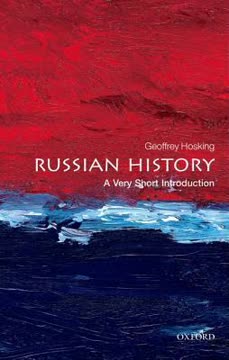
Russian History by Geoffrey Hosking receives mixed reviews averaging 3.64/5 stars. Positive reviews praise its concise overview spanning millennium of Russian history, traditional historical style avoiding ideological bias, and insights into recurring autocratic themes. Critics note it's too dense, assumes prior knowledge, lacks depth on key figures and events like the Cold War, and feels rushed. Some found it dry with disjointed chapters. Many agree it serves better as a refresher than true introduction. Readers appreciate its brevity (130 pages) and thematic approach covering geography, serfdom, and political structures, though specialized periods receive insufficient coverage.
Similar Books