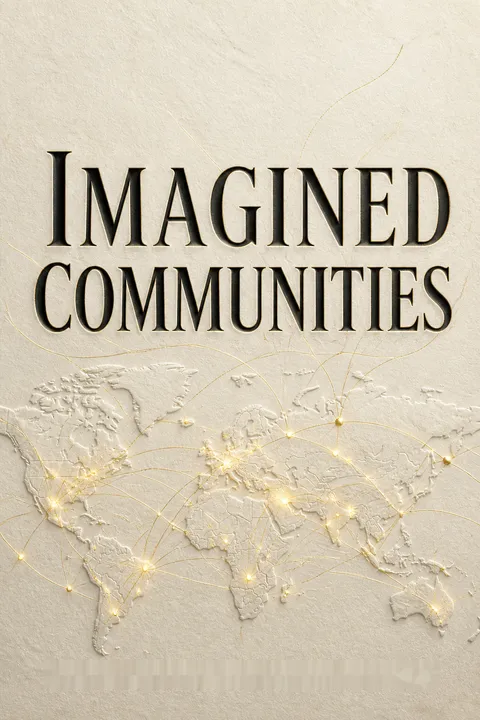


Key Takeaways
Treat nations as real social bonds, not ancient natural facts
A shared political picture. Anderson defines a nation as an imagined political community: imagined because most members will never meet, limited because it has boundaries, sovereign because it claims self-rule, and communal because people picture one another as equals in a shared society. “Imagined” does not mean fake. The ties are socially real even when members know one another only through symbols, stories, and institutions.
Why it can command sacrifice. The nation offers a way to connect individual lives to a collective past and future. Anderson opens with the empty tombs of unknown soldiers: their occupants need not be identified for the monuments to hold meaning. National belonging can make an accidental birthplace feel like a lasting bond, and private death part of a shared story.
The distinction between imagined and imaginary is essential. Money, citizenship, and universities also depend on shared belief, yet their consequences are tangible. National identity belongs in this category: neither a biological fact nor an illusion that can simply be dismissed. The framework also makes a useful question possible: what practices keep a community believable to people who have never met? Its account of horizontal fellowship captures the ideal nations project, but it should not be mistaken for a description of equal treatment. A nation may imagine its members as peers while preserving sharp differences in power and belonging.
Notice how shared media makes strangers feel present together
Time shared at a distance. Anderson calls the modern sense of people acting at the same moment in “homogeneous, empty time”: time measured by clocks and calendars, not by sacred events that connect past and future. Novels helped readers picture strangers pursuing separate lives within one society. Newspapers did something similar by placing unrelated events under the same date, inviting readers to imagine a world continuing beyond the stories on the page.
A daily act of belonging. A reader may know nothing about the other people reading that day’s paper, yet can imagine them doing so at the same time. The newspaper’s brief life matters: yesterday’s edition is obsolete, but the ritual repeats tomorrow. For Anderson, this ordinary, private act helps make an anonymous public feel like a community.
This account links media form to political feeling rather than treating communication as a neutral pipe for ideas. The calendar date and the page’s arrangement give separate events a shared frame, much as a common timetable can coordinate people who never interact. The claim is especially useful for understanding how belonging can grow without personal acquaintance. It also invites a distinction between shared attention and shared interpretation. Readers may encounter the same headlines yet draw opposed conclusions, so simultaneity can create a public without guaranteeing consensus.
Follow the language market, not ideology alone, to explain nationalism
Print found new readers. Print-capitalism means the commercial production and sale of printed material. As Latin-reading audiences became saturated, publishers sought larger markets among people who read vernacular languages. Printing made texts reproducible, helped stabilize written languages, and connected speakers of different local dialects through a common print form. Before 1500, most printed books were still in Latin; by the late sixteenth century, vernacular books had become dominant in places such as France.
A religious upheaval accelerates it. Luther’s German works spread rapidly through print. Between 1520 and 1540, German-language publishing tripled compared with the preceding two decades, and Luther’s books formed a large share of sales. The Reformation helped expand vernacular readership, while print markets turned language into a medium through which strangers could recognize a wider public.
The argument is stronger than a simple claim that people unite because they speak alike. It shows how commercial incentives, technology, and linguistic diversity interacted to make some forms of communication scalable. Language communities are partly built by decisions about what gets printed, sold, and taught. That perspective also cautions against treating a national language as an untouched inheritance. Still, market forces alone cannot explain why one print language wins over another. Political institutions and unequal access to literacy shape who can publish, read, and define the standard.
Look to colonial administration to see where early nations took shape
Creole limits mattered. The first American nations did not emerge because colonists spoke a language different from Europe. Creoles, people of European descent born in the Americas, shared language and ancestry with the imperial centers. But colonial offices restricted their rise: of 170 Spanish American viceroys before 1813, only four were creoles. Their administrative careers usually ended in the colony where they began, making local fellow officials familiar companions and potential allies.
A province becomes a homeland. Long distances, restricted trade, and colonial administrative borders made the provinces distinct settings. Local newspapers connected readers through news about ships, prices, appointments, and events in their own region. Independence movements then turned these administrative units into national projects. Their leaders were often elite landowners wary of popular revolt, so national inclusion did not automatically mean social equality.
This explanation shifts attention from abstract ideals to the routines that organize careers and communication. A bounded administrative career can cultivate shared interests before anyone declares a national identity. The account also usefully resists a heroic story in which independence movements begin as democratic campaigns for everyone. Creole leaders could oppose imperial control while fearing enslaved and Indigenous people’s political mobilization. The result is a necessary tension: national language can invite people into a new community, while the leaders defining that community may still defend hierarchy.
Treat national models as portable inventions, not Europe’s private property
Nations became copyable. Anderson uses “piracy” to describe the adoption and adaptation of political models, not literal theft. The American and French revolutions became printable examples of what a nation-state might look like. In nineteenth-century Europe, writers, teachers, and language scholars helped turn local speech into standardized print languages and link them to claims of national community.
Language work could reshape politics. Czech scholars documented their language and literature; Hungarian writers argued that Hungarian could support serious literary work. Such efforts made a national future imaginable, but they did not follow one script. National movements borrowed from earlier examples and changed them to suit local conditions. The nation was no longer just a result of particular historical circumstances. It became a political possibility people could deliberately pursue.
The idea of modularity helps explain why political forms travel without producing identical societies. A borrowed constitution, national anthem, or language policy takes on new meaning in its setting. This is a useful corrective to accounts that treat Europe as the sole source of national consciousness and everywhere else as a late imitation. At the same time, models are never copied on neutral terms. The people with power to define the borrowed form can exclude others, and later generations may mistake a recent adaptation for an ancient inheritance.
When empires borrow national identity, ask who remains excluded
A defensive national costume. Official nationalism is the state-led use of national identity to protect or extend dynastic power. European rulers adopted national labels as popular national movements challenged their authority. The Russian Empire promoted Russian language and identity across a diverse population; Britain developed policies to produce English-speaking colonial administrators. Both could present empire as national unity while limiting who could share in power.
Assimilation had a ceiling. Anderson describes Indian officials educated in English who adopted British habits yet remained confined to careers in India. They could be culturally Anglicized without being permitted to rise through the same imperial paths as British officials. Similar contradictions appeared in Japanese rule over colonized peoples. The promise of national membership could therefore coexist with barriers to advancement, movement, and equal status.
This is a sharp way to see how inclusion can serve control. Teaching a common language or national history may expand opportunity, but it can also produce subordinate intermediaries for an empire. The key test is not whether a state celebrates shared identity, but whether the people it assimilates can access the same institutions and authority. Anderson’s examples connect national belonging to professional mobility, a dimension often obscured by flags and speeches. The framework also suggests that exclusion is not always a failure of assimilation; it can be built into the system’s design.
Read borders, categories, and monuments as political technologies
Colonial rule made its own map. Anderson groups the census, map, and museum as tools through which colonial states organized people, territory, and history. Census categories turned varied identities into fixed, countable groups. Printed maps depicted borders as continuous lines and helped make territory appear as a bounded unit. Museums and archaeological projects gathered monuments into a state-managed account of the past.
The tools could outlive empire. In Siam, maps and geography textbooks helped replace older ideas of rule centered on capitals and settlements with a bounded territorial idea of the country. In Indonesia, the map’s outline helped make a distant region part of the national imagination even when most citizens had never visited it. Colonial classifications could thus furnish postcolonial states with both administrative habits and national symbols.
The chapter’s lasting insight is that representation can help produce what it appears merely to record. A map used in schools, a category repeated in forms, or a monument reproduced on official material makes a political claim familiar through repetition. This is not proof that borders or identities are unreal; it shows how institutions give them durability. The account is particularly valuable for readers examining identity documents and heritage displays. Its Southeast Asian evidence is rich, though the book itself cautions that this pattern cannot automatically be applied everywhere.
Separate patriotism’s attachment from racism’s claim of inherited contamination
Belonging can invite newcomers. Anderson sees patriotism as attachment often expressed through the language of home and kinship. National songs make strangers voice the same words together, creating what he calls “unisonance,” a felt harmony among people who cannot see one another. This bond can be historically formed rather than fixed by ancestry: leaders such as San Martín could declare Indigenous people citizens of Peru.
Racism draws a different boundary. National identity can be entered through citizenship and language, however unevenly. Racism, in Anderson’s distinction, treats ancestry or appearance as an unchangeable mark that overrides language and political allegiance. He traces much modern racism to inherited class hierarchies and imperial rule, where claims of superior blood helped justify domination. The distinction clarifies how national solidarity may be inclusive in principle while still being used to exclude in practice.
This distinction prevents a common analytical shortcut: treating every intense national attachment as disguised hatred of outsiders. Love of place and inherited racial hierarchy can overlap, but they are not the same logic. One can imagine a nation that admits new members, even as its institutions make admission difficult. That gap between principle and practice deserves attention. Anderson’s emphasis on love illuminates sacrifice and solidarity, while the contrast with racism helps identify a more rigid form of exclusion. Neither point makes nationalism harmless; each makes its effects easier to diagnose.
National histories turn selective forgetting into family memory
Continuity needs a story. Anderson argues that major changes in consciousness produce gaps in memory, and those gaps invite narratives of identity. A person’s life story connects experiences that cannot all be remembered; national histories similarly link separate generations into a single account. Historians and schools can present past conflicts as episodes within one national family, even when the people involved did not share that identity.
Old violence gets a new frame. Ernest Renan argued that nations depend partly on forgetting. Anderson highlights how French accounts could present the St. Bartholomew’s Day killings between Catholics and Protestants as an episode of French history, smoothing over the fact that participants did not necessarily see themselves as fellow French citizens. Such stories make historical divisions appear safely internal, like quarrels among relatives.
National memory is not simply a storehouse of facts. It is an arrangement that decides which deaths become public symbols and which differences fade from view. This helps explain why anniversaries and school histories can create shared identity without requiring a literally shared past. The concept also applies beyond nations: families, institutions, and political movements build continuity through selective storytelling. Yet forgetting should not be treated as a single coordinated act. Official curricula matter, but popular memory can remain divided, contested, or resistant to the state’s preferred narrative.
A revolution can change rulers while inheriting the old state’s wiring
Power arrives with infrastructure. A successful revolution inherits more than territory. It takes over offices, records, laws, maps, archives, and administrative routines. Anderson notes that revolutionary governments often occupy the former rulers’ capitals and use state institutions built for earlier regimes. These continuities can make a new state effective, but they can also carry forward habits of surveillance and centralized control.
Nationalism does not stop at ideology. Vietnam, Cambodia, and China fought despite their revolutionary socialist identities. Anderson describes these conflicts as shaped by state leadership and inherited national projects, not simply by the wishes of ordinary people. Nationalism had become a portable political form, available to revolutionary governments as well as empires. The book’s own later translations offer a smaller parallel: readers and translators adapted its arguments to local political debates rather than reproducing one fixed meaning.
The image of inherited wiring makes institutional continuity concrete: changing the people at the controls does not automatically redesign the machine. This is a useful lens for revolutions, regime changes, and postcolonial transitions, where new political language may coexist with old administrative capacities. Anderson also insists that internationalist ideologies do not erase national loyalties, a point made vivid by socialist states at war. The caution is that inherited institutions do not determine every outcome. Political choices, public resistance, and institutional redesign still matter, even when the old machinery is ready to be switched on.
Analysis
Anderson’s central achievement is to explain how a community can be simultaneously imagined and consequential. He avoids two tempting errors: treating nations as timeless natural units, and treating them as mere fabrications with no social reality. Instead, he follows the media, bureaucracies, schools, and stories that make large-scale anonymous solidarity plausible. Print markets standardize languages; colonial offices turn people and territory into administrative objects; national histories connect generations through selective memory. The argument is especially compelling when it shows how unintended effects become political resources. A colonial map can furnish an anticolonial emblem, and an administrative career ladder can foster a community the empire never intended to create.
The book’s comparative range is a strength, but also a boundary. Its arguments are grounded especially in the Americas and Southeast Asia, and Anderson himself signals that some mechanisms may not travel equally well across regions. The account also places less emphasis on how gender, class, and racial power shape the everyday experience of belonging than on how national communities become imaginable. That is not a reason to discard the framework; it is a reason to ask who performs the imagining, whose story becomes common history, and who is counted as a full member.
The framework remains useful in a media environment unlike the one it describes. Digital platforms can make distant people feel simultaneous and can circulate national symbols at extraordinary speed, but the resulting public is fragmented as well as connected. The important question is not whether newer media repeat the newspaper’s role exactly. It is how their rhythms, categories, and audiences organize shared attention. Anderson’s deeper lesson is methodological: study the ordinary systems that make collective identity feel natural, then examine the political interests that inherit and use them.
Review Summary
Imagined Communities is a seminal work on nationalism that explores how nations are constructed as "imagined communities" through shared language, print media, and cultural practices. Reviews praise Anderson's non-Eurocentric approach and insightful analysis of how nationalism develops, particularly in former colonies. Many find it intellectually challenging but rewarding, offering a new perspective on national identity formation. Some criticize its academic language and limited scope. Overall, readers consider it an essential, thought-provoking text for understanding the origins and spread of nationalism, despite its occasional difficulty.
People Also Read






Glossary
imagined political community
A large shared identityAnderson’s definition of a nation: a political community whose members imagine a bond with many people they will never meet. It is limited because it has boundaries, sovereign because it claims self-rule, and imagined as a community because it presents members as sharing a form of horizontal belonging. Imagined does not mean unreal or merely fabricated.
print-capitalism
Commercial mass printingThe commercial production and sale of printed texts. Publishers seeking wider markets printed in vernacular languages, helping readers who spoke related dialects share standardized written forms. In Anderson’s account, this interaction of capitalism, print technology, and linguistic diversity helped create the communication fields in which national consciousness could develop.
homogeneous, empty time
Clocked, shared public timeA modern way of imagining time as uniform, measurable, and moving forward by clock and calendar. It allows people to picture strangers acting simultaneously without meeting or knowing one another. Anderson contrasts it with religious conceptions in which past, present, and future can be linked through sacred meaning rather than chronological coincidence.
official nationalism
State-led national identityA policy through which dynastic or ruling groups adopt national identity to preserve authority over diverse populations. It often combines national symbols, language policy, education, and historical narratives with continued limits on political equality. Anderson presents it as a state response to popular national movements, later copied in imperial and postcolonial settings.
secular pilgrimage
Career paths through state officesAnderson’s term for the journeys made through bureaucratic careers. Officials posted to different places encounter colleagues who share a language and institutional path. In colonial settings, limits on promotion and movement could make a particular administrative territory feel like a common political world, helping turn an imperial unit into a possible nation.
unisonance
Shared voices across distanceThe experience of many people singing or voicing the same words at the same time, despite not knowing one another. Anderson uses national anthems to show how sound can make an imagined community feel physically present. The act offers a fleeting sense of collective participation through a shared language and melody.
FAQ
What's Imagined Communities about?
- Exploration of Nationalism: Imagined Communities by Benedict Anderson examines the origins and spread of nationalism, arguing that nations are "imagined communities" that exist in the minds of their members.
- Cultural Constructs: Anderson posits that nations are not natural entities but rather cultural artifacts that emerged from specific historical contexts, particularly in the late 18th century.
- Role of Print Capitalism: The book emphasizes the role of print capitalism in fostering national consciousness, as it allowed for the dissemination of ideas and the creation of a shared identity among people who would never meet.
Why should I read Imagined Communities?
- Understanding Modern Nationalism: This book provides critical insights into how modern nationalism has shaped political landscapes and identities worldwide, making it essential for anyone interested in contemporary politics.
- Historical Context: Anderson's analysis connects historical events to the rise of nationalism, offering a comprehensive view of how nations are constructed and perceived.
- Influential Scholarship: The book is considered a foundational text in the study of nationalism and has influenced scholars across various disciplines, including history, sociology, and political science.
What are the key takeaways of Imagined Communities?
- Nations as Imagined: Anderson argues that "the nation is an imagined political community—and imagined as both inherently limited and sovereign." This means that members of a nation may never meet, yet they share a sense of belonging.
- Census, Map, Museum: He discusses how the colonial state used tools like censuses, maps, and museums to create and reinforce national identities, shaping how people perceive their communities.
- Historical Evolution: The book traces the evolution of nationalism from its roots in the Enlightenment and the American and French revolutions to its modern manifestations, highlighting its adaptability and persistence.
What are the best quotes from Imagined Communities and what do they mean?
- "The nation is an imagined political community.": This quote encapsulates Anderson's central thesis that nations exist in the collective imagination of their members, rather than as tangible entities.
- "Census, Map, Museum": This phrase refers to the tools used by colonial powers to construct national identities, emphasizing how these instruments helped shape perceptions of belonging and governance.
- "All communities larger than primordial villages of face-to-face contact are imagined.": This quote highlights the idea that larger communities, including nations, are constructed through shared narratives and symbols rather than direct personal relationships.
What is the significance of print capitalism in Imagined Communities?
- Facilitates Communication: Anderson argues that print capitalism allowed for the widespread dissemination of ideas, which helped create a shared sense of identity among people who would never meet.
- Standardization of Language: The rise of print led to the standardization of languages, which in turn fostered a sense of belonging and community among speakers of those languages.
- Creation of National Consciousness: Print media played a crucial role in shaping national consciousness, as it provided a platform for discussing national issues and fostering a collective identity.
How does Anderson define nationalism in Imagined Communities?
- Cultural Artifact: Anderson defines nationalism as a cultural artifact that emerged from specific historical conditions, particularly during the late 18th century.
- Imagined Community: He emphasizes that nationalism is an "imagined community," meaning that members of a nation perceive themselves as part of a larger group, despite often being strangers to one another.
- Sovereignty and Limits: Nationalism is characterized by its inherent limitations and aspirations for sovereignty, as nations seek to define themselves against others.
What role does colonial education play in shaping nationalism according to Imagined Communities?
- Awareness of Identity: Colonial education systems often educated colonized peoples about their own histories and identities, leading to a greater awareness of their national identity.
- Transmission of Ideas: The curriculum in colonial schools included European histories and ideologies, which were often at odds with the realities of the colonized peoples.
- Formation of Nationalist Intelligentsia: Anderson argues that colonial education produced a new class of educated elites who became the leaders of nationalist movements.
How does Imagined Communities address the concept of identity?
- Collective Identity: Anderson argues that national identity is a collective construct, shaped by shared experiences, narratives, and symbols that bind individuals together.
- Fluidity of Identity: The book highlights the fluid nature of identity, as national identities can evolve and change in response to historical events and cultural shifts.
- Role of Memory: Anderson emphasizes the importance of memory in shaping national identity, as nations often construct narratives that connect their past to their present, creating a sense of continuity.
How does Anderson's concept of "imagined communities" apply to contemporary nationalism?
- Relevance to Modern Nationalism: The concept of "imagined communities" remains relevant as contemporary nationalisms continue to be constructed through shared narratives and symbols.
- Impact of Social Media: In the digital age, social media plays a significant role in shaping national identities by allowing individuals to connect with others who share similar beliefs and experiences.
- Challenges to National Identity: Anderson's framework also highlights the challenges faced by contemporary nationalisms, such as globalization and multiculturalism.
What critiques does Anderson make about traditional views of nationalism?
- Eurocentrism: Anderson critiques the Eurocentric perspective that often dominates discussions of nationalism, arguing that it overlooks the contributions and experiences of non-European nations.
- Simplistic Models: He challenges simplistic models of nationalism that fail to account for the complexities and variations in how nationalism manifests across different cultures and historical contexts.
- Static Definitions: Anderson argues against static definitions of nationalism, advocating for a more dynamic understanding that considers the historical and cultural factors that shape national identities.
What is the relationship between nationalism and internationalism in Imagined Communities?
- Interconnectedness of National Movements: Anderson highlights that nationalist movements are often influenced by international ideas and struggles.
- Globalization of Nationalism: The book suggests that nationalism is not a static or isolated phenomenon but is shaped by global forces and interactions.
- Dual Nature of Nationalism: Anderson posits that nationalism can be both a unifying force within a nation and a divisive force between nations.
What is the impact of Imagined Communities on the study of nationalism?
- Foundational Text: Imagined Communities is considered a foundational text in the field of nationalism studies, influencing scholars across various disciplines.
- Interdisciplinary Approach: Anderson's interdisciplinary approach, drawing from history, sociology, and cultural studies, has encouraged a broader understanding of nationalism as a complex phenomenon.
- Continued Dialogue: The book has sparked ongoing dialogue and debate about the nature of nationalism, its origins, and its implications for contemporary society.
Download PDF
Download EPUB
.epub digital book format is ideal for reading ebooks on phones, tablets, and e-readers.








