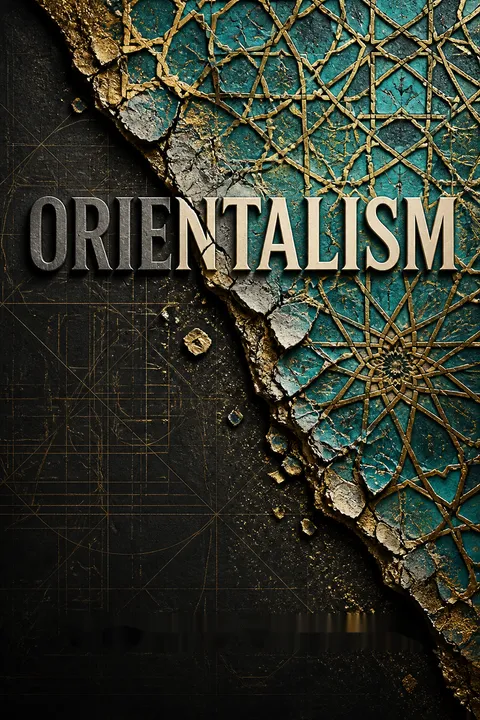


Key Takeaways
Ask who gets to define the East before treating it as a natural fact.
A line with consequences. Said opens with British statesman Arthur Balfour defending the occupation of Egypt in 1910. Balfour presents British rule as justified by British knowledge: Britain understands Egypt, he argues, while Egyptians cannot govern themselves. His logic makes domination sound like expertise put to good use. Said calls the larger system Orientalism: academic study, imaginative writing, and institutional practice that define the Orient from a position of Western authority.
Not imaginary, but made. Said does not claim that Eastern societies are fictional. He argues that Orient and Occident are human-made categories with histories, and that they shape what people notice and believe. Once East and West are treated as fixed opposites, a diverse region can be made to seem uniformly backward, while the West appears naturally rational and fit to rule.
The opening example exposes how authority can hide inside apparently practical language. Balfour’s argument is not simply that Britain has more information, but that its information grants it the right to decide what Egyptians need. This distinction matters in any field where expertise guides policy. Still, the critique does not make expertise inherently suspect. The useful question is whether knowledge remains answerable to the people it describes, or turns their presumed deficiencies into a reason to overrule them.
Treat expertise as power when description becomes permission to govern.
Knowledge has an address. Said argues that ideas about the Orient were produced alongside imperial power, not in a sealed academic world. His use of the term discourse, drawn from Foucault, means a connected system of institutions, authorities, vocabulary, and practices that shapes what can be said and treated as true. Orientalist scholarship helped classify societies, train officials, and supply governments with interpretations of the places they controlled.
Cromer makes it concrete. As Britain’s representative in Egypt, Lord Cromer described Egyptians as incapable of Western-style reasoning and used that portrait to justify British supervision. His claims were not detached from rule: he was both an administrator of Egypt and a consumer of knowledge that cast Egyptians as dependent. In this arrangement, an account of a people could become part of the machinery used to manage them.
The connection between description and administration is the book’s most durable analytical tool. It resembles a feedback loop: institutions reward certain accounts, those accounts guide decisions, and the decisions can make the original account appear confirmed. This does not mean that every scholar is an agent of government. It means that claims about a population deserve scrutiny when they travel easily from research into policy, especially if the people described have little power to contest them.
Reject labels that turn millions into one timeless personality.
A type replaces a person. Said shows how writers repeatedly described Orientals as irrational, passive, sensual, or incapable of self-rule. Lord Cromer portrayed Egyptians as the opposite of Europeans in almost every respect. In the twentieth century, Harold Glidden’s short essay on Arabs assigned a single set of traits to a vast population, drawing sweeping conclusions from a handful of sources. The specific judgments changed, but the habit of treating a label as an explanation persisted.
Origins become destiny. Orientalist scholars often used language, race, or religion to define supposedly permanent traits. Ernest Renan, for example, treated Semitic languages and peoples as evidence of arrested development. Said’s objection is not that all group analysis is useless. It is that a category becomes misleading when it erases internal differences, historical change, and the choices people make in particular circumstances.
This is a warning against a familiar error in social analysis: mistaking a category for a cause. Group labels can help organize research, but they become dangerous when they are treated as explanations that need no further evidence. The corrective is not to forbid generalization. It is to ask what variation a generalization hides, how it was built, and whether people described by it can challenge its terms.
Remember that texts can script what observers believe they discover.
An inherited picture guides sight. Said calls the mental mapping of familiar and foreign places imaginative geography. It turns distance into difference, dividing the world into spaces imagined as ours and theirs. Older European accounts of Islam show this process clearly: Muslim belief was often described as a distorted imitation of Christianity before Muslim texts or interpretations were taken seriously.
The library can outrank the landscape. In 1798, Napoleon invaded Egypt with scholars who catalogued the country’s history, language, and natural features. Their vast Description de l’Égypte made Egypt legible through European methods and classifications. Said’s point is not that the findings were all false. It is that the work presented a complex society through a framework that placed Western observers in command of its meaning, and treated their account as more authoritative than local voices.
The idea of imaginative geography helps explain why stereotypes can feel like direct observation. A traveler or analyst may see real details, yet inherited categories influence which details stand out and how they are arranged. The challenge is to compare the representation with evidence produced in different settings, including accounts by the people represented. No single viewpoint is neutral, but contrasting viewpoints can expose what one framework leaves out.
Track scholarship from classroom authority to colonial administration.
Follow the chain of influence. Said traces Orientalist knowledge from scholars such as Silvestre de Sacy, who edited and arranged Arabic texts for European students, to officials who used such expertise in governing the East. A strategic location is the position a writer takes toward the subject, visible in voice, structure, and choice of evidence. A strategic formation is the network of texts and institutions that gives related works authority together. These terms help connect an individual book to the larger system around it.
Ideas acquired infrastructure. Orientalist societies, university posts, journals, and colonial offices circulated knowledge and made it useful. Napoleon’s scholarly expedition to Egypt joined military occupation with organized research. By the end of World War I, European powers controlled about 85 percent of the earth’s surface, and Orientalist work had become part of a wider enterprise of classifying and administering territories.
The focus on circulation improves on explanations that blame either a single author or an abstract system. A claim gains influence through its sponsors, venues, readers, and uses. Mapping those pathways is valuable in the history of science, journalism, and public policy alike. Yet institutional reach does not prove that every result is false or coerced. The stronger test is to examine how authority was earned, whose evidence counted, and what practical decisions the knowledge supported.
Read travel accounts for the gap between encounter and control.
The observer shapes the scene. Said contrasts Edward Lane’s account of Egypt with the more personal journeys of Chateaubriand, Nerval, Flaubert, and Richard Burton. Lane sought scholarly authority through detailed description and distance from Egyptian domestic life. Chateaubriand filtered Palestine through Christian memory and his own sense of mission. Flaubert’s encounter with the dancer Kuchuk Hanem became material for his writing, while her perspective remained largely absent.
Experience is not innocence. These writers did not simply record an untouched Orient. Their journeys were shaped by reading, ambition, desire, and inherited expectations. Burton’s knowledge of local customs let him move through unfamiliar settings, but his writing still carried the authority of a European observer. Said uses these differences to show how personal style can vary while the imbalance between narrator and represented subject remains.
Travel writing offers a useful case study in situated observation. Immersion can correct distance, but it does not erase unequal power or make an observer’s account transparent. Lane’s restraint, Flaubert’s aesthetic use of encounter, and Burton’s self-fashioning each produce different kinds of knowledge. Readers can ask two questions at once: what did the traveler learn, and what could the people encountered say about the traveler’s account?
Spot old assumptions hiding inside modern policy vocabulary.
Two levels of belief. Said distinguishes latent Orientalism, the largely unspoken assumptions that the Orient is fixed and inferior, from manifest Orientalism, the explicit claims made about its societies, languages, or history. The explicit claims may change, while the underlying contrast between a rational West and a backward East remains stable.
The vocabulary gets updated. After World War II, American area studies and social science increasingly replaced older philology as the language of expertise. Yet Said argues that terms such as modernization, stability, and political elites could preserve older assumptions in technical form. He points to scholarship that treated Arab societies as deficient or politically immature while overlooking colonial history and contemporary conflicts. New methods can sharpen inquiry, but new terminology alone does not guarantee a new perspective.
The distinction between explicit theories and background assumptions is especially useful when a field changes its methods. A new vocabulary can make old premises harder to notice because it sounds more precise. At the same time, continuity should not be presumed simply because the subject remains the same. The careful approach is to test whether newer research changes its evidence, explanatory logic, and openness to revision, rather than judging it by terminology alone.
Critique domination without inventing an equally false opposite.
Do not reverse the binary. Said rejects the idea that exposing Western representations requires defending a pure, authentic Orient. That would preserve the same habit of dividing humanity into sealed civilizations, only with the moral ranking reversed. He argues instead for humanistic study: historically grounded interpretation that questions inherited authority and recognizes exchange among cultures.
Make room for overlap. Said points to philologists such as Erich Auerbach, whose work approached texts through close reading, historical context, and attention to literary difference. He also draws on Goethe’s idea of studying the world’s literatures without flattening them into sameness. The goal is not to erase disagreement or injustice. It is to understand people in context and to resist turning cultural difference into a permanent license for domination.
This is a demanding alternative because it refuses the emotional simplicity of choosing one civilizational camp. Comparative work can reveal borrowing and shared histories without denying real asymmetries in power. Its risk is that appeals to dialogue can become vague if they ignore occupation, exclusion, or coercion. The strongest humanism in this account is therefore critical rather than sentimental: it enlarges understanding while keeping political inequality visible.
Test civilizational claims against the material interests they serve.
Ask what is at stake. Said connects representations of the Orient to trade, territory, military strategy, and imperial policy. In the 2003 preface, he asks readers to consider whether Iraq would have provoked the same invasion if it had exported fruit rather than oil. The question challenges explanations that present intervention as a response to culture alone, while the region’s strategic resources and history of foreign control disappear from view.
Ideas and interests interact. Said does not argue that every political decision has a single economic motive. His point is that cultural stories can make material projects appear benevolent, necessary, or natural. Describing a society as irrational or dangerous can prepare audiences to accept control over it. Examining the interests behind those descriptions makes it harder to confuse a justification for power with a complete account of events.
This test is most productive when it avoids two easy answers: that stated ideals explain everything, or that material gain explains everything. Security, resources, ideology, and domestic politics can reinforce one another. Said’s question usefully asks which interests are visible and which are obscured by civilizational language. A fuller analysis also needs evidence about decision-makers, institutions, and the views of people who bear the consequences.
Analysis
Orientalism’s central achievement is to make representation part of political history. It asks not only whether a description of the East is accurate, but how its categories acquired authority, where they circulated, and what actions they made easier to justify. That shift remains valuable because stereotypes rarely operate as isolated opinions. They gain force through schools, scholarship, administration, news, and policy, each reinforcing the others.
The book is also strongest when it distinguishes a system from the intentions of any one writer. Said can recognize genuine scholarship and individual complexity while still tracing the larger conventions that shape what scholars can see. This avoids the weak claim that all Western knowledge is simply propaganda. The more rigorous claim is that knowledge is situated, and that claims made under conditions of unequal power deserve particular scrutiny.
A tension remains. Said’s focus on British and French writing about the Arab and Islamic East gives the argument force and historical specificity, but it can encourage readers to treat Western culture as more unified than it is. The book itself resists that simplification through its varied examples, though its broad account of Orientalism sometimes makes institutional continuity seem stronger than local disagreement or intellectual change. A useful application therefore treats Orientalism as a diagnostic lens, not a verdict on every study of another society.
The lens is most useful when applied concretely: identify the category, inspect the evidence, locate the institutions that authorize it, and ask whose account is missing. It should also be turned toward non-Western elites when they reproduce inherited civilizational stereotypes for their own purposes. The point is not to replace one privileged narrator with another. It is to make representation more accountable to history, context, and the people whose lives become its subject.
Review Summary
Orientalism is a seminal 1978 work examining how the West has stereotyped and misrepresented the East, particularly the Middle East and Islam. Said argues that Orientalism is a political discourse supporting colonialism by portraying the Orient as exotic, backward, and inferior. The book analyzes historical texts, literature, and scholarship to show how Western knowledge production justified imperialism. Reviewers praise its groundbreaking critique and lasting relevance, though some find the prose dense or overly academic. Critics note Said's methodology and selectivity, but most acknowledge the work's profound influence on postcolonial studies and cultural criticism.
People Also Read




Glossary
Orientalism
Western knowledge and powerSaid uses Orientalism for an interconnected tradition of academic study, imaginative representation, and institutional practice concerning the Orient. It depicts East and West as fundamentally different, while giving Western writers and institutions authority to define the East. The term describes not just mistaken images, but a durable system that shapes knowledge and can support political control.
latent Orientalism
Underlying assumptions about the EastLatent Orientalism is Said’s name for the deep, often unspoken assumptions that the Orient is fixed, passive, inferior, and radically unlike the West. These assumptions can persist even when explicit theories and scholarly methods change. They form a background framework that makes certain descriptions of Eastern peoples seem natural or self-evident.
manifest Orientalism
Explicit claims about the OrientManifest Orientalism refers to stated descriptions and theories about Eastern societies, languages, religions, and histories. Said distinguishes it from latent Orientalism because explicit claims can shift with new scholarship or politics, while underlying assumptions about the Orient’s difference and inferiority may remain comparatively stable.
imaginative geography
Mental mapping of differenceImaginative geography is the process of dividing the world into meaningful spaces such as ours and theirs, familiar and foreign. These divisions are human constructions, not simply facts of nature. In Said’s account, they shape how distant peoples are imagined and can turn geographic difference into claims about character, culture, and political entitlement.
strategic location
Writer’s position toward a subjectStrategic location describes where a writer places himself in relation to the Oriental material he presents. It can be seen in narrative voice, structure, imagery, and the writer’s assumed authority. Said uses the term to analyze how a text addresses readers and positions its author as observer, interpreter, or representative.
strategic formation
Authority built across textsStrategic formation describes how texts, genres, audiences, and institutions become connected and gain influence together. A work can acquire authority through its relationship to earlier scholarship and its circulation in universities, libraries, or government. Said uses the term to study how a body of writing gains cultural power beyond any single author.
discourse
System shaping what can be saidUsing Foucault’s concept, Said treats discourse as a network of language, institutions, expertise, and practices that makes certain statements about the Orient authoritative and others difficult to express. It is not merely a collection of words. It organizes knowledge and can connect intellectual descriptions to political and administrative power.
FAQ
What is "Orientalism" by Edward W. Said about?
- Critical analysis of Western views: "Orientalism" examines how the West, especially Europe and later America, has historically perceived, represented, and dominated the "Orient," primarily the Middle East and Islamic world.
- Orientalism as discourse: Said argues that Orientalism is not just an academic field but a system of thought and a corporate institution that constructs the Orient as fundamentally different and inferior to the West.
- Power and representation: The book explores how these representations have justified colonial and imperial control over Eastern societies, shaping both knowledge and policy.
Why should I read "Orientalism" by Edward W. Said?
- Reveals power-knowledge dynamics: The book exposes how Western knowledge about the Orient is intertwined with imperial power, influencing political and cultural attitudes.
- Challenges stereotypes: It critiques essentialist and stereotypical views of Eastern societies, encouraging readers to question received ideas.
- Influential across disciplines: "Orientalism" has had a major impact on literary criticism, postcolonial studies, anthropology, and political science, making it essential reading for understanding cultural representation.
What are the key takeaways from "Orientalism" by Edward W. Said?
- Orientalism is a discourse: The West’s representations of the East are not neutral but serve to reinforce Western dominance.
- Knowledge and power are linked: Academic and cultural portrayals of the Orient have justified and facilitated imperialism.
- Stereotypes persist: Even as methods change, many Orientalist assumptions about the East’s irrationality and backwardness remain embedded in Western culture and policy.
How does Edward W. Said define "Orientalism" in his book?
- Three interrelated definitions: Orientalism is an academic field, a style of thought based on East/West distinctions, and a corporate institution of power.
- Discourse of power: Said borrows from Foucault to describe Orientalism as a system of knowledge and power that shapes what can be said and done about the Orient.
- Constructed representation: Orientalism is not objective knowledge but a constructed representation that serves Western interests.
What is the relationship between Orientalism and imperialism according to Edward W. Said?
- Mutually reinforcing systems: Orientalism provides the ideological justification and knowledge framework that supports imperial domination.
- Cultural imperialism: It shapes Western attitudes to see the Orient as a place to be controlled, civilized, or exploited.
- Institutional collaboration: Academic Orientalism often works hand-in-hand with colonial administrations and later with government policy and business interests.
Who was Edward W. Said and what influenced his writing of "Orientalism"?
- Personal background: Said was a Palestinian-born scholar and professor at Columbia University, with a deep personal connection to the Middle East.
- Academic and political influences: His upbringing in Palestine, Egypt, and Lebanon, combined with his Western academic training, gave him a unique perspective on East-West dynamics.
- Political engagement: Said’s involvement in Middle Eastern politics, especially after the 1967 Arab-Israeli war, and his humanistic commitment shaped his critical approach to Orientalism.
What are the key historical phases and figures in Orientalism discussed by Edward W. Said?
- Early encounters: European scholars and travelers began constructing knowledge about the Orient during the Renaissance and Enlightenment.
- 19th-century institutionalization: Figures like Silvestre de Sacy and Edward Lane formalized Orientalism in academia and colonial administration.
- 20th-century transformations: Orientalism shifted into area studies and social sciences, especially in the U.S., but retained many of its ideological assumptions.
How did philology and language studies shape Orientalism in Edward W. Said's analysis?
- Foundation of modern Orientalism: Philology, especially the study of Semitic and Indo-European languages, provided a scientific basis for classifying and understanding the Orient.
- Key figures: Scholars like Silvestre de Sacy and Ernest Renan established Orientalism as a rigorous academic discipline.
- Reinforcement of hierarchies: Language studies often linked linguistic families to notions of superiority and inferiority, shaping Western perceptions of the Orient.
What is the "textual attitude" toward the Orient in "Orientalism" by Edward W. Said?
- Reliance on texts: The West tends to understand the Orient through authoritative texts and representations rather than direct experience.
- Self-reinforcing system: This attitude creates a cycle where the Orient is defined as static, exotic, and inferior through repeated textual representations.
- Limits genuine understanding: Said argues that this approach perpetuates stereotypes and prevents a true understanding of the living realities of Eastern societies.
How does Edward W. Said critique the representation of Arabs and Islam in Western culture?
- Negative stereotyping: Arabs are often portrayed as irrational, violent, and incapable of modernity, while Islam is depicted as monolithic and static.
- Popular culture influence: Films, textbooks, and media frequently reduce Arabs and Muslims to simplistic and demeaning images.
- Academic complicity: Even scholarly works sometimes reinforce these stereotypes, failing to account for the diversity and complexity of Arab and Islamic societies.
What is the difference between latent and manifest Orientalism in Edward W. Said's framework?
- Latent Orientalism: Refers to the underlying, stable set of ideas, stereotypes, and assumptions about the Orient that persist over time.
- Manifest Orientalism: Consists of explicit, stated views and scholarly works that change with time but are grounded in latent assumptions.
- Continuity and change: While manifest Orientalism evolves, latent Orientalism remains constant, shaping how the Orient is always perceived and represented.
What solutions or alternatives does Edward W. Said propose to overcome Orientalism?
- Critical scholarship: Encourages interdisciplinary and self-critical approaches that avoid essentializing and stereotypical representations.
- Recognition of hybridity: Emphasizes the interconnectedness and fluidity of cultures rather than fixed oppositions.
- Humanistic engagement: Advocates for scholarship that respects the humanity and agency of Eastern peoples, promoting coexistence and mutual respect beyond Orientalist binaries.
About the Author
Other books by Edward W. Said
Download PDF
Download EPUB
.epub digital book format is ideal for reading ebooks on phones, tablets, and e-readers.








