

Key Takeaways
Use culture to keep a people present when political power tries to erase them
Culture keeps a record. Said sees Palestinian poetry, film, theater, and criticism as more than artistic expression. They preserve a shared identity when a people has been displaced and denied political recognition. Culture can carry history in forms that survive beyond official institutions and borders.
Memory becomes resistance. The book describes Israeli forces destroying Palestinian archives and ransacking the Khalil Sakakini Cultural Center in Ramallah, a place named for an educator who helped nurture Palestinian cultural life. Said argues that destroying records is an attempt to weaken the sense of a continuous history. Yet stories, language, art, and family keepsakes can transmit that history outside state control.
What's compelling is the account of culture as infrastructure: it stores a community's knowledge when political institutions are vulnerable. That idea applies beyond art, to archives, family photographs, place names, and the everyday language through which people inherit a sense of belonging. Cultural memory does not, by itself, settle disputes over competing histories, and preserving it is not the same as proving every claim. Its force is different. It prevents a powerful actor from making a people disappear simply by controlling the official record.
Begin Palestine's modern story in 1948, not only with the 1967 occupation
The starting date matters. Said argues that Palestinians understand 1948, the year Israel was established, as the beginning of their dispossession, not merely as a prelude to the occupation that began in 1967. He cites the displacement of roughly 800,000 Palestinians, the destruction of more than 400 villages, and the continuing refugee population as central facts of that history.
History remains unsettled. In his account, Israeli national narratives often presented the land as nearly empty and Palestinian departure as voluntary. Israeli historians using archival records challenged parts of that account. For Said, acknowledging what happened is necessary to discuss Palestinian claims, including the right of refugees to return, and to understand why later negotiations could not treat the past as irrelevant.
The central insight is that a conflict's apparent beginning is often a political choice. Start the timeline in 1967, and the issue looks like ending a military occupation; start in 1948, and it also concerns displacement, refugees, and the creation of a state. That framing helps explain why negotiations focused narrowly on borders could leave core grievances untouched. Historical memory is not a substitute for negotiation, however, and competing accounts require careful scrutiny. The value of Said's insistence is that it makes those unresolved claims visible rather than assuming they have expired.
Ask who benefits when resistance is called terrorism and occupation defense
Labels allocate legitimacy. Said challenges the description of the Israeli military as a defensive force when it operates inside territories under occupation. He contrasts Israeli missiles, tanks, and aircraft with Palestinian youths throwing stones, arguing that descriptions of two equal combatants conceal a steep imbalance in power and casualties.
Words shape what counts. In discussing the 2000 uprising, Said cited 180 Palestinians killed and fourteen Israelis in its first six weeks, most of the Palestinians described as civilians. He also traces the word terrorism across political contexts, arguing that governments often apply it to resistance while overlooking violence by states. His purpose is not to excuse attacks on civilians, but to question why some violence is framed as security and other violence as innate barbarism.
The useful move is to treat political vocabulary as part of the conflict, not as neutral packaging. Calling an army defensive or a population violent can direct attention away from who controls territory and who can inflict harm at scale. Yet a critique of selective labeling must not become a license to minimize civilian deaths by non-state actors. A consistent standard asks who was targeted, what means were used, and whether civilians were protected. Context explains why violence occurs; it does not by itself determine whether an act is defensible.
Map control on the ground before accepting claims that negotiations are producing peace
Territory tells the story. Said argues that the Oslo process gave an appearance of movement toward peace while leaving Israel in control of much of the West Bank and Gaza. He points to expanding settlements, Israeli control over borders and movement, and Palestinian areas divided into disconnected enclaves. In his account, the process managed the occupation rather than ending it.
Maps expose the terms. The book includes maps of successive proposals and interim arrangements. They make visible how roads, settlements, checkpoints, and annexed areas shaped daily movement and the possibility of a contiguous Palestinian state. Said also complains that news reports often discuss negotiations without showing maps, leaving readers unable to see what land, access, and authority are actually at stake.
A map forces political language to answer material questions: Who controls the road, the border, or the water supply? It can reveal that a promise of autonomy may coexist with another authority's control over movement and security. The same visual clarity has limits: maps can flatten lived experience and make contested boundaries look settled. They work best alongside accounts of how people use, cross, and are excluded from the spaces shown. Said's point is not that cartography resolves the dispute, but that peace claims should be tested against geography.
Build a political future around equal citizenship, not permanent separation
Interdependence changes the question. After visiting Israel, the West Bank, and Gaza, Said concluded that Israelis and Palestinians were so interwoven through settlement, work, roads, and shared geography that separation could not provide a durable answer. He proposed a binational state: a single political framework in which both peoples could live with equal rights, rather than one group ruling or displacing the other.
The proposal is a horizon, not a shortcut. Said also accepted that two states free of military occupation might serve as a transition. He points to Palestinian citizens of Israel, who were organizing around civil rights and citizenship, as evidence that political identity need not be defined only by religion or ethnicity. The central test is whether institutions can protect both communities as equals.
Said's proposal shifts the test of a solution from how neatly it separates populations to whether it guarantees equal political standing. That is a powerful response to a geography already shaped by interdependence. But proximity alone does not generate trust, and a shared state would need credible answers about representation, security, language, and protection from majority domination. The proposal is most useful as a challenge to treating partition as self-evidently just or workable. It makes equality the measure, while leaving institutional design as a demanding political task.
Study the adversary and meet people across barriers built to keep them apart
Knowledge can cross a wall. Said criticizes Arab societies for refusing contact with Israelis in the name of resisting normalization, the establishment of ordinary relations with Israel. He argues that boycotts can isolate Palestinians from medical, educational, and cultural support, while leaving Arabs less informed about the society that shapes their lives. Learning Hebrew and studying Israeli society, he says, are ways to understand a neighbor and an opponent, not to endorse its policies.
Encounter can be concrete. He recounts arranging a Daniel Barenboim piano recital at Bir Zeit University, despite the history of hostility and the difficulty of bringing an Israeli musician to a Palestinian campus. The concert offered a human exchange without pretending that music could settle the political conflict.
The distinction between engagement and endorsement is essential here. Refusing contact can preserve moral clarity, but it can also deprive people under pressure of useful relationships and knowledge. A concert cannot substitute for rights or political change; its significance lies in creating a limited space where the other side is encountered as human rather than as a symbol. Such exchanges are strongest when they do not demand that the less powerful party forget the conditions under which the meeting occurs.
Explain political violence without excusing attacks on civilians
Context is not absolution. After the September 11 attacks, Said described them as deliberate crimes against civilians and rejected treating them as a political program. At the same time, he urged readers to examine the history of U.S. involvement in the Middle East, including support for regimes and armed groups, and policies that many people in the region experienced as hostile or indifferent to their aspirations.
Power shapes the cycle. Said notes that the United States had supported Afghan fighters against Soviet forces, then treated some forces from that milieu as enemies. He also compares terrorism by non-state groups with state violence, including aerial attacks on defenseless populations. His point is that examining causes is necessary for judgment and prevention, not a reason to excuse indiscriminate killing.
The strongest principle is a refusal to choose between explanation and moral judgment. Political violence has histories, incentives, and enabling conditions; understanding them can improve analysis without making victims less innocent. The comparison between state and non-state violence is valuable because state power can make large-scale harm appear routine or technical. It also requires care: differences in intent, scale, and responsibility matter, and comparisons should clarify rather than erase them. A serious account keeps civilian protection central across every category of perpetrator.
Turn cultural dissent into organized solidarity, not just eloquent protest
The intellectual must question. Said describes teaching as giving students knowledge, training them to read critically, and showing that texts emerge from social and political choices. He resists packaged information that encourages passive acceptance. For him, intellectual work means testing claims, examining who has authority, and keeping inquiry open rather than treating any account as final.
Dissent needs allies. He urges Palestinians and their supporters to reach beyond familiar political circles to universities, churches, labor, and civil-rights movements. His examples include public pressure on companies and the growing campus divestment effort. He also sees poetry, film, and public debate as ways to challenge official narratives. Cultural expression can make injustice legible, but organization is needed to turn attention into sustained pressure.
Said's model joins interpretation to public responsibility: critical reading matters because it changes what people notice and what they are willing to accept. The coalition-building emphasis keeps dissent from becoming a performance centered on a celebrated intellectual. It also presents a practical challenge: broad alliances need shared aims without requiring every participant to hold identical views. Cultural work can open a conversation, but durable change depends on institutions, resources, and collective action. The section's most grounded lesson is that speaking clearly is a beginning, not a strategy by itself.
Analysis
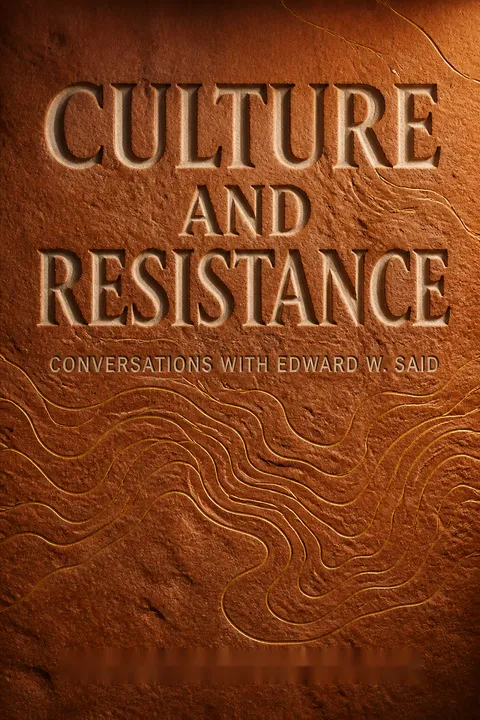
Culture and Resistance is not a systematic political treatise. Its six interview-based chapters preserve the urgency and friction of Edward Said's public arguments from 1999 to 2003. That form gives the book its energy: a question about a settlement or a newspaper phrase can lead into history, language, personal memory, and political strategy. It also means the book's claims are anchored in a specific moment, especially the second Intifada and the run-up to the Iraq war. Statistics and forecasts should therefore be read as claims made in those interviews, not as current measurements.
The book's most durable method is to inspect the frame before accepting the story. Said asks what a map leaves out, whose violence receives the name of defense, and which historical starting point makes a proposed solution seem reasonable. This method connects his scholarship on representation to his political advocacy: domination works through land and force, but also through the power to make one account seem natural and another unreasonable. His emphasis on memory is not merely nostalgic. It is a defense against a political order that can treat displaced people as if they have no prior claim or continuous history.
The one-state proposal is the book's most daring political conclusion and its least fully specified. The interviews make a compelling case against assuming that partition automatically creates justice, given the interwoven population and unequal control described. They offer less detail about institutions capable of ensuring equal citizenship, mutual security, and accountability. This gap does not negate the proposal, but marks the difference between a moral horizon and a negotiated constitution.
Said's argument is most persuasive when it combines structural analysis with human particularity: a damaged archive, a blocked road, a musician crossing into a Palestinian university. It is less persuasive if readers treat his sharp political language as a complete account of every actor's motives. The book is best read as an invitation to scrutinize power, recover suppressed histories, and keep moral standards consistent, while testing advocacy claims against evidence and the experiences of everyone affected.
Review Summary
Culture and Resistance presents Edward Said's views on Palestine, cultural resistance, and global politics through interviews. Readers praise Said's insightful analysis of the Israeli-Palestinian conflict, his advocacy for Palestinian rights, and his critique of American foreign policy. Many find the book still relevant today, appreciating Said's nuanced perspective and intellectual depth. Some readers disagree with certain points but acknowledge the book's importance. The interview format makes Said's ideas accessible, covering topics like the peace process, terrorism, and the role of culture in resistance.
People Also Read


Glossary
Orientalism
Knowledge that helps organize powerSaid's term for a Western tradition of describing the Middle East and Asia as fixed, irrational, backward, or fundamentally different from the West. He argues that such representations are not simply neutral descriptions: they can support political authority by making domination appear justified, natural, or necessary.
hasbara
Israeli public messagingA Hebrew term meaning information or explanation, used in the book for Israeli messaging aimed at foreign audiences. Said uses it critically to describe public relations that present Israel as defensive, democratic, and generous while obscuring the conditions of occupation and the imbalance of power.
tatbee
Normalization with IsraelAn Arabic term for normalization, or the development of ordinary relations with Israel. In the interviews, opponents of normalization view cultural, academic, and commercial contact as legitimizing Israeli policy. Said argues that refusing all contact can also isolate Palestinians from practical support and prevent people from learning about the society affecting them.
Intifada
Palestinian uprisingAn Arabic word for uprising, used in this book for major waves of Palestinian resistance to Israeli rule. Said discusses the 1987 uprising and the revolt that began in 2000, emphasizing the latter's setting under military occupation and the large disparity in force between Israeli military power and Palestinian protest.
binational state
One state for two peoplesSaid's proposed political arrangement for Israelis and Palestinians: one state in historical Palestine that recognizes both peoples and provides equal rights rather than assigning permanent superiority to one national or religious group. He presents it as a long-term alternative to separation, while allowing that two states without military occupation might serve as a transition.
right of return
Refugees' claim to returnThe principle that people displaced from their homes should be able to return, a central Palestinian demand in Said's account. He connects it to the displacement of Palestinians in 1948 and to broader human-rights claims. The interviews emphasize that peace negotiations cannot treat refugee claims as irrelevant simply because they complicate a settlement.
About the Author
Other books by Edward W. Said
Download PDF
Download EPUB
.epub digital book format is ideal for reading ebooks on phones, tablets, and e-readers.








