

Key Takeaways
Understand Palestine as a settler-colonial war that became a national conflict.
A warning in family papers. Rashid Khalidi begins with a letter his ancestor Yusuf Diya al-Khalidi sent to Zionist founder Theodor Herzl in 1899. Al-Khalidi respected Judaism and understood why European Jews sought refuge, but warned that Palestine was already inhabited and its people would not consent to being displaced. Herzl replied that Jewish immigration would benefit the existing population, without addressing the political conflict al-Khalidi had identified.
Two histories, one land. Khalidi argues that the conflict began as a colonial project backed by outside powers, then became a national struggle between Palestinians and Israeli Jews. The colonial frame draws attention to settlement, land control, demographic change, and unequal power. It does not erase Jewish history or the existence of two peoples with national claims in Palestine today.
What's striking is how the 1899 exchange turns an abstract framework into a testable historical question: who was treated as a political subject, and whose future could be decided without consent? Settler-colonial analysis makes land and institutions central, where a simple religious-feud story can obscure them. The frame is most useful when it explains power, not when it flattens distinct histories. Jewish persecution and attachment to the land are real, as are Palestinian rootedness and dispossession. Taking both seriously need not imply that both sides possessed equal power.
Read Balfour's silence as policy: Palestinians received civil rights, not national standing.
A majority left unnamed. In 1917, Palestinians made up about 94 percent of the population of Palestine. The Balfour Declaration nevertheless promised a national home for the Jewish people, describing the majority only as existing non-Jewish communities. It protected their civil and religious rights, but said nothing about national or political rights.
A promise became infrastructure. The 1922 British Mandate expanded that commitment. It recognized the Jewish Agency as the representative of the Jewish community and gave it broad roles in immigration, land settlement, education, and public works. Palestinians received no equivalent national institution. The Mandate thus helped create a Zionist administration operating alongside the British government, while denying the majority representative institutions for the country as a whole.
The important lesson is that political exclusion can be built into administration before it appears as a dramatic act of force. The Mandate's unequal institutions helped one movement prepare for sovereignty while restricting the other from exercising majority rule. This is a form of path dependence: organizations that gain legal authority, money, and international access accumulate advantages that outlast the original policy. Legal texts are not neutral containers. Their omissions can decide who counts as a people entitled to govern.
Palestinian identity was taking shape before 1917, not invented afterward.
A changing society. Before World War I, Palestine was not a stagnant or empty land. Education, trade, transport, print, and urban life were changing quickly. Thirty-two newspapers and periodicals appeared in Palestine between 1908 and 1914. Publications such as Filastin and al-Karmil debated Zionism, local politics, and the country’s future.
Identity had many roots. People could feel attachment to family, religion, city or village, the Arabic language, the Ottoman Empire, and Palestine at the same time. Modern Palestinian nationalism grew from these overlapping ties, as did national identities elsewhere in the region. Khalidi’s point is not that identity was ancient or fixed, but that it was developing before the state of Israel and alongside political Zionism.
National identities are historically formed, but that does not make them imaginary or politically disposable. The same distinction is essential in debates about Palestinian and Israeli nationhood: contingent origins do not negate present belonging. Newspapers are especially useful evidence because they show people arguing over identity as it forms, rather than historians imposing a finished category afterward. The record here is richer for educated and urban Palestinians than for poorer rural people, a limitation Khalidi acknowledges. That gap should encourage more history from below, not revive claims that a people did not exist.
British repression weakened Palestinians while building the institutions of their rival.
A revolt from below. After years of failed petitions and negotiations, Palestinian frustration erupted in a general strike in 1936, followed by a revolt that lasted until 1939. The British deployed as many as one hundred thousand troops to suppress it. Khalidi estimates that 10 percent of the adult male Palestinian population was killed, wounded, imprisoned, or exiled. Palestinian leaders were divided, and the revolt also deteriorated into internal violence.
Unequal preparation. British repression devastated Palestinian leadership and economic life. At the same time, the Zionist movement received weapons, training, and room to strengthen its military and political institutions. A British policy shift in 1939 restricted Jewish immigration, but did not create Palestinian self-government. By the end of the revolt, Palestinians were less able to resist, while the Zionist movement was better organized.
The chapter shows how colonial rule can shape the balance between movements, not merely referee a dispute between them. Repression removed leaders and networks, while selective assistance strengthened the rival institutions. At the same time, Khalidi does not present Palestinian choices as blameless: elite caution, factional conflict, and assassinations inside the movement mattered. That combination makes the history more useful than a simple story of either inevitable defeat or pure victimhood. Structural disadvantage was formidable, but political organization still affected what options remained.
The Nakba turned military defeat into mass expulsion and permanent exile.
A country transformed. In 1947, the UN proposed partitioning Palestine, assigning more than half the country to a Jewish state despite an Arab-majority population. Palestinian society had no comparable state apparatus or army, while the Zionist movement already possessed a functioning political and military structure. The offensive that preceded Israel's creation captured and emptied major Arab towns, including Jaffa and Haifa.
Flight became dispossession. By 1949, at least 720,000 Palestinians had become refugees, and Israel controlled 78 percent of Mandatory Palestine. Most refugees were not allowed to return, and many homes and villages were destroyed. Khalidi calls this the Nakba, or catastrophe. Palestinian weakness, leadership failures, Arab rivalries, and international decisions all shaped the outcome, but expulsion and seizure of land made a Jewish majority state possible.
The emphasis on institutional readiness explains why a formal vote for partition did not itself produce two states. A resolution cannot implement sovereignty if one side has no comparable administration, military, or diplomatic reach. The account also resists explaining the Nakba through a single cause: local military events interacted with decisions made in London, Washington, Moscow, and Amman. That layered explanation matters because it distinguishes responsibility from inevitability. Displacement was not simply a by-product of a map being redrawn; it became a durable system when return and restitution were blocked.
Resolution 242 addressed territory while omitting the people displaced from it.
A victory reframed. In 1967, Israel defeated Egypt, Syria, and Jordan in six days and occupied the Sinai Peninsula, Gaza, the West Bank, East Jerusalem, and the Golan Heights. Khalidi challenges the claim that Israel faced imminent destruction, pointing to US assessments that expected an Israeli victory and to Washington's approval of an Israeli first strike.
The Palestinians disappear again. Security Council Resolution 242 treated the conflict chiefly as a dispute between states. It called for Israeli withdrawal from territories occupied in the war, but did not name Palestine or the Palestinians, and referred vaguely to a solution for the refugee problem. The resolution became the basis for later diplomacy while leaving the origins of the conflict, refugee return, and Palestinian self-determination largely outside the frame.
Resolution 242 illustrates how an international document can acknowledge a problem while narrowing what counts as a solution. Its call against acquiring territory by war mattered, but its omissions allowed the dispute to be treated as a border question among states rather than a conflict involving a displaced people. That narrowing made negotiations easier to organize and harder to make just. The broader lesson applies beyond Palestine: when a settlement framework excludes a party or its central claims, procedural agreement can coexist with deepening grievance.
The 1982 siege expelled the PLO, but shifted resistance back to Palestine.
A war witnessed firsthand. In 1982, Israel invaded Lebanon with a force equivalent to eight divisions and besieged West Beirut for seven weeks. Khalidi describes collecting his children as bombs struck the neighborhood where his pregnant wife worked. The PLO eventually evacuated Beirut under US-mediated assurances that Palestinian civilians left behind would be protected. Those assurances failed. Israeli forces enabled Lebanese militia fighters to enter the Sabra and Shatila camps, where more than 1,300 people were killed.
A military result with a twist. The invasion weakened and expelled the PLO, but it did not end Palestinian nationalism. The movement's center of gravity shifted toward Palestinians living under occupation in the West Bank and Gaza, where the First Intifada began in 1987. Khalidi also notes that the PLO's domineering conduct in Lebanon had eroded support among many Lebanese.
The personal account gives scale to strategic decisions: a diplomatic promise about civilian safety becomes a question of who is actually protected when armed forces leave. Responsibility in this episode is distributed across the invading state, its militia allies, and the US government that arranged the evacuation. That does not absolve the PLO of its conduct toward its Lebanese hosts. The section is a reminder that a movement's military presence can generate both protection and resentment, and that political support cannot be assumed simply because a cause is just.
The First Intifada made unarmed mass resistance politically harder to erase.
An uprising built locally. The First Intifada began in 1987 after an Israeli army vehicle struck a truck in Gaza, killing four Palestinians. It spread through towns, villages, and refugee camps, organized by grassroots networks that included women, students, workers, professionals, and farmers. Strikes, boycotts, tax refusal, and demonstrations were central tactics. The uprising was mainly unarmed, though violence occurred and Israeli forces used severe force, including beatings and live ammunition.
Images shifted opinion. Television coverage of soldiers confronting young demonstrators damaged Israel's image as a permanently endangered underdog. The uprising showed that occupation faced broad opposition, not merely armed resistance from outside. The PLO leadership in Tunis then tried to direct the movement from afar, sometimes overriding the local organizers who had built it.
The Intifada demonstrates how coordinated civil resistance can change the audience watching a conflict, not just the behavior of the governing power. Its force came from participation across social groups and tactics that were difficult to portray as a conventional military threat. That does not make the uprising wholly nonviolent: confrontations and Palestinian violence also occurred. Nor does favorable coverage itself produce political rights. Its deeper achievement was to make Palestinian agency visible and to expose the limits of treating military control as consent.
Oslo recognized the PLO without transferring sovereignty over Palestinian land.
Recognition without independence. The 1993 Oslo agreement brought mutual recognition between Israel and the PLO and created an interim Palestinian Authority. It did not promise a sovereign Palestinian state. Under the 1995 Oslo II agreement, the West Bank was divided into Areas A, B, and C. Israel retained direct control over Area C, about 60 percent of the territory, while the Palestinian Authority received limited powers in Areas A and B.
Interim became permanent. Israel continued to control borders, movement, much of the land and water, and the settlements. Jerusalem was increasingly cut off from Palestinians elsewhere, and settlement construction continued. The Palestinian Authority gained administrative responsibilities but remained without sovereignty. Khalidi argues that the interim structure relieved Israel of some burdens of governing while helping it maintain control.
Oslo's central weakness was not simply that negotiation failed, but that the interim arrangement distributed authority unevenly while postponing the hardest questions. In negotiation theory, a temporary deal needs credible enforcement and a plausible route to completion. Without either, the party that controls territory can improve its position during the waiting period. The accords did create direct recognition and limited Palestinian self-government, real achievements for their participants. The critique is that these gains did not rebalance control, and the promised endpoint never arrived.
The Second Intifada and Gaza wars deepened division and magnified civilian costs.
A failed process turns violent. The Second Intifada erupted in 2000 after years of worsening restrictions and stalled negotiations; Ariel Sharon's visit to the Haram al-Sharif helped ignite the crisis. Israeli forces used heavy weapons, while Palestinian groups, including Hamas and Islamic Jihad, carried out suicide bombings that killed civilians. Khalidi argues these attacks strengthened hard-line Israeli politics and damaged Palestinian support abroad.
Division made Gaza more vulnerable. Hamas won the 2006 Palestinian parliamentary election, then violent conflict with Fatah split Palestinian governance in 2007. Israel imposed a blockade on Gaza and launched major assaults in 2008, 2012, and 2014. Khalidi reports 3,804 Palestinians killed across those attacks, nearly 1,000 of them minors, compared with 87 Israelis, most of them soldiers. He condemns attacks on civilians by Palestinian groups while stressing the enormous imbalance in military power and casualties.
This section resists the easy equation of violence with effectiveness. Suicide attacks on civilians raised grave moral and legal concerns, and Khalidi argues they were strategically counterproductive because they rallied Israeli opinion behind force. The later Gaza wars reveal a different imbalance: a besieged, densely populated territory faced a far more powerful military. Casualty ratios illuminate that disparity, though numbers alone cannot capture fear, displacement, or the distinct responsibilities of occupying forces and armed groups. Neither side's actions become lawful merely because the other side has greater firepower.
Make equality and global public opinion the test of any strategy.
The goal must be rights. Khalidi rejects the idea that a settlement can last while one people holds superior rights over another. He recognizes that Israelis and Palestinians are both national communities, though their histories and power differ. Possible political arrangements include a Palestinian state, return and compensation for refugees, or a shared democratic state. The book does not prescribe one final design; it insists that any viable outcome protect equal personal, civil, political, and national rights.
Change the arena. Khalidi argues that the United States cannot be treated as a neutral mediator after decades of alignment with Israel. He calls for Palestinian unity, sustained engagement with public opinion in the United States and elsewhere, and serious efforts to reach Israeli society. He points to civil-society organizing, including boycott activism and student campaigns, as more effective than the divided leadership's recent strategies.
Equality is a demanding standard because it turns a vague promise of peace into questions about law, land, mobility, security, and political representation. It also asks both populations to recognize the other's national existence without pretending their histories are interchangeable. The strategic proposal has a real difficulty: broad public campaigns can change legitimacy, but they do not by themselves settle borders or guarantee safety. Any durable program would need institutions and protections that address those practical fears without converting security into permanent domination.
Analysis
Khalidi's central intervention is to change the scale at which the conflict is read. Instead of beginning with competing national claims or the latest failed negotiation, he traces how outside powers repeatedly allocated political standing, territory, and institutional capacity. His six turning points make that argument chronological: British sponsorship and the Mandate, partition and the Nakba, the 1967 occupation, the 1982 invasion, Oslo, and the post-2000 blockade and wars. The family archive gives this history human continuity. A letter, a lost home, a father's diplomatic errand, and the author's experience of bombardment keep imperial policy from becoming a chart of abstractions.
The settler-colonial lens is particularly effective at explaining why land, population, and institutions recur across otherwise different episodes. It also clarifies why a peace process focused on procedure can leave the fundamental distribution of power intact. Khalidi does not claim that Palestinian leaders were consistently wise or that the PLO's conduct was harmless. His accounts of elite factionalism, strategic misjudgment, attacks on civilians, and poor diplomacy complicate a simple victim narrative. He also insists that Israeli Jews are now a people with national claims, even as he rejects their exclusive sovereignty.
The book's limits follow partly from its purpose. Six major episodes cannot provide a balanced survey of every community, Israeli political current, or internal debate. Its family perspective is vivid but draws most deeply on educated and politically connected Palestinians, leaving everyday experiences less fully represented. And the colonial framework, while illuminating power, can become too total if readers use it to explain every decision or erase the genuine fears that shape Jewish Israeli politics. Khalidi's strongest conclusion is therefore not that history supplies a ready-made constitutional answer. It is that any answer which preserves unequal rights, denies either people, or postpones the central questions is unlikely to end the conflict.
Review Summary
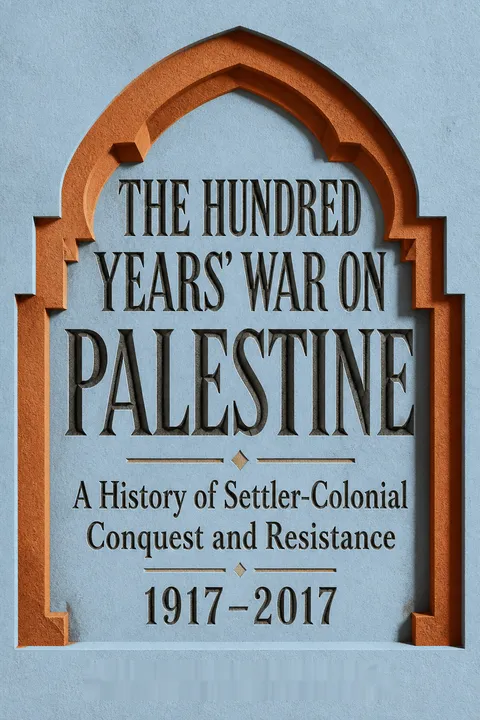
The Hundred Years' War on Palestine receives mostly positive reviews for its comprehensive overview of the Israeli-Palestinian conflict from a Palestinian perspective. Readers appreciate Khalidi's personal anecdotes and detailed historical analysis, though some criticize potential bias and omissions. The book is praised for its accessible writing and illuminating insights into the conflict's complexities. Critics argue it may oversimplify or present a one-sided view, while supporters find it an essential read for understanding Palestinian history and the ongoing struggle against colonialism and occupation.
People Also Read


Glossary
Nakba
1948 Palestinian catastropheArabic for catastrophe, the Nakba is the mass displacement and dispossession of Palestinians during the 1948 war and the creation of Israel. At least 720,000 Palestinians became refugees, many lost homes and land, and most were not permitted to return. Khalidi also describes the Nakba as an ongoing process because displacement and land loss continued after 1948.
Yishuv
Jewish community in PalestineYishuv refers to the Jewish population and its developing institutions in Palestine before Israel was established in 1948. Under the British Mandate, the Jewish Agency and related organizations formed a political and economic structure with many functions of a state. Khalidi contrasts this organized system with the lack of comparable Palestinian state institutions.
Iron Wall
Force shielding colonizationThe Iron Wall is Zionist leader Ze'ev Jabotinsky's argument that settlement in a land with an existing population could proceed only behind the protection of overwhelming force. In Khalidi's account, the idea openly recognizes that indigenous opposition is predictable and cannot simply be persuaded away. British military power initially supplied much of that protection.
politicide
Erasure of a people politicallyPoliticide describes efforts to undermine or eliminate a people as a political community, including denial of its national identity, institutions, and rights to self-determination. Khalidi uses the term, associated with scholar Baruch Kimmerling, to describe practices that make Palestinians politically invisible even when they remain present in the land.
First Intifada
1987 Palestinian uprisingThe First Intifada was a broad Palestinian uprising against Israeli military occupation that began in 1987 and continued into the early 1990s. It relied heavily on local organizing, strikes, boycotts, demonstrations, and other forms of civil disobedience. Though mainly unarmed, it included violent confrontations and was met with severe force by Israeli security forces.
Dahiya doctrine
Disproportionate force against communitiesThe Dahiya doctrine is the Israeli military approach, named after a suburb of Beirut heavily damaged in 2006, of applying overwhelming force and extensive destruction in areas from which attacks originate. Khalidi links it to later assaults on Gaza and criticizes it as a strategy that imposes severe harm on civilian populations and infrastructure.
Areas A, B, and C
Oslo's West Bank divisionsOslo II divided the West Bank into Areas A, B, and C, assigning different administrative and security powers in each. The Palestinian Authority received limited authority in Areas A and B, while Israel retained direct control over Area C, about 60 percent of the territory. Khalidi argues that this arrangement left Israel with decisive control over land, movement, and settlements.
PISGA
Palestinian interim self-government proposalPISGA stands for Palestinian Interim Self-Governing Authority, a proposal developed by the Palestinian delegation during the Madrid and Washington negotiations. It envisioned an elected Palestinian authority receiving broad jurisdiction over the occupied territory and its Palestinian population, while stopping short of immediate sovereignty. Israel rejected the proposal, and the Oslo agreements created a more limited form of self-rule.
FAQ
What is The Hundred Years’ War on Palestine by Rashid Khalidi about?
- Comprehensive historical account: The book traces the Israeli-Palestinian conflict from 1917 to 2017, framing it as a century-long settler-colonial war against the indigenous Palestinian population.
- Six key turning points: Khalidi structures the narrative around six major "Declarations of War," each marking a pivotal escalation in the conflict.
- Colonial and imperial context: The book emphasizes the roles of Zionism, British and American imperialism, and international diplomacy in shaping the conflict’s trajectory.
- Blend of scholarship and memoir: Khalidi combines rigorous historical research with personal family history to illuminate the lived experience of Palestinians.
Why should I read The Hundred Years’ War on Palestine by Rashid Khalidi?
- Unheard Palestinian perspectives: The book foregrounds Palestinian voices and experiences often marginalized in mainstream histories, offering a more nuanced understanding.
- Critical analysis of power: Khalidi exposes the roles of global powers and the failures of international diplomacy, challenging dominant narratives.
- Interweaving personal and political: The narrative blends scholarly analysis with personal stories, making the history vivid and relatable.
- Essential for deeper understanding: It is recommended for anyone seeking a historically grounded, critical perspective on the Israeli-Palestinian conflict.
What are the key takeaways from The Hundred Years’ War on Palestine by Rashid Khalidi?
- Conflict as settler colonialism: Khalidi frames the conflict as a colonial project, not just a national or religious dispute.
- Role of external powers: The indispensable support of Britain, the US, and other powers enabled Zionist objectives and marginalized Palestinian rights.
- Persistent Palestinian resistance: Despite overwhelming odds, Palestinians have continually resisted dispossession and erasure.
- Need for new strategies: Khalidi calls for Palestinian unity, global grassroots support, and a focus on equality and justice for a just resolution.
What are the six "Declarations of War" or turning points in The Hundred Years’ War on Palestine by Rashid Khalidi?
- First (1917–1939): The Balfour Declaration and British Mandate enabled Zionist colonization and sparked Palestinian resistance, culminating in the 1936–39 Arab Revolt.
- Second (1947–1948): The UN Partition Plan and the Nakba led to mass Palestinian dispossession and the creation of Israel.
- Third (1967): The Six-Day War resulted in Israeli occupation of the West Bank, Gaza, and other territories, sidelining Palestinian rights.
- Fourth (1982): The Israeli invasion of Lebanon targeted the PLO, leading to the Sabra and Shatila massacres and shifting resistance inside Palestine.
- Fifth (1987–1995): The First Intifada and Oslo Accords marked a new phase of grassroots activism and flawed peace processes.
- Sixth (2000–2014): The Second Intifada and subsequent Gaza wars reflected ongoing resistance, repression, and political fragmentation.
How does Rashid Khalidi define and analyze Zionism in The Hundred Years’ War on Palestine?
- Settler-colonial project: Khalidi characterizes Zionism as a colonial movement aiming to establish Jewish sovereignty in Palestine at the expense of its indigenous population.
- Dependence on imperial powers: Zionism’s success relied heavily on British and later American support, making it inseparable from global power politics.
- Displacement and denial: The movement’s leaders planned for the removal or marginalization of Palestinians, often denying their existence or rights.
- Myth-making: Zionist narratives, such as "a land without a people," served to justify colonization and erase Palestinian presence.
What role did Britain play in the Israeli-Palestinian conflict according to The Hundred Years’ War on Palestine by Rashid Khalidi?
- Imperial sponsor of Zionism: Britain enabled Zionist colonization through the Balfour Declaration and the Mandate, privileging Jewish settlement over Palestinian rights.
- Contradictory promises: British commitments to both Arabs and Zionists during WWI created a "triple bind" that deepened Palestinian dispossession.
- Repression of resistance: British authorities used harsh measures, including executions and exile, to suppress Palestinian opposition, especially during the 1936–39 Arab Revolt.
- Colonial legacy: Khalidi argues that British actions constituted an early "declaration of war" on Palestinians, shaping the conflict’s future.
How does The Hundred Years’ War on Palestine by Rashid Khalidi explain the impact of the 1947 UN Partition Plan and the 1948 Nakba?
- Partition as legitimization of dispossession: The UN Partition Plan is described as a declaration of war that ignored Palestinian rights and set the stage for ethnic cleansing.
- Nakba’s devastation: Over 700,000 Palestinians were expelled, hundreds of villages destroyed, and Palestinian society shattered, creating a foundational trauma.
- Failure of Arab states: The inability of neighboring Arab countries to protect Palestinians contributed to the scale of the catastrophe.
- Enduring legacy: The Nakba remains central to Palestinian identity and the ongoing conflict.
What was the significance of the 1967 Six-Day War and UN Security Council Resolution 242 in The Hundred Years’ War on Palestine by Rashid Khalidi?
- Dramatic territorial changes: Israel’s occupation of the West Bank, Gaza, East Jerusalem, Sinai, and Golan Heights altered the regional landscape.
- Resolution 242’s omissions: The resolution ignored Palestinian rights, treating the conflict as a state-to-state issue and legitimizing Israeli occupation.
- Resurgence of Palestinian nationalism: The defeat of Arab states led to a revival of Palestinian identity and the rise of the PLO as a central actor.
- Entrenchment of occupation: The war intensified Palestinian dispossession and set the stage for future resistance and negotiations.
How does Rashid Khalidi describe the 1982 Israeli invasion of Lebanon and its consequences in The Hundred Years’ War on Palestine?
- Targeting the PLO: The invasion aimed to destroy the PLO’s presence in Lebanon, resulting in massive civilian casualties and the Sabra and Shatila massacres.
- US complicity: The war was a joint Israeli-US endeavor, marking a shift in American involvement and support for Israeli military objectives.
- Rise of Hizballah: The conflict intensified Lebanon’s civil war and led to the emergence of Hizballah as a major force.
- Shift in resistance: The weakening of the PLO abroad led to a strengthening of grassroots resistance within the Occupied Territories.
What does The Hundred Years’ War on Palestine by Rashid Khalidi reveal about the First and Second Intifadas?
- First Intifada: A spontaneous, largely unarmed uprising in 1987, characterized by civil disobedience and broad societal participation, including women leaders.
- Impact on perceptions: The First Intifada shifted global opinion, portraying Palestinians as resisting occupation and damaging Israel’s international image.
- Second Intifada: Beginning in 2000, it saw a sharp escalation in violence, including suicide bombings and harsh Israeli military responses.
- Consequences: The Second Intifada led to political fragmentation, loss of international sympathy for Palestinians, and setbacks for the national movement.
How does Rashid Khalidi assess the Oslo Accords and their aftermath in The Hundred Years’ War on Palestine?
- Asymmetrical agreement: Oslo recognized the PLO but did not grant Palestinian statehood, instead establishing limited self-rule under continued Israeli control.
- Security collaboration: The accords made the PLO responsible for policing Palestinians, undermining resistance and legitimacy.
- Entrenchment of occupation: Oslo fragmented Palestinian territories and allowed ongoing settlement expansion, failing to deliver freedom or justice.
- Missed opportunities: The process entrenched inequality and left Palestinians in a prolonged state of subjugation.
What are Rashid Khalidi’s main conclusions and recommendations in The Hundred Years’ War on Palestine?
- Recognition of colonial reality: Khalidi insists that acknowledging the settler-colonial nature of the conflict is essential for a just resolution.
- Critique of US and international roles: He highlights the consistent support of Israel by global powers and calls for diversifying Palestinian alliances.
- Call for new strategies: Khalidi urges Palestinians to build grassroots global support, pursue unity, and focus on equality and international law.
- Cautious optimism: He notes shifting public opinion, especially among younger Americans, as a sign of potential change in the global power dynamic.
Download PDF
Download EPUB
.epub digital book format is ideal for reading ebooks on phones, tablets, and e-readers.








