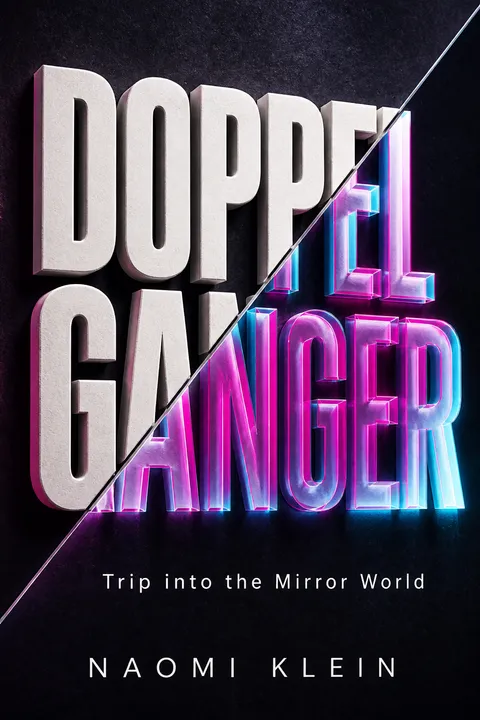


Key Takeaways
Treat the double as a warning about what a culture refuses to face
A personal mix-up opens a larger inquiry. Naomi Klein has spent years being mistaken for Naomi Wolf, a writer whose politics and claims changed sharply. The confusion became more than an inconvenience when Wolf’s pandemic misinformation was attributed to Klein, and Klein found herself asking who gets to define a person: the person, the audience, or the platforms carrying their image and words.
The double becomes a social map. Klein uses this experience to explore a doppelganger culture: a world of performed online selves, machine-generated replicas, political mirror images, and groups projecting rejected traits onto one another. The uncanny feeling, she argues, signals not only personal instability but collective denial. A distorted double can reveal a danger, or a truth, that people would rather leave unseen.
What's compelling is the book's movement from a comic identity error to a serious account of how identity is socially assigned. The double is not just a look-alike; it is a story others attach to a person, sometimes with material consequences. This resonates with sociology's distinction between self-understanding and social identity. The framework is especially useful online, where a name and thumbnail can stand in for a whole person. Its limit is that the metaphor can stretch widely, so readers should ask what concrete mechanism each supposed doubling describes.
Stop packaging your changing self as a product with a permanent promise
A brand rewards sameness. Klein recalls resisting the idea that she was a brand after publishing No Logo, her critique of corporate branding. Yet she designed the book to be visually distinctive, joked about her anti-brand persona, and benefited from the attention. Her experience exposes the bind: even rejecting a brand can become part of one.
The performance starts early. Klein’s university students describe turning personal histories into polished admissions essays, shaping difficult experiences for an imagined audience. A student’s elevator pitch can make a person feel reduced to a sales proposition. Klein contrasts this with bell hooks, who used a pen name and urged people to describe what they support rather than make identity labels the whole conversation. A fixed public persona can make change feel like betrayal, even when learning demands change.
The tension between a coherent public identity and an evolving private self is not unique to influencers. Institutions routinely ask people to become legible through a résumé, application, or professional profile. That legibility can help people find opportunity, but it also rewards stories that fit familiar templates. Klein’s account is strongest when it distinguishes a chosen identity from an identity shaped for market approval. It is less useful to treat every public persona as false: performance can also be creative, protective, or politically effective. The important question is who controls the performance and who benefits from it.
Treat platforms as identity-making institutions, not neutral mirrors
The machine learns the confusion. During the pandemic, people repeatedly mixed up the two Naomis. Klein noticed that Twitter autocomplete began suggesting the wrong name. Her corrections could reinforce the very association she wanted to undo, because the platform learned from repeated patterns rather than from the meaning of each post.
Digital doubles are made from data. Klein distinguishes the curated avatar a person presents from the data profile assembled through clicks, searches, location traces, and other activity. She calls this constructed profile a digital golem: a likeness made from collected fragments that can shape what opportunities, information, and judgments reach someone. The convenience of personalized recommendations, such as appealing shoe ads, helps normalize a system whose same data practices can affect privacy, employment, and political attention.
The key insight is institutional: online identity is not simply expressed on platforms, it is also sorted and amplified by them. A mistaken name suggestion shows how a statistical pattern can harden into a social fact. This resembles a feedback loop: people act on a platform’s prediction, and the resulting behavior appears to confirm the prediction. Personalization can be helpful, but its benefits do not erase the power imbalance between users and data collectors. The book’s language of digital doubles also invites a practical question: which decisions should never be delegated to an opaque profile?
Answer conspiracy with honest accountability, not ridicule or silence
False claims can exploit real failures. Wolf described vaccine verification apps as all-seeing tools that could monitor private conversations, track people at home, and connect health records to payment systems. Klein says those specific claims were false. But fears about surveillance were not invented: phones, apps, data brokers, and governments already collect sensitive information, often with little public control.
A vacuum invites bad explanations. Pandemic policies also placed too much responsibility on individuals while public systems remained strained. Governments could have invested more in ventilation, paid sick leave, health care, and free tests. Vaccine access was unequal across countries, while Pfizer earned billions from its vaccine. When institutions evade those failures or dismiss every question, conspiracy entrepreneurs can offer an emotionally satisfying, if inaccurate, account of who is to blame.
This section makes a valuable distinction between validating a fear and validating the explanation attached to it. People may distrust institutions for reasons grounded in experience, including corporate profiteering and surveillance. A blanket response of mockery can strengthen the impression that powerful actors are hiding something. At the same time, acknowledging legitimate grievances does not mean every claim deserves equal standing. Credibility depends on showing evidence, naming uncertainty, and explaining what safeguards would address the real risk. Trust is not restored by asking people to trust harder.
Claim neglected grievances before authoritarians turn them into recruiting tools
A new coalition crosses old lines. Klein uses diagonalism to describe political alliances that claim to reject the left-right divide while often moving toward far-right politics. During Covid, wellness influencers, small-business owners, anti-vaccine activists, and established right-wing figures found common ground in claims about tyranny, Big Tech, and a global plot.
Bannon organized the grievance. On his War Room program, Steve Bannon turned listeners into a political posse, promoted local school and election campaigns, and welcomed Wolf as a prominent crossover voice. He recognized anxieties that many progressives addressed poorly, including surveillance, pharmaceutical profiteering, and the abandonment of small businesses. His answers relied on false claims and culture-war targets, but the organizing itself was real. Klein’s warning is strategic: leaving a legitimate concern unattended does not make it disappear. It gives someone else the chance to define it.
The analysis is strongest when it treats political recruitment as an organizational achievement, not merely a matter of bad ideas spreading. Movements offer belonging, an explanation, and a task. A campaign that supplies all three can attract people even when its account of events is unsound. The book also resists a lazy equivalence between opposing camps: it identifies far-right aims while examining failures among progressives. The challenge is to distinguish coalition-building from compromising core protections. Listening to a grievance is not the same as endorsing the proposed remedy.
Reject body perfection when it makes vulnerability a reason to discard people
Wellness can become a purity test. Klein describes how fitness and wellness culture can promise control over an unpredictable world. During the pandemic, some influencers converted that promise into claims that disciplined, healthy bodies needed no protection, while people with illness or disabilities were responsible for their own vulnerability. She connects this individualism to hostility toward public-health measures meant to protect others.
The autism myth shows the cost. The claim that vaccines cause autism traces in part to a 1998 study by Andrew Wakefield that was later retracted; Wakefield was barred from practicing medicine in Britain. Yet parents seeking explanations for unmet needs were offered blame and expensive cures instead of support. The book notes that autism diagnoses rose as definitions broadened and recognition improved, not because evidence linked vaccines to autism.
Klein’s critique does not require dismissing exercise, alternative care, or parents’ real frustration with medicine. It asks when self-care becomes a market ideology that treats health as proof of virtue and illness as personal failure. Disability justice offers a useful countermeasure: design public life around varied bodies rather than treating some people as exceptions. The book’s account is persuasive about the social consequences of cure narratives, though the motivations of parents and practitioners are not uniform. Better services and respectful medical communication matter alongside fact-checking.
Trace power structurally, while demanding evidence for specific plots
Suspicion needs a method. Klein distinguishes conspiracy theories from investigative reporting by the work required to verify claims: checking documents, consulting experts, testing interpretations, and acknowledging uncertainty. A structural account can explain why institutions repeatedly favor profit without inventing a secret mastermind behind every crisis.
Some conspiracies are documented. The book points to the CIA-backed overthrow of Chile’s elected government, official cover-ups of Flint’s poisoned water, and oil companies’ efforts to sow doubt about climate change. These are not proof that every alarming story is true. Klein argues that conspiracy entrepreneurs often redirect justified anger toward fantastical plots, distracting people from documented abuses. She calls the resulting flood of disconnected claims denialism, and draws on John Berger’s idea that calm can help people regain focus after shock.
This is a useful epistemic discipline: neither credulity nor reflexive dismissal is adequate. Structural explanations can reveal recurring incentives without requiring a hidden council coordinating every event. Conversely, structural language should not become a shield against investigating deliberate collusion when evidence exists. Klein’s emphasis on calm is not a demand for emotional neutrality; it is a way to preserve attention long enough to distinguish a documented chain of decisions from a dramatic but unsupported story.
Recognize when victimhood becomes a mask for repeating old violence
History supplies dangerous doubles. Klein examines how groups can cast themselves as innocent victims while projecting their own violence onto an enemy. She draws on scholarship connecting Nazi racial policies to older colonial practices, while stressing that historical crimes are not identical. The point is that exterminatory thinking did not appear from nowhere, and societies can reproduce familiar hierarchies under new names.
Israel and Palestine sharpen the dilemma. Klein describes Israel as shaped by Jewish persecution and refuge, and also by the displacement and continuing subordination of Palestinians. She traces how trauma can be used to justify state violence and how Palestinian resistance can be reduced to eternal antisemitism. The answer is not to flatten the histories into symmetry, but to hold victimhood and responsibility together without treating either people as a single character.
The book’s historical method is deliberately unsettling: it refuses the comfort of placing fascism safely outside respectable democratic societies. Its strongest safeguard is the insistence that resemblance is not sameness. Comparisons can uncover inherited political techniques, but careless equivalence can trivialize distinct histories and obscure unequal power. The Israel-Palestine discussion is most productive when it sustains contradiction rather than demanding a clean moral identity. That discipline is difficult, especially where inherited trauma is real, but it is necessary for resisting both denial and collective blame.
Turn shared language into shared work that changes material conditions
Words need an organized sequel. Klein describes a 2021 truck convoy that traveled in solidarity with Indigenous communities grieving children who died at residential schools. Eight months later, a much louder convoy occupied Ottawa to oppose pandemic restrictions and mixed freedom rhetoric with far-right symbols. The contrast shows how collective energy can express care or retreat into self-protection.
Build the conditions for care. Klein’s answer is not personal virtue alone. It is collective organization: unions, tenant groups, community media, public health, and institutions that make life safer for people with different needs. She recalls Red Vienna, a democratic-socialist experiment that built public housing, parks, child services, and schools around the needs of working families. Such models were imperfect, but they demonstrate that societies can organize care rather than treating it as a private burden.
The ending translates a broad diagnosis into a political test: does a proposed response create durable capacity for people to act together? Shared language can clarify injustice, but without organizations and public goods it may remain a performance. The contrast between the two convoys makes solidarity concrete, though no single organizing model transfers intact across places or eras. Red Vienna is valuable less as a blueprint than as proof that infrastructure, care, and democracy can be designed together. Collective work also changes who people understand as part of their community.
Analysis
Doppelganger is a political memoir built as an expanding investigation. A mistaken identity between Naomi Klein and Naomi Wolf begins as a private humiliation, then becomes a lens for examining online selves, conspiracy movements, racial projection, disability, and the suppressed violence beneath ordinary prosperity. The book’s organizing metaphor is unusually productive because it links intimate and institutional forms of doubling: the brand-self beside the changing person, the data profile beside the embodied user, and the polished national story beside its excluded victims. Its central argument is not that political opponents are secretly alike. Rather, reactive politics can make groups mirror one another’s language while leaving underlying structures untouched. Wolf’s claims about surveillance passports were wrong, Klein argues, but they gained traction partly because real surveillance, corporate power, and public-health failures remained inadequately addressed. This creates a demanding standard for progressive politics: refute falsehoods without surrendering the valid concerns they exploit.
The book’s broad historical movement, from colonialism and Nazism to Israel and Palestine, asks readers to resist the fantasy of innocent societies. Klein is careful to say that historical parallels do not make distinct crimes identical, though the scale of the synthesis can still invite overgeneralization. The strongest passages preserve particular histories and unequal power; the weaker risk letting the double metaphor do too much explanatory work.
The memoir’s self-implication keeps the argument from becoming a simple indictment of Wolf or her followers. Klein examines her own attraction to online attention, her discomfort with personal branding, and the limits of her political camp. The final turn toward collective action is essential: recognition alone cannot repair the conditions that breed denial. Organizing, public infrastructure, and durable coalitions offer a material alternative to both self-optimization and fantasy. The book’s deepest contribution is to make self-criticism strategic rather than merely confessional: look clearly, name structures, and build with people who do not share every identity or assumption.
Review Summary
Doppelganger explores the concept of doubles through Naomi Klein's experiences being confused with Naomi Wolf. Klein examines how conspiracy theories, misinformation, and political extremism have gained traction, especially post-pandemic. The book delves into topics like capitalism, fascism, and climate change, offering insights into modern society's complexities. Readers appreciate Klein's analysis and writing style, though some find the doppelganger theme forced at times. While praised for its relevance and depth, a few critics argue it lacks novel ideas or concrete solutions.
People Also Read










Glossary
Doppelganger culture
A society of performed doublesKlein’s term for a culture saturated with doubles of people and societies. It includes online personas, data profiles, artificial simulations, political groups defined against their opposites, and identities projected onto racial or religious groups. These doubles are not merely fictional: they shape how people are perceived, treated, and governed.
Mirror World
A distorted political realityKlein’s name for a political and media environment where familiar concerns are reflected in distorted forms. Real anxieties about corporate power, surveillance, and public institutions can be recast as unsupported plots. Opposing groups then define themselves against one another, often copying each other’s language while avoiding shared structural problems.
diagonalism
Cross-partisan far-right alignmentA political formation that claims to escape the traditional left-right divide and brings together people from different movements and subcultures. In Klein’s account, pandemic-era diagonalism joined parts of the wellness world, anti-vaccine activism, small-business grievances, and the political right. Though it presents itself as nonpartisan, its alliances often move toward far-right politics.
pipikism
Serious ideas made farcicalKlein adapts the term from Philip Roth’s novel Operation Shylock, where a character called Moishe Pipik embodies trivialization. Pipikism describes the process by which buffoonish political figures distort important words and ideas until public discussion itself seems ridiculous. It can make concepts such as fascism, racism, or genocide harder to use accurately.
Shadow Lands
Hidden costs of ordinary lifeKlein’s term for the obscured places, people, and ecosystems that support the visible comforts of wealthy societies. These include mines, factories, warehouses, prisons, migration detention, polluted communities, and exploited labor. The Shadow Lands are not accidental exceptions to the global economy; they are often integral to its supply chains and profits.
second body
A person’s wider material footprintA concept Klein draws from Daisy Hildyard. Alongside the body experienced directly, each person has a broader material presence in other places through consumption, energy use, labor systems, and environmental effects. This second body links everyday life to distant workers, ecosystems, and political decisions that may otherwise seem separate.
conspirituality
Wellness fused with conspiracyA term used for the convergence of New Age or wellness beliefs with conspiracy theories. In the book, some wellness figures combine suspicion of medical institutions with claims about hidden plots, while presenting spiritual awareness, bodily purity, or alternative health as protection. The term describes a cultural overlap, not all wellness practice.
Screen New Deal
Crisis-driven expansion of screen technologyKlein’s label for technology companies’ efforts during early pandemic lockdowns to make temporary digital and contactless systems permanent. The agenda included expanding online education, remote services, smart-city surveillance, and automation. She argues that the crisis accelerated business plans already under development and created new profit opportunities.
disaster doppelgangers
Profitable crisis misdirectionKlein’s term for people and media projects that profit from attention by offering sensational, often unsupported explanations of crises. Their conspiracy narratives can distract from documented profiteering, policy failures, or exploitation. The double lies in how their claims imitate investigative reporting while bypassing its verification practices.
partitioning, performing, and projecting
A pattern of self-divisionKlein’s description of how people divide themselves into a private self and an idealized public persona, perform that persona for others, and project unwanted qualities onto outsiders. She connects this pattern to personal branding and political identity. It can narrow people’s capacity to change, recognize shared interests, or face difficult realities.
FAQ
1. What is Doppelganger: A Trip into the Mirror World by Naomi Klein about?
- Exploration of doubles and identity: The book investigates the phenomenon of doppelgangers—uncanny doubles or mirror selves—using Klein’s personal experience of being confused with Naomi Wolf as a lens to examine broader cultural, political, and technological issues.
- Mirror World concept: Klein introduces the idea of a “Mirror World,” a fractured reality where misinformation, conspiracy theories, and polarized identities thrive, distorting truth and public discourse.
- Historical and contemporary analysis: The narrative connects past atrocities like colonialism and the Holocaust to present-day crises such as Covid misinformation, climate change, and rising authoritarianism.
- Call for integration and solidarity: Ultimately, Klein advocates for confronting our collective shadows and divisions to build a more caring, interconnected society.
2. Why should I read Doppelganger: A Trip into the Mirror World by Naomi Klein?
- Unique blend of memoir and analysis: The book combines personal narrative, cultural critique, and historical research, offering a rare perspective on how individual identity crises mirror societal fractures.
- Insight into current crises: Klein provides a deep understanding of how conspiracy theories, fascism, and ecological collapse are interconnected and manifest in today’s world.
- Encourages critical reflection: Readers are challenged to reconsider narratives about history, victimhood, and power, moving beyond binaries toward solidarity and collective action.
- Hopeful pathways forward: Despite heavy themes, Klein ends with a call to “unselfing” and collective organizing, inspiring readers to imagine and build alternative futures.
3. What are the key takeaways and warnings from Doppelganger: A Trip into the Mirror World by Naomi Klein?
- Beware of doubling and distortion: The proliferation of doppelgangers—personal, digital, and political—reflects deep societal fractures that threaten shared reality and democratic norms.
- Trivialization and pipikism: Klein warns that the cultural tendency to trivialize serious issues (“pipikism”) undermines activism and meaningful discourse.
- Urgency of collective meaning-making: She stresses the need to resist fragmentation by building collective narratives and power to confront crises like climate change and authoritarianism.
- Call for reclaiming information commons: The book advocates for reclaiming digital spaces from corporate and authoritarian control to ensure trustworthy information and protect democratic discourse.
4. How does Naomi Klein use the concept of the doppelganger in Doppelganger: A Trip into the Mirror World?
- Uncanny double as metaphor: The doppelganger represents the frighteningly familiar yet alien double, causing identity crises and paranoia, both personally and societally.
- Warning and mirror: Historically, doubles serve as warnings or harbingers, signaling ignored or repressed parts of ourselves or society, with potential dangers if unheeded.
- Societal and digital doubling: Klein shows how doubling occurs at both the personal and societal levels, including in digital culture where people perform partitioned selves or “brands.”
- Fascist doubles: The book highlights the “fascist clown state” as a shadow twin of liberal democracies, a monstrous double threatening to engulf societies.
5. What is the “Mirror World” in Doppelganger: A Trip into the Mirror World by Naomi Klein, and how does it affect society and politics?
- Distorted and polarized reality: The Mirror World is a fractured landscape where opposing camps define themselves in opposition, often adopting contradictory beliefs and narratives that mirror and distort each other.
- Platform for misinformation: It is a space where conspiracy theories, misinformation, and performative identities flourish, fueled by digital platforms and figures like Naomi Wolf and Steve Bannon.
- Diagonalism and new alliances: Klein describes “diagonalism,” where left and right elements blend into new, often far-right, coalitions united by distrust of elites and shared grievances.
- Threat to democracy: The Mirror World embodies the dangerous doubles of liberal democracies, including rising authoritarianism and the erosion of shared reality necessary for democratic governance.
6. How does Naomi Klein analyze personal branding and identity in Doppelganger: A Trip into the Mirror World?
- Branding as internal doubling: Klein discusses personal branding as a form of internal doubling, where individuals create curated, consumable identities (“Brand You”) that are partitioned from their authentic selves.
- Conflict with authenticity: She reflects on her own conflicted relationship with branding, having become an “anti-brand brand” with her book No Logo, yet recognizing the pressures of maintaining a consistent public persona.
- Digital self and surveillance: The book explores how personal branding is intertwined with surveillance capitalism, where data-driven digital doubles are created by algorithms, complicating selfhood and control.
- Cultural and political implications: Klein argues that the demand for fixed, singular brands undermines the healthy multiplicity of the self necessary for critical thinking and collective action.
7. What is “pipikism” in Doppelganger: A Trip into the Mirror World by Naomi Klein, and why is it important?
- Definition of pipikism: Pipikism, or “bellybuttonism,” is described as the force that trivializes, farcicalizes, and superficializes serious issues, making meaningful engagement difficult.
- Impact on public discourse: Pipikism turns critical issues into spectacles or jokes, undermining the seriousness needed for activism and policy change.
- Examples in culture and politics: Figures like Steve Bannon, Tucker Carlson, and Naomi Wolf are cited as agents of pipikism, appropriating important terms and diluting their meaning.
- Barrier to activism: This tendency fosters cynicism and speechlessness, making it harder to mobilize collective action and resist authoritarianism.
8. How does Doppelganger: A Trip into the Mirror World by Naomi Klein connect wellness culture, conspiracy theories, and far-right politics?
- Wellness and conspiracy: Klein highlights how parts of the wellness industry, including fitness influencers and alternative health practitioners, have become entangled with Covid denialism and conspiracy theories.
- Hyper-individualism: Wellness culture’s emphasis on personal responsibility and body optimization aligns with far-right libertarianism’s focus on individualism, rejecting collective solutions.
- Supremacist undercurrents: The pursuit of “pure” and “optimized” bodies can echo fascist ideas of genetic superiority and disposability of the weak.
- Economic motivations: Many wellness influencers monetize fear and misinformation, selling products and services that exploit anxieties about health and control.
9. How does Naomi Klein address the relationship between autism, parenting, and anti-vaccine movements in Doppelganger: A Trip into the Mirror World?
- Vaccine-autism myth origins: Klein traces the origins and persistence of the debunked claim that vaccines cause autism, showing how it laid the groundwork for Covid vaccine skepticism.
- Parental grief and denial: Many parents of autistic children experience grief over lost expectations and may turn to conspiracies or extreme therapies as a way to cope.
- Historical and cultural context: These dynamics are linked to societal pressures around perfection, control, and the stigmatization of disability, as well as to the legacy of eugenics and Nazi-era policies.
- Doppelganger of the child: The book explores the concept of children as doubles or extensions of parents’ identities, complicating acceptance of neurodiversity and fueling denial and control impulses.
10. How does Doppelganger: A Trip into the Mirror World by Naomi Klein connect historical colonialism, the Holocaust, and contemporary crises?
- Colonial roots of Nazi ideology: Klein highlights how Hitler and the Nazis drew inspiration from British colonialism and racial hierarchies in North America, including the use of concentration camps and eugenics laws.
- Continuity of extermination policies: The Holocaust is presented as the culmination of a long history of genocidal practices rooted in European colonial expansion and racial violence.
- Parallels recognized by Black intellectuals: Figures like W. E. B. Du Bois and Aimé Césaire saw the Holocaust as a continuation of colonial violence, with Europeans tolerating such brutality when inflicted on non-European peoples.
- Modern implications: The book draws connections between these historical patterns and present-day issues like climate crisis, settler colonialism, and rising authoritarianism.
11. What is the significance of “Unselfing” and integration in Doppelganger: A Trip into the Mirror World by Naomi Klein?
- Unselfing as resistance: Drawing on thinkers like bell hooks and Iris Murdoch, Klein describes unselfing as the process of decentering the ego to connect more deeply with others and the natural world.
- Integration of shadow selves: The book emphasizes the need to confront and integrate the parts of ourselves and society we deny or project, moving beyond partitioned identities toward solidarity.
- Collective action and coalition: Klein argues that individual change is insufficient; systemic transformation requires collaboration across differences, building movements that can challenge entrenched power.
- Hope in historical models: She points to past experiments like Red Vienna and the Jewish Labor Bund as examples of care-based, inclusive societies that can inspire new futures.
12. What are the best quotes from Doppelganger: A Trip into the Mirror World by Naomi Klein and what do they mean?
- “Calm is a form of resistance.” (John Berger): Emphasizes the importance of maintaining composure and clarity amid chaos and shock, enabling focused action rather than panic.
- “I AM THE YOU THAT IS NOT WORDS.” (Fake Roth): Highlights the tension between representation and action, questioning what makes a person
About the Author
Other books by Naomi Klein



Download PDF
Download EPUB
.epub digital book format is ideal for reading ebooks on phones, tablets, and e-readers.








