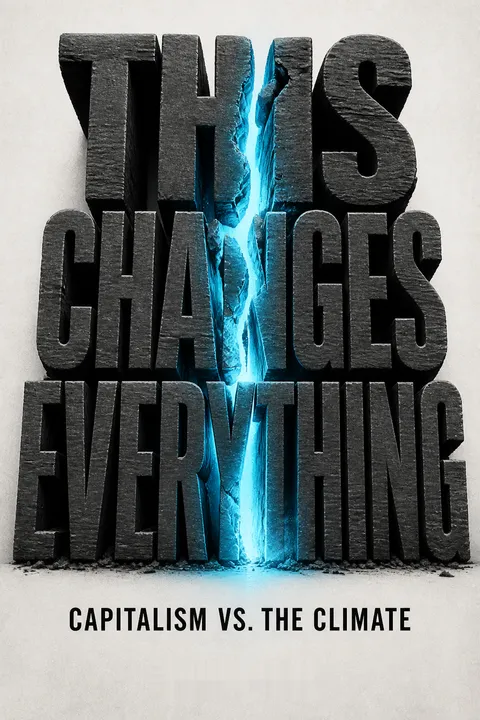


Key Takeaways
Treat climate change as a crisis that can rebuild society, not merely protect it.
The danger is present. Klein opens with a Washington flight grounded because its plane’s wheels sank into heat-softened pavement. The scene captures a larger contradiction: fossil-fuel dependence is already disrupting the systems built to sustain it, yet business continues as usual. People often look away because facing the science seems to require changing familiar lives and institutions, not just buying greener products.
A crisis is declared. Bolivia’s climate negotiator Angélica Navarro Llanos reframes the threat as an opportunity for a global investment plan: countries that emitted little should receive money and technology to adapt and develop without repeating the high-carbon path. Klein argues that emergencies become political priorities when movements insist they are emergencies. The response could protect lives while improving public services and reducing inequality.
What's striking is the shift from climate as a technical problem to climate as a question of collective purpose. Crisis language can focus attention and unlock resources, but it can also excuse centralized power or suspend ordinary rights. The crucial distinction is who defines the emergency and who benefits from the response. Klein's account makes the case for a public, democratic declaration of urgency, one that treats safety and fairness as connected goals rather than competing expenses.
Challenge growth economics before carbon budgets make its contradictions irreversible.
Trade moved emissions. Klein argues that market liberalization accelerated pollution while making climate action harder. Global emissions in 2013 were 61 percent higher than in 1990, when climate negotiations began. As production shifted overseas, wealthy countries could appear to reduce domestic emissions while consuming goods made with emissions elsewhere. International shipping emissions were largely left outside national accounting, and trade rules could penalize governments that favored local clean-energy industries.
Delay raises the price. Citing climate researchers Kevin Anderson and Alice Bows-Larkin, Klein reports that wealthy countries might need annual emissions cuts of roughly 8 to 10 percent to preserve a reasonable chance of staying below 2 degrees Celsius, with fairness between countries considered. Such cuts are far beyond what modest efficiency measures alone had delivered. Her target is not every form of commerce, but an economic system that depends on ever-expanding material consumption.
The strongest insight is about institutional fit: climate targets cannot be met by policies that protect the rules driving emissions growth. The distinction between production-based and consumption-based accounting also exposes how a country can outsource pollution without reducing its demand for carbon-intensive goods. Still, the argument is most precise when aimed at deregulated, resource-intensive growth, not at every market exchange or every increase in output. The relevant test is whether economic activity reduces material harm quickly and fairly.
Make climate policy public, planned, and fair enough to earn mass consent.
Public control matters. In 2013, Hamburg voters narrowly backed bringing their electricity, gas, and heating grids back under city control. Supporters wanted democratic oversight and a faster shift to renewables. Klein contrasts this with Ontario, where a clean-energy program that supported local manufacturing lost its local-content rules after a World Trade Organization ruling. In her account, trade law constrained a climate policy that had also created local jobs.
Fairness makes sacrifice possible. Klein calls for public investment in transit, housing, clean energy, and disaster protection, with polluters paying a substantial share. She draws on wartime rationing: Britain’s overall consumption fell, while poor people’s calorie intake rose because rations gave them access to food they otherwise lacked. The lesson is not that everyone must bear identical costs, but that rules need to be seen as shared and equitable.
This section connects climate policy to a basic principle of political legitimacy: people are more willing to accept constraint when they can see both a fair process and a meaningful public return. Public ownership is not automatically democratic, and a municipal utility can still be slow or unaccountable. Its value lies in creating levers citizens can use. Pairing national coordination with local control helps address a real tension between the scale of the transition and the need for community consent.
Stop expanding fossil fuel frontiers, even when industry calls extraction innovation.
New extraction locks in emissions. The book argues that tar sands mining, fracking, mountaintop removal, and deepwater drilling are not neutral improvements to energy supply. They push industry into more damaging deposits and often require long-lived infrastructure that assumes decades of continued fossil-fuel use. Tar sands oil, Klein reports, can be three to four times as greenhouse-gas intensive to produce as conventional oil.
The arithmetic is stark. A Carbon Tracker estimate cited in the book compares about 2,795 gigatons of carbon in fossil-fuel reserves claimed by companies with a roughly 565-gigaton budget for the period 2011 to 2049 if warming is to remain below 2 degrees Celsius with a substantial chance. The figures are estimates from the period, but the political point is clear: companies have financial incentives to extract far more carbon than the climate can safely absorb. Cutting emissions requires leaving much of it underground.
The reserve comparison makes climate change legible as a conflict over assets, not only a debate about consumer behavior. It also explains why voluntary corporate pledges struggle against shareholder expectations and the pressure to replace depleted reserves. The transition still has to account for workers and communities whose incomes depend on extraction. A credible phase-down therefore needs both binding limits on new projects and durable alternatives, or the costs of decarbonization will fall on people with the least room to absorb them.
Refuse climate fixes that preserve polluters while shifting danger elsewhere.
Markets can disguise delay. Klein criticizes carbon offsets and trading schemes that let a company continue emitting by claiming a reduction elsewhere. Some projects rewarded factories for destroying a potent greenhouse gas while preserving incentives to produce it, and forest offset projects sometimes restricted the people who had long lived in those forests. The European carbon market also suffered from excess permits and a collapse in carbon prices, weakening incentives to cut pollution directly.
Miracles can protect business as usual. Richard Branson publicly pledged $3 billion for climate solutions, but Klein's review found that his investment was far below that promise while Virgin expanded its airlines. She is also wary of solar radiation management, which would reflect sunlight to cool the planet without removing carbon dioxide. Modelled risks included altered rainfall, while stopping the intervention could unleash rapid warming that had been temporarily masked.
These examples share a useful diagnostic: ask whether a proposed fix reduces the underlying harm, or merely moves it across time, geography, or accounting categories. The distinction matters because complex systems rarely respect the neat boundaries drawn by markets. At the same time, research and experimentation are not inherently evasive; the problem is treating uncertain interventions as substitutes for measures already available. Governance, transparency, and a clear path to reducing emissions are essential whenever risk is imposed on people who did not choose it.
Organize where extraction touches home, and turn local defense into shared power.
Resistance has a geography. Klein uses the term Blockadia for a dispersed, transnational zone of conflict appearing wherever companies pursue mines, fracking, pipelines, and other extractive projects. It is not one organization or place. In Greece, villagers opposed a gold mine they feared would damage forests and water; in New Brunswick, Mi'kmaq and non-Indigenous residents joined protests against fracking exploration. Similar fights linked communities along pipelines, rail routes, and coal export corridors.
Local fights can scale. These campaigns often begin with immediate concerns about drinking water, health, or land, then connect with climate arguments about keeping fossil fuels underground. Residents have delayed or stopped projects, and communities have shared tactics across borders. Klein argues that this is also a democracy movement: people are demanding a say over decisions that place their homes and livelihoods at risk, rather than relying only on distant politicians or corporate promises.
Place-based organizing turns an abstract global threat into a concrete question: what happens to this water, this forest, and the people who depend on them? That specificity can build alliances among groups that do not share a single political identity. It also guards against a weakness of purely digital mobilization, where attention can travel faster than trust. Local control alone cannot manage a global carbon budget, however. The most durable strategy links community power to national standards and cross-border cooperation.
Treat Indigenous rights and climate debt as enforceable foundations of climate justice.
Rights need real backing. Indigenous treaties and land claims have become important barriers to extraction. In Canada, court rulings affirmed that some agreements allowed continued hunting, fishing, and other uses of ancestral lands. Those rights mean little if industrial pollution destroys the ecosystems on which they depend. Klein recounts how a credit-rating agency dismissed Indigenous claims against Canada because it doubted they could be enforced, revealing the gap between legal rights and political power.
Responsibility is unequal. Climate debt describes the claim that countries and industries responsible for much of the historical pollution owe support to communities and nations that contributed little but face severe impacts. Ecuador's Yasuní proposal sought international funding in exchange for leaving oil beneath rainforest in the ground. The promised support fell far short. Klein stresses that Indigenous communities should not be asked to defend the climate without resources, consent, or viable economic choices.
The argument joins legal standing to material capacity: a right without money, political allies, or enforcement mechanisms can remain largely symbolic. Climate debt similarly reframes international aid as responsibility for unequal contributions to a shared atmospheric problem. These ideas become harder to apply as wealth and emissions rise within developing countries, so justice cannot be reduced to a simple North versus South division. The more durable principle is to assign burdens by both historical responsibility and present capacity, while protecting the agency of affected communities.
Invest in economies that renew soil, energy, and community instead of exhausting them.
Extraction is a worldview. Klein uses extractivism to mean taking from land and people without reciprocal care for renewal. Nauru illustrates the cost: phosphate mining stripped much of the island's interior, leaving damaged land and a fragile economy; climate impacts now threaten the same community from another direction. The point is not that every use of resources is wrong, but that taking without restoring eventually undermines the conditions for life.
Build for renewal. On the Northern Cheyenne reservation, Lakota educator Henry Red Cloud trained residents to install solar heaters, lowering household energy costs while creating skills and local work. Klein also highlights agroecology, which combines crops and ecological practices to protect soil, manage pests, and reduce dependence on synthetic inputs. These examples make climate action constructive: resist destructive projects while building systems that can sustain people and ecosystems.
Regeneration offers a stronger goal than simply reducing damage: it asks whether economic activity improves the capacity of living systems to continue. That perspective connects energy policy to agriculture, public health, and community resilience. The practical examples also show why alternatives matter politically: people need credible ways to meet immediate needs, not only warnings about future harm. Yet local projects cannot carry the whole transition alone. They need public financing, technical support, and safeguards against being captured or imposed by outside interests.
Analysis
Klein's central claim is that climate change is not merely an environmental problem confronting an otherwise neutral economy. It exposes a conflict between ecological limits and an economic order organized around privatization, corporate freedom, and continual expansion. Her most persuasive move is to connect that structural diagnosis to lived places: a plane stranded by heat, a town guarding its water, an Indigenous community invoking treaty rights, or a worker learning to install solar equipment. These stories make political economy tangible without reducing the crisis to individual lifestyle choices.
The book's strongest practical insight is that resistance and construction must proceed together. Blocking a pipeline can prevent lock-in, but a durable coalition also needs jobs, public services, and locally controlled alternatives. Fairness is not an optional moral gloss on climate policy. It is a condition for political consent, especially when communities are asked to change industries and habits that support their livelihoods. The account also makes a compelling case for joining climate action to struggles over democratic power and historical responsibility.
The argument's sharpest tension is its framing of capitalism against climate stability. That framing clarifies how current institutions obstruct rapid reductions, but it risks making the political choice sound more binary than the policy landscape is. Markets can help deploy clean technology, while public regulation and investment shape which technologies grow, who owns them, and who bears their costs. The relevant distinction is less market versus state than whether an institution rewards ecological depletion or supports a just transition. The book also faces a practical challenge: the rapid, coordinated change it demands must be democratic, yet its proposed scale requires strong planning capacity. Klein's answer is movement pressure paired with decentralized control. The adaptation's enduring value lies in treating climate action as both a carbon task and a project of rebuilding collective agency.
Review Summary
This Changes Everything receives mostly positive reviews for its critique of capitalism's role in climate change. Readers praise Klein's thorough research and call for systemic change, though some find it overly long or biased. Many consider it an important, eye-opening work that challenges current economic systems and proposes radical solutions. Critics argue it lacks practical alternatives or oversimplifies complex issues. The book's emphasis on grassroots movements and indigenous rights resonates with many readers, while others question its economic analysis.
People Also Read


Glossary
Extractivism
Taking without restoringA way of organizing economies and relationships in which land, ecosystems, and people are treated primarily as resources to be taken and used, without responsibility for renewal or future wellbeing. Klein applies the term beyond mining and drilling to a broader mindset that normalizes sacrifice zones and ignores the connections among ecological damage, labor, and inequality.
Blockadia
Network of extraction resistanceKlein's name for the growing, dispersed field of community resistance wherever extractive projects are proposed or operating. It includes campaigns against mines, fracking, pipelines, coal trains, and export terminals. Blockadia is not a single organization; its local struggles connect through shared concerns about land, water, health, democratic control, and climate impacts.
People's Shock
Crisis-led democratic transformationKlein's alternative to crisis exploitation by elites. A People's Shock occurs when ordinary people use an emergency to demand a fairer distribution of power and resources, expand public goods, and address the causes of repeated crises. Climate change could prompt such a response if movements shape the recovery and transition, rather than leaving decisions to corporations and political elites.
climate debt
Responsibility for historical emissionsThe claim that countries and industries responsible for a disproportionate share of cumulative greenhouse gas emissions owe support to less responsible communities and nations facing climate impacts or seeking low-carbon development. The concept treats financial and technological assistance as a matter of responsibility and fairness, not simply charity.
Greenhouse Development Rights
Equitable global emissions frameworkA framework developed by researchers to distribute climate obligations according to both historical responsibility for emissions and the capacity to pay. It seeks to protect poor people's right to development while requiring wealthier people and countries to shoulder more of the mitigation and financing burden, including support for low-carbon development elsewhere.
solastalgia
Distress from a changed homeA term coined by philosopher Glenn Albrecht for the distress people feel when environmental change damages or transforms the place where they continue to live. Unlike homesickness caused by leaving, solastalgia describes a loss of comfort and belonging while still at home. Klein uses it to connect local extraction damage with the wider unease of climate disruption.
Solar Radiation Management
Reflecting sunlight to cool EarthA form of geoengineering intended to reduce warming by reflecting some incoming sunlight away from Earth. Proposed methods include injecting reflective particles into the stratosphere or brightening clouds. It would not remove atmospheric carbon dioxide, and Klein emphasizes concerns about uneven rainfall effects, governance, and the rapid warming risk if deployment stopped.
FAQ
What's This Changes Everything: Capitalism vs. the Climate about?
- Central Theme: The book argues that climate change is not just an environmental issue but a profound challenge to capitalism itself. Naomi Klein posits that addressing climate change requires a fundamental transformation of our economic systems.
- Capitalism vs. Climate: Klein explores how capitalism, particularly in its current deregulated form, exacerbates climate issues. She emphasizes that the solutions to climate change must involve significant changes to our economic structures.
- Call to Action: The book advocates for a mass movement to demand systemic change, linking climate action with social justice and economic equity. Klein believes that the urgency of climate change can galvanize collective action for a more equitable society.
Why should I read This Changes Everything: Capitalism vs. the Climate?
- Urgent Message: Klein presents a compelling argument that climate change is an existential threat that requires immediate and radical action. The book is timely, given the increasing frequency of climate-related disasters.
- Interconnected Issues: It connects climate change with broader social and economic issues, making it relevant for readers interested in social justice, economics, and environmentalism. Klein’s insights encourage readers to think critically about the systems that govern our lives.
- Inspiring Examples: The book includes numerous case studies and examples of grassroots movements fighting for climate justice, providing hope and practical models for action. Readers can find inspiration in the stories of communities taking control of their energy systems.
What are the key takeaways of This Changes Everything: Capitalism vs. the Climate?
- Transformative Change Required: Klein emphasizes that to combat climate change effectively, we must transform our economic systems. This includes moving away from fossil fuels and rethinking consumption patterns.
- Role of Corporations: The book critiques the role of corporations in perpetuating environmental degradation and argues for holding them accountable. Klein advocates for policies that make polluters pay for the damage they cause.
- Collective Action: Klein calls for a united movement that links climate action with social justice, emphasizing that the fight against climate change can also address inequality. She believes that a strong grassroots movement is essential for achieving meaningful change.
What are the best quotes from This Changes Everything: Capitalism vs. the Climate and what do they mean?
- “We need to remember that the work of our time is bigger than climate change.” This quote highlights the idea that climate change is a symptom of larger systemic issues. It calls for a holistic approach to societal transformation.
- “The only way to reach two degrees is to shut down the whole global economy.” This stark statement underscores the urgency of the climate crisis and the need for radical changes. It suggests that incremental measures are insufficient to meet climate goals.
- “Climate change is a civilizational wake-up call.” Klein frames climate change as an opportunity for profound societal change. This quote encourages readers to view the crisis as a chance to rethink and reshape our values and systems.
How does Naomi Klein connect capitalism and climate change in This Changes Everything: Capitalism vs. the Climate?
- Capitalism's Role: Klein argues that capitalism, particularly in its neoliberal form, is fundamentally at odds with the urgent need to address climate change. The profit motive often leads to environmental exploitation and degradation.
- Economic Growth vs. Sustainability: The book discusses the conflict between the need for continuous economic growth and the finite nature of the planet's resources. Klein posits that the current economic model prioritizes short-term profits over long-term sustainability.
- Need for Regulation: Klein advocates for strong government intervention and regulation to curb corporate power and protect the environment. She believes that without such measures, meaningful progress on climate change is unlikely.
What solutions does Naomi Klein propose for climate change in This Changes Everything: Capitalism vs. the Climate?
- Grassroots Movements: Klein emphasizes the importance of grassroots activism and community organizing in driving change. She highlights successful examples of local movements that have reclaimed energy systems and pushed for renewable alternatives.
- Public Ownership: The book advocates for public ownership of energy resources to ensure that they serve the public good rather than corporate interests. Klein argues that local control can lead to more sustainable and equitable energy solutions.
- Policy Changes: Klein calls for comprehensive policy changes that prioritize renewable energy and reduce reliance on fossil fuels. This includes implementing a “polluter pays” principle to hold corporations accountable for their emissions.
How does This Changes Everything: Capitalism vs. the Climate address the issue of climate justice?
- Linking Climate and Inequality: Klein argues that climate change disproportionately affects marginalized communities, making climate justice a social justice issue. She emphasizes the need to address these inequalities in climate action plans.
- Indigenous Rights: The book highlights the importance of respecting Indigenous rights and knowledge in the fight against climate change. Klein advocates for Indigenous communities to have a central role in decision-making processes regarding land and resources.
- Global Solidarity: Klein calls for global solidarity among movements fighting for climate justice. She believes that a united front can amplify the voices of those most affected by climate change and push for systemic change.
What is the concept of "extractivism" in This Changes Everything: Capitalism vs. the Climate?
- Definition of Extractivism: Klein defines extractivism as a nonreciprocal relationship with the earth, focused solely on taking resources without regard for regeneration or sustainability.
- Impact on Communities: This mindset leads to the exploitation of both natural resources and marginalized communities, often resulting in environmental degradation and social injustice.
- Call for Stewardship: The book advocates for a shift towards stewardship, where humans take care of the earth and its ecosystems rather than exploiting them.
What are "stranded assets" as discussed in This Changes Everything: Capitalism vs. the Climate?
- Definition of Stranded Assets: Stranded assets refer to investments in fossil fuel resources that may become worthless due to changes in environmental policy or market dynamics.
- Economic Risks: Klein explains that if governments take serious action on climate change, many fossil fuel projects will lose their projected value, impacting investors and the economy.
- Implications for the Future: The concept underscores the urgency of transitioning to renewable energy sources to avoid the financial fallout associated with stranded assets.
How does Naomi Klein view the role of corporations in the climate crisis in This Changes Everything: Capitalism vs. the Climate?
- Corporate Influence: Klein discusses how corporations have significant influence over political decisions and public policy, often prioritizing profits over environmental concerns. This influence can lead to policies that exacerbate climate change.
- Greenwashing: The book critiques the practice of greenwashing, where companies present themselves as environmentally friendly while continuing harmful practices. Klein argues that this undermines genuine efforts to combat climate change.
- Need for Accountability: Klein calls for greater accountability for corporations regarding their environmental impact. She advocates for policies that hold companies responsible for their emissions and encourage sustainable practices.
How does This Changes Everything: Capitalism vs. the Climate critique capitalism?
- Incompatible with Sustainability: Klein argues that capitalism's inherent need for growth is fundamentally at odds with environmental sustainability. She posits that the pursuit of profit leads to the exploitation of natural resources and contributes to climate change.
- Corporate Influence on Policy: The book critiques the influence of corporations on political decision-making, highlighting how this undermines efforts to address climate change. Klein argues that corporate interests often prioritize short-term gains over long-term environmental health.
- Need for Alternatives: Klein calls for the exploration of alternative economic models that prioritize ecological health and social equity. She emphasizes that a shift away from capitalism is necessary to create a sustainable future.
What is the significance of the title This Changes Everything: Capitalism vs. the Climate?
- Call to Action: The title reflects the urgent need for a paradigm shift in how we approach climate change. Klein argues that the current trajectory is unsustainable and that we must fundamentally change our systems to protect the planet.
- Interconnectedness of Issues: The title also highlights the interconnectedness of environmental, social, and economic issues. Klein emphasizes that addressing climate change requires a holistic approach that considers the broader implications of our actions.
- Hope for the Future: Ultimately, the title conveys a sense of hope that change is possible. Klein believes that through collective action and grassroots movements, we can create a more just and sustainable world.
About the Author
Other books by Naomi Klein




Download PDF
Download EPUB
.epub digital book format is ideal for reading ebooks on phones, tablets, and e-readers.








