

Key Takeaways
Treat climate change as a human-systems crisis, not a distant nature story
The damage is already ours. Wallace-Wells argues that warming is not a remote threat to wildlife or coastlines. It reaches into food, health, migration, politics, and economic life. The book stresses how quickly the cause has accumulated: more than half of fossil-fuel carbon emissions had been released in the three decades before publication. The Industrial Revolution began the process, but people alive now have intensified it dramatically. The Anthropocene, a proposed name for the period in which human activity reshapes Earth’s systems, captures the scale of that influence, though it can misleadingly suggest humans have mastered nature.
There is no outside. Climate conditions shape the systems people depend on, from crops and water to roads and hospitals. The author’s challenge is to stop treating environmental damage as scenery and recognize it as a threat to human societies themselves.
The shift from nature protection to human systems is strategically powerful: it connects atmospheric change to matters people already regard as urgent, such as public health, housing, and economic security. It also exposes a weakness in the familiar appeal to save distant landscapes, which can make environmental harm feel optional. Yet a human-centered case has limits. If nature matters only when it serves people, its losses can be overlooked when immediate human benefits appear to outweigh them. A durable argument needs both registers: ecosystems have value beyond utility, and their disruption also undermines the conditions of human life.
The climate forecast is largely a forecast of what societies choose
Two uncertainties interact. Climate projections depend on how much greenhouse gas people emit and how the climate responds. The second question involves real scientific uncertainty, including feedbacks, processes that amplify or moderate an initial change. But the first uncertainty is political: it depends on human decisions about energy, land use, and consumption. The book cites a 2018 estimate that existing national pledges would lead to roughly 3.2 degrees Celsius of warming, while emphasizing that those pledges were not being met.
Scenarios are not destiny. Even if climate models cannot specify every local outcome, they can show how risks change across different warming levels. The uncertainty is not a reason to wait for perfect precision. It is a reason to ask which choices make the more dangerous outcomes more likely, and which reduce that risk.
This distinction resembles risk management in fields where outcomes depend on both physical hazards and human exposure. A storm’s path may be uncertain, but building in a floodplain or maintaining evacuation systems remains a choice. Climate discussion can become trapped in the search for a single forecast, although decisions must be made across a range of plausible outcomes. Still, a political framing should not imply that every consequence is fully controllable. Physical inertia and poorly understood feedbacks constrain the options. Agency is meaningful, but it is not omnipotence.
Plan for cascades, because one disaster can manufacture the next
Climate risks compound. The book calls these interacting harms cascades or systems crises. A wildfire can remove the vegetation that holds a hillside in place, so later rain triggers lethal mudslides. In Santa Barbara County, fires were followed by evacuation orders for mudslides; more than a dozen people died, and roads and schools were disrupted. At a planetary scale, melting Arctic ice exposes darker ocean that absorbs more heat, while thawing permafrost can release stored carbon. These processes can accelerate warming, which then intensifies further ice loss and fire risk.
Attribution is not a switch. A disaster need not be wholly caused by climate change to be made more likely or damaging by it. The author argues that debating whether one storm was climate-caused can distract from the larger pattern: hazards now unfold in a climate already altered by human emissions.
Systems thinking is useful because emergency planning often treats hazards one at a time, while communities experience them in sequence and combination. The Santa Barbara example shows how a fire can change the terrain, turning a later rainstorm into a different kind of danger. This logic supports planning around dependencies, such as whether roads, power, communications, and medical care can function together during a crisis. The caution is that describing every event as part of a cascade can blur differences in cause and scale. Careful attribution still matters for learning which protections work.
Heat threatens the body before a place looks uninhabitable
Humidity changes the danger. The book explains wet-bulb temperature, a measure that combines heat and humidity to indicate how effectively the body can cool itself through evaporation. At extreme levels, cooling fails and the body can overheat even at rest. Wallace-Wells cites research identifying 35 degrees Celsius wet-bulb temperature as a limit beyond which humans cannot survive for long. Dangerous heat stress arrives well below that threshold. The book also notes a fiftyfold increase in dangerous heat waves since 1980 and describes the 2003 European heat wave, which killed tens of thousands.
Cities hold heat overnight. Asphalt and concrete absorb heat and release it after sunset, reducing the recovery period the body needs. Air conditioning helps some people, but already consumes a significant share of global electricity, and demand is expected to grow sharply.
Heat makes climate risk bodily and immediate, not merely a matter of future coastlines or abstract temperature averages. Wet-bulb measures also improve on the simple question of how hot a day feels, because humidity affects the body’s ability to shed heat. The urban example points toward practical adaptation, including shade, cool roofs, reliable power, and protections for outdoor workers. But adaptation is unequal: air conditioning and medical support are not available to everyone, and cooling can increase energy demand. A heat plan must therefore address both access and the emissions that power cooling.
Protect food and water as climate’s most intimate infrastructure
Food can lose quantity and quality. The book summarizes research suggesting that yields of major cereal crops decline as temperatures rise, especially in regions already near their ideal growing conditions. At four degrees of warming, one cited estimate projected a near-halving of U.S. corn yields. Higher carbon dioxide can also dilute nutrients in some crops. A study of rice varieties found declines in protein and several nutrients under higher carbon dioxide conditions, threatening a staple food for billions.
Water is a governance test. Only a tiny fraction of Earth’s water is readily available freshwater, and agriculture uses most of it. Climate change threatens snowpack, glaciers, and reliable rainfall, but waste and unequal access already worsen scarcity. Cape Town’s near-Day Zero crisis exposed disputes over who was using water, even as structural uses, including agriculture, dwarfed many household choices. Scarcity is shaped by infrastructure and policy as well as weather.
Food and water reveal how climate pressure travels through institutions. A crop failure matters differently where people have savings, storage, and functioning markets than where a harvest is the main source of food and income. The Cape Town example likewise shows why household conservation campaigns can become scapegoats when larger allocation decisions go unexamined. This framing can guide action toward resilient farming, reduced waste, and fair distribution. It should not imply that technology or crop adaptation is futile: improved varieties and methods may help, but benefits depend on access, affordability, and whether ecological limits are respected.
Sea-level rise is a long commitment, not a 2100 endpoint
Ice loss continues beyond a calendar. The book contrasts estimates ranging from several feet to substantially higher sea-level rise by 2100, reflecting uncertainty about how ice sheets respond. It reports that Antarctic ice loss accelerated markedly between the early 1990s and the 2010s. Even lower warming scenarios can commit the planet to further rise over centuries, because oceans warm and ice sheets respond slowly. The consequences reach beyond beachfront homes: ports, power plants, farmland, internet infrastructure, and major cities are often clustered near coasts.
Flood risk is already changing. The book cites a 2018 estimate that nearly 311,000 U.S. homes could face chronic inundation by 2045. It also notes that repeated flooding can make insurance and rebuilding untenable. The important distinction is between when rising seas begin to cause harm and how long the underlying process continues.
Sea-level rise is a problem of time horizons as much as geography. Mortgage periods, infrastructure lifespans, and political terms are short compared with the centuries over which ice sheets and oceans adjust. That mismatch can make a slow-moving hazard appear financially distant until assets become difficult to insure or defend. The book’s emphasis on long-term commitment is valuable, though individual sea-level estimates carry substantial uncertainty and should not be treated as precise local forecasts. Decisions are stronger when they pair broad risk projections with local elevation, subsidence, and flood data.
Climate damage follows inequality, then returns through migration and conflict
Exposure is unequal. Poorer communities often have weaker infrastructure, fewer resources for recovery, and greater dependence on climate-sensitive work. The book calls this a climate caste system: those who have contributed least to emissions can face severe impacts, while wealth offers some protection but no complete escape. Its cited World Bank estimate projected 140 million internal climate migrants by 2050 across sub-Saharan Africa, South Asia, and Latin America under the conditions it examined.
Pressure can destabilize societies. Drought and crop failure contributed to instability in Syria before its civil war, though the book is careful not to treat climate as the sole cause. Researchers cited by the author found that warmer conditions raise conflict risks across societies. Migration, food insecurity, economic loss, and weakened public trust can interact, turning climate stress into a political crisis rather than a purely environmental one.
This account connects climate justice to political stability: unequal exposure is not only an ethical failure, but a source of wider disruption. The idea of a climate caste system makes visible how wealth, housing, and infrastructure sort people into different levels of risk. It also cautions against explaining conflict with a single environmental cause. War depends on institutions, political choices, and historical grievances, while climate pressure can intensify existing tensions. Migration figures should be read as scenario-dependent estimates, not certainties; the underlying point is that displacement risks rise when livelihoods and homes become less secure.
Make climate visible in culture without turning it into fatalism
Fiction often displaces the real crisis. Wallace-Wells observes that popular stories depict crop blight, oil scarcity, pandemics, or nuclear catastrophe more readily than climate change itself. Climate is difficult to dramatize because it has no single villain or decisive battle: responsibility is spread across institutions, industries, governments, and consumers, though not equally. The author argues that climate change can become the background condition shaping ordinary stories, rather than a separate disaster plot.
The story affects the response. Treating climate impacts as parables about distant animals or landscapes can make human vulnerability easier to ignore. But stories of inevitable collapse can also encourage passivity. The challenge is to make the harms concrete while preserving the fact that different choices produce different futures.
The storytelling problem is also a problem of political imagination. Audiences readily understand a villain who can be defeated, but climate change is a distributed outcome of systems that millions participate in and a smaller number influence far more heavily. That makes conventional hero narratives a poor fit, not proof that the issue cannot be narrated. Stories can instead focus on institutions, collective decisions, and the unequal consequences of delay. The risk is that repeated catastrophe imagery becomes spectacle. Specific human experiences can make the stakes legible without presenting disaster as either entertainment or fate.
Clean technology must replace fossil systems, not merely join them
Addition is not transition. The book points out that renewable energy grew cheaper without bringing global emissions down, because new clean capacity was added to energy systems that continued expanding their fossil-fuel use. Replacing electricity sources is only part of the task. Transportation, buildings, industry, agriculture, land use, and supply chains also need to change. The author cites an estimate that, at the pace then observed, a full energy transition would take far longer than the time available to avoid severe warming.
No gadget absolves policy. Carbon capture could remove emissions, but the book describes it as expensive and unproven at the required scale. Solar geoengineering, which would reflect sunlight, carries risks including health damage and unpredictable effects on rainfall. Technology matters, but relying on a future fix can postpone known changes to energy and infrastructure.
The difference between adding clean energy and displacing fossil energy is central to evaluating transition claims. A new technology can improve efficiency or lower costs while total consumption continues to rise, leaving emissions high. This is a familiar systems problem: local improvement does not guarantee a better overall outcome when demand and incentives expand. The book is right to resist technological salvation stories, especially where speculative interventions distract from deployable changes. Still, skepticism should not become technological pessimism. Public investment, regulation, and infrastructure can make technologies useful at scale, while governance must manage their risks.
Scale personal concern into politics, where emissions can actually fall
Private virtue has limited reach. The book challenges the idea that climate progress mainly depends on perfect consumer behavior. Personal choices matter, but the author argues that their impact is small unless scaled through policy and institutions. The richest 10 percent of people were estimated to produce about half of global emissions; if that group reduced its footprint to the European Union average, the book cites an estimate that global emissions would fall by roughly a third. That scale cannot be achieved by symbolic purchases alone.
Responsibility is not equal blame. The author rejects both the comforting idea that a few villains alone caused the crisis and the claim that everyone is equally responsible. Fossil-fuel companies and political leaders have distinct influence, while wealthy consumers and voters also shape demand and policy. The future is not fixed: reducing emissions and preparing communities can still limit harm.
The distinction between individual action and political leverage avoids two common traps: treating shopping choices as a complete climate strategy, and treating personal behavior as irrelevant. People can reduce waste while also supporting policies that change energy, transport, and building systems. The unequal emissions figures make targeting high-consumption groups especially consequential. Yet an emphasis on individual responsibility must be handled carefully, since it can shift attention away from corporate power and public infrastructure. The strongest interpretation is not that every person carries equal guilt, but that civic action can change the rules governing far larger sources of emissions.
Analysis
The book’s most useful move is to redraw climate change as a crisis of human systems rather than a specialist concern about weather or wildlife. Heat becomes labor risk, drought becomes food and water insecurity, flooding becomes infrastructure failure, and those stresses can amplify migration, conflict, and economic decline. This integrated view makes the subject harder to compartmentalize, which is both its analytical strength and its communication challenge.
Wallace-Wells writes with deliberate urgency. That approach pushes back against decades of understatement and the comforting assumption that gradual change must be manageable. Yet the book also gathers projections with different assumptions, confidence levels, and time horizons. Its most extreme scenarios are possibilities, not uniform predictions. Readers should retain the central risk logic without treating every vivid estimate as equally likely. The author’s own acknowledgement of scientific uncertainty helps, but the forceful rhetoric can sometimes make scenario boundaries feel like forecasts.
The book’s political argument is stronger than a narrow appeal to personal purity. Emissions are shaped by infrastructure, investment, law, and unequal consumption, so individual restraint cannot substitute for institutional change. At the same time, collective responsibility should not flatten unequal power: corporations, governments, wealthy populations, and lower-income communities occupy very different positions in both causing and enduring the crisis.
Its final moral stance avoids both easy optimism and surrender. Human choices helped create the danger, and choices can still influence how severe it becomes. That is not a promise of rescue. It is a rejection of fatalism as an excuse for inaction. The most durable lesson is to treat uncertainty as a reason to prepare and reduce risk, while demanding political action proportional to the scale of the systems involved.
Review Summary
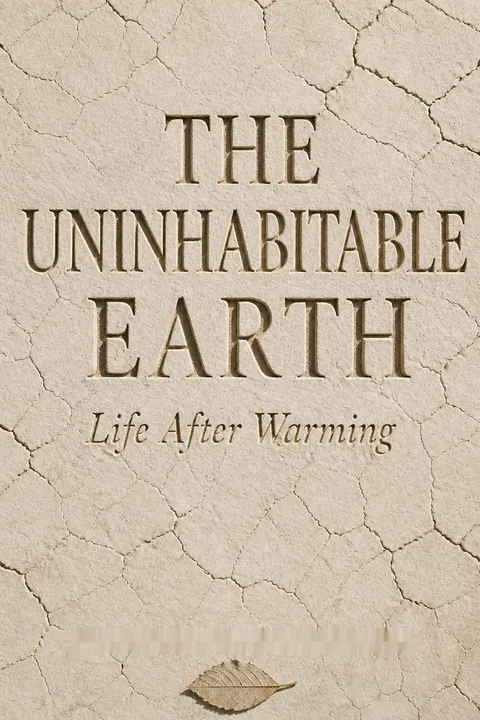
The Uninhabitable Earth is a sobering and alarming book about the catastrophic effects of climate change. Many reviewers found it eye-opening and terrifying, praising Wallace-Wells' thorough research and compelling writing. Some criticized the book's repetitive and overly pessimistic tone, while others felt it lacked concrete solutions. Despite its bleak outlook, many readers considered it essential reading for understanding the urgency of addressing climate change. The book's impact left many feeling anxious but also motivated to take action.
People Also Read

Glossary
Anthropocene
Human-shaped geological eraA proposed name for the period in which human activity has become a major force shaping Earth’s systems. In the book, the term emphasizes that industrial activity and land use have altered climate and ecosystems. Wallace-Wells cautions that the name can sound like humans have conquered nature, when the consequences instead reveal how dependent people remain on environmental systems.
feedbacks
Processes that amplify or moderate changeInteractions in the climate system that affect the initial warming. Some feedbacks intensify it: melting ice exposes darker surfaces that absorb more sunlight, while warming can thaw carbon-rich permafrost. Other feedbacks can moderate warming. Their combined effects are difficult to predict precisely, and the book treats them as a source of uncertainty about the pace and severity of change.
wet-bulb temperature
Heat and humidity measureA temperature measure that accounts for humidity and indicates how effectively moisture can evaporate from a surface. For human bodies, evaporation through sweating is a crucial cooling mechanism. At sufficiently high wet-bulb temperatures, the body cannot shed heat effectively, creating dangerous stress even when a standard air-temperature reading might not convey the full risk.
climate justice
Unequal climate harms and responsibilityA way of understanding how climate change distributes its causes, burdens, and protections unequally. The book emphasizes that poorer communities and countries often face greater exposure and have fewer resources to recover, despite contributing less to accumulated emissions. The term also raises questions about the responsibility of wealthy societies whose industrial growth helped create the danger.
negative emissions
Removing greenhouse gases from airMethods intended to remove carbon dioxide from the atmosphere rather than simply reduce new emissions. The book discusses technological carbon capture and approaches involving forests or agriculture. Such methods appear in many climate pathways, but the author stresses that their feasibility, costs, and ability to operate at the necessary scale were uncertain at the time of writing.
fossil capitalism
Growth powered by fossil fuelsAn interpretation of modern economic growth that places fossil fuels at its center. The book describes the argument that coal, oil, and gas supplied an unusually large, concentrated source of energy, enabling industrial expansion and material growth. It presents this as a contested account, not a complete explanation of capitalism or economic development.
heat island effect
Cities retaining extra heatThe tendency of dense urban areas to become hotter than surrounding areas because surfaces such as asphalt and concrete absorb heat during the day and release it later. The effect can reduce nighttime cooling, which is important for recovery during heat waves. It can intensify heat risks, especially for residents with limited access to cooling or healthcare.
hyperobject
A phenomenon too vast to grasp wholeA term from philosopher Timothy Morton for phenomena so extensive across space and time that no single person can fully perceive them. The book applies it to climate change, which unfolds globally, accumulates over generations, and appears through many separate events. The term helps describe why climate can be hard to imagine, though the author warns against treating it as literally incomprehensible.
FAQ
What's The Uninhabitable Earth: Life After Warming about?
- Climate Change Focus: The book explores the catastrophic impacts of climate change on human life and the planet, emphasizing its threat to civilization.
- Cascading Effects: It discusses interconnected crises like economic collapse, food scarcity, and increased conflict due to climate change.
- Human Responsibility: Wallace-Wells argues that the current generation has a unique responsibility to address climate change, as recent damage is unprecedented and self-inflicted.
Why should I read The Uninhabitable Earth?
- Urgent Message: The book delivers a stark warning about the realities of climate change, making it essential for anyone concerned about the planet's future.
- Comprehensive Analysis: It combines scientific research with storytelling to examine the consequences of inaction on climate change.
- Call to Action: Encourages readers to confront uncomfortable truths about climate change and consider their role in shaping a sustainable future.
What are the key takeaways of The Uninhabitable Earth?
- Warming Consequences: Even modest temperature increases can lead to severe consequences like food shortages and uninhabitable regions.
- Interconnected Crises: Climate change will exacerbate social and economic inequalities, leading to increased conflict and migration.
- Human Agency: While the situation is dire, there is still time for action, and today's choices will determine Earth's future.
What are the best quotes from The Uninhabitable Earth and what do they mean?
- "It is worse, much worse, than you think.": Urges readers to recognize the severity and immediacy of the climate crisis.
- "We have done as much damage... since Al Gore published his first book on climate than in all the centuries... that came before.": Highlights the rapid acceleration of carbon emissions and environmental degradation.
- "The planet brought from seeming stability to the brink of catastrophe in the years between a baptism or bar mitzvah and a funeral.": Reflects on generational responsibility to address climate change.
How does The Uninhabitable Earth address economic collapse?
- Economic Impact: Climate change could lead to significant economic losses, with a potential decline in global GDP by 23% by century's end.
- Resource Scarcity: Climate-induced disasters will strain resources, leading to increased competition and conflict over dwindling supplies.
- Long-term Consequences: Economic repercussions will be felt for generations, altering the global economic landscape.
What role does climate conflict play in The Uninhabitable Earth?
- Increased Likelihood of War: Climate change will increase the likelihood of armed conflict, with a 10-20% rise in conflict probability for every half degree of warming.
- Resource Wars: Competition for scarce resources like water and arable land will exacerbate tensions and lead to violence.
- Historical Context: Past conflicts are connected to climate impacts, showing how environmental stressors contribute to social unrest and warfare.
What are the psychological effects of climate change discussed in The Uninhabitable Earth?
- Mental Health Crisis: Extreme weather events can lead to psychological distress, including PTSD and anxiety.
- Climate Trauma: Individuals experience ongoing stress and fear related to climate impacts, affecting overall well-being.
- Generational Anxiety: Younger generations are particularly affected, grappling with the uncertainty of their future in a warming world.
How does The Uninhabitable Earth discuss the concept of climate refugees?
- Mass Displacement: Climate change could create hundreds of millions of climate refugees as people flee uninhabitable regions.
- Global Inequality: Displacement burdens will fall disproportionately on poorer nations, exacerbating existing inequalities and humanitarian crises.
- Political Implications: The influx of climate refugees could lead to increased political instability and conflict in receiving countries.
What solutions does The Uninhabitable Earth propose for addressing climate change?
- Urgent Action Needed: Immediate and aggressive action is necessary to reduce carbon emissions and transition to renewable energy.
- Technological Innovation: Potential advancements like carbon capture and geoengineering could mitigate some effects of climate change.
- Collective Responsibility: A collective effort from individuals, governments, and corporations is essential to address the climate crisis.
How does The Uninhabitable Earth challenge common misconceptions about climate change?
- Misunderstanding of Timeframe: Climate change is not a distant problem; its effects are already being felt and will worsen rapidly.
- Separation of Nature and Humanity: Climate change is not solely an environmental issue; it profoundly impacts human life and society.
- Complacency in Wealth: Wealth cannot shield individuals from climate impacts; climate change will affect everyone, regardless of socioeconomic status.
What are the main causes of climate change discussed in The Uninhabitable Earth?
- Fossil Fuel Emissions: Burning fossil fuels is the primary driver of climate change, with significant CO2 emissions since 1751.
- Deforestation and Land Use: Changes in land use, particularly deforestation, contribute significantly to greenhouse gas emissions.
- Industrial Agriculture: Modern agricultural practices exacerbate climate change, with food production accounting for about a third of emissions.
How does The Uninhabitable Earth address the concept of climate justice?
- Historical Responsibility: Wealthy nations have a historical responsibility for climate change, owing a "climate debt" to poorer nations.
- Generational Equity: Younger generations will bear the brunt of climate change consequences, highlighting the need for equitable solutions.
- Global Inequality: Climate change exacerbates existing inequalities, with the world's poorest being the most vulnerable.
Download PDF
Download EPUB
.epub digital book format is ideal for reading ebooks on phones, tablets, and e-readers.








