

Key Takeaways
Imagine Earth without people to measure what our presence suppresses.
A question with teeth. The book opens in an Ecuadorian Amazon village with Ana María Santi, an elder of the Zápara people. Her community has lost much of its ancestral forest and wildlife. The rubber boom, fueled by demand for automobile tires, brought outsiders who enslaved and killed Zápara people; later, forest clearing and depleted game reshaped daily life. When monkey meat is served, Santi refuses it because spider monkeys are kin in Zápara belief. The scene makes the central thought experiment personal: what would happen if humans disappeared, while the rest of the living world remained?
Not an extinction forecast. The scenario is a way to examine what human activity has changed, what natural systems might repair, and what damage could outlast its makers. It also asks whether humans contribute anything worth preserving.
Expect water, not age, to expose a city's weakest design.
A city depends on upkeep. In New York, subway workers keep about 13 million gallons of groundwater from overwhelming the tunnels each day. The system relies on electricity, pumps, and crews clearing drains. In the book's scenario, power stops when people vanish, and flooding can disable trains within hours. Water then undermines streets and foundations; repeated winter freezing and thawing widens cracks in pavement and buildings.
Green arrives through the cracks. Weeds and trees take root in neglected streets, while fires, corrosion, and collapsing structures gradually dismantle the built city. The abandoned High Line, where wildflowers and trees colonized an unused rail bed, offers a small present-day preview. Weisman estimates that centuries of succession could turn much of Manhattan into forest, although the original landscape would not return unchanged.
The city appears less like a solid object than a system of continuous repairs. That perspective connects urban ecology with infrastructure engineering: a pump, drain, or maintenance shift can matter more than a skyscraper's apparent strength. The thought experiment also exposes how cities displace water rather than abolish its routes. Its exact sequence is necessarily speculative, since rainfall, climate, and structural failures interact in unpredictable ways. The durable insight is not that every city fails on schedule, but that resilience depends on maintenance and on planning for the forces a design redirects.
Let ecosystems recover, but do not mistake recovery for a rewind.
Wilderness has a history. Poland's Białowieża forest preserves old trees, abundant deadwood, and species that managed woodlands often remove. Its decomposing trunks feed fungi, insects, and microbes, which in turn support a rich food web. When nearby fields are abandoned, trees can reclaim them within decades. Weisman suggests that several centuries without intensive management could restore forest across much of the region.
The past does not simply return. Humans have moved species across the globe, altered soils, and eliminated animals that cannot reappear. In New York, invasive ailanthus trees and other introduced plants may remain part of a future forest. Even the Białowieża landscape bears traces of earlier human activity. Recovery means renewed ecological function, not a perfect recreation of a world untouched by people.
This distinction anticipates a central problem in restoration ecology: choosing a baseline. A landscape may be healthy without matching a historical snapshot, especially when climate, species ranges, and human influence have changed. The forest's deadwood is a useful corrective to tidy ideas of conservation; decay is productive habitat, not waste. At the same time, the claim that function matters more than native species can be contentious. A functioning ecosystem may still lose unique species, cultural relationships, or evolutionary history that cannot be replaced by an ecological substitute.
Treat human-caused megafauna extinction as a serious risk, not a settled verdict.
A rapid loss, disputed cause. Paleontologist Paul Martin's Blitzkrieg theory argues that humans helped drive the late Ice Age extinction of many large mammals in the Americas. Clovis spear points, some found near mammoth and mastodon remains, support a hunting connection. Martin also points to Caribbean ground sloths that survived thousands of years longer than mainland relatives, disappearing after people reached the islands. Other scientists emphasize climate shifts or disease, and the evidence does not settle the debate.
History changes the odds. African large mammals evolved alongside human predators and developed ways to evade them, unlike animals encountering people in newly reached continents. This contrast suggests that an ecosystem's prior experience with a predator can shape its vulnerability. The book uses the extinction debate as a warning about what happens when a powerful newcomer meets prey with no history of avoiding it.
The value of this argument lies partly in its uncertainty. Extinction histories rarely offer a single clean cause: hunting, climate, habitat change, and disease can interact, while the fossil record preserves only fragments. The contrast between Africa and the Americas also makes evolutionary history visible as a form of ecological preparation. Yet coevolution does not guarantee safety; familiar predators can still drive prey down when pressure rises. The practical lesson is to treat rapid losses as signals of systemic risk, without turning a contested explanation into a universal law.
Assume plastic fragments will travel farther than the products they came from.
A durable material escapes its uses. Marine biologist Richard Thompson finds tiny plastic pellets, called nurdles, and broken consumer plastics on beaches far from manufacturing sites. His team also detects increasing plastic fragments in archived ocean samples. In one North Pacific study described in the book, surface samples contained more plastic by weight than plankton, a striking result from a particular sampling method, not a measure of the whole ocean.
Smaller does not mean gone. Waves and sunlight can break plastic into fragments, but fragmentation is not the same as biodegradation. Small particles can be swallowed by marine organisms, and some plastics collect pollutants on their surfaces. Microplastic beads in some body products added another direct route from household drains to waterways. The material's convenience ends quickly; its movement through ecosystems may continue for a very long time.
Plastic pollution illustrates a design mismatch: products are often useful for minutes or years, while their material remains in circulation far longer. Fragmentation can hide a problem from view without removing it, much as a dissolved contaminant becomes harder to track than a discarded bottle. The book's measurements are historical and depend on where and how researchers sampled, so individual ratios should not be mistaken for universal ocean conditions. Still, the larger systems lesson holds: waste policy must account for a product's full pathway, including what happens after disposal.
Farms can vanish quickly while contaminated soils keep their history for millennia.
Fields change faster than their chemistry. Agriculture and grazing together occupy more than a third of Earth's land surface in the book's account. At Rothamsted in England, researchers stopped harvesting a wheat plot; native plants displaced the crop within a few years. Abandoned fields can gradually return to grassland, scrub, or forest, depending on their past treatment and local conditions.
The soil keeps an archive. Long-running Rothamsted experiments show how fertilizers, industrial fallout, and sewage sludge altered soil. One researcher estimated that added zinc could persist for thousands of years, lead for tens of thousands, and chromium longer still. Fertilizer runoff also feeds algae blooms and oxygen-poor waters far downstream. The book points to Amazonian terra preta, charcoal-enriched soil created through older farming practices, as evidence that agriculture can be organized differently.
The contrast between fast plant succession and slow chemical persistence is a powerful model of ecological time. A field can look wild again while retaining contaminants invisible to the eye. That distinction matters for land restoration, food safety, and environmental monitoring. The terra preta example also complicates a simple story in which farming always degrades nature: practices that retain organic matter can build durable fertility. The book's persistence estimates depend on local soil conditions and methods, but they make a larger point: stopping an input is not the same as removing its legacy.
Make critical infrastructure safe when its human operators are gone.
Complexity needs caretakers. The book examines a world where power plants, pumps, and industrial facilities lose their operators without warning. Nuclear reactors can shut down automatically, but their fuel continues producing heat and requires cooling. At plants with spent fuel stored in pools, losing power and water circulation could create serious contamination risks. Weisman discusses all 441 operating nuclear plants reported in his 2007 account, emphasizing that their safety depends on systems that need human attention.
A shutdown is not an ending. The same question applies to petrochemical plants, dams, and city water systems: what happens when backup power, inspections, and repairs stop? The Chernobyl exclusion zone shows both sides of the problem. Wildlife has returned to an abandoned landscape, but radiation remains a hazard. Nature's capacity to recolonize damaged places does not make every industrial legacy harmless.
The chapter raises a core issue in safety engineering: a system can be reliable during normal operation yet fragile when its supporting institutions disappear. Passive safety, automatic shutdown, and long-term containment are different design goals, and the thought experiment forces them into view. The book's plant-by-plant outcomes are hypothetical, not precise forecasts; reactor designs and emergency systems vary. Still, the broader question applies well beyond nuclear power: critical infrastructure should be evaluated not only by how it works when staffed, but by how it fails when people can no longer intervene.
Protect wildlife corridors before parks become ecological islands.
A refuge needs room. Korea's Demilitarized Zone became an accidental wildlife sanctuary because military restrictions kept most people out. Its wetlands shelter endangered cranes and other species, while nearby development presses against the zone's edges. The animals need more than a protected strip: they need connected habitat in which populations can move and breed.
Coexistence can shape landscapes. In Kenya, conservationist David Western describes Maasai pastoralists moving with cattle across seasonal grazing lands. Their movement and the animals' browsing helped maintain a patchwork of grassland and woodland. As fencing and settlement restrict migration, wildlife becomes concentrated in parks, where populations can strain limited habitat. The book argues for corridors and conservation approaches that work with local communities rather than treating people as automatically incompatible with wildlife.
The corridor idea links conservation biology with land-use politics. Protecting a small reserve can preserve habitat today while isolating populations tomorrow; connectivity helps maintain movement and exchange across a landscape. The Maasai example also challenges the assumption that every human presence degrades nature. However, traditional land use is not automatically sustainable under every population, market, or climate pressure. Durable conservation therefore depends on local rights, viable livelihoods, and institutions that can adapt, not simply on drawing lines around parks or romanticizing past practices.
Some human works outlast us, but durability is not immortality.
Materials choose the survivors. Bronze can resist corrosion for ages, and fired ceramics may endure unless broken. Canvas paintings, wooden buildings, and museum collections are far more vulnerable to water, mold, fire, and neglected roofs. Even the most impressive monuments eventually erode or collapse. What lasts is often determined less by artistic importance than by chemistry and circumstance.
A message can outlive its makers. The Voyager spacecraft carry a record of sounds, greetings, and images intended to introduce Earth to unknown listeners. Radio broadcasts also continue outward through space, growing fainter with distance. These artifacts and signals extend human expression beyond the planet, but they cannot guarantee that anyone will find or understand them. The book's question about legacy therefore includes both material survival and the fragile possibility of interpretation.
This section distinguishes preservation from communication. A durable object can persist without conveying its meaning, while a fragile medium can carry an idea widely for a short time. That distinction matters for archives, digital culture, and public memory: longevity depends on material stability, but intelligibility depends on context and shared codes. The Voyager record is compelling precisely because it makes those limits explicit. Its existence is not proof of lasting remembrance; it is an attempt to make a message interpretable across an immense cultural and temporal distance.
Reduce human pressure voluntarily before scarcity imposes harsher limits.
The ending turns toward choice. Weisman does not treat human disappearance as the only route to ecological recovery. He describes continental wildlife corridors, rewilding, and ways for people to share landscapes with large animals. In the conclusion, he also presents a population scenario in which each woman has one child; a demographic model cited in the 2007 book projected a decline from about 6.5 billion people to 1.6 billion by 2100 under that assumption. This is a provocative hypothetical, not a simple or ethically neutral policy.
Intelligence has obligations. The book's final wager is that humans can recognize limits before resource pressure and ecological damage make choices for them. Its examples range from restoring migration routes to learning from soil-building practices. Human culture, art, and knowledge are part of Earth's story too; protecting them requires keeping the systems that support other life intact.
The conclusion's strongest move is to reject the false choice between human prosperity and a living planet. Corridors and shared landscapes suggest that conservation can be designed into inhabited places, rather than postponed until people leave. The population proposal, by contrast, exposes a difficult ethical boundary: demographic targets can treat individual freedom as a variable in a system model. Population size matters, but so do consumption, technology, and unequal access to resources. The lasting challenge is to reduce ecological pressure through fair institutions, not through coercion or a fantasy of effortless limits.
Analysis
The book's central device is a counterfactual: remove humanity while leaving its infrastructure, pollutants, altered climate, and introduced species behind. That selective disappearance is scientifically artificial, but analytically useful. It separates the immediate effects of stopping human activity from the slower consequences of what people have already set in motion. The result is a tour through different clocks: a house begins to fail within decades, forests reclaim fields over centuries, pollutants persist for millennia, and atmospheric carbon and radioactive materials can matter on geologic timescales.
Weisman's narrative strength is the way local detail makes these scales legible. A flooded subway, a forgotten farm plot, or a seabird's plastic-filled stomach turns an abstract environmental problem into a visible chain of causes. The book also complicates the familiar idea that nature is simply the opposite of humanity. Indigenous land use shaped landscapes; pastoralists sometimes supported ecological mosaics; and abandoned places can become new habitats. Yet human influence is so widespread that recovery rarely means returning to a pristine prior state. The future forest may contain introduced trees, altered soils, and animals whose former competitors are extinct.
The scientific claims vary in certainty. Some are grounded in observed decay, succession, or material properties; others depend on speculative timelines, uncertain climate pathways, or contested extinction explanations. The book's numerical estimates reflect its 2007 research context and should be read as scenario evidence, not current forecasts. Its most durable contribution is therefore not a precise schedule for the end of cities or the return of forests. It is a model of ecological inheritance: human systems outlast intentions, and the costs of design choices can travel far beyond their original setting. The final ethical turn matters because the thought experiment does not romanticize a planet without people. It asks whether human ingenuity can learn to share the conditions on which human life itself depends.
Review Summary
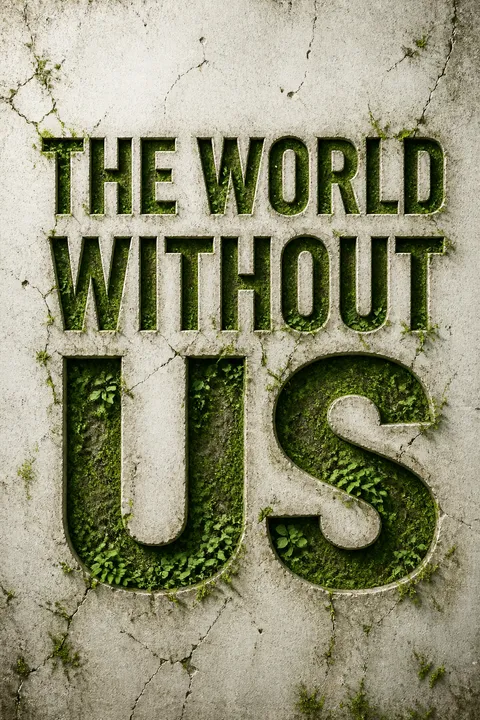
Reviews of The World Without Us are generally positive, averaging 3.81/5. Many readers praise its fascinating premise—imagining Earth after humanity's sudden disappearance—and its well-researched, accessible writing. Highlights include chapters on plastics, nuclear waste, urban decay, and biodiversity recovery. Critics find it occasionally repetitive, meandering, or preachy, with some feeling the book strays too far into environmental advocacy rather than fulfilling its speculative promise. Several note it reads more as environmental history than future speculation. Despite mixed feelings about execution, most agree the book raises important, thought-provoking questions about humanity's lasting impact on the planet.
People Also Read

Glossary
Blitzkrieg theory
rapid human-driven extinctionsPaleontologist Paul Martin's explanation for the rapid disappearance of many large mammals in the Americas after humans arrived. It proposes that skilled hunters could quickly overwhelm animals unfamiliar with human predation. The theory is influential but contested; alternative explanations emphasize climate change, disease, or interacting causes, and the evidence does not settle every case.
Mannahatta Project
reconstructing Manhattan's pastA Wildlife Conservation Society research project led by landscape ecologist Eric Sanderson. It combines historical maps, colonial records, sediment evidence, and biological data to reconstruct Manhattan Island as it appeared before urban development. The project helps reveal how the modern city's streets and infrastructure replaced earlier hills, streams, wetlands, and habitats.
terra preta
charcoal-enriched Amazonian soilA dark, unusually fertile soil found in parts of the Amazon and associated with past human cultivation. The book describes it as enriched by charcoal and organic materials that helped retain nutrients and improve soil fertility. Terra preta challenges the assumption that all agriculture necessarily impoverishes land and is presented as a possible guide to more durable farming.
Great Pacific Garbage Patch
debris gathered by ocean currentsA concentration of floating human-made debris in the North Pacific Subtropical Gyre, a large rotating system of ocean currents. The book describes plastic objects and fragments accumulating there after entering the sea from ships and, especially, land-based sources. It is not a solid island of trash; much of the pollution consists of dispersed pieces, including small fragments.
Gaia hypothesis
Earth as a self-regulating systemJames Lovelock's hypothesis that Earth's living organisms and physical systems, including the atmosphere, oceans, and soils, interact in ways that can regulate planetary conditions. The book invokes the idea to emphasize the interdependence of life and Earth systems. It does not mean that the planet consciously acts or that every ecological process maintains conditions favorable to humans.
Golden Record
messages carried by VoyagerA gold-plated record sent aboard the Voyager spacecraft in 1977. It contains sounds, music, spoken greetings, and images selected to represent Earth and human life to any intelligence that might find it. The record includes instructions intended to help a finder interpret and play it, while acknowledging the uncertainty of whether it will ever be encountered or understood.
FAQ
What's The World Without Us about?
- Exploration of human impact: The book imagines a world where humans suddenly disappear, examining the effects of human activity on nature, including ecosystem destruction and species extinction.
- Nature's resilience: Alan Weisman explores how nature would reclaim urban and agricultural areas, highlighting the potential for ecosystems to recover over time.
- Post-human world vision: Readers are invited to envision a world without humans, considering both immediate and long-term environmental consequences.
Why should I read The World Without Us?
- Unique perspective: The book offers a thought-provoking exploration of humanity's relationship with nature, challenging the notion of human superiority and permanence.
- Engaging storytelling: Weisman combines scientific research with compelling narratives, making complex ecological concepts accessible and engaging.
- Environmental awareness: It enhances understanding of ecological issues and inspires appreciation for conservation efforts, serving as a wake-up call about our planet's fragility.
What are the key takeaways of The World Without Us?
- Nature's recovery potential: Ecosystems have a remarkable ability to recover when freed from human pressures, as illustrated by how cities and farms would be reclaimed by nature.
- Long-lasting human impact: Human activities, such as pollution and habitat destruction, have enduring effects that can take thousands of years to reverse.
- Interconnectedness of species: The book underscores the importance of biodiversity for a healthy planet, showing how the absence of humans could lead to unexpected ecological shifts.
What are the best quotes from The World Without Us and what do they mean?
- “When we’re down to eating our ancestors, what is left?” This quote emphasizes the dire consequences of environmental degradation and the interconnectedness of all life forms.
- “Nature has been through worse losses before, and refilled empty niches.” It highlights nature's resilience and ability to adapt, suggesting ecosystems can recover from significant disturbances.
- “Every life-form adds to this vast pageant.” This underscores the importance of each species in maintaining ecological balance, reminding readers of biodiversity's value.
How does The World Without Us address the concept of extinction?
- Human-induced extinction: Weisman details how human activities have led to numerous species extinctions, providing historical examples of rapid biodiversity loss.
- Future extinction scenarios: The book speculates on potential future extinctions if humans continue negatively impacting the environment, raising awareness about the biodiversity crisis.
- Nature's response to extinction: Weisman explores how ecosystems might adapt and evolve in the absence of humans, potentially leading to new species and ecological dynamics.
What scientific methods does Alan Weisman use in The World Without Us?
- Ecological studies: Weisman incorporates findings from ecological studies to support his arguments about nature's resilience and recovery.
- Historical analysis: The book draws on historical events and archaeological findings to illustrate human civilization's long-term environmental impacts.
- Imaginary scenarios: Weisman uses thought experiments to envision a world without humans, engaging readers and encouraging critical thinking.
How does The World Without Us depict urban environments after humans?
- Nature reclaiming cities: Urban areas would quickly be overtaken by vegetation and wildlife, with buildings collapsing and streets becoming overgrown.
- Decay of infrastructure: The book details the processes of decay affecting buildings and infrastructure, highlighting human constructions' fragility.
- Biodiversity resurgence: Urban wildlife would thrive in the absence of humans, leading to increased biodiversity in cities.
What role do plastics play in The World Without Us?
- Persistence of plastics: Plastics can remain in the environment for hundreds or thousands of years, posing significant challenges for recovering ecosystems.
- Impact on wildlife: Plastic pollution affects marine and terrestrial life, with animals ingesting or becoming entangled in plastic debris.
- Future implications: Weisman speculates on plastics' future in a world without humans, considering their potential environmental effects.
How does The World Without Us explore the relationship between humans and nature?
- Interdependence: Weisman emphasizes the interconnectedness of humans and the natural world, illustrating how our actions impact ecosystems.
- Cultural perceptions: The book examines how cultural attitudes toward nature have shaped human behavior and environmental policies.
- Future possibilities: Weisman suggests a world without humans could lead to a more balanced ecosystem, but warns of past actions' potential consequences.
What are the potential ecological changes discussed in The World Without Us?
- Species migration: The book explores how species might adapt and migrate in response to changing environmental conditions without humans.
- Habitat restoration: Weisman discusses ecosystems' potential to recover and restore habitats degraded by human activity.
- Climate implications: The absence of human-induced climate change could lead to a more stable climate over time, affecting global ecosystems.
How does The World Without Us address the issue of climate change?
- Long-term effects of human activity: Weisman discusses climate change's far-reaching consequences for ecosystems and biodiversity.
- Potential for recovery: The book suggests Earth's climate could eventually stabilize if humans disappeared, allowing ecosystems to recover.
- Interconnectedness of systems: Weisman highlights the interconnected nature of climate, ecosystems, and human activity, emphasizing understanding these relationships for effective solutions.
What are the implications of The World Without Us for conservation efforts?
- Need for sustainable practices: The book emphasizes adopting sustainable practices to protect ecosystems and biodiversity.
- Lessons from nature's resilience: Weisman illustrates how ecosystems can recover when left undisturbed, providing valuable lessons for conservation.
- Call to action: The author encourages readers to consider their role in preserving the planet and advocate for conservation-supporting policies.
Download PDF
Download EPUB
.epub digital book format is ideal for reading ebooks on phones, tablets, and e-readers.








