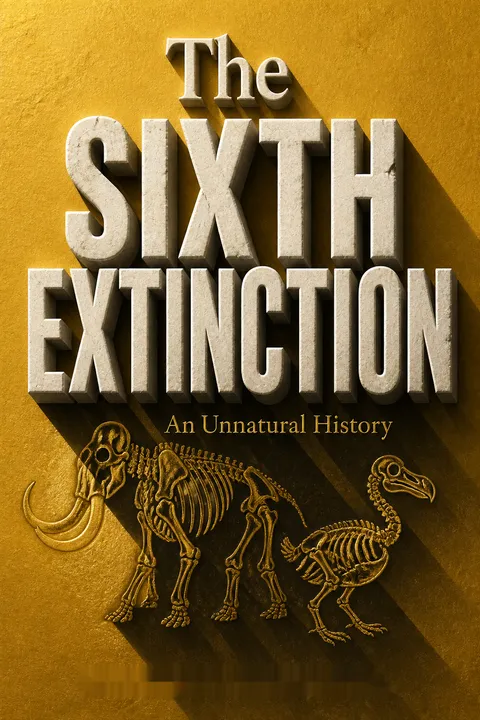


Key Takeaways
Treat vanishing species as evidence of a human-made mass extinction
A local warning sign. Around El Valle, Panama, the golden frog went from common along streams to absent in the wild. Biologists moved survivors into a sealed conservation center, but the fungus killing them could persist in the forest, making release unsafe. The pathogen, called Bd, damages amphibians’ ability to regulate essential salts through their skin. Its international spread likely depended on humans transporting infected frogs. The rescue tanks preserve individuals, but cannot yet restore their former home.
A global pattern. A mass extinction is a rapid, worldwide loss of a substantial share of life. The book describes amphibians as especially endangered, with estimated extinction rates up to 45,000 times their background rate. Other groups face severe losses, too. The claim is not that every species will disappear, but that human activity is driving losses on a scale and pace unusual in the history of complex life.
The frog story makes an abstract planetary trend visible at the scale of a stream, a tank, and a failed return home. It also exposes a difficult conservation distinction: keeping animals alive is not the same as restoring the ecological conditions they need. The argument is strongest when multiple signs converge, including disappearing populations, pathogens crossing continents, and habitat change. Any single extinction estimate carries uncertainty, especially where species are poorly documented, but uncertainty about the exact total does not erase the observed pattern.
Read extinction science as a history of frameworks, not settled first guesses
A tooth changed the picture. For centuries, many naturalists assumed every species still existed somewhere. The strange, knobby molars found with mastodon bones helped Georges Cuvier argue that some animals had vanished altogether. Fossils then revealed successive worlds of life. Charles Lyell resisted sudden change, favoring gradual processes, while Darwin explained the creation and disappearance of species through evolution and natural selection.
Evidence revised the rules. In the 1970s, Walter and Luis Alvarez investigated a thin clay layer at the boundary between the Cretaceous and Paleogene periods. Its extraordinary iridium content, later supported by other evidence, led them to propose an asteroid impact that caused a mass extinction. The scientific account shifted again: gradual change is real, but rare catastrophes can abruptly reshape life. The history shows how evidence can overturn assumptions that once seemed essential to scientific rigor.
This history is more than a parade of famous scientists. It shows how a good explanatory model can become a filter that makes inconvenient observations seem impossible. Lyell’s emphasis on processes visible in the present helped geology become disciplined, yet it also encouraged some scientists to explain away abrupt evidence. The useful lesson is not to distrust frameworks, but to keep them answerable to new evidence. The Alvarezes’ proposal mattered because independent clues accumulated, not because a dramatic story was inherently more persuasive.
Expect extinction causes to differ, but watch the speed of change
Different disasters, similar outcome. The end-Cretaceous extinction followed an asteroid impact about 66 million years ago and eliminated roughly three-quarters of species. The end-Ordovician event, around 444 million years ago, is associated with glaciation and falling seas. The much larger end-Permian extinction coincided with intense warming and radically altered ocean chemistry. These events did not share one trigger, and the precise mechanisms remain debated.
Adaptation has limits. Species evolve in response to conditions they have encountered. A sudden change can make once-useful traits irrelevant or harmful. The ammonites, for example, had survived for hundreds of millions of years, yet their small, drifting young may have been especially vulnerable after the asteroid impact. Their disappearance does not show that they were poorly adapted to ordinary conditions. It shows that familiar measures of fitness can fail when the environment changes beyond anything a species has previously faced.
The comparison among ancient extinctions cautions against searching for one master explanation. It also clarifies why the rate of change matters: adaptation through generations cannot reliably keep pace with a transformed environment arriving in a short interval. Still, the fossil record does not always preserve the decisive mechanism, and researchers cannot reconstruct every ecological interaction. That uncertainty should limit claims about exact causes, not obscure the broader lesson that abrupt environmental shifts can dismantle thriving systems.
Ocean carbon is dissolving the foundations of coral ecosystems
The chemistry is changing. The ocean absorbs carbon dioxide from the air. Once dissolved, that carbon changes seawater chemistry and reduces the carbonate ions many organisms need to build shells or skeletons. Since the industrial era began, average surface-ocean pH has fallen from about 8.2 to 8.1. Because the pH scale is logarithmic, that small numerical change represents roughly a 30 percent increase in acidity.
The reef loses builders. At volcanic vents near Italy’s Castello Aragonese, researchers found that the more acidic waters supported fewer species. In a zone around pH 7.8, roughly one-third of the species counted in unaffected waters were absent, including many shell-building organisms. Corals are especially consequential because their structures shelter and support many other species. Acidification is not the only reef threat, and warming, disease, pollution, and overfishing add pressure. But experiments and natural carbon dioxide vents point to serious risks for reef growth.
The vents offer a rare view of how marine communities respond across a natural acidity gradient, while laboratory studies test particular mechanisms. Together, these approaches make the case stronger than either could alone. Yet a volcanic vent is not a perfect miniature of a future ocean: exposure, local ecology, and multiple stressors differ. The central concern remains compelling because reef-building depends on organisms that must continually construct against erosion. A reef can look present while its capacity to maintain itself is already weakening.
Protect tropical species by making room for climate-driven migration
The tropics hold extraordinary variety. A set of research plots in Peru’s Manú region contains more than 1,000 tree species across a mountain slope. Because tropical species often occupy narrow temperature ranges, even modest warming can push suitable conditions uphill or toward the poles. In the plots, tree genera were already shifting upslope at an average rate of about eight feet per year, while some moved much faster and others barely moved at all.
Movement may not keep pace. The book contrasts today’s warming with the slower temperature changes associated with the end of past ice ages. It argues that modern warming is happening at least ten times faster, raising the risk that species cannot migrate or adapt quickly enough. A 2004 study estimated substantial climate-related extinction risks, though its methods and projections were challenged, and later estimates vary. Protected areas can conserve habitat, but fixed boundaries may fail when the climate zones and species within them move.
This account shifts attention from the poles, which dominate popular images of climate change, to tropical regions where biodiversity is concentrated and many species have limited ranges. It also makes conservation a spatial problem: protecting a patch is less effective if organisms cannot reach suitable habitat beyond it. Migration corridors are not a complete answer, since species differ in mobility and ecological needs. The plots matter because they replace a broad forecast with measured, uneven movement among real organisms.
Keep habitats connected before isolated populations acquire extinction debt
A forest can become an island. The Biological Dynamics of Forest Fragments Project in Brazil studies rainforest patches surrounded by cleared land. In one 25-acre fragment, researchers initially caught more birds, as animals fled nearby clearing. Over time, however, both bird numbers and variety declined. Small populations are more vulnerable to chance, and species that disappear may not be able to cross roads or open land to recolonize the fragment.
Loss can be delayed. Extinction debt is the future loss of species already made likely by habitat reduction or fragmentation, even though those species remain for now. The species-area relationship describes the broad pattern that larger areas generally support more species. It does not predict exactly when a given species will disappear. The project shows why a fragment can appear healthy for years while ecological connections and populations are quietly eroding.
The fragment experiment is valuable because it follows change over time rather than treating a cleared landscape as an immediate before-and-after event. Its findings also make connectivity more than a decorative conservation goal: recolonization can buffer local losses. However, fragments vary in size, shape, and surrounding land use, so one reserve cannot stand for every ecosystem. The practical insight is to consider both the habitat retained and the routes organisms need to move between it.
Treat every shipment as a possible biological invasion, not harmless commerce
Travel moves organisms past natural barriers. Human migration, shipping, and trade have carried plants, animals, and pathogens between regions that were separated for millions of years. The fungus linked to white-nose syndrome, for instance, spread through bat populations in North America, where it caused severe losses. The book estimates that only a minority of introduced species establish themselves, and fewer still spread widely, but those that do can transform ecosystems.
New neighbors can be dangerous. Species transported away from their predators or competitors may flourish. Guam’s introduced brown tree snake devastated native birds and bats. In Hawaii, a snail brought in to control another invasive snail instead preyed on native snails. The resulting global mixing is called the New Pangaea: a human-driven rearrangement of life that weakens geographic barriers. Local species counts may rise even as unique native species disappear and global biodiversity declines.
The invasion examples resist the easy story of villains and victims. A snake or fungus is not malicious; the ecological damage comes from placing organisms into relationships for which local species have no defenses. That distinction points toward prevention, careful trade controls, and caution when introducing a supposed biological fix. It also complicates simple measures of biodiversity. A landscape with more kinds of organisms can still be less distinct, less resilient, and poorer in species found nowhere else.
Humans were reshaping extinction long before engines and smokestacks
The pressure began early. As humans spread across the world, many large, slow-reproducing animals disappeared. In Australia, the timing of megafauna decline broadly tracks human arrival, and evidence from ancient sediments suggests that animal losses preceded major vegetation changes. New Zealand’s moas vanished within decades of human settlement, leaving extensive remains of hunted birds. The role of climate remains debated, but human hunting is strongly implicated in several regional losses.
The great auk shows the pattern again. Flightless and concentrated at breeding sites, the bird was killed for meat, feathers, bait, and fuel. Its final known pair was killed in Iceland in 1844. Such animals can be vulnerable because they reproduce slowly or gather in predictable places. The larger lesson is not that every ancient extinction had a single human cause, but that humans altered ecosystems well before industrial technology made that influence global and visible.
This long view unsettles the comforting idea that humanity lived harmlessly within nature until modern industry appeared. It also warns against treating gradual disappearance as harmless: a decline can unfold across generations without appearing catastrophic to the people causing it. The evidence for prehistoric overhunting is strongest in some regions and more contested in others, so the account benefits from distinguishing a repeated pattern from a universal explanation. Human influence has a deep history, even where its precise local story remains disputed.
Recognize human ingenuity as both an extinction force and a conservation tool
The same capacities cut both ways. Humans cooperate, communicate, and alter environments on a scale other species cannot match. The book connects those abilities to the extinction of Neanderthals and other human relatives, and to humanity’s continuing reach across the planet. Yet people also organize to protect threatened species. Conservationists have bred California condors, trained captive-raised whooping cranes to migrate, and worked to reproduce Sumatran rhinos in zoos.
Rescue is not restoration. The Panamanian golden frogs preserved in tanks cannot safely return to forests where Bd persists. A captive breeding program can keep a species from disappearing entirely, but it cannot by itself recreate habitat or reverse the causes of decline. The book’s final warning is about evolutionary possibility: human choices affect which lineages survive and which disappear, with consequences that may outlast human monuments and records.
This is not a simple verdict that people are either destroyers or stewards. The capacity to coordinate long-term rescue is real, but it operates alongside economic and cultural systems that continue to alter habitats. Captive programs are best understood as emergency measures, not substitutes for functioning ecosystems. The deeper ethical challenge is to pair care for individual animals with attention to the conditions that sustain whole communities. Hope is meaningful when it changes those conditions, not when it merely preserves a few symbols of loss.
Analysis
Kolbert’s central argument is that humanity has become a geological force, and that this power is visible not only in carbon emissions but in the rearrangement of species, habitats, and ecological relationships. Her strongest method is to connect scales that are usually kept apart: a frog tank in Panama, an Icelandic bird killed in the nineteenth century, a thin layer of iridium, and a reef responding to altered seawater chemistry. The travel narrative makes mechanisms tangible without losing the deep-time frame that gives them significance.
The book also offers a history of scientific correction. Cuvier recognized extinction but misread its causes; Lyell and Darwin clarified gradual processes while resisting catastrophe; evidence from the Cretaceous boundary forced geology to accommodate sudden global disruption. This sequence is a useful warning against both extremes: treating every change as gradual, or assuming one dramatic cause explains every extinction. The fossil record is incomplete, estimates of current losses depend on difficult measurements, and some causal disputes remain unresolved. Kolbert’s case does not require false precision. It rests on convergence among independent pressures and observations.
A productive tension runs through the work. Humans are described as exceptional because they can represent the world symbolically, cooperate at scale, and cross barriers that once constrained other species. Yet those same traits do not place humanity outside nature. They make human actions unusually consequential while leaving people dependent on the biological and geochemical systems they change. Conservation projects demonstrate moral concern and technical ingenuity, but they can also create the illusion that endangered life can be managed through rescue alone. The book’s challenge is therefore not merely to care more, but to recognize that care must alter the causes of loss. Its most durable insight is that species do not need to be visibly doomed before their future has been narrowed. A planet can remain crowded with life while its range of possible futures contracts.
Review Summary
The Sixth Extinction is widely praised as an engaging and informative exploration of mass extinctions, focusing on the current human-caused crisis. Kolbert's writing style, combining scientific research with personal experiences, makes complex topics accessible. The book covers historical extinctions, current threats to biodiversity, and human impact on the environment. Many readers find it eye-opening and depressing, emphasizing the urgency of environmental protection. Some critics note familiar content or occasional dryness, but most consider it a crucial read for understanding our planet's ecological challenges.
People Also Read





Glossary
Sixth Extinction
Human-driven mass extinctionThe proposed ongoing mass extinction caused primarily by human activity. The term places current biodiversity losses alongside the five major extinction events recognized in Earth’s past. The book argues that human actions are raising extinction rates through habitat destruction, climate change, ocean acidification, and the movement of species, while noting that the event’s final scale is not yet known.
Anthropocene
Human-dominated geological intervalA proposed name for a geological interval in which human activity has become a major force shaping Earth’s climate, landscapes, oceans, and living communities. The book describes evidence that human actions could leave a distinctive signal in future rock layers. It presents the term as a scientific proposal under consideration, rather than as a formally settled geological designation.
background extinction rate
Ordinary extinction paceThe rate at which species disappear during relatively stable stretches of geological time, outside mass extinction events. It varies among groups and is estimated from fossil evidence. In the book’s example, the background rate for mammals implies that, very roughly, one species among the mammals alive today would disappear about every 700 years.
Signor-Lipps effect
Fossils blur extinction timingThe tendency for a sudden extinction event to appear gradual in the fossil record. Species with low preservation potential are less likely to be represented in the final layers before their disappearance, so their last fossils may occur well before the actual event. This makes simultaneous losses appear staggered across geological time.
Lilliput effect
Smaller survivors after extinctionThe observed tendency for surviving organisms in some groups to be unusually small after a mass extinction. The book points to tiny foraminifera found above the Cretaceous boundary layer as an example. The term describes a post-extinction pattern, though the particular causes and its relevance can vary among events and organisms.
extinction debt
Delayed species lossThe future disappearance of species made likely by an earlier environmental change, even though those species remain present for a time. Habitat destruction or fragmentation may leave populations too small or isolated to persist, but extinction can be delayed. The lag means that current species counts can understate the eventual effects of past habitat loss.
New Pangaea
Human-driven species mixingA term for the global reshuffling of plants, animals, and pathogens through human travel and trade. Organisms cross barriers that once kept continents and islands biologically distinct. The mixing can increase the number of species in a particular place while eliminating unique native species and reducing differences among ecosystems worldwide.
species-area relationship
Area predicts species richnessThe broad ecological pattern that larger areas generally contain more species than smaller areas. It is often represented by a mathematical curve relating area to species number. The relationship helps researchers estimate how habitat loss may affect biodiversity, but it does not specify exactly which species will disappear or when.
enemy release
Escaping familiar predatorsAn advantage an introduced species may gain when it arrives in a new region without the predators, parasites, or competitors that constrained it in its original range. This can help some introduced organisms establish and spread. It is one possible explanation for invasive success, not a guarantee that every transported species will thrive.
Biological Dynamics of Forest Fragments Project
Long-term rainforest fragment studyA research project in the Brazilian Amazon that studies rainforest patches surrounded by cleared land. Researchers compare fragments with continuous forest and monitor changes in birds, plants, and other organisms. The project has documented that habitat isolation can cause continuing declines over time, rather than an immediate transition to a stable, less diverse community.
FAQ
What's The Sixth Extinction: An Unnatural History about?
- Focus on Extinction Events: The book examines the current mass extinction event, known as the Sixth Extinction, primarily driven by human activities. It compares this event to the five major extinction events in Earth's history.
- Human Impact: Elizabeth Kolbert highlights how human actions, such as habitat destruction and climate change, are accelerating extinction rates, altering ecosystems globally.
- Interconnectedness of Life: The narrative explores the complex relationships within ecosystems, showing how the loss of one species can affect others, using case studies like the Panamanian golden frog.
Why should I read The Sixth Extinction?
- Timely and Relevant: The book addresses pressing environmental issues, making it essential for those concerned about biodiversity and climate change.
- Engaging Narrative: Kolbert combines scientific research with personal storytelling, making complex topics accessible and engaging.
- Critical Insights: It offers insights into the consequences of human actions on the environment, encouraging reflection and action for conservation.
What are the key takeaways of The Sixth Extinction?
- Mass Extinction is Happening Now: The book argues that human activities are causing a mass extinction event, with extinction rates much higher than historical norms.
- Historical Context: Kolbert provides a historical overview of past extinction events, helping readers understand the current crisis's gravity.
- Hope for Change: Despite the grim outlook, the book highlights conservation efforts and the importance of awareness and action.
What are the best quotes from The Sixth Extinction and what do they mean?
- "We are losing all these amphibians before we even know that they exist.": Highlights the urgency of biodiversity loss and the need for conservation.
- "The history of life consists of long periods of boredom interrupted occasionally by panic.": Reflects the cyclical nature of extinction and evolution.
- "We have already left a record that is now indelible.": Emphasizes the lasting impact of human actions on geological history.
What is the significance of the term "Anthropocene" in The Sixth Extinction?
- Human-Dominated Era: The Anthropocene is a proposed epoch marked by significant human impact on Earth's geology and ecosystems.
- Geological Record: Kolbert explains that the Anthropocene will leave a distinct mark, similar to past extinction events.
- Call to Action: The term urges readers to recognize their role in shaping the planet's future and the need for environmental stewardship.
How does The Sixth Extinction address the concept of extinction rates?
- Current Extinction Rates: Kolbert presents alarming statistics showing that current extinction rates are significantly higher than historical rates.
- Factors Contributing to Extinction: The book details factors like habitat destruction and climate change as drivers of the current crisis.
- Implications for Biodiversity: Rising extinction rates disrupt ecosystems, leading to further species loss and ecological decline.
How does The Sixth Extinction connect past and present extinction events?
- Historical Patterns: Kolbert draws parallels between past events, like the end-Cretaceous extinction, and the current crisis.
- Lessons Learned: Understanding past extinctions can inform current conservation efforts and strategies.
- Cyclical Nature of Extinction: While life has recovered from past events, the current rate of extinction poses a unique threat.
What role do scientists play in addressing extinction, according to The Sixth Extinction?
- Research and Conservation: Scientists work to understand and mitigate extinction impacts, informing conservation strategies.
- Public Awareness: Effective communication of scientific findings is crucial for mobilizing action and support for conservation.
- Collaboration and Innovation: Collaboration among scientists, policymakers, and the public is essential for preserving endangered species.
How does The Sixth Extinction illustrate the interconnectedness of species?
- Ecosystem Dynamics: The loss of one species can have cascading effects on entire ecosystems, disrupting food webs and relationships.
- Case Studies: Examples like the decline of amphibians show how interconnected species are and the impact of their loss.
- Human Impact: Human activities disrupt these relationships, leading to rapid biodiversity declines.
How does The Sixth Extinction address climate change?
- Climate Change as a Driver: Kolbert highlights climate change as a primary factor in the current extinction crisis.
- Examples from Ecosystems: Rising temperatures and ocean acidification threaten species' habitats and survival.
- Call for Action: Immediate action is needed to combat climate change and protect biodiversity.
What role do invasive species play in extinction, according to The Sixth Extinction?
- Threat to Native Species: Invasive species outcompete natives for resources, leading to biodiversity declines.
- Examples of Invasives: Species like the brown tree snake illustrate the consequences of human actions on ecosystems.
- Management Challenges: Prevention and control measures are crucial for protecting native biodiversity.
How does The Sixth Extinction explore the concept of biotic attrition?
- Definition of Biotic Attrition: Describes the gradual loss of species due to environmental changes and human impact.
- Cumulative Effects: Small changes can lead to significant biodiversity declines, often overlooked in extinction discussions.
- Long-term Consequences: Biotic attrition reshapes ecosystems and evolutionary trajectories, highlighting the need to address biodiversity loss.
Download PDF
Download EPUB
.epub digital book format is ideal for reading ebooks on phones, tablets, and e-readers.








