

Key Takeaways
Read your body as a fossil record, not a finished design.
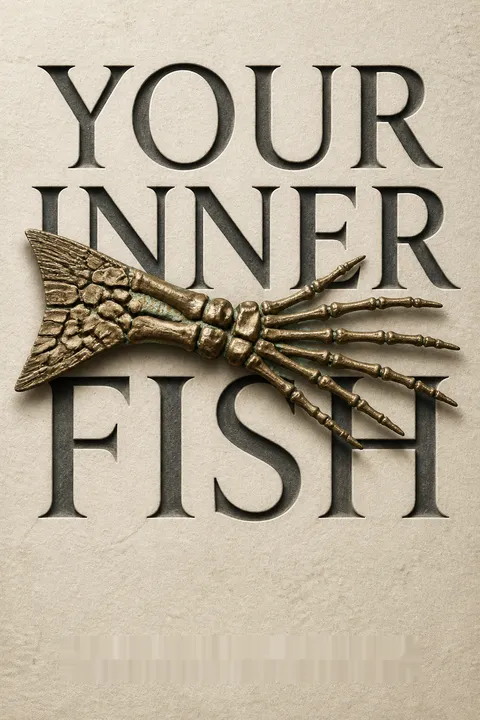
A discovery in Arctic rock. In 2004, after years of searching on Ellesmere Island, Neil Shubin’s team uncovered Tiktaalik, a 375-million-year-old fish with a flat head, a neck, scales, and fins containing bones like an upper arm, forearm, and wrist. It combined features associated with fish and early land animals, just where geological evidence predicted such an intermediate might appear.
History inside anatomy. Tiktaalik was not presented as the direct ancestor of humans. It shows that parts of our bodies have a much older history than their present uses suggest. The book follows that history through fossils, living animals, embryos, and genes, arguing that human anatomy is a record of structures repeatedly modified across deep time.
The fossil is powerful not because it resembles a person, but because its mix of traits makes a testable prediction visible. That distinction matters: evolutionary history is not a ladder with humans at its summit, but a branching record of related forms. Reading the body historically also changes the meaning of anatomical oddities. A seemingly awkward structure may be less a design failure than the inherited solution to an older problem, adapted for a new one.
Predict fossil sites by matching rock age, formation, and exposure.
A practical search image. Fossil hunters look for three conditions: rocks from the right period, sedimentary deposits likely to preserve remains, and exposed surfaces where fossils can be spotted. For the fish-to-land transition, the team targeted Devonian rocks formed in ancient streams. Volcanic and heavily altered rocks were poor bets because their heat or pressure destroys fossil evidence.
Planning meets accident. Early work in Pennsylvania roadcuts yielded Hynerpeton, but only fragmentary remains. A geological map in a textbook pointed the team toward exposed Devonian stream deposits in the Canadian Arctic. Four expeditions later, a student’s chance discovery of fossil fragments led to the rich site that produced Tiktaalik. Luck mattered, but preparation made the find legible.
This is a compact account of how scientific discovery combines theory and attention. A prediction narrows the search, while field observation can overturn assumptions about where evidence lies. The same logic appears in fields that search large spaces, from astronomy to medicine: models guide attention, but the unexpected observation is not noise to be discarded. It is also a reminder that a failed expedition can improve the next search if its failure is diagnostic.
Your wrist began in a fish fin built for bracing, not walking.
A limb assembled over time. The basic pattern of one large bone, two smaller bones, wrist-like elements, and digits did not appear all at once. Devonian fish such as Eusthenopteron had bones comparable to the upper arm and forearm. Tiktaalik had a wrist-like joint inside a webbed fin. Acanthostega, an early limbed animal, had full digits, though its flipper-shaped limbs suggest they could help in water rather than support ordinary walking.
What the joints reveal. Tiktaalik’s shoulder, elbow, and wrist could bend in ways that let it brace against the ground. Its broad head, eyes on top, and strong ribs fit life in shallow streams and muddy margins. These bones were not yet a human hand. Later evolution reshaped inherited parts for new tasks, including walking and grasping.
The distinction between having a structure and using it as humans do is essential. A wrist-like joint does not mean Tiktaalik was practicing a primitive push-up routine on its way to becoming human. It means a useful mechanical possibility existed before land walking became the defining use. This is a broader evolutionary pattern: new abilities often emerge through changes in the arrangement, proportions, and coordination of existing parts, rather than through an entirely new anatomical invention.
Evolution often changes ancient genetic switches instead of inventing new genes.
The same toolkit, reused. A developing hand is shaped by genes switching on and off in particular cells and at particular times. In chickens, a small limb-bud region called the zone of polarizing activity, or ZPA, helps distinguish the thumb side from the little-finger side. The gene Sonic hedgehog is active in this region. Altering its activity can duplicate the digit pattern.
A cross-species test. Randy Dahn studied skate embryos, whose fins look very different from hands. The same gene was active in the corresponding fin region. Vitamin A treatment produced a duplicated pattern, and Sonic hedgehog protein from a mouse changed the shape of skeletal rods in a skate fin. The result suggests that major evolutionary changes can come from deploying old genetic machinery in new settings.
This finding gives evolution a useful kind of economy: shared developmental tools can generate strikingly different structures when their timing, location, or intensity changes. The skate experiment is especially persuasive because it manipulates the system rather than relying only on resemblance. At the same time, a shared gene does not make a fin and a hand equivalent. The gene is one component in a larger developmental network, and outcomes depend on how the surrounding system interprets its signal.
Teeth began as tools for eating, then helped build armor and mammal chewing.
Hard parts have a history. Conodonts, once known only as tiny fossils, were eventually found in the mouths of ancient jawless fish. They were teeth, even though their owners lacked hard bones. This evidence suggests that hydroxyapatite-based hard tissues first served feeding, not simply protection. Later, early fish called ostracoderms developed bony head shields whose microscopic structure resembled fused tooth-like tissues.
A mammal mouth takes shape. Fossils from roughly 225 to 195 million years ago record changes from reptile-like jaws with many bones and continual tooth replacement to mammalian jaws with precise tooth contact and limited replacement. Tritheledonts show an early stage of this chewing arrangement. Later mammals developed different teeth for cutting, puncturing, and grinding, supporting a wider range of foods.
Teeth demonstrate how a feature’s first function need not determine its eventual role. A material associated with feeding could be incorporated into protective structures, while changing tooth shapes and fit could expand dietary options. Fossils also correct a common bias in reconstruction: durable parts are overrepresented, so teeth can reveal an animal’s habits when the rest of its body is missing. Their abundance is informative, but it can also make the fossil record look more complete than it is.
Use embryonic gill arches to decode the adult human head.
A hidden developmental map. Early human embryos form four pairs of swellings called gill arches. In fish, related structures support the gills. In humans, cells within the arches form parts of the jaws, middle ear, throat, muscles, blood vessels, and nerves. The trigeminal nerve supplies structures associated with the first arch; the facial nerve serves many structures from the second.
A jaw becomes an ear. Fossils and embryology show two striking transformations. A fish bone that supported the upper jaw became the small stapes bone involved in hearing as vertebrates moved onto land. Later, two bones at the back of reptile jaws became the mammalian malleus and incus. These changes helped produce the three-boned mammalian middle ear, which supports more precise hearing.
Embryology makes adult anatomy easier to understand because it preserves relationships that growth later disguises. The arch map explains why nerves can take routes that look needlessly tangled: they supply structures with a shared developmental origin. The jaw-to-ear transitions also show that evolution can alter not only a part’s shape, but its place in the body and its job. Similarity of origin is strong evidence of relationship, though it does not imply that every embryonic feature is a literal replay of an ancestor.
Compare embryos to uncover the shared rules behind radically different bodies.
Common beginnings, different outcomes. Human, fish, bird, and amphibian embryos pass through stages with striking similarities. Their organs arise from three germ layers: ectoderm, mesoderm, and endoderm. These layers form broadly corresponding tissues across vertebrates. Shared early structures appear before many species-specific features, such as feathers, shells, or enlarged brains.
Genes organize the body. Hox genes help specify regions along the front-to-back axis. In the 1920s, Hilde Mangold and Hans Spemann showed that a small embryonic region, called the Organizer, can direct surrounding tissue to form a body axis. Later work connected this effect to interacting genes and signals. The lesson is not that embryos pass through adult fish or reptile stages, but that related species build different bodies using inherited developmental systems.
The strongest comparison is between embryos at corresponding stages, not between a human embryo and an adult fish. That methodological choice avoids turning resemblance into a simplistic evolutionary pageant. Development also shows why genes are not blueprints that specify each finished part independently. Their effects depend on interactions among cells, signals, and timing. This makes biological form both constrained and flexible: inherited processes limit the available routes, while changes in their operation can produce substantial novelty.
Bodies arose when cells learned to cooperate, attach, and communicate.
An individual is more than a cluster. A body depends on cells sticking together, exchanging signals, and dividing work among specialized parts. Sponges illustrate these capacities: their cells perform different roles, and separated cells can reassemble into an organized sponge. Placozoans, simple animals with only a few cell types, also show a basic division of labor.
The tools came first. Single-celled choanoflagellates, close relatives of animals, possess versions of molecules involved in cell adhesion, communication, and the material between animal cells. One possible explanation is that microbes used these tools in other contexts before multicellular bodies arose. A laboratory experiment found that algae exposed to predators formed stable groups of eight cells. The book proposes that ecological pressure and rising oxygen helped make bodies viable, though the precise origin remains a complex question.
The important conceptual shift is from asking how cells multiplied to asking how they became an integrated individual. Cooperation creates new capabilities, but it also creates vulnerability: a cell that stops following shared rules can damage the whole organism. The predator experiment makes one possible route to multicellularity experimentally imaginable, not a complete reconstruction of ancient history. The account appropriately combines inherited molecular capacity with environmental opportunity, while the exact sequence of conditions remains uncertain.
Your senses carry both ancient tools and genetic leftovers.
Old genes, new perceptions. The light-sensitive molecule opsin appears across animals, and the eye-building gene Pax 6 is shared by flies, mice, and humans. In experiments, activating the mouse version in a fly could trigger development of a fly eye. These shared tools do not make all eyes identical; they show that different eye designs draw on ancient molecular components.
Smell records changing priorities. Olfactory receptor genes make up about 3 percent of the human genome, yet roughly 300 human copies no longer function. Comparisons across animals link many such genes to earlier mammalian smell systems. The book also describes a primate shift toward stronger color vision alongside losses in some smell genes. Genes can therefore preserve evidence of old capacities even when a lineage no longer relies on them.
Sensory evolution is a vivid case of biological reuse at several scales: molecules, cells, organs, and whole behavioral priorities. A gene shared across species is not an eye in miniature; it is a component whose effect depends on a broader network. Likewise, nonfunctional genes are historical clues, not necessarily evidence of a simple one-for-one trade between senses. The deeper point is that genomes contain both active instructions and remnants, so present-day function alone cannot explain every sequence we inherit.
Trace shared traits to test ancestry, and inherited history to explain bodily costs.
Build family trees from evidence. Descent with modification means that descendants inherit features while acquiring changes. Shared traits form nested groups: humans and polar bears share mammalian features that turtles lack, while all share deeper traits with fish. Fossils, anatomy, development, and DNA can test whether these groupings agree. Tiktaalik is a close relative of the transition, not a claim to have found the exact human ancestor.
History leaves trade-offs. Human knees, the route of nerves from the brain stem, and the descent of male testes reflect bodies modified from earlier forms. Shubin connects such inherited arrangements to injury, hiccups, hernias, choking, and other vulnerabilities. A body is not engineered from scratch for a modern lifestyle. Its strengths and weaknesses reflect changes layered onto an older structure.
The book’s evidence is most compelling when several independent records converge: fossils establish timing, anatomy shows structural correspondences, and genes and embryos reveal shared developmental machinery. That convergence makes ancestry a testable explanation rather than a story built from resemblance alone. The medical perspective adds a useful caution against treating every discomfort as an evolutionary adaptation. Some traits are compromises, some are incidental inheritances, and some harms arise from modern environments interacting with bodies shaped under very different conditions.
Analysis
The book’s central achievement is methodological as much as evolutionary. It teaches readers to move between scales of evidence: a fossil in a cliff, a bone’s joint surface, a pattern of embryonic development, and the activity of a gene. Each scale answers a different question. Fossils reveal when and where forms existed; comparative anatomy identifies structural correspondences; embryos show how adult parts arise; genetics exposes shared developmental machinery. Their agreement makes the case for common ancestry far stronger than any single resemblance could.
The narrative of finding Tiktaalik gives this method a memorable human shape. A prediction about age, sediment, and exposure directs the search, but discovery still depends on patient fieldwork, collaboration, and noticing what does not fit. That balance avoids portraying science either as pure deduction or as lucky accident. Chance matters, but preparation determines whether a chance observation becomes evidence.
The book’s most generative idea is reuse. A jaw support can become part of an ear; a fin’s internal skeleton can contribute to a limb; developmental genes can participate in building dramatically different organs. This explains both biological novelty and anatomical constraint. Evolution can create new functions without designing from a blank page, but inherited structure can leave awkward routes and vulnerabilities. The body is therefore neither a perfect machine nor a random assortment. It is a workable historical construction.
Some of the broadest causal claims, especially about why bodies arose when they did, are necessarily more tentative than the fossil and genetic comparisons. The proposed combination of predation, existing cellular tools, and rising oxygen is an explanatory hypothesis, not a single witnessed event. That distinction strengthens rather than weakens the book: it models how science can build plausible accounts while marking where evidence is incomplete. The lasting invitation is to treat the human body as evidence of relationship, change, and contingency, not as a self-contained object.
Review Summary
Your Inner Fish explores human evolution through comparative anatomy and genetics. Readers praise Shubin's engaging writing style and clear explanations of complex scientific concepts. The book traces the development of human body parts from fish and other ancestors, offering fascinating insights into our evolutionary history. Many reviewers found it eye-opening and accessible to non-scientists. Some criticize the lack of depth in certain areas, while others appreciate its broad overview. Overall, it's widely recommended for those interested in evolution and the human body.
People Also Read

Glossary
Tiktaalik
Transitional Devonian fishA fossil fish discovered in 375-million-year-old Arctic stream deposits. It combined fish features, including scales and fins, with traits also seen in early land vertebrates, including a flat head, a neck, and limb-like bones within its fins. Its anatomy helps document the evolutionary transition toward limbed animals, though it is not claimed to be the direct ancestor of humans.
zone of polarizing activity (ZPA)
Digit-patterning limb tissueA small region of developing limb tissue that helps establish differences between the two sides of a limb, including the thumb side and little-finger side. Experiments showed that moving this tissue or altering signals associated with it can duplicate digit patterns. The ZPA provides a way to study how developmental signals organize the bones of hands, feet, and other limbs.
Sonic hedgehog
Developmental signaling geneA gene that produces a signaling protein involved in shaping developing limbs and other body structures. In limb buds, it is active in the ZPA and helps pattern digits according to the signal’s location and strength. Related activity in chicken limbs and skate fins indicates that ancient genetic mechanisms can be used in different appendages.
Hox genes
Body-region patterning genesA family of genes that helps specify the identities of regions along an animal’s front-to-back body axis. In many animals, the order of these genes along DNA corresponds broadly to the order of the body regions in which they are active. Changes in Hox activity can alter the development of segments and organs.
Organizer
Embryonic body-axis organizerA region of early embryonic tissue identified through Hilde Mangold and Hans Spemann’s transplantation experiments. When moved to another location, it could direct surrounding cells to form an additional body axis and associated structures. The Organizer is not one molecule acting alone; its effects involve interacting genes and signals.
descent with modification
Inheritance plus changeThe principle that living things inherit biological information from predecessors while accumulating changes across generations. Shared inherited traits can be used to infer relatedness and construct family trees of species. The framework is tested by comparing many kinds of evidence, including fossils, anatomy, embryology, and DNA.
thrifty genotype hypothesis
Energy-storage adaptation hypothesisJames Neel’s proposal that ancestors facing cycles of plentiful food and scarcity benefited from storing energy during periods of abundance. In modern settings with constant access to calorie-rich food and less physical activity, those inherited tendencies may contribute to obesity and related health problems. The book presents it as one explanation for a mismatch between ancestral conditions and present lifestyles.
FAQ
What's "Your Inner Fish" about?
- Exploration of Human Anatomy: "Your Inner Fish" by Neil Shubin explores the evolutionary history of the human body, tracing its origins back 3.5 billion years.
- Connection to Other Species: The book reveals how our anatomy is connected to that of fish, worms, and other ancient creatures, showing the shared evolutionary paths.
- Scientific Discoveries: It discusses significant paleontological and genetic discoveries that illuminate the development of human anatomy.
- Educational Journey: The narrative takes readers on a journey through various scientific fields, including paleontology, genetics, and embryology, to understand human evolution.
Why should I read "Your Inner Fish"?
- Understanding Evolution: The book provides a comprehensive understanding of how human anatomy evolved over billions of years.
- Interdisciplinary Approach: It combines insights from paleontology, genetics, and embryology, offering a holistic view of human evolution.
- Engaging Narrative: Neil Shubin uses engaging storytelling to make complex scientific concepts accessible and interesting.
- Relevance to Modern Science: The book highlights how evolutionary biology is crucial for understanding modern human health and disease.
What are the key takeaways of "Your Inner Fish"?
- Evolutionary Connections: Humans share a deep evolutionary history with fish and other ancient organisms, which is evident in our anatomy.
- Genetic Insights: The book explains how genes that control development in humans are similar to those in other species, revealing our shared ancestry.
- Fossil Discoveries: Significant fossil finds, like Tiktaalik, provide evidence of the transition from aquatic to terrestrial life.
- Human Anatomy Origins: Many features of human anatomy, such as limbs and sensory organs, have origins that can be traced back to ancient species.
How does Neil Shubin explain the connection between humans and fish?
- Fossil Evidence: Shubin discusses the discovery of Tiktaalik, a fossil that shows the transition from fish to land-dwelling animals, highlighting shared anatomical features.
- Genetic Similarities: The book explains how genes responsible for limb development in humans are similar to those in fish, indicating a common evolutionary origin.
- Embryological Development: Shubin describes how the development of human embryos mirrors the evolutionary history shared with fish.
- Anatomical Comparisons: The book compares human anatomy with that of fish, showing how certain structures have evolved over time.
What is the significance of Tiktaalik in "Your Inner Fish"?
- Transitional Fossil: Tiktaalik is a key fossil that represents the transition from aquatic to terrestrial life, bridging the gap between fish and early land animals.
- Anatomical Features: It possesses features of both fish and tetrapods, such as fins with bones similar to limbs, providing insight into the evolution of limbs.
- Evolutionary Milestone: The discovery of Tiktaalik supports the theory of evolution by demonstrating a clear evolutionary link between fish and land animals.
- Research Impact: Tiktaalik has become a cornerstone in the study of vertebrate evolution, influencing how scientists understand the development of limbs and other structures.
How does "Your Inner Fish" address the evolution of human senses?
- Olfactory Genes: The book discusses the evolution of olfactory genes, showing how humans have a reduced sense of smell compared to other mammals due to evolutionary trade-offs.
- Vision Development: Shubin explains the development of the human eye, tracing its origins back to primitive light-sensitive cells in ancient organisms.
- Hearing Mechanisms: The evolution of the ear is explored, highlighting how structures in the human ear have evolved from those in fish and other ancestors.
- Genetic Evidence: The book uses genetic evidence to show how sensory organs have evolved over time, adapting to different environmental needs.
What role do genes play in the narrative of "Your Inner Fish"?
- Developmental Genes: The book highlights the role of genes like Sonic hedgehog in the development of limbs and other body parts, showing genetic continuity across species.
- Evolutionary Insights: Genetic research provides insights into how complex structures like eyes and ears evolved from simpler forms.
- Shared Genetic Heritage: Shubin emphasizes the shared genetic heritage between humans and other species, illustrating the concept of descent with modification.
- Genetic Mutations: The book discusses how genetic mutations can lead to evolutionary changes, contributing to the diversity of life forms.
How does Neil Shubin use paleontology to explain human evolution?
- Fossil Discoveries: Shubin uses fossil discoveries, such as Tiktaalik, to provide concrete evidence of evolutionary transitions.
- Field Expeditions: The book describes field expeditions and the process of finding fossils, offering a behind-the-scenes look at paleontological research.
- Historical Context: Fossils are placed in a historical context, showing how they fit into the broader narrative of life's evolution on Earth.
- Anatomical Comparisons: Fossils are compared with modern species to highlight evolutionary changes and adaptations over time.
What are the best quotes from "Your Inner Fish" and what do they mean?
- "Seeing Lucy, we can understand our history as highly advanced primates. Seeing Tiktaalik is seeing our history as fish." This quote emphasizes the importance of fossils in understanding human evolution, highlighting the connection between ancient and modern species.
- "Our world is so highly ordered that we can use a walk through a zoo to predict the kinds of fossils that lie in the different layers of rocks around the world." Shubin illustrates the predictability of evolutionary patterns, showing how living species can inform our understanding of the fossil record.
- "The record of those events remains inside us, as part of our anatomical organization." This quote underscores the idea that human anatomy is a living record of evolutionary history, with each part of our body reflecting past adaptations.
How does "Your Inner Fish" explain the concept of descent with modification?
- Family Tree Analogy: Shubin uses the analogy of a family tree to explain how species are related through descent with modification, with each branch representing evolutionary changes.
- Shared Traits: The book discusses how shared traits among species indicate common ancestry, supporting the concept of descent with modification.
- Evolutionary Evidence: Fossil and genetic evidence are used to trace the lineage of species, showing how modifications accumulate over time.
- Predictive Power: Descent with modification allows scientists to make predictions about evolutionary relationships and the characteristics of ancestral species.
What is the significance of embryology in "Your Inner Fish"?
- Developmental Stages: Shubin explains how embryonic development stages reflect evolutionary history, with early stages showing similarities across species.
- Gill Arches: The book discusses the role of gill arches in embryonic development, highlighting their transformation into various structures in different species.
- Embryonic Evidence: Embryology provides evidence for common ancestry, as similar developmental processes are observed in diverse species.
- Evolutionary Insights: Studying embryos helps scientists understand how complex structures evolved, offering insights into the mechanisms of evolution.
How does "Your Inner Fish" relate to modern human health?
- Evolutionary Medicine: The book discusses how understanding evolutionary history can inform medical research and treatment, particularly in areas like genetics and developmental biology.
- Anatomical Vulnerabilities: Shubin highlights how certain human health issues, such as back pain and hernias, are linked to our evolutionary past and anatomical adaptations.
- Genetic Disorders: The book explores how genetic disorders can be traced back to evolutionary changes, providing a framework for understanding and addressing these conditions.
- Holistic Perspective: By integrating evolutionary biology with medicine, "Your Inner Fish" offers a holistic perspective on human health, emphasizing the importance of understanding our evolutionary roots.
About the Author
Other books by Neil Shubin
Download PDF
Download EPUB
.epub digital book format is ideal for reading ebooks on phones, tablets, and e-readers.








