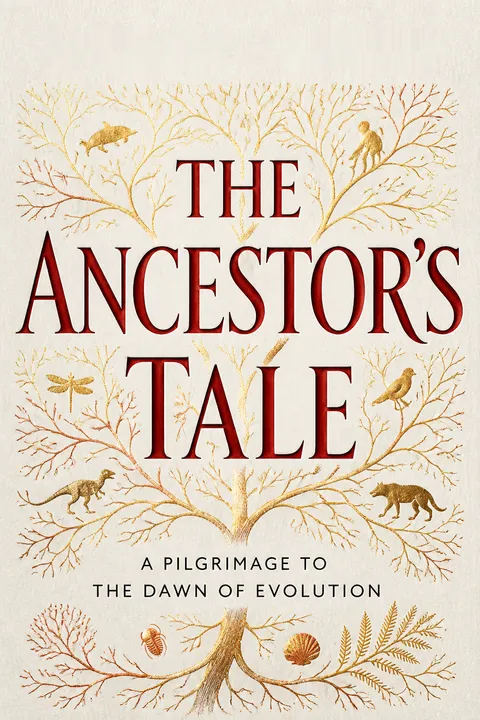


Key Takeaways
Use humanity as a starting point, never as evolution's destination.
The journey runs backward. Dawkins begins with modern humans, then imagines other species joining the pilgrimage as their lineages meet ours. Each meeting point is a rendezvous; the shared ancestor at that point is a Concestor. The route is human-centered only because humans are curious about their own ancestry, not because evolution aimed toward us. In forward time, the story is branching diversity. In reverse, every lineage converges on a shared ancestor, ultimately linking animals, plants, fungi, and bacteria.
One family of life. The strongest evidence is molecular: known organisms share essentially the same genetic code, whose detailed complexity is unlikely to have originated independently. The common ancestor of all surviving life lived billions of years ago, though it was not necessarily the first living thing.
The backward structure turns a familiar storytelling bias into a useful method. Historical accounts often make the present seem inevitable because they select only the events that led here. Starting from humans makes the narrative engaging, while the repeated meetings expose how arbitrary that starting point is. The same discipline is useful in history and policy: distinguish a path that happened from a path that had to happen. The book's image of universal kinship is powerful, but it does not imply equal evolutionary histories or equal ecological roles.
Reconstruct ancestry with fossils, genes, and living cousins together.
Three kinds of evidence. Fossils are hard relics, preserved unevenly because sediment forms only under particular conditions. DNA is a renewed relic: its molecules decay, but living descendants keep copying much of the information. Comparison among living species provides a third tool, called triangulation, which infers an ancestor from traits shared by its descendants. Each method can support the others, and none needs to carry the entire argument alone.
A clock with caveats. A molecular clock estimates separation times by comparing accumulated genetic differences, then calibrating the estimate against fossils with known dates. Different genes change at different speeds, and some lineages evolve faster than others. The method is powerful, especially where fossils are scarce, but it is not a literal stopwatch.
This is a model of historical inference: use independent traces that fail in different ways. A fossil can be misdated or absent; a genetic sequence can be misread or evolve at an unexpected rate; anatomical similarity can be convergent. Agreement across methods is therefore more persuasive than a single striking specimen. The same logic appears in forensic science and climate reconstruction. The caution is important: a molecular clock inherits uncertainty from its fossil calibration and its assumptions about evolutionary rates, so precision in a date should not be mistaken for certainty.
Human family trees converge sooner than intuition expects, but models are not dates.
A mathematical surprise. Joseph Chang modeled a closed population of 5,000 Tasmanians, assuming random mating and constant population size. In that simplified world, the most recent common ancestor of everyone alive appears after about 12 generations. Roughly 22 generations back, about 80 percent of people in that generation would be ancestors of everyone alive. Dawkins calls these reference points Chang One and Chang Two.
Reality is messier. Real populations do not mate randomly. Geography, migration, population growth, and isolation all change the result. Tasmania's long isolation also sets a firm lower bound on any ancestor shared with the rest of humanity. The book therefore suggests that all living humans probably share a genealogical ancestor from tens of thousands, perhaps low hundreds of thousands, of years ago, not a date calculated directly from the toy model.
The model's value is not that it dates a real ancestor. It reveals how quickly family trees overlap when populations exchange partners, even occasionally. This is a useful distinction between a mathematical baseline and an empirical estimate, a distinction often blurred in public discussion of ancestry. The result also unsettles the intuition that distant populations must have wholly separate family histories. However, the random-mating assumption is decisive, not cosmetic. Migration barriers and social boundaries can stretch convergence dramatically, so the model should provoke better questions rather than supply a headline date.
Track genes separately: Mitochondrial Eve was neither first woman nor lone mother.
Different ancestral paths. A person has many genealogical ancestors, but each particular gene traces one path through that larger family tree. The coalescent is the history of gene lineages joining at shared ancestral copies. Mitochondrial DNA passes through mothers, while the Y chromosome passes through fathers, so their most recent common ancestors are only two among many possible genetic ancestors.
Not a founding couple. The book's estimates put Mitochondrial Eve around 140,000 years ago and Y chromosome Adam around 60,000 years ago. They need not have lived together, been the only people alive, or been ancestors of every gene in modern humans. Their titles can shift as lineages disappear. A Neanderthal could also be a genealogical ancestor of modern people without contributing genes that survive today.
This distinction is essential whenever genetic evidence is used to tell a story about identity. A single inherited marker is a narrow historical thread, not a complete biography of a person or population. The same limitation applies to surnames, maternal ancestry tests, and any account built from one lineage. The book's emphasis on multiple gene histories usefully counters genetic essentialism. Its specific estimates and Neanderthal conclusions reflect the evidence available in 2004, however, and should be read as time-stamped scientific claims rather than timeless definitions.
Evolution has no ladder, yet nature repeatedly invents similar solutions.
No species is unfinished. Evolution has no designated destination, and a fossil is not an early draft of humanity. A Devonian fish was making its living in its own environment, not striving to become an amphibian. Calling one species more evolved than another confuses a branching history with a ladder.
Similar problems, repeated answers. Natural selection can independently produce comparable forms. South American and Australian mammals evolved gliders resembling flying squirrels; howler monkeys independently acquired trichromatic vision, as did apes and Old World monkeys. Flightlessness evolved repeatedly on islands, where wings became costly and unnecessary. Such convergence reflects recurring environmental problems and limited workable solutions, not nature's intention to reach a preferred design.
Convergence is more than a colorful curiosity. It lets biologists test explanations: if similar environments repeatedly produce similar traits, selection is a stronger candidate than shared ancestry alone. But resemblance does not prove identical causes. The same outward form can arise through different genetic routes, and historical accidents still matter. This balance avoids two extremes: treating evolution as a ladder toward humans, and treating it as unconstrained randomness. The useful question is not whether evolution has a destination, but which recurring pressures make certain outcomes more likely than others.
Find barriers that let isolated populations become evolutionary experiments.
Isolation opens possibilities. Speciation often begins when geography restricts gene flow between populations. Lake reefs can function as islands for fish, even though the fish could physically swim between them. Lake Victoria's cichlids diversified into roughly 450 species in a young lake, with differences in diet and other traits. Changes in lake levels may have repeatedly separated populations, giving them room to diverge.
Selection can reverse. On the Galapagos island of Daphne Major, a 1977 drought disproportionately killed smaller medium ground finches. Average beak length rose from 10.68 to 11.07 millimeters, because larger birds handled the remaining tough seeds better. When food conditions changed, selection favored smaller birds. An adaptive radiation is the diversification of descendants into different ecological roles; neither its speed nor direction is guaranteed.
The island metaphor is valuable because it shifts attention from species labels to actual barriers to reproduction. A reef, a mountain range, a language boundary, or a drying lake can all restrict gene flow in different ways. The finches add an important corrective: selection does not push steadily toward one optimum when conditions fluctuate. Yet geographic isolation is not the only route to new species, and not every isolated population diverges. The framework is strongest as a way to identify conditions that permit separation, not as a universal recipe.
A body is not a blueprint; developmental switches reuse old genetic tools.
Genes act through programs. DNA does not map one gene onto one body part like labels on a blueprint. Development depends on when and where genes are switched on, and on interactions among cells. The same basic genetic toolkit can therefore build very different bodies through different sequences of activity.
Position matters. Hox genes help cells identify their location along an animal's body. In fruit flies, a mutation can make a leg develop where an antenna normally grows. Related developmental genes occur in other animals, where they help organize body structures. Gene duplication can also create extra copies that later diverge in function. Evolution can thus build novelty by changing the deployment of inherited tools, not only by inventing entirely new genes.
This developmental perspective explains why large anatomical differences do not require entirely different genetic inventories. It also clarifies how small changes in regulation can have large consequences when they alter a developmental sequence. That is a central insight of evolutionary developmental biology. Still, a switch is not an explanation by itself: mutations must produce viable outcomes, and selection or drift determines whether they spread. Development constrains the routes available to evolution, but it does not replace the population-level processes that shape which routes persist.
Count ecological partners as part of an organism's evolutionary machinery.
Effects can extend outward. The extended phenotype is an effect of genes that reaches beyond the body carrying them. Beaver genes influence building behavior; dams create lakes that become part of the beaver's working environment. The lake is not made of beaver cells, but differences in beaver genes can help produce differences in dams and lakes.
Partnerships reshape life. Leaf-cutter ants cultivate fungi for food, while termites also maintain fungus gardens. In animal and plant cells, mitochondria and chloroplasts descend from bacteria that became indispensable partners. These examples show that survival often depends on structures or organisms outside an individual's skin. They do not make every ecosystem a single organism, but they reveal how evolution can build durable dependencies between previously independent lives.
The extended-phenotype idea is a powerful way to connect behavior, ecology, and evolution without pretending that genes act directly on distant objects. A causal chain links inherited variation to behavior, then to a dam, then to a changed habitat. This resembles niche construction: organisms alter the conditions under which selection operates. The boundary still matters. A beaver lake is not literally part of a beaver's body, and ecological communities need not share a unified interest. The framework is most useful when it makes causal links testable.
Cultural change can redirect genes before people notice evolution.
Farming changed selection. Agriculture began about 10,000 years ago in several regions, shifting many people from hunting and gathering to settled food production. It supported larger populations, but not necessarily better health or happiness; denser populations also made infectious disease easier to spread. Human activity transformed landscapes and contributed to extinctions.
Culture can alter biology. Domestication often began gradually, without deliberate breeding plans. In a Russian experiment, silver foxes bred for tameness changed behavior and appearance within 20 years. In humans, adult lactose tolerance became common in some pastoral populations, where milk provided a continuing food source. Cultural practices changed the selection pressures, and natural selection changed gene frequencies in response.
This is a clear case of gene-culture coevolution: inherited biology influences cultural practice, while cultural practice alters which inherited traits are advantageous. Farming is therefore neither a simple triumph nor a simple mistake. It expanded food production and population size while changing disease exposure, labor, and other species' habitats. The fox experiment also shows that selection can produce correlated traits, not just the trait explicitly targeted. The caution is to avoid reading modern preferences backward as the purpose of ancient domestication.
Separate cultural leaps from anatomical change, and keep origin stories provisional.
The record changes unevenly. Around 40,000 years ago, archaeology shows a striking rise in art, ornaments, carvings, and musical instruments, although the people involved were anatomically much like humans today. Whether this marks a sudden cognitive leap, a new use of language, or a change in what survives archaeologically remains uncertain.
Human traits invite competing explanations. Bipedalism appeared before the major expansion of the human brain. Proposed explanations include carrying food, feeding while squatting, and sexual selection. Sexual selection has also been proposed for brain expansion and loss of body hair. These are hypotheses, not settled answers. Fossils establish some sequences more firmly than they establish the selective pressures behind them.
The distinction between anatomical and cultural evidence is especially important because archaeological visibility can change abruptly even when biology does not. A sudden increase in surviving artifacts need not mean that language or consciousness appeared overnight. The book is strongest when it treats explanations as competing hypotheses rather than a single heroic story of human ascent. Sexual selection is a plausible source of rapid, arbitrary change, but it can become a catch-all if researchers cannot identify the relevant preferences, traits, and reproductive consequences.
A missing fossil is a gap in evidence, not a missing ancestor.
The record is incomplete by nature. Fossils usually form in sedimentary deposits, which are created intermittently and later destroyed or buried. Even an enormous fossil collection cannot preserve every species or every transitional population. The Cambrian record appears to show many animal groups arriving in a geological burst, but the book presents competing explanations: earlier lineages may not have fossilized, or diversification may have accelerated near the boundary.
Dates need cross-checks. Radiometric methods date rocks through predictable radioactive decay; molecular clocks estimate divergence from genetic differences calibrated against fossils. Both transformed evolutionary history, but deep dates remain uncertain when fossils are sparse and molecular rates vary. The evidence supports common ancestry without requiring every branch point to be visible or precisely dated.
Historical science often works from traces rather than direct observation, so a missing trace is not equivalent to evidence that an event never happened. The strongest account combines fossils, molecular comparisons, and geological context, while keeping confidence proportional to the evidence. The Cambrian debate also warns against false precision: a rapid appearance in rocks may reflect preservation as well as biological change. Conversely, incomplete fossils do not justify imagining that every gap hides a dramatic leap. Uncertainty narrows claims; it does not erase the underlying evidence for evolution.
Analysis
The book's most effective choice is structural: it starts with humans, then walks backward so that human ancestry becomes one route through a branching history rather than evolution's destination. That form quietly disciplines the reader's intuitions. The successive arrivals of chimpanzees, other mammals, fish, invertebrates, and microbes convert kinship from an abstract claim into a repeated encounter. The device also makes a subtle point about historical explanation: a narrative can have a human viewpoint without making humanity its causal purpose.
Its deepest conceptual contribution is the separation of species histories from gene histories. Family trees of organisms are useful summaries, but particular genes can have different genealogies, and individual organisms may be ancestors without contributing surviving genes. This is a powerful antidote to genetic essentialism. The book also excels at showing how similar solutions can arise independently, while refusing to confuse convergence with destiny. Its examples, from cichlid diversification to the bacterial machinery inside complex cells, make evolutionary theory feel less like a ladder and more like a set of interacting histories.
The main limitation is uneven certainty. The local mechanisms of selection, developmental regulation, and endosymbiosis are presented alongside highly speculative accounts of human origins and very deep dates. In a 2004 book, some claims about human migration and Neanderthal ancestry were necessarily based on narrower evidence than is available to researchers today. The narrative is most trustworthy when it signals that difference: robust shared ancestry, provisional branching order, and much weaker confidence about the exact conditions at life's beginning. Its lasting lesson is not that every puzzle is solved, but that uncertainty can be mapped, tested, and reduced without surrendering the central explanatory power of evolution.
Review Summary
The Ancestor's Tale is a fascinating journey through evolutionary history, tracing life back to its origins. Readers praise Dawkins' clear explanations, engaging writing style, and the book's comprehensive scope. Many find it awe-inspiring and mind-expanding, appreciating how it connects all life forms. While some note its length and complexity, most consider it worthwhile. Critics highlight occasional digressions and outdated information. Overall, reviewers recommend it as an excellent exploration of evolution, accessible to both science enthusiasts and general readers.
People Also Read

Glossary
Concestor
Shared ancestral speciesA term used for the most recent common ancestor shared by the lineages that meet at a particular point in the backward pilgrimage. Concestor numbers correspond to rendezvous numbers. A concestor is generally an inferred ancestral population or type, not a particular fossil specimen known to be a direct ancestor.
Rendezvous
Meeting of ancestral lineagesA milestone in the book's backward journey through evolutionary history. At each rendezvous, the human lineage meets another group of living organisms at a shared ancestor, and the pilgrim company grows. The metaphor organizes the narrative; it does not imply that separate species literally travelled together through time.
Coalescent
Gene lineages joining backwardThe backward tracing of gene copies to their shared ancestral copy. Unlike a family tree of people, a gene has one parent copy, so each gene follows one path through a much larger network of genealogical ancestors. Coalescent patterns help reconstruct population history, migration, and relationships among genetic lineages.
Molecular clock
Genetic differences estimate timeA method for estimating when lineages separated by comparing accumulated differences in DNA or proteins. The estimate is calibrated using fossils or other dated events. It is not a perfectly regular clock: mutation rates vary among genes and lineages, so results depend on calibration, sampling, and statistical assumptions.
Encephalisation Quotient
Brain size relative to body sizeA comparative measure of how much larger or smaller an animal's brain is than expected for its body size, relative to a specified reference group. The result depends on the chosen group and the scaling relationship used. Fossil estimates are especially uncertain because both brain and body mass must be inferred.
Extended phenotype
Gene effects beyond the bodyThe effects of genes that extend outside the body carrying them. A beaver dam is an example: inherited differences can influence building behavior, which produces differences in dams and the lakes they create. The term treats these external consequences as evolutionary effects without claiming that the structure is literally part of the organism.
Hox genes
Genes that specify body positionA family of developmental genes that helps cells identify their position along an animal's body and influences which structures develop there. Related Hox genes occur across many animal groups. Their organization and effects help explain how changes in developmental regulation can alter body plans using inherited genetic tools.
Dollo's Law
Exact evolutionary reversal is unlikelyA principle stating that evolution does not precisely retrace an earlier pathway. It does not forbid the reappearance of broadly ancestral traits, such as a return to aquatic life. Rather, exact reversal is improbable because the many steps and genetic changes that produced a trait are unlikely to occur again in precisely the opposite order.
Adaptive radiation
Diversification into ecological rolesThe evolution of multiple descendant species from a common ancestor, with different lineages becoming adapted to different ways of life or ecological resources. The cichlid fishes of African lakes and the finches of the Galapagos are examples discussed in the book. Radiation can be rapid, but its pace and direction depend on changing conditions.
Great Historic Rendezvous
Origin of the eukaryotic cellThe book's name for the ancient incorporation of bacterial partners into the lineage that produced complex cells. Mitochondria, and in plants chloroplasts, retain evidence of bacterial ancestry. This event transformed cell organization and underlies the later evolution of animals, plants, and fungi.
FAQ
What's The Ancestor's Tale about?
- Exploration of Evolutionary History: The Ancestor's Tale by Richard Dawkins is a narrative journey through the history of life on Earth, tracing the evolutionary paths of various species back to their common ancestors.
- Backward Chronology: The book uses a backward chronology, starting from modern humans and moving back through time to the origin of life, emphasizing the unity of life and shared ancestry.
- Rendezvous Concept: Dawkins introduces "rendezvous points," significant moments in evolutionary history where different lineages diverged, illustrating the interconnectedness of all living beings.
Why should I read The Ancestor's Tale?
- Engaging Narrative Style: Dawkins employs a unique storytelling approach, likening the exploration of evolutionary history to a pilgrimage, making complex scientific concepts accessible and engaging.
- Deepens Understanding of Evolution: The book provides a comprehensive overview of evolutionary biology, making it an excellent resource for understanding how life has evolved over millions of years.
- Challenges Misconceptions: Dawkins addresses common misconceptions about evolution, such as the idea of a linear progression towards humans, emphasizing that evolution is a branching process.
What are the key takeaways of The Ancestor's Tale?
- Unity of Life: All living organisms share a common ancestor, highlighting the interconnectedness of life and the shared lineage of all organisms.
- Evolutionary Patterns: Evolution is not a straightforward path but a complex web of branching lineages, with recurring patterns that provide insights into evolutionary processes.
- Conceit of Hindsight: Dawkins warns against viewing evolution as a linear progression towards humans, arguing that evolution has no privileged line of descent.
What are the best quotes from The Ancestor's Tale and what do they mean?
- "History doesn't repeat itself, but it rhymes.": This quote underscores the idea that while historical events may not occur in the same way, they often share underlying patterns, reflecting Dawkins' view of evolution.
- "Evolution has reached many millions of interim ends.": This highlights that evolution is not a linear process leading to humans but a branching tree with many successful species, emphasizing life's diversity.
- "The conceit of hindsight tempts us at other stages in our history.": Dawkins cautions against viewing past evolutionary events as leading directly to humans, reminding us to avoid anthropocentric interpretations.
How does Richard Dawkins explain the concept of common ancestry in The Ancestor's Tale?
- Shared Genetic Code: Dawkins points out that all living organisms share the same genetic code, serving as evidence of common ancestry.
- Backward Chronology: The book's backward chronology emphasizes that no matter where you start, you will eventually converge on a common ancestor.
- Unity of Life: The concept of common ancestry reinforces the idea that all life is interconnected, highlighting the shared lineage of all organisms.
What role does DNA play in understanding evolution in The Ancestor's Tale?
- Genetic Evidence: DNA is crucial for tracing evolutionary relationships and understanding common ancestry, as all examined organisms share the same genetic code.
- Triangulation of Ancestry: DNA can be used to triangulate ancestry by comparing genetic sequences across species, allowing for plausible reconstructions of ancestors.
- Molecular Clock: Dawkins introduces the molecular clock concept, estimating the timing of evolutionary events based on genetic differences.
How does The Ancestor's Tale address the topic of extinction?
- Natural Part of Evolution: Extinction is a natural part of the evolutionary process, with many species going extinct over time, yet the evidence for evolution remains strong.
- Impact of Human Activity: Dawkins highlights the responsibility humans have for recent extinctions, emphasizing the impact of human activity on extinction rates.
- Lessons from Extinction: Studying extinct species provides valuable insights into the evolutionary process, exploring themes like adaptation and survival.
How does Richard Dawkins explain the concept of speciation in The Ancestor's Tale?
- Geographical Isolation: Geographical barriers can lead to speciation by preventing gene flow between populations, allowing them to evolve independently.
- Sympatric Speciation: Dawkins discusses sympatric speciation, where species diverge in the same area due to behavioral differences or resource specialization.
- Role of Natural Selection: Natural selection favors traits that enhance survival and reproduction, leading to the formation of new species through adaptations.
What is the significance of Madagascar in The Ancestor's Tale?
- Unique Biodiversity: Madagascar exemplifies how isolation can lead to the evolution of unique species, serving as a critical location for understanding evolutionary processes.
- Natural Experiments: The island is described as a "textbook showcase of biogeographical natural experiments," where evolutionary history can be studied in isolation.
- Convergent Evolution: Dawkins discusses how similar traits can evolve independently in different species, illustrated by Madagascar's diverse adaptations.
How does The Ancestor's Tale illustrate the concept of "adaptive radiation"?
- Rapid Speciation: Dawkins uses examples like cichlid fish to illustrate adaptive radiation, where a single ancestral species diversifies into many new species.
- Environmental Pressures: Different environmental pressures lead to the evolution of specialized traits, allowing species to exploit various ecological niches.
- Convergent Evolution: Unrelated species develop similar traits in response to similar challenges, highlighting the dynamic nature of evolution.
How does Dawkins explain the RNA World hypothesis in The Ancestor's Tale?
- RNA as a Precursor to DNA: The RNA World hypothesis posits that RNA molecules were the first self-replicating entities before DNA evolved.
- Autocatalytic Processes: RNA could catalyze its own replication, leading to the emergence of complex life forms over time.
- Experimental Evidence: Dawkins references experiments supporting the hypothesis, demonstrating RNA's ability to replicate and evolve.
What is the Great Historic Rendezvous mentioned in The Ancestor's Tale?
- Origin of Eukaryotic Cells: The Great Historic Rendezvous marks the emergence of eukaryotic cells, a significant transition in life's history.
- Merging of Prokaryotic Cells: This event involved the merging of different prokaryotic cells, leading to the development of eukaryotic cell structures.
- Implications for Evolution: The rendezvous enabled the rise of diverse and complex organisms, highlighting cooperation and symbiosis in evolutionary history.
About the Author
Other books by Richard Dawkins



Download PDF
Download EPUB
.epub digital book format is ideal for reading ebooks on phones, tablets, and e-readers.








