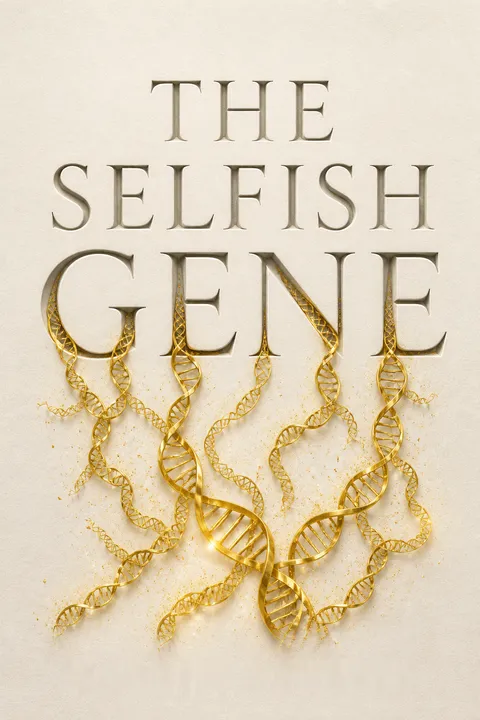


Key Takeaways
Read animal sacrifice through gene survival, not devotion to the species
Start with the effects. Dawkins defines altruistic behavior by its consequences: it raises another individual’s chances of survival while lowering the actor’s. A worker bee may die defending its colony; a bird may expose itself by sounding an alarm; a parent may risk injury to protect its young. These acts look selfless at the level of the animal, but the book asks what they do to the genes that shape them. Kinship and other conditions can make an apparently costly act advantageous to shared genes.
Keep ethics separate. The book rejects the assumption that natural selection favors behavior for the good of a species. It also does not recommend copying nature’s competitive logic. An evolutionary explanation describes how behavior can arise, not what people ought to do.
The shift in scale is powerful because it explains why visible sacrifice need not contradict natural selection. It also disciplines moral debate: an account of how a behavior evolved cannot, by itself, justify that behavior. The risk is that gene-level language can sound like a claim about conscious motive. It is not. The argument concerns inherited effects and reproductive outcomes, not secret calculations in an animal’s mind.
Track the replicator that lasts, not only the body carrying it
Begin with copying. A replicator is an entity that makes copies of itself. Dawkins imagines early molecules copying imperfectly in the ancient environment, with some variants lasting longer, reproducing faster, or copying more accurately than others. Competition among these variants provides a route from simple chemistry toward life. This origin story is presented as a plausible sketch, not a witnessed account.
Separate roles. Genes are modern replicators: DNA sequences whose copies persist across generations. Organisms are vehicles, temporary structures built under genetic influence that help replicators survive and reproduce. A body dies, while successful genetic information can pass through many bodies. Sexual reproduction reshuffles genes, but does not erase their lineage.
This distinction clarifies two different questions: what gets copied, and what does the copying. It also explains why organisms can be treated as coherent agents in everyday biology without making them the ultimate units of inheritance. The origin-of-life scenario is necessarily conjectural, but its conceptual lesson is broader than any single chemistry: copying, variation, and unequal persistence are the ingredients needed for cumulative selection.
Test a strategy against its rivals before calling it evolutionarily stable
Define the test. An evolutionarily stable strategy, or ESS, is a behavioral strategy that cannot be displaced by a rare alternative once it is common in a population. Dawkins illustrates the idea with two imagined fighters. Hawks escalate fights; doves threaten but retreat rather than risk injury. Hawks exploit doves, but a population of hawks suffers costly injuries. Neither pure strategy is secure in the example. A mixture can persist, with the balance depending on the costs and rewards of fighting.
Look beyond individuals. The point is not that animals consciously calculate pay-offs. Selection favors inherited tendencies that perform well under prevailing conditions. A strategy that seems best in isolation may fail when most rivals use it. The same logic helps explain how compatible genes can be favored within a shared body.
The ESS framework is a compact bridge between individual conflict and population patterns. Its strongest insight is conditionality: the value of a move depends on what others are doing. That same logic appears in bargaining, arms races, and market competition. Its limitation is that model results depend on the chosen pay-offs and available strategies. A clean model reveals a mechanism, but field evidence is needed to establish whether the mechanism explains a particular species.
Count shared genes before calling sacrifice selfless
Follow genetic relatives. Kin selection describes how a gene promoting help to relatives can spread when enough copies of that gene survive in the beneficiaries. Full siblings and parent-child pairs have an average relatedness of one half; first cousins have one eighth. Hamilton’s Rule expresses the condition as rB > C: the benefit to the recipient, B, multiplied by relatedness, r, must exceed the cost to the helper, C.
Reinterpret the act. A warning call that helps relatives escape a predator may benefit the caller’s genes despite putting the caller at risk. The same principle can explain care among siblings and the sterile workers of social insects. Kin selection is not a claim that animals identify exact genetic percentages, nor is it simply group selection under another name.
Relatedness turns generosity into a question about whose future is affected, rather than how noble an act appears. The framework is especially useful when it distinguishes family-level benefits from vague claims about species welfare. Its application still depends on accurate estimates of costs, benefits, and kinship. Those quantities are difficult to measure in the wild, so an elegant explanation should be treated as a testable hypothesis, not a label that ends inquiry.
See family care as bargaining over scarce parental investment
Name the investment. Parental investment is any effort or resource devoted to one offspring that improves its prospects while reducing what a parent can give elsewhere. Food, protection, and time all count. A mother may benefit from dividing these resources among the number of young she can successfully raise, rather than producing as many as possible. A runt may need more care than its expected survival justifies, while an older child may resist being weaned even when a younger sibling could use the food more.
Expect conflicting interests. Parents are related to each child, but each child is more closely related to itself than to a sibling. A child can therefore benefit by demanding more than its share, while a parent has reason to distribute resources across offspring. Cuckoos make the conflict vivid by exploiting foster parents that feed them at the expense of their own young.
The family becomes a useful case study in how cooperation can coexist with conflict. Shared genes create common interests, but they do not make those interests identical. This helps explain why care is often negotiated through signals of hunger, need, and dependence. The framework should not be mistaken for a claim that affection is unreal. It describes selection pressures that can shape caring behavior, while leaving subjective experience and social meaning as separate questions.
In mating, ask who invests more and who can leave
Start with unequal costs. In most species, eggs are larger and more resource-rich than sperm. This asymmetry can make females invest more in each offspring, while males may gain more from seeking additional mates. The balance varies: some males provide substantial parental care, and some species have very different mating systems. The book’s strategies include coy females favoring prolonged courtship and females choosing males for traits that may signal good genes.
Separate sex ratio from mating success. A few male elephant seals may father most of a population’s young, yet the stable investment in sons and daughters is generally equal. If one sex becomes rarer, parents investing in that sex can gain a reproductive advantage. Human mating patterns, Dawkins cautions, are also shaped strongly by culture, so animal comparisons do not settle human social questions.
The investment lens replaces broad stereotypes with specific questions about cost, certainty of parentage, and reproductive opportunity. It also shows why sex differences are predictions about selection pressures, not universal descriptions of individuals. The account is strongest when it compares species and weakest when readers import it directly into human politics. Human institutions and norms can alter the costs that shaped ancestral behavior, and biological tendencies do not dictate a single social arrangement.
Repeated cooperation can outlast cheating when partners meet again
Change the game. In a one-time Prisoner’s Dilemma, each player has an incentive to defect, even though mutual cooperation would leave both better off. In the repeated version, the same players meet again, so past behavior can shape future responses. Axelrod’s computer tournaments found that Tit for Tat, which cooperates first and then mirrors the other player’s previous move, performed well against many strategies.
Find the conditions. Reciprocal altruism is cooperation that can be returned after a delay. Vampire bats sometimes feed unlucky roostmates, and the book describes trench soldiers developing local patterns of restraint during the First World War. Such cooperation is most plausible when individuals meet repeatedly and can recognize or remember one another. A forgiving strategy can restore cooperation after a single defection, while indiscriminate trust invites exploitation.
Repeated interaction changes the arithmetic of trust: restraint can be a durable strategy rather than a sentimental exception. The game-theory connection is useful in diplomacy, shared resources, and everyday relationships, where reputations affect future choices. But cooperation is not guaranteed by repetition alone. Partners need enough continuity, some way to track behavior, and a cost structure that makes mutual benefit possible. Those conditions explain both the reach and the limits of reciprocity.
Genes can influence worlds beyond the bodies that carry them
Widen the phenotype. The extended phenotype is the set of effects a gene produces in the world, including effects outside the body containing it. A caddis larva builds a protective case from stones or other streambed material. Beaver genes influence dams that reshape water and terrain. These structures are not merely scenery; if inherited differences in behavior build different structures, those structures can affect genetic success.
Include manipulation. Parasites can alter their hosts in ways that benefit parasite genes. A fluke is associated with thicker snail shells, while cuckoo nestlings can prompt foster birds to feed them. The gene’s effects need not stop at its body wall. Dawkins uses this view to distinguish replicators, which are copied, from vehicles, which are organisms or other structures that help those copies persist.
This idea makes biological boundaries less tidy without making them meaningless. It connects animal behavior to architecture, ecology, and the study of host manipulation: a dam or a nest can be part of an organism’s evolutionary impact. The concept also demands caution. A structure that looks useful is not automatically an adaptation, and a plausible story about its benefit is not evidence by itself. Comparative and experimental work must establish the relevant inherited variation and consequences.
Treat cultural ideas as replicators, but not as literal genes
Follow imitation. A meme is an idea or cultural pattern that spreads through imitation. Tunes, catchphrases, fashions, and religious beliefs can pass from one mind to another and change as they spread. Dawkins points to saddleback birds whose songs are learned from neighbors, showing that cultural transmission is not unique to humans. Human language and custom can change far faster than genetic inheritance.
Notice competition. Memes compete for limited attention, memory, and channels of communication. A religious idea may persist because it appeals psychologically and is repeatedly taught, not because it improves the genes of every person who adopts it. Dawkins suggests that foresight and conscious choice can let people resist both inherited tendencies and cultural influences, although he presents the meme analogy as a proposal rather than a complete science of culture.
The meme concept invites a productive question: what makes an idea spread, independent of whether it is true or beneficial to its host? That question connects cultural history with communication and social learning. The analogy has limits, however. Cultural units are harder to define than genetic sequences, and ideas often change substantially in transmission. Memes are best used as a lens for replication and competition, not as a substitute for detailed accounts of institutions, interpretation, or power.
Read genomes as records of ancestral populations and environments
Trace shared ancestry. A coalescence point is the ancestral gene from which two present-day copies descend. Because different genes have different histories, patterns of coalescence across a genome can reveal changes in ancestral population size. In the anniversary epilogue, Dawkins describes analysis of his own genome suggesting a sharp population decline among his Eurasian ancestors around 60,000 years ago. A Nigerian genome showed a less dramatic decline around the same period.
Read the environment too. Dawkins proposes that a species’ gene pool preserves clues about the conditions in which its ancestors survived: a mole’s genes reflect underground life, while a dolphin’s reflect life at sea. He calls this idea the Genetic Book of the Dead. It is a research ambition, not a fully deciphered archive, and genomic patterns require careful interpretation.
The epilogue extends the gene-centered perspective from explaining behavior to reconstructing history. A genome is not just a blueprint for an individual; it also contains statistical traces of ancestry and adaptation. The population inference is compelling precisely because it is probabilistic, not a literal narrative encoded in DNA. One person’s genome cannot stand for every population, and environmental signatures may be ambiguous. The promise lies in combining genomic evidence with other records, not treating DNA as a complete historical witness.
Analysis
The Selfish Gene is popular science organized as an argument, not a handbook of advice. Its narrative begins with the origin of replicators, follows genes into bodies and social behavior, then widens toward culture and the extended phenotype. The challenge is preserving the distinction that makes the argument work: genes are the replicators, organisms are vehicles, and neither level makes the other irrelevant. Compress that distinction carelessly and the title sounds like a claim that animals are consciously selfish, or that evolution commands a moral code. Dawkins explicitly rejects both readings.
The book’s lasting strength is its change of explanatory scale. Kin care, sexual conflict, aggression, and reciprocal cooperation become comparable problems in the persistence of inherited variants. The same perspective encourages precise questions: what is the cost, who benefits, how related are the parties, and what happens when the interaction repeats? Its game-theoretic examples are especially effective because they show that cooperation can be stable without assuming benevolence.
The framework is not a universal answer machine. Evolutionary explanations can become persuasive stories faster than evidence accumulates, especially when a behavior is difficult to measure or has several plausible causes. The gene-centered view also does not erase organisms, development, ecology, or history. Dawkins’s own distinction between replicators and vehicles is a reminder that explanations at different levels answer different questions.
The memes chapter is an imaginative extension, but cultural transmission is less cleanly particulate than genetic inheritance. Its value is as a prompt to investigate how ideas spread, not as proof that culture behaves exactly like DNA. The epilogue’s genomic perspective is more empirically grounded, while still dependent on statistical inference and representative sampling. The book’s central achievement is therefore not reducing life to genes, but showing how much becomes intelligible when genes are treated as enduring participants in a larger biological story.
Review Summary
The Selfish Gene is widely praised as an influential and accessible work on evolutionary biology. Readers appreciate Dawkins' clear explanations of complex concepts, his use of engaging examples, and his thought-provoking ideas about genes as the primary unit of natural selection. Many find the book enlightening and paradigm-shifting, particularly the chapters on memes and game theory. Some criticize Dawkins' reductionist approach or perceived dismissal of religion, but most reviewers consider it a must-read for anyone interested in genetics and evolution.
People Also Read





Glossary
Selfish Gene
gene-centered evolutionDawkins’s gene-centered way of describing natural selection. A gene is called selfish metaphorically because variants that leave more copies tend to persist. The phrase does not mean DNA has desires, nor that organisms must behave selfishly. It describes the outcomes of selection, including cases where gene propagation favors care or cooperation.
Replicator
copy-making entityAn entity capable of making copies of itself. In Dawkins’s account, early replicators arose before modern organisms and competed through differences in persistence, copying speed, and copying accuracy. Genes are the principal replicators in life as we know it. The concept can, in principle, apply to other self-copying systems.
Vehicle
replicator-carrying structureA body or other organized structure that carries replicators and helps them survive and reproduce. An organism is a familiar vehicle: its development and behavior are influenced by genes, but the organism itself is not copied intact from parent to offspring. Dawkins uses the term to distinguish the carrier from the inherited information it carries.
Evolutionarily stable strategy
strategy resistant to invasionA strategy that, when common in a population, cannot be successfully displaced by a rare alternative. The idea helps analyze conflicts in which the success of one behavior depends on what others do. It is a model of selection, not a claim that animals consciously calculate strategies.
Kin selection
selection through relativesNatural selection favoring inherited tendencies to help genetic relatives when the benefit to shared genes can outweigh the cost to the helper. The strength of the effect depends on relatedness and on the consequences of the behavior. Parental care is one case; help among siblings and other relatives can be explained by the same logic.
Hamilton's Rule
relatedness-weighted benefit testA condition for the spread of an altruistic gene, expressed as rB > C. Here, r is the relatedness between actor and beneficiary, B is the benefit to the beneficiary, and C is the cost to the actor. The rule formalizes when helping relatives can increase the representation of the gene associated with the behavior.
Parental investment
costly care for offspringAny resource or effort a parent gives an offspring that improves its prospects while reducing the parent’s ability to invest in other offspring. Food, protection, and time are examples. The concept makes it possible to compare costs across different kinds of care and to analyze conflicts between parents and young.
Meme
imitated cultural unitA unit of cultural transmission, such as a tune, phrase, idea, or fashion, that spreads from mind to mind through imitation. Dawkins proposes memes as cultural counterparts to genes because they can be copied, altered, and selected for their ability to persist. The analogy is useful, but cultural units are less sharply defined than genes.
Extended phenotype
gene effects beyond bodiesThe effects of a gene on the world beyond the body in which it resides. These effects may include structures an organism builds or changes it induces in another organism. The concept treats dams, nests, and parasite-driven host changes as possible consequences of inherited variation, subject to evidence that selection produced them.
coalescence point
shared ancestral geneThe ancestral copy of a gene from which two present-day copies descend. By comparing many such relationships across a genome, researchers can infer aspects of ancestral population history. A coalescence point concerns a particular genetic lineage, not a complete family tree for the whole organism.
The Genetic Book of the Dead
genomic record of ancestral conditionsDawkins’s proposal that a species’ gene pool contains clues to the environments in which its ancestors survived. Different adaptations may preserve traces of ancestral ways of life, such as underground or marine conditions. The phrase describes a research ambition: interpreting those traces is difficult and requires more than simply reading a genome as a direct narrative.
FAQ
What's The Selfish Gene about?
- Gene-Centric View: The Selfish Gene by Richard Dawkins posits that genes are the primary unit of natural selection, driving evolution and behavior.
- Selfishness and Altruism: It explores how genes, while inherently selfish, can lead to altruistic behaviors, especially towards relatives.
- Cultural Evolution: The book introduces memes as cultural replicators, suggesting that cultural ideas evolve similarly to genes.
Why should I read The Selfish Gene?
- Understanding Evolution: The book offers a clear explanation of evolutionary theory, making complex ideas accessible to a general audience.
- Influential Concepts: It introduces key ideas like "selfish genes" and "memes," which have impacted both scientific thought and popular culture.
- Provocative Insights: Dawkins challenges traditional views on altruism and cooperation, encouraging readers to rethink human and animal behavior.
What are the key takeaways of The Selfish Gene?
- Genes as Replicators: Genes are the fundamental units of selection, striving to replicate through the survival of their host organisms.
- Kin Selection: Altruistic behaviors often arise among relatives, as helping kin can increase the chances of shared genes surviving.
- Memes as Cultural Replicators: Cultural ideas and behaviors can replicate and evolve similarly to biological genes.
What are the best quotes from The Selfish Gene and what do they mean?
- "We are survival machines": This quote emphasizes that organisms exist primarily to propagate their genes, highlighting a gene-centric view of evolution.
- "Let us try to teach generosity": Dawkins acknowledges the inherent selfishness of genes while advocating for the cultivation of altruistic behaviors in society.
- "The gene is the basic unit of selfishness": This statement reinforces the idea that genes operate under a selfish imperative, influencing behaviors that enhance their own survival.
What is the concept of the "selfish gene" in The Selfish Gene?
- Definition: The "selfish gene" refers to the idea that genes act to maximize their own replication and survival, often at the expense of the organism.
- Behavioral Implications: Behaviors perceived as altruistic may actually be strategies to enhance the survival of shared genes among relatives.
- Gene-Centered Evolution: Understanding evolution through gene selfishness provides a clearer explanation for complex behaviors in animals and humans.
How does Richard Dawkins explain altruism in The Selfish Gene?
- Kin Selection Theory: Dawkins discusses how individuals are more likely to exhibit altruistic behaviors towards close relatives, sharing significant genetic material.
- Gene Survival: Altruistic acts can benefit gene survival, as saving a relative can ensure shared genes continue in the gene pool.
- Examples in Nature: The book provides examples of altruistic behaviors in various species, illustrating genetic relationships' role.
What role do memes play in The Selfish Gene?
- Definition of Memes: Memes are cultural replicators, akin to genes, spreading ideas, behaviors, and practices through imitation and social learning.
- Cultural Evolution: Memes evolve through variation, competition, and inheritance, similar to biological evolution.
- Impact on Society: Memes highlight how cultural phenomena can replicate and influence human behavior, paralleling genetic mechanisms.
How does The Selfish Gene address the nature vs. nurture debate?
- Genetic Influence: Dawkins acknowledges genes' significant role in shaping behavior but also emphasizes environmental factors and learning.
- Complex Interactions: While genes provide a framework for behavior, individual experiences and cultural influences can modify genetic predispositions.
- No Absolute Determinism: Dawkins argues against a strict nature vs. nurture dichotomy, proposing that both genetic and environmental factors interact to shape behavior.
What is the significance of the "gene pool" in The Selfish Gene?
- Definition of Gene Pool: The gene pool is the total collection of genes within a population, representing genetic diversity for natural selection.
- Evolutionary Stability: The gene pool changes as genes compete for survival, leading to shifts in allele frequencies over generations.
- Implications for Species: Understanding the gene pool helps explain how populations adapt to environments and how traits become prevalent or diminish.
How does Richard Dawkins use examples from nature to illustrate his points in The Selfish Gene?
- Diverse Species: The book includes examples from species like honeybees and black-headed gulls to demonstrate concepts like kin selection and altruism.
- Behavioral Observations: Dawkins analyzes behaviors such as parental care and social interactions to show how they can be explained through gene selfishness.
- Real-World Applications: These examples ground theoretical concepts in observable phenomena, making arguments more relatable and understandable.
What is the extended phenotype concept in The Selfish Gene?
- Definition: The extended phenotype refers to the idea that genes' influence extends beyond the organism to affect the environment and other organisms.
- Examples in Nature: Dawkins uses examples like beaver dams and spider webs to illustrate how genes manifest in structures and behaviors impacting ecosystems.
- Implications for Evolution: This concept challenges traditional views of genes as solely responsible for individual traits, emphasizing their role in shaping the broader environment.
How does The Selfish Gene address the concept of group selection?
- Critique of Group Selection: Dawkins argues against natural selection operating primarily at the group level, emphasizing genes as the true drivers of evolutionary change.
- Kin Selection as an Alternative: Instead of group selection, Dawkins highlights kin selection as a more viable explanation for altruistic behaviors.
- Evolutionary Stability: The book discusses how group selection theories often fail to account for genetic interactions' complexities within populations.
About the Author
Other books by Richard Dawkins




Download PDF
Download EPUB
.epub digital book format is ideal for reading ebooks on phones, tablets, and e-readers.








