

Key Takeaways
Let evidence, not supernatural stories, reveal reality's deeper wonder
Reality exceeds the senses. Telescopes reveal distant galaxies, microscopes expose bacteria, and fossils provide traces of animals no living person has seen. Science can also infer what cannot be observed directly: it proposes a model, derives what that model predicts, then checks those predictions against evidence. Mendel, for example, inferred rules of heredity by counting pea traits long before anyone knew genes were made of DNA.
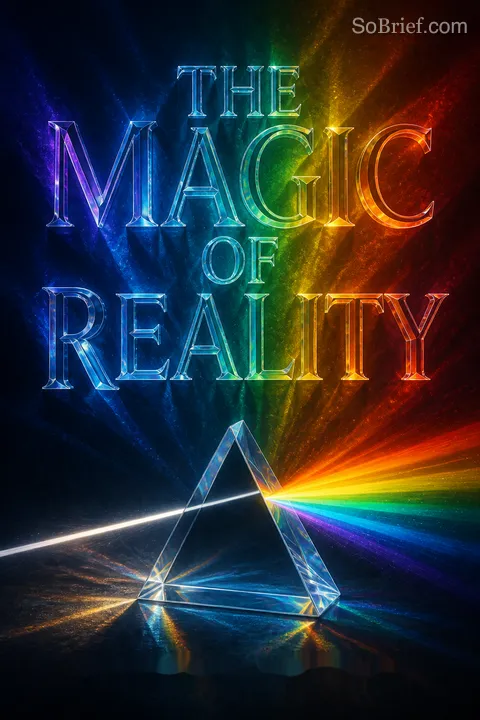
Wonder has several meanings. The book distinguishes supernatural magic, stage illusion, and poetic magic, the awe inspired by something real and understood. A supernatural explanation does not solve a mystery; it declares the mystery beyond investigation. Science treats gaps in knowledge as reasons to ask better questions, not as proof of invisible forces.
The approach makes scientific knowledge feel less like a warehouse of facts and more like an expanding set of ways to notice. Instruments matter because they expose evidence unavailable to ordinary perception, while models make hidden mechanisms testable. That combination is a powerful antidote to the assumption that only what is immediately visible is real. One useful caution: a model that predicts well is evidence for its usefulness, not a guarantee that it captures every layer of reality. Scientific confidence should grow with successful tests, while remaining open to revision.
Stop searching for a first human; evolution leaves no clean starting line
Change has no sharp edge. Every person had parents who belonged to the same species as their child. Trace ancestry backward, and there is no single birth that cleanly marks the arrival of the first human. A thought experiment in the book stretches a family line across roughly 185 million generations, back to an ancestor living about 417 million years ago that was a fish.
Species boundaries blur in the past. Evolution proceeds through small inherited changes, so each generation resembles its parents even while long sequences of generations can become profoundly different. The book compares this with growing up: there is no exact day when a baby becomes a toddler. Fossils and radioactive dating help reconstruct the larger transitions, but labels such as human and nonhuman do not always have a precise dividing point.
This example exposes a common difficulty in thinking about gradual processes: people look for a dramatic event because categories such as human and fish feel distinct. The family-line thought experiment shifts attention from categories to continuity. Similar reasoning applies to language change and geological history, where gradual local differences accumulate into large transformations. The species concept is useful, but it is not a perfect ruler for every case, especially fossils. A fuzzy boundary does not make the underlying history uncertain; it means nature did not necessarily divide itself according to human labels.
Explain animal diversity through branching populations, isolation, and inherited advantages
Separation lets populations diverge. Gene flow is the movement of genes between populations through breeding. When geography limits that exchange, populations can develop different traits and, over enough time, become separate species. The Galapagos land iguanas illustrate the process: populations on different islands became distinct, while one lineage adapted to feeding on seaweed and evolved into marine iguanas.
Selection is not a planner. Natural selection is the change in inherited traits across generations when some individuals survive and reproduce more successfully than others. It can favor useful features without anyone choosing an outcome. Languages offer a helpful comparison: speech changes gradually in separated communities, and once dialects diverge far enough, speakers may no longer understand one another. Unlike language, animal populations can also become unable to interbreed.
The branching-tree picture explains abundance without requiring a separate act of creation for every species. It also connects two scales: isolation changes which genes circulate, and selection changes which inherited traits become common. The language comparison is memorable because it makes divergence feel gradual, but it has limits. Words can cross between languages through borrowing, whereas animal populations that can no longer interbreed generally stop exchanging genes sexually. The broader lesson holds: repeated splits, followed by time and local adaptation, can turn one ancestral lineage into a great many forms.
Look inside solid matter: atoms, forces, and carbon make complexity possible
Solid does not mean packed. Matter is made of atoms, and atoms consist of a nucleus and electrons. In the book's scale model of diamond, if each nucleus were a football, neighboring nuclei would be more than 15 kilometres apart. Matter feels solid because forces and fields structure how atoms interact, not because it is a block of tightly packed miniature stuff. Crystals show how orderly arrangements of atoms create materials with strikingly different properties: carbon can form hard diamond or soft graphite.
Carbon builds varied structures. Carbon atoms readily link into long chains and rings, allowing an enormous variety of molecules. Living bodies depend on this chemistry to build complex components, including proteins such as myoglobin. The tiny world is not an empty curiosity: its structures and interactions make the visible world, including life, possible.
The contrast between familiar solidity and atomic structure is a useful reminder that perception is not a literal map of matter. What feels continuous can emerge from relationships among parts and forces. The carbon example then links physical structure to biological possibility: life's complexity depends on chemistry capable of making many different molecular arrangements. The scale model is intentionally startling, but the football comparison should not be mistaken for a physical portrait of nuclei or electrons. At atomic scales, ordinary ideas of shape and empty space become imperfect descriptions.
Earth's tilted axis, not its distance from the sun, makes seasons
Tilt changes the sunlight. Earth's axis is inclined about 23.5 degrees relative to its orbit around the sun. As Earth travels around that orbit, each hemisphere tilts toward the sun during its summer and away during its winter. The sun's rays then arrive at different angles, spreading energy across more or less ground, while daylight lasts longer or shorter. Together, angle and day length produce seasonal differences in heating.
Distance is a red herring. Earth's orbit is close to circular, and the planet is actually nearer the sun in January than in July. That cannot explain why the Northern and Southern Hemispheres have opposite seasons. The tilt explains both at once: when one hemisphere leans toward the sun, the other leans away. Plants also receive more usable sunlight in the local summer, affecting growth and the food available to other organisms.
This is a strong example of replacing an intuitive explanation with one that accounts for more observations. Distance sounds plausible because heat usually fades with distance, but it cannot explain opposite seasons north and south. A good explanation must fit the pattern across the whole system, not just one familiar case. The chapter also shows how astronomy reaches ordinary experience: the same geometry that shapes daylight affects plant growth and animal life. Its account is deliberately simplified, but the key causal mechanism remains clear and testable.
Trace life's energy and ingredients back to stars, sunlight, and ancient organisms
Stars forge the ingredients. The sun is a star, powered by nuclear reactions that turn hydrogen into helium. More massive stars can produce heavier elements, and supernova explosions scatter elements such as carbon, oxygen, and iron through space. Later stars and planets form from this material. In that literal sense, the ingredients of Earth and its living things were made in earlier stars.
Sunlight powers the living world. Plants capture sunlight and use it to make sugars. Herbivores obtain some of that stored energy by eating plants, and predators obtain some by eating herbivores; energy also reaches decomposers and parasites. Each transfer loses energy as heat. Coal and peat are older stores of energy captured by plants, while river power depends on a water cycle driven by the sun.
This account joins cosmic history to everyday biology. The atoms in a body have a history older than Earth, while the energy moving through ecosystems is continually supplied by sunlight. Those are different kinds of inheritance: matter is recycled, while usable energy flows through living systems and dissipates as heat. The distinction matters because it prevents a poetic image of cosmic kinship from obscuring the mechanisms behind it. The star story also makes clear that life depends on a long chain of physical events, not merely on the presence of a habitable planet.
Read starlight's spectral lines to measure elements, motion, and cosmic history
A rainbow carries a barcode. A spectroscope spreads starlight into a spectrum, where each element leaves a characteristic pattern of lines. Comparing those patterns with known laboratory spectra lets astronomers infer what distant stars contain. A red shift occurs when those spectral features move toward the red end of the spectrum, indicating that the light source is moving away. The farther galaxies are, the greater the shift observed in the account presented here.
Distance turns motion into history. Astronomers estimate galaxy distances using methods such as parallax for nearby stars and standard candles, objects with known intrinsic brightness, for greater distances. Combining distance with red shift shows that the universe is expanding. Working backward from that expansion supports the big bang model, which places the beginning of the observable universe roughly 13 to 14 billion years ago.
The spectrum is a striking example of indirect evidence doing more than the unaided eye could manage. Light carries information about both the source and its motion, and a sequence of distance measurements gives that information a cosmic scale. The reasoning depends on multiple methods fitting together, rather than on one dramatic observation. It is also important to distinguish an established inference from an ultimate account of existence: evidence for an expanding observable universe does not, by itself, settle every question about what preceded it or whether anything lies beyond what can be observed.
Treat alien life as an open scientific question, not a settled fact
Possibility is not proof. The book describes 763 planets detected around stars beyond the sun at the time of writing, using effects such as a star's slight motion or dimming when a planet crosses in front of it. Since many stars appear to have planets, the number of possible habitats could be enormous. Yet detecting planets is not the same as detecting life.
Search for conditions, then evidence. The Goldilocks zone is the range around a star where a planet could have liquid water, rather than water frozen solid or vaporized. Water and suitable temperatures make a world a candidate, not a confirmed home for organisms. The author favors the possibility that life exists elsewhere but emphasizes that no direct evidence establishes it. Scientific honesty means keeping the question open while identifying what observations could answer it.
The distinction between a vast probability space and a confirmed discovery is central to good reasoning under uncertainty. Large numbers make extraterrestrial life plausible, but plausibility cannot substitute for observation. The search becomes meaningful when it identifies measurable conditions, such as liquid water, and methods that can test them. The Goldilocks image is useful as a first filter, though a planet's position alone cannot establish habitability. The chapter's strongest lesson is methodological: scientists can make progress by narrowing possibilities even while the headline question remains unanswered.
Expect earthquakes where moving plates store stress, not where myths assign blame
The crust is in motion. Plate tectonics is the account that Earth's outer rocky shell is divided into large plates that move slowly over hotter material below. Their movements can pull apart, collide, or grind alongside one another. The continents ride on these plates; they are not simply rafts cutting through the ocean floor. Sea-floor spreading creates new crust between separating plates, while subduction occurs when one plate moves beneath another.
Slow pressure can end abruptly. Plate movement is usually too gradual to notice, but friction can hold parts of a boundary in place while strain accumulates. When the rock finally shifts, the sudden release is felt as an earthquake. The collision of the Indian plate with the Eurasian plate helped raise the Himalayas; movement near the San Andreas Fault makes California earthquake-prone. These mechanisms explain danger without assigning earthquakes a moral purpose.
Geology offers a useful contrast between the timescale of human life and the timescale of a planet. A movement too slow to see can still produce sudden, destructive consequences when accumulated strain is released. That distinction helps explain why a seemingly stable landscape can become hazardous. The account also shows how scientific explanations can replace blame with mechanisms without making the suffering less real. Understanding causes improves prediction and preparation, but it does not guarantee that every particular earthquake, or its consequences for a community, can be forecast precisely.
A coin has no memory, and misfortune has no moral schedule
Chance keeps no score. If a coin is fair, a run of previous heads does not make tails due on the next toss. The book uses a cricket captain's repeated wins at the toss to expose the mistaken belief that averages restore fairness one event at a time. A long run of heads might instead be evidence that the coin or the tossing method is biased. The next result alone cannot repair an earlier imbalance.
Causes are not purposes. A tsunami can have a physical cause, such as an undersea earthquake, without being sent to punish anyone. People often notice coincidences that frustrate them and overlook the many occasions when nothing remarkable happens. Natural selection is a limited exception to the idea of an indifferent world: predators and parasites can evolve traits that harm their victims, though they need not consciously intend harm.
The separation of causation from moral meaning is emotionally difficult, especially after disaster. Still, treating random events as a system that remembers past outcomes leads to bad predictions, as the coin toss example shows. The distinction also guards against blaming victims for events governed by physical processes. At the same time, statistical randomness does not imply that all risks are evenly distributed. Human decisions and social conditions can shape who is exposed to danger and who can recover. Rejecting cosmic punishment leaves room to examine preventable causes and responsibilities.
Compare miracle claims with error, rumor, and fraud before rewriting nature
Weigh the alternatives. David Hume's test asks whether a witness's error, deception, or mistaken interpretation is less extraordinary than the alleged miracle. A report that the sun appeared to move at Fatima, for example, is easier to explain through rumor, expectation, or misreporting than through a physical change powerful enough to alter Earth's motion. The test does not prove which ordinary explanation is right; it compares how much each explanation asks the reader to accept.
Stories change as they travel. Many miracle accounts arrive through chains of retelling, not direct observation. Coincidences also attract attention precisely because they are unusual: nobody makes a story of dreaming about someone who remains alive. If an event genuinely conflicts with current scientific understanding, the honest response is to check the observation and investigate the gap, rather than declare it permanently beyond explanation.
Hume's reasoning is valuable because it sets a high evidentiary bar for claims that would overturn well-tested knowledge. It does not require dismissing witnesses as dishonest; sincere people can be mistaken, and reports can change without a deliberate lie. Nor does the comparison establish that every puzzling report has already been explained. Its force lies in keeping explanation proportional to evidence. A remarkable claim deserves careful examination, but the wish for certainty should not turn a report, however moving, into proof of a violation of nature.
Analysis
The book is both an introduction to science and an argument about how to live with uncertainty. Its recurring movement from myth to mechanism gives the reader a simple narrative: people notice something astonishing, invent a story to explain it, and then discover that investigation can produce an account more intricate than the original tale. The chapter sequence ranges across biology, physics, astronomy, geology, and psychology, but its deeper subject is how knowledge earns confidence.
Its strongest teaching device is the joining of scales. A family tree makes evolution visible across immense time; a scale model makes atomic spacing imaginable; a spectrum lets distant galaxies disclose their composition and motion. These are not merely illustrations. They demonstrate how reasoning, measurement, and models connect ordinary perception to processes too large, small, or slow to observe directly. The book also repeatedly separates causal explanations from claims about purpose, particularly when discussing disasters and disease.
The same clarity creates a tension. The book treats supernatural claims principally as explanations of physical events, where they can be compared against testable accounts. Religious traditions also serve social, ethical, and communal functions that this comparison does not address. That omission does not weaken the scientific argument, but it narrows the kind of religious claim under examination. Another limitation is temporal: figures for detected planets and other scientific details belong to the book's publication context, not necessarily to the present state of research.
The central achievement is not a catalogue of answers. It is a stance toward unanswered questions: distinguish what is known from what is inferred, ask what evidence could decide between explanations, and resist confusing emotional force with factual support. That stance makes science feel less like a rival mythology and more like a disciplined, revisable practice of attention.
Review Summary
The Magic of Reality is praised as an accessible and engaging introduction to science for younger readers. Reviewers appreciate Dawkins' clear explanations of complex topics and the book's beautiful illustrations. Many find it enlightening and thought-provoking, sparking curiosity about the natural world. Some critics note that it may be too basic for adults or science-savvy readers. Dawkins' critiques of religion and mythology in the book are contentious, with some finding them unnecessary or disrespectful. Overall, most reviewers recommend it as an excellent primer on scientific concepts for children and teens.
People Also Read





Glossary
Poetic magic
Awe at real phenomenaThe sense of exhilaration or wonder produced by experiencing the natural world. The book distinguishes this meaning of magic from supernatural powers and stage illusions. Scientific understanding does not diminish poetic magic; learning how a rainbow, star, or living organism works can make its reality more moving.
Scientific model
A testable accountA proposed representation of how some part of reality works. A scientist uses the model to derive predictions, then compares those predictions with observations or experimental measurements. A model that succeeds gains support, but it can be revised or replaced when its predictions fail or better evidence becomes available.
Natural selection
Unequal reproductive successThe process by which inherited traits become more or less common because individuals with some traits survive and reproduce more successfully than others. No conscious selector is required. Across many generations, small differences in reproductive success can change a population and contribute to the evolution of adaptations and new species.
Gene flow
Genes moving between populationsThe movement of genes between populations when individuals migrate and reproduce with members of another population. Gene flow mixes their inherited variations. When barriers greatly reduce this exchange, populations may change independently and their genetic differences can accumulate.
Gene pool
Genes in a populationThe combined genetic variations present in a breeding population. Sexual reproduction reshuffles genes across generations, while natural selection and other evolutionary processes change how common particular gene variants are. Evolution can be described as change in a population's gene pool over time.
Plate tectonics
Movement of Earth's platesThe theory that Earth's outer rocky shell consists of large plates that move over hotter, softer material beneath them. Plates carry continents and ocean floor. Their separation, collision, subduction, and sideways motion shape features such as mountain ranges and generate earthquakes and volcanic activity.
Doppler shift
A motion-related wave changeA change in the observed frequency or wavelength of a wave when its source and observer move relative to each other. For sound, a passing source seems to change pitch. For light, motion changes the observed spectrum, allowing astronomers to infer whether a star or galaxy is approaching or receding.
Red shift
Light shifted toward redThe displacement of spectral features toward the red, longer-wavelength end of visible light. In astronomy, a red shift is evidence that a light source is moving away relative to the observer. Comparing the shifts of galaxies with their distances supports the conclusion that the universe is expanding.
Standard candles
Objects of known brightnessAstronomical objects whose actual brightness can be estimated. Comparing that intrinsic brightness with how bright the object appears allows astronomers to estimate its distance. Such objects extend distance measurement beyond the range where parallax, the apparent shift of a nearby star against a background, is useful.
Goldilocks Zone
Region permitting liquid waterThe range of distances from a star where temperatures could allow water to remain liquid on a planet's surface. A planet in this zone is a possible candidate for life as known on Earth, not evidence that it has water or organisms. Other conditions also matter.
Big bang model
An expanding universe's beginningThe scientific model that the observable universe began in a hot, dense early state and has expanded over time. Evidence discussed in the book includes the measured recession of distant galaxies and the pattern of that expansion. Working backward from present observations yields an estimated age of roughly 13 to 14 billion years.
FAQ
What's "The Magic of Reality" about?
- Exploration of Reality: "The Magic of Reality" by Richard Dawkins explores the wonders of the natural world through the lens of science, contrasting it with myths and supernatural explanations.
- Scientific Explanations: The book provides scientific explanations for a wide range of phenomena, from the composition of matter to the origins of the universe.
- Myths vs. Science: Dawkins juxtaposes ancient myths with scientific truths, illustrating how science offers more magical and awe-inspiring explanations than traditional stories.
- Educational Purpose: It aims to educate readers of all ages about the scientific method and the joy of discovering reality through evidence-based understanding.
Why should I read "The Magic of Reality"?
- Clarity and Engagement: Richard Dawkins is known for his clear and engaging writing style, making complex scientific concepts accessible to a general audience.
- Broad Range of Topics: The book covers a wide array of topics, including evolution, the solar system, and the nature of reality, providing a comprehensive overview of scientific knowledge.
- Debunking Myths: It offers a critical examination of myths and supernatural beliefs, encouraging readers to think critically and embrace scientific reasoning.
- Inspiration for Curiosity: The book inspires curiosity and a sense of wonder about the natural world, motivating readers to explore and understand the universe scientifically.
What are the key takeaways of "The Magic of Reality"?
- Science as Magic: Science reveals the true magic of reality, which is more fascinating and beautiful than any myth or supernatural explanation.
- Importance of Evidence: The book emphasizes the importance of evidence and the scientific method in understanding the world around us.
- Evolution and Natural Selection: Dawkins explains evolution and natural selection as fundamental processes that shape life on Earth.
- Critical Thinking: It encourages readers to question and critically evaluate information, distinguishing between evidence-based science and unfounded beliefs.
How does Richard Dawkins explain evolution in "The Magic of Reality"?
- Gradual Process: Dawkins describes evolution as a gradual process where small changes accumulate over generations, leading to the diversity of life we see today.
- Natural Selection: He explains natural selection as the mechanism by which advantageous traits become more common in a population, driving evolutionary change.
- Common Ancestry: The book illustrates the concept of common ancestry, showing how all living organisms are related through evolutionary history.
- Evidence-Based: Dawkins supports his explanations with evidence from fossils, genetics, and observable natural phenomena.
What myths does "The Magic of Reality" debunk?
- Creation Myths: The book contrasts various creation myths from different cultures with the scientific explanation of the universe's origins.
- Supernatural Beliefs: Dawkins addresses supernatural beliefs, such as miracles and magic, providing scientific explanations for phenomena often attributed to these beliefs.
- Origin of Species: Myths about the origin of species are debunked with evidence from evolutionary biology and genetics.
- Natural Phenomena: The book explains natural phenomena like rainbows, earthquakes, and the changing seasons, dispelling myths and providing scientific clarity.
How does "The Magic of Reality" address the concept of miracles?
- Definition of Miracles: Dawkins defines miracles as events that violate the laws of nature, often attributed to supernatural causes.
- Skeptical Approach: He encourages a skeptical approach to miracle claims, suggesting that natural explanations are more plausible than supernatural ones.
- Historical Context: The book examines historical miracle claims, analyzing them through the lens of scientific understanding and evidence.
- Hume's Argument: Dawkins references David Hume's argument that the improbability of a miracle is always greater than the improbability of a natural explanation.
What is the scientific method according to "The Magic of Reality"?
- Model Testing: The scientific method involves creating models or hypotheses about how the world works and testing them through experiments and observations.
- Evidence-Based: It relies on evidence and repeatability, ensuring that scientific conclusions are based on reliable data.
- Falsifiability: A key aspect is falsifiability, meaning that scientific claims must be testable and capable of being proven wrong.
- Continuous Inquiry: Science is an ongoing process of inquiry, where new evidence can refine or overturn existing theories.
How does "The Magic of Reality" explain the origins of the universe?
- Big Bang Theory: Dawkins explains the Big Bang theory as the scientific model for the universe's origin, occurring approximately 13.8 billion years ago.
- Cosmic Expansion: The book describes the evidence for cosmic expansion, such as the redshift of galaxies, supporting the Big Bang model.
- Time and Space: It discusses the concept that time and space began with the Big Bang, challenging traditional notions of a pre-existing universe.
- Scientific Evidence: Dawkins emphasizes the role of scientific evidence, such as cosmic microwave background radiation, in understanding the universe's beginnings.
What does "The Magic of Reality" say about the possibility of extraterrestrial life?
- Likelihood of Life: Dawkins suggests that, given the vast number of planets in the universe, it is likely that life exists elsewhere.
- Scientific Search: The book discusses the scientific search for extraterrestrial life, including the study of exoplanets and the conditions necessary for life.
- Speculative Nature: While acknowledging the speculative nature of the topic, Dawkins encourages scientific exploration and open-mindedness.
- No Direct Evidence: He notes that, as of now, there is no direct evidence of extraterrestrial life, but the search continues with advancing technology.
How does "The Magic of Reality" explain natural phenomena like rainbows and earthquakes?
- Rainbows: Dawkins explains rainbows as a result of light refraction, reflection, and dispersion in water droplets, creating a spectrum of colors.
- Earthquakes: The book describes earthquakes as the result of tectonic plate movements, where stress builds up and is released as seismic waves.
- Scientific Clarity: By providing scientific explanations, Dawkins dispels myths and misconceptions about these natural phenomena.
- Educational Purpose: These explanations serve to educate readers about the natural world and the scientific principles that govern it.
What are the best quotes from "The Magic of Reality" and what do they mean?
- "The truth is more magical than any myth or made-up mystery or miracle." This quote emphasizes the wonder and beauty of reality as revealed by science, surpassing fictional stories.
- "Science has its own magic: the magic of reality." Dawkins highlights the awe-inspiring nature of scientific discovery and understanding.
- "We should not rest until we have improved our science so that it can provide an explanation." This quote encourages continuous scientific inquiry and the pursuit of knowledge.
- "The universe has no mind, no feelings and no personality, so it doesn’t do things in order to either hurt or please you." Dawkins reminds readers that natural events are not influenced by human desires or morality.
What is the role of myths in "The Magic of Reality"?
- Cultural Context: Myths are presented as cultural stories that attempt to explain the world before scientific understanding was available.
- Contrast with Science: Dawkins uses myths to contrast with scientific explanations, showing how science provides more accurate and reliable answers.
- Educational Tool: The book uses myths as an educational tool to engage readers and introduce scientific concepts in a relatable way.
- Historical Insight: Myths offer historical insight into how different cultures have understood and interpreted natural phenomena throughout history.
About the Author
Other books by Richard Dawkins

Download PDF
Download EPUB
.epub digital book format is ideal for reading ebooks on phones, tablets, and e-readers.








