

Key Takeaways
Let scientific explanation enlarge wonder rather than protect mystery from scrutiny.
Explanation is not disenchantment. Dawkins answers the charge that science makes life cold by arguing that understanding can intensify awe. Newton’s account of a rainbow does not erase its beauty. It connects the colors to light, rain, and the physical order of the world. Science can also show how astonishing it is that any particular person exists: the chain of conception and ancestry leading to each of us could easily have gone another way.
Meaning need not be cosmic. The universe may have no human-centered purpose, but that does not cancel love, ambition, art, or the pleasure of learning. A finite life can make discovery more precious, not less. Science matters not only because it is useful, but because it lets people understand the world they briefly inhabit.
What's striking is the distinction between cosmic purpose and lived value. An explanation of how something happens does not decide whether it matters; those are different questions. Dawkins makes science emotionally inviting by treating knowledge as an aesthetic experience, not merely a tool. That argument can reach readers who do not care about science's practical returns. Its limit is that wonder alone cannot settle questions of ethics or belonging. Those require human commitments, which scientific knowledge can inform without replacing.
Interrupt familiarity by looking at life across alien scales.
The ordinary can be strange. Dawkins calls habituation an anaesthetic of familiarity: the gradualness of everyday life makes astonishing things feel routine. To break the spell, he turns the familiar world into an alien one. A squid can ripple patterns across its skin with precision, almost like a display whose pixels are controlled by its nervous system. Human cells are no less elaborate: the body contains roughly 100 trillion cells, with more than 200 acres of internal membrane folded into chemical workspaces.
Change the scale. Geological time can also reset perception. In one comparison, the entire history of life fits across outstretched arms, while human history occupies only a tiny fragment near a fingernail. Microscopes, telescopes, and deep time make the nearby and ordinary strange again.
The method is more than a vivid teaching trick. It trains attention by changing the scale at which an object is perceived: a cell becomes a city, and a familiar animal becomes an alien design. That shift can make abstract knowledge emotionally available without replacing evidence with spectacle. There is a useful caution, though. Metaphors such as a cell as a city illuminate some relations while hiding others. They work best as invitations to investigate, not as complete explanations.
A rainbow's physics opens a window onto the composition and motion of stars.
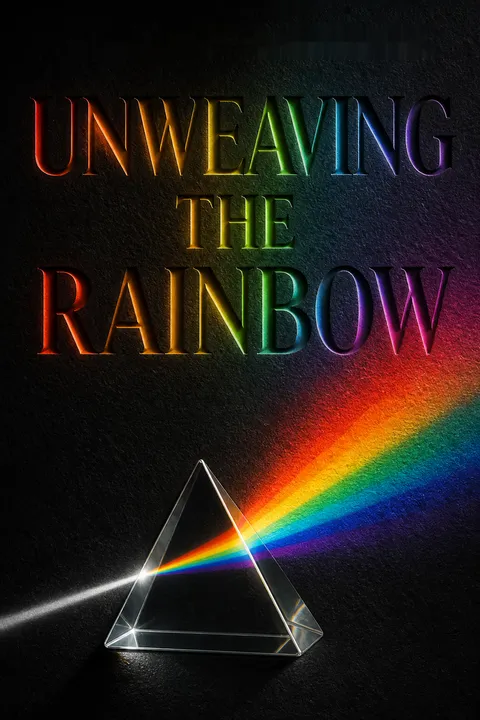
Color carries evidence. Newton showed that a prism separates colors already present in white light. The rainbow is not a fixed object at the horizon: each observer sees light from a different arrangement of raindrops, so each sees a different rainbow. Explanation adds surprising details instead of taking beauty away.
Starlight has a barcode. Fine dark lines in a spectrum, called Fraunhofer lines, form patterns that identify the elements in the light’s path. They let astronomers infer what distant stars contain without travelling to them. The same spectral patterns shift toward red when a galaxy recedes, providing evidence that the universe is expanding. From a prism and a rain shower, the story reaches the chemistry of stars and the motion of galaxies.
This is a model of how measurement can extend perception rather than compete with it. Spectroscopy turns a narrow band of light into evidence about distant matter, linking a familiar visual effect to questions far beyond unaided sight. The method also shows that an instrument does not simply reveal a ready-made picture: interpretation depends on reliable patterns and theories connecting them to physical causes. Its power comes from that disciplined chain, not from the romance of the word barcode.
Treat coincidences as probability problems before calling them messages.
Count the missed chances. Dawkins calls the relevant set the population of events that would have appeared coincidental, abbreviated PETWHAC. The point is to count not only the striking event that happened, but the many possible events that would also have impressed someone. A four-digit bicycle lock number happened to match a photocopier code. Since there are 10,000 four-digit combinations, the match sounds unlikely. Yet across a large population, somebody is bound to encounter a match.
The room changes the odds. With 23 people together, the chance that at least two share a birthday is slightly greater than one half. Most people underestimate this because they imagine one particular pair, rather than all possible pairs. Coincidences feel designed when the mind notices the hit and forgets the enormous number of chances for a hit.
PETWHAC makes a neglected feature of human reasoning visible: the apparent rarity of an event depends on how many opportunities were available for something similarly striking to occur. This is closely related to selection effects in data analysis, where attention lands on the unusual result after many possible results have been inspected. The tool is powerful, but estimates of the relevant population can be difficult. A careful answer therefore states its assumptions instead of presenting a rough probability as certainty.
Demand stronger evidence when a claim overturns well-tested natural laws.
Compare the explanations. Dawkins uses a test associated with the philosopher David Hume: a report of a miracle deserves belief only when rejecting the report would be even less plausible than accepting the miracle. At Fatima, a large crowd was said to have seen the sun move dramatically. But the sun is visible across a vast part of Earth, and its actual movement would have had consequences far beyond the witnesses at the site. Mass misperception, error, or an embellished report is a more ordinary explanation.
Skepticism is not closure. Strange claims are not automatically impossible. A surviving unknown animal would be exciting and need not overturn physics. But a television performance or a collection of anecdotes is not enough to establish a new force or natural law. Claims that challenge established knowledge call for repeatable, controlled evidence.
The comparison of explanations is a practical form of evidential discipline. It avoids two errors: accepting every extraordinary report, and treating current knowledge as final. The distinction matters because a new discovery can revise a theory, while a vivid anecdote rarely provides the controls needed to distinguish a real effect from error or deception. A reasonable skeptic remains open to being surprised, but places the burden on evidence that can survive scrutiny by people who do not share the original enthusiasm.
Replace childhood trust with adult habits of evidence.
Credulity starts as protection. Children depend on adults for information about a world they cannot safely test for themselves. If a parent warns a child away from a dangerous animal, experimentation may be costly. Trust helps children learn quickly, but it also means that false claims can enter alongside useful ones. Dawkins compares children to information caterpillars, absorbing what their elders know before developing stronger critical habits.
Old beliefs can persist. A child may accept a story about Father Christmas even when its details do not add up, because trusted adults supplied it. The same early trust can leave adults open to astrologers, psychics, and other confident claimants. The answer is not to mock belief, but to learn how to ask what supports it, what alternatives exist, and what evidence could change the conclusion.
This account explains why misinformation is not simply a failure of intelligence. Trust is a useful learning strategy when experience is limited, especially when acting on bad advice can be dangerous. The challenge is updating that strategy as the world and its sources of authority change. Skepticism cannot mean distrusting everyone equally; that would make learning impossible. It means matching confidence to the reliability of the source and the consequences of being wrong.
Make juries weigh DNA match rates against population and handling errors.
A match needs context. DNA fingerprinting compares variable regions of a person’s genetic material with a sample from a crime scene. Because those regions differ among people, a sufficiently detailed match can provide strong identification evidence. But the strength of a match depends on how common that pattern is in the relevant population. A statistic calculated for the population at large can mislead if the suspect belongs to a group with a different pattern frequency.
Evidence has failure points. Samples can be contaminated or mislabeled, and DNA amplification can also amplify stray material. Courts must weigh those risks alongside the statistics, rather than treating a match as automatic proof of guilt. The same reasoning matters when considering a national DNA database: it could aid investigations, but it could also expose private information about health, ancestry, and parentage.
The chapter’s central lesson is that technical evidence does not interpret itself. Legal reasoning needs both the probability that a match is coincidental and an account of how the sample was collected and handled. This is also a reminder that scientific tools carry political consequences: a database designed for one purpose can enable uses its subjects never agreed to. Better public understanding includes not only how reliable a method is, but who controls it and what safeguards govern it.
Use metaphor to illuminate mechanisms, not to substitute for evidence.
Not every resemblance explains. Scientific metaphors can make unfamiliar mechanisms graspable, but a superficial similarity does not prove a connection. Dawkins criticizes writers who group unrelated evolutionary events together because each seems like a sudden change. A mass extinction, a large genetic mutation, and punctuated equilibrium are not one process merely because all can look abrupt in a fossil record. Punctuated equilibrium describes long periods of relative stability interrupted by comparatively rapid species change, not a species appearing in one miraculous leap.
Follow the mechanism. The same warning applies to claims that the shape of DNA reflects the spiral of Earth’s orbit, or that quantum physics explains spiritual healing. The language may sound evocative, but an explanation needs a causal account and evidence linking the ideas. Good poetic science makes a mechanism clearer. Bad poetic science makes an association feel profound without making it testable.
Metaphor is indispensable in science communication because it compresses relationships into images people can carry. The risk is that fluency can masquerade as explanation: a phrase may feel coherent before its causal steps have been examined. A useful test is to ask what the metaphor predicts, and what observation would count against it. This standard preserves imaginative language while preventing the image from doing the work that evidence and mechanism must do.
Read genes as selfish units that prosper through cooperation.
Cooperation can serve self-interest. Dawkins’s phrase selfish cooperator describes genes that persist by succeeding in a genetic environment largely made up of other genes. A gene that helps build a useful body can thrive because it works well with the other genes in its species’ gene pool. In a cheetah, for example, traits for pursuit, digestion, and predatory behavior fit together; a mismatched mixture would be less effective.
The team is not the replicator. Genes do not need to plan for the species, and the organism is not the unit that gets copied unchanged through generations. Individuals are unique combinations; genes pass onward in changing combinations. Mitochondria, descended from bacteria that now live inside cells, offer a striking case of intimate biological cooperation, but the underlying story is not universal altruism. It is the persistence of partners whose interests align in a particular setting.
This perspective separates the level at which selection acts from the appearance of coordinated bodies. Cooperation is not evidence that competition has vanished; it can emerge when each participant does better in the presence of compatible partners. The idea is useful well beyond genes, since it clarifies how systems can look unified while remaining composed of agents with distinct interests. The caution is that the metaphor of selfishness can be misread as a claim about conscious motive. Genes have no intentions.
Treat a species' gene pool as an archive of ancestral environments.
Bodies record old conditions. Dawkins calls a species’ shared genetic inheritance a Genetic Book of the Dead: not a literal diary, but a record shaped by which genes survived in ancestral environments. A zoologist could infer much about an animal’s way of life from its teeth, limbs, and digestive system. The same logic applies to the gene pool, which preserves adaptations to conditions that may have disappeared.
Cuckoos show different histories. Female cuckoos often lay in the same host species’ nests as their maternal ancestors. Because a bird’s Y chromosome passes down the female line, its history can remain tied to one host type. This may help explain why some cuckoo eggs resemble their hosts’ eggs more closely than others. A species is not a conscious historian, but its inherited variation can carry traces of many past worlds.
The archive image turns adaptation into a form of historical evidence. A living structure can reveal pressures that no longer exist, much as a record can preserve information after its original context has vanished. The cuckoo example makes the claim unusually concrete: different lines of inheritance can carry different ancestral histories within one species. Still, an adaptation is not a transparent record. Many evolutionary routes can produce similar traits, so reconstruction depends on comparative evidence, not interpretation of one feature alone.
Use symbolic imagination to model worlds beyond immediate survival.
Perception is constructed. Dawkins describes the brain as building a constrained virtual reality: an internal model shaped by sensory information and updated as the world changes. The hollow-face illusion shows how the brain can insist on seeing a solid face even when the evidence comes from the mask’s hollow side. Perception is useful, but it is not a simple copy of the outside world.
Imagination extends the model. Human beings can also work with symbols, language, and imagined futures. Dawkins proposes that cultural skills may have helped drive the growth of the human brain through software-hardware co-evolution, in which new mental abilities and neural capacity reinforce one another. Language is a candidate, not a proven explanation. The broader point is that humans can build models of places and times they have never directly experienced, then use those models to think and choose.
The model-making account connects perception, imagination, and scientific thought without treating them as identical. Ordinary perception stays tethered to incoming evidence, while symbols allow the mind to explore possibilities that are absent from the immediate scene. That freedom supports planning and creativity, but it also enables hallucination, fantasy, and confident error. The account is strongest as a functional picture of how information guides action. It does not by itself solve the harder question of why experience feels subjective.
Analysis
The book’s most durable argument is not simply that science is beautiful. It is that beauty and explanation need not compete. Dawkins repeatedly moves from a familiar object to a more expansive account of it: a rainbow becomes evidence about light, starlight becomes evidence about distant matter, and a living body becomes a record of ancient environments. The narrative works because each expansion changes the reader’s scale of attention while retaining a concrete starting point.
A second strength is the book’s insistence that skepticism is a method, not a mood. Probability, sample selection, and error rates make the difference between a compelling anecdote and a reliable conclusion. The legal discussion gives this principle public stakes: evidence can be scientifically powerful and still vulnerable to mishandling, misleading statistics, or invasive uses. Scientific literacy here means learning how claims are supported, not merely learning scientific facts.
The book is less secure when its defense of science becomes a defense of scientific culture as a whole. Its critique of misleading metaphor is persuasive, but its polemical treatment of academic fashions sometimes gives opponents less charitable interpretation than it demands for scientific uncertainty. That tension matters because science communicates through institutions, education, and public trust, not just through correct reasoning. A reader can accept the book’s case for evidence while asking how scientific authority earns legitimacy and how expertise remains accountable.
Its deepest synthesis is the account of humans as both products and interpreters of history. Genes retain traces of ancestral environments; brains construct models of the present; language and symbols let people imagine remote pasts and possible futures. These are different kinds of record, not interchangeable explanations. The book’s poetry is most convincing when it keeps those distinctions clear. Wonder then arises not from mystery being protected, but from the scale and intricacy of what explanation reveals.
Review Summary
Unweaving the Rainbow receives mixed reviews. Many readers appreciate Dawkins' passion for science and his ability to convey complex ideas. They praise his arguments against superstition and his celebration of scientific wonder. However, some find his writing style pompous or rambling. Critics note his dismissive attitude towards religion and mythology. The book's strengths lie in its explanations of scientific concepts and its advocacy for scientific literacy. Overall, readers find it thought-provoking, even if they don't agree with all of Dawkins' views.
People Also Read







Glossary
PETWHAC
Coincidence opportunity setAn acronym for Population of Events That Would Have Appeared Coincidental. It means the full set of events that could have seemed striking if they had occurred, not just the event noticed after the fact. Counting that larger set helps estimate whether a coincidence is genuinely unlikely or merely one noticed outcome among many opportunities.
selfish cooperator
Gene-level mutual dependenceDawkins’s description of genes that persist through competition while also depending on compatible partners. A gene’s environment includes other genes, and a gene that works effectively with those partners can be favored. Cooperation at the level of bodies or gene pools therefore need not mean that genes act for the good of a species or possess intentions.
Genetic Book of the Dead
Inherited environmental recordA metaphor for the way a species’ gene pool carries information about environments in which ancestral genes survived. The record is indirect: genes influence development, and selection changes their frequencies across generations. An animal’s structure and genetic inheritance can therefore offer clues about ancestral conditions, although neither is a literal, complete diary.
constrained virtual reality
Sensory-based world modelThe brain’s internal model of the world, assembled from sensory information and continually updated as new information arrives. It is constructed rather than a direct copy, but constrained by contact with the outside world. Dawkins uses the term to distinguish ordinary perception from a wholly invented fantasy, while noting that the model can still produce illusions.
meme
Culturally copied ideaA unit of cultural transmission that spreads from mind to mind through imitation or other forms of copying. Dawkins applies the term to items such as tunes, skills, and ideas. Like genes, memes can vary in how readily they are copied, though the analogy does not mean that cultural transmission works exactly like biological inheritance.
software/hardware co-evolution
Abilities and brains reinforcingDawkins’s proposed process in which new cognitive abilities and the brain structures that support them reinforce each other. A mental innovation could create advantages for greater neural capacity, while increased capacity could support further innovations. Language is one possible trigger discussed in the book, but the proposed explanation for human brain expansion remains speculative.
Fraunhofer lines
Spectral element markersFine lines appearing in a spectrum of light. Their characteristic patterns identify chemical elements that absorbed or emitted particular wavelengths. Comparing these patterns in starlight allows astronomers to infer the chemical composition of distant stars. Shifts in the patterns can also reveal motion, as with the red shifts associated with receding galaxies.
DNA fingerprinting
Genetic identity comparisonA forensic method that compares variable regions of DNA from a person with DNA recovered from a sample. The resulting pattern can help identify an individual or establish biological relationships. Its evidential strength depends on how many regions are examined, how common the pattern is in the relevant population, and whether collection and laboratory procedures avoid contamination or mislabeling.
punctuated equilibrium
Stasis with rapid changeAn evolutionary theory associated with long periods in which a species shows little apparent change, interrupted by comparatively brief episodes of evolutionary change and speciation. The theory concerns patterns in the fossil record and does not require a new species to appear in a single generation. Dawkins warns against confusing it with mass extinction or large-effect mutations.
Skinner box
Animal learning apparatusA controlled experimental chamber, commonly used with rats or pigeons, where an animal can perform an action such as pressing a key and receive a reward. Dawkins discusses experiments in which rewards arrived independently of the animal’s behavior. The animals sometimes repeated arbitrary movements as though those movements caused the reward, illustrating how mistaken pattern detection can arise.
FAQ
1. What is Unweaving the Rainbow by Richard Dawkins about?
- Science and wonder intertwined: The book argues that scientific understanding does not diminish wonder or poetry, but rather deepens our appreciation of the natural world.
- Critique of superstition: Dawkins challenges the idea that science kills mystery, showing instead how it exposes deeper layers of beauty and complexity.
- Science as inspiration: He explores how scientific discoveries, from rainbows to DNA, can inspire creativity, poetry, and awe.
- Advocacy for rational thinking: The book also warns against pseudoscience and superstition, advocating for scientific literacy and skepticism.
2. Why should I read Unweaving the Rainbow by Richard Dawkins?
- Reframes science and poetry: The book challenges the misconception that science destroys wonder, showing how it enriches both scientific and artistic perspectives.
- Promotes critical thinking: Dawkins encourages readers to develop a scientific mindset, valuable for understanding complex issues and debunking pseudoscience.
- Engaging and accessible: Written with clarity and passion, the book combines scientific explanation with literary references, making it stimulating for a broad audience.
- Bridges cultural divides: It offers insights into reconciling tensions between scientific and literary cultures, and between rationality and superstition.
3. What are the key themes and takeaways from Unweaving the Rainbow by Richard Dawkins?
- Science enhances wonder: Scientific explanations of natural phenomena, like rainbows or DNA, increase our sense of awe rather than diminish it.
- Poetry and science compatibility: Dawkins argues that both poetry and science share a spirit of wonder and creativity, and can inspire each other.
- Skepticism against superstition: The book warns against the allure of pseudoscience, astrology, and paranormal beliefs, which exploit our desire for mystery.
- Importance of scientific literacy: Understanding science and probability is crucial for society, especially in law and culture, to avoid errors and promote rationality.
4. How does Richard Dawkins in Unweaving the Rainbow address the criticism that science destroys the poetry of phenomena like the rainbow?
- Refuting Keats's claim: Dawkins challenges the poet Keats's idea that Newton "destroyed the poetry of the rainbow" by explaining its colors, arguing that science reveals deeper beauty.
- Science reveals new poetry: Newton's discoveries led to spectroscopy, unlocking secrets of the stars and universe, inspiring awe beyond the rainbow itself.
- Poetry of understanding: Dawkins, echoing Feynman, asserts that scientific study adds layers of meaning and enriches poetic sensibility.
- Science as inspiration for poets: He suggests that poets could find new sources of inspiration in scientific discoveries, creating even greater poetry.
5. How does Unweaving the Rainbow by Richard Dawkins explain the human appetite for wonder and its misuse?
- Innate desire for mystery: Humans have a natural appetite for wonder, which science can satisfy by revealing the universe's true beauty.
- Hijacking by superstition: Dawkins warns that this appetite is often exploited by astrology, paranormal claims, and pseudoscience, offering false mysteries.
- Childhood credulity: He explains that children are naturally credulous to absorb knowledge, but this must be replaced by adult skepticism to avoid gullibility.
- Need for scientific skepticism: The book advocates cultivating a scientific mindset to protect against deception and appreciate genuine wonder.
6. What is "bad poetic science" according to Richard Dawkins in Unweaving the Rainbow?
- Definition and danger: Bad poetic science is the misuse of poetic imagery and metaphor that misleads scientific understanding, even if the poetry is appealing.
- Examples of misuse: Dawkins cites homeopathy, astrology, New Age quantum mysticism, and overgeneralized evolutionary metaphors as cases where poetic allure obscures scientific truth.
- Ideological distortions: He critiques certain feminist and postmodernist writings that reject logic and scientific methods, warning against undermining science with ideology.
- Contrast with good poetic science: Good poetic science uses metaphor to stimulate imagination and insight, as seen in Faraday's "lines of force" or Kekulé's dream of the benzene ring.
7. How does Unweaving the Rainbow by Richard Dawkins explain human fascination with coincidences and pattern recognition?
- Misjudged probabilities: Dawkins shows that many coincidences are statistically more common than intuition suggests, due to large populations and many opportunities for overlap.
- Sampling and probability: He uses real-world examples, like telephone directories, to demonstrate that what seems astonishing is often expected when considering the numbers.
- Intuitive statistics and errors: Humans and animals often make false positive errors, seeing patterns where none exist, as shown in experiments with pigeons.
- Evolutionary calibration: Our brains evolved in small groups, so modern large populations and media exposure cause us to overreact to coincidences—a "miscalibrated gasp threshold."
8. What is the "selfish cooperator" concept in Unweaving the Rainbow by Richard Dawkins?
- Genes as selfish but cooperative: Genes are selected for their own replication, but they cooperate within gene pools to build complex organisms.
- Organism as gene vehicle: The individual organism is a temporary combination of genes; cooperation occurs at the species gene pool level.
- Co-evolution and adaptation: Genes co-evolve with those of other species, forming complex ecological networks, but this cooperation arises from selfish interests.
- Critique of naive cooperation: Dawkins warns against romanticizing universal cooperation in nature, emphasizing that apparent altruism often serves selfish genetic strategies.
9. What is the "genetic book of the dead" metaphor in Unweaving the Rainbow by Richard Dawkins?
- Genes as ancestral records: The metaphor describes the gene pool as a coded record of the environments and experiences in which ancestors survived.
- Genes encode adaptations: Genes collectively describe the worlds—deserts, forests, seas—in which ancestors lived, encoding adaptations to those environments.
- Variation in gene experiences: Some genes, like sex chromosomes or those in parasitic species, have specialized ancestral experiences reflecting different selective pressures.
- Species as averaging computers: Over generations, species "learn" from experience by shifting gene frequencies, building a genetic description that helps predict and survive future environments.
10. How does Unweaving the Rainbow by Richard Dawkins explain the brain's construction of reality and the concept of "virtual reality"?
- Virtual reality in the brain: The brain constructs internal models or simulations of the external world, using sensory input to build a coherent, predictive reality.
- Economy via redundancy removal: Sensory systems filter out redundant information, focusing on changes and unexpected stimuli to efficiently encode the environment.
- Illusions reveal processing: Visual illusions, like the hollow mask or Necker cube, show how the brain actively interprets ambiguous data, sometimes creating false perceptions.
- Dynamic updating: The brain continuously updates its models based on sensory feedback and movement, maintaining stable perception despite changes in viewpoint.
11. What is the significance of memes and cultural evolution in Unweaving the Rainbow by Richard Dawkins?
- Memes defined: Memes are units of cultural inheritance that replicate by imitation, analogous to genes replicating biologically.
- Darwinian selection of memes: Memes vary in their ability to spread; those better at infecting minds survive and propagate, leading to cultural evolution.
- Genes and memes co-evolve: Genes are selected for producing brains good at acquiring and transmitting memes, while memes evolve to exploit human cognition.
- Examples and effects: Catchy tunes, phrases, and ideas can spread like viruses, influencing behavior and culture, sometimes independent of their truth or utility.
12. What are the most memorable quotes from Unweaving the Rainbow by Richard Dawkins and what do they mean?
- "We are going to die, and that makes us the lucky ones." Dawkins uses this to highlight the improbability and wonder of our existence, inspiring awe at being alive.
- "To see a world in a grain of sand / And a heaven in a wild flower." Quoting Blake, Dawkins reinterprets this as a scientific appreciation of nature's complexity and beauty.
- "Science is, or ought to be, the inspiration for great poetry." Dawkins's thesis that scientific understanding enriches, rather than diminishes, poetic imagination.
- "Any sufficiently advanced technology is indistinguishable from magic." Citing Clarke's Third Law, Dawkins explains how new scientific discoveries can seem miraculous but are grounded in natural law.
- Praise from Melvyn Bragg: "The product of a beguiling and fascinating mind..." underscores Dawkins's ability to share his enthusiasm for science with all readers.
About the Author
Other books by Richard Dawkins

Download PDF
Download EPUB
.epub digital book format is ideal for reading ebooks on phones, tablets, and e-readers.








