

Key Takeaways
Make science's real wonders as accessible as its impostors.
Wonder needs a pathway. Sagan opens with a curious driver who wants to discuss Atlantis, astrology, and alien secrets, but knows little about discoveries in astronomy, biology, or geology. The man is not foolish. Popular culture has simply made unsupported claims easier to find than good explanations. Science can offer its own astonishments: life’s molecular building blocks in interstellar space, ancient footprints preserved in volcanic ash, and viruses that hijack cells.
Give curiosity better food. Pseudoscience often supplies reassurance, magical power, or cosmic importance. Science may not satisfy those wishes, but it can reveal a universe more intricate than the fantasies it replaces. Sagan’s answer is not to scold the curious. It is to communicate real science with enough clarity and vividness that wonder does not have to choose between excitement and evidence.
The driver’s story is about distribution, not intelligence. People cannot evaluate evidence they rarely encounter, while vivid, emotionally satisfying claims travel easily. That makes science communication part of the substance of science, not a decorative extra. The same distinction matters in any information environment: fact-checking is useful, but it cannot compensate for a public diet dominated by confident fiction. A useful challenge is to make explanations compelling without exaggerating certainty. Science earns trust not by imitating sensationalism, but by showing that reality has enough drama of its own.
Let wonder propose; let evidence decide.
Science corrects itself. Sagan presents science as a disciplined way of thinking, not a shelf of final answers. It welcomes imaginative explanations, then tests them against observation and makes room for uncertainty. An error bar is a visible estimate of how uncertain a measurement is. It signals that evidence has limits, rather than pretending knowledge is perfect.
Criticism is productive. Newtonian physics predicts ordinary motion with great accuracy, yet fails in conditions involving very high speeds or strong gravity. Einstein’s relativity accounts for those cases while preserving Newton’s success where it applies. Science advances through such revisions, peer criticism, and repeated checks. Even a theory supported by extensive evidence remains open to testing. The point is not that scientists never err; it is that the method gives others a chance to find and correct errors.
This balance resembles a well-designed learning process: imagination generates candidate explanations, while feedback distinguishes useful models from attractive ones. Neither stage works alone. Unrestrained openness accepts contradictions indiscriminately; reflexive skepticism can dismiss discoveries simply because they feel strange. The chapter’s strength is its refusal to equate provisional knowledge with weakness. Its caution is equally important: scientific communities can protect status or overlook inconvenient data. Their advantage is not purity, but the possibility of public criticism and correction.
Test claims with tools that could expose your own mistake.
Use a detection kit. Sagan calls his practical guide the baloney detection kit: habits for judging claims without relying on a speaker’s confidence or credentials. Look for independent confirmation, consider competing explanations, quantify where possible, and ask what evidence could disprove the claim. A simpler explanation is preferable when it accounts for the evidence equally well.
Design the test first. Sagan’s invisible dragon in a garage illustrates why unfalsifiable claims carry little evidential weight. If every proposed test is answered with a new reason the dragon cannot be detected, the claim makes no testable prediction. Good tests also control for alternatives. A medicine, for example, must be compared with a placebo, and researchers should not know which patients received which treatment when judging results. A claim that survives serious attempts to test it deserves more confidence than one protected from every possible challenge.
The kit turns skepticism from a personality trait into a repeatable practice. That matters because people are especially vulnerable when a claim confirms a hope, fear, or identity. Asking in advance what would change a judgment creates a useful guardrail against moving the goalposts. Still, simplicity should not become a shortcut: new discoveries can initially require unfamiliar explanations. The decisive question is not whether an idea sounds ordinary, but whether it makes clear predictions and withstands fair, independent tests.
Treat faces in rocks and Mars as perception, not proof.
Brains find familiar patterns. Humans are unusually quick to recognize faces, a useful ability that can also make random shapes look intentional. The Moon’s familiar face is actually a pattern of ancient cratered highlands and younger lava plains. It records geological events, not a sculptor’s design. Across enough clouds, rocks, and vegetables, some will resemble faces by chance.
Check the image against the world. Astronomers once reported straight canals on Mars, sometimes interpreting them as evidence of an engineering civilization. Later spacecraft mapped the planet in much greater detail and found no such network. The famous Martian Face was likewise a low-resolution landform whose apparent features were strengthened by lighting and missing image data. Sagan does not rule out artificial structures in principle. He argues that suggestive resemblance is a reason to investigate, not a verdict about what made it.
The examples expose a common reasoning trap: once a pattern has a name, observers become better at seeing it, even when the pattern is not physically present. Modern image analysis can intensify this effect by sharpening, cropping, or enhancing selected features. The corrective is not to distrust all visual evidence, but to ask how the image was produced, what information is missing, and whether the pattern persists under better measurement. Familiarity makes a shape legible; it does not establish its cause.
A convincing experience proves experience, not its cause.
Feelings can be vivid and sincere. Sagan describes sleep paralysis, a brief state around waking or falling asleep in which a person may be unable to move and may sense a presence or see figures. The experience can feel entirely real. Hallucinations can also occur in ordinary people under stress, illness, sleep loss, or sensory deprivation. None of this proves that every unusual experience has an internal cause; it does show why testimony alone cannot settle the explanation.
Culture supplies the characters. Reports of alien abduction often echo older stories about demons, fairies, and other beings that enter bedrooms, paralyze sleepers, or interfere sexually. Sagan argues that familiar cultural images can shape how people interpret ambiguous experiences. He also challenges a poll that inferred alien abduction from reports of sleep paralysis and missing time, although respondents were not actually asked whether aliens had taken them.
Respecting a report requires separating two questions: did the person undergo a frightening experience, and what produced it? The first may be clear while the second remains uncertain. This distinction is useful in clinical care, eyewitness accounts, and investigations of anomalous events because it avoids both automatic credulity and contemptuous dismissal. Cultural context can shape interpretation without making distress imaginary. The caution is that a plausible psychological explanation is not proof in an individual case; explanations, too, must answer to evidence.
Protect vulnerable people with compassion and evidence, not certainty.
Memory can be reshaped. Sagan describes how hypnosis and leading questions can encourage people to construct vivid memories of events that did not occur. In psychologist Elizabeth Loftus’s experiments, people shown a film of a car accident could later recall a stop sign after being given false information about one. Repetition and confidence did not guarantee accuracy.
Errors can injure in both directions. Sagan takes childhood sexual abuse seriously, but warns that therapists who assume abuse must have happened can implant false memories, damage families, and contribute to wrongful convictions. The case of Paul Ingram shows how suggestions from investigators, a therapist, and a pastor helped generate elaborate recollections that he eventually recognized as false. The ethical task is to support a distressed person without treating emotional intensity as proof, and without dismissing allegations that may be true.
This is an argument for epistemic care: compassion should shape how people are heard, while evidence should shape what is concluded. In trauma work, the risk of disbelief is real, but certainty imposed by an authority figure can also cause lasting harm. A sound approach distinguishes support from confirmation and uses methods that minimize suggestion. Sagan’s warning is strongest when it protects both possible victims and the wrongly accused. Its practical challenge is institutional: professionals need training and procedures that make humility easier than premature certainty.
Make scientific literacy a civic safeguard, not a school subject.
Public decisions need public understanding. Sagan argues that citizens cannot judge policies about pollution, medicine, weapons, or technology if they cannot grasp the evidence beneath them. Scientific literacy does not mean every voter must become a specialist. It means people should understand how claims are tested, where uncertainty remains, and when an authority has not shown its work.
Inquiry and democracy share habits. Both depend on open debate, evidence, criticism, and the ability to correct mistakes. Sagan connects this to protections such as free speech and due process, which help prevent power from becoming immune to challenge. His account of witch trials shows what happens when accusations cannot be tested, defendants cannot answer them, and officials treat dissent as guilt. Scientific habits cannot decide every political value, but they help citizens judge claims about consequences.
The civic case is more demanding than teaching a list of scientific facts. A population can memorize conclusions and still be unable to assess a new claim or recognize an abuse of authority. Democratic institutions and scientific institutions both need routes for dissent, correction, and independent review. Yet evidence alone cannot determine what society ought to value. Science can clarify likely consequences; public reasoning must still choose among competing goals. That boundary strengthens, rather than weakens, the case for scientific literacy.
Teach science through questions, experiments, and intellectual permission.
Protect the early curiosity. Sagan recalls young children asking bold questions about the Moon, dreams, and the origins of the world, then contrasts them with older students trained to memorize answers and fear looking foolish. He argues that adults should admit when they do not know, then investigate alongside the child. A question need not already be well phrased to be worth exploring.
Let learners test ideas. Hands-on experiments make explanations tangible: a candle under a bell jar can show how burning changes when oxygen is depleted. Sagan also describes a classroom in which students simulate a constitutional convention before reading the actual document, discovering why delegates made different choices. His model of education joins content with the process of finding out. Reading matters too: Frederick Douglass taught himself to read as an enslaved child, recognizing literacy as a route toward freedom and independent thought.
A question-friendly classroom builds more than scientific knowledge. It teaches students that uncertainty is an invitation to investigate rather than a public embarrassment. Experiments also make learners active judges of claims, which is harder to achieve through passive exposure to correct answers. But curiosity alone cannot overcome unequal access to books, trained teachers, time, and nutrition. Sagan’s educational ideal therefore has both a teaching and a social dimension: intellectual permission matters, and so do the material conditions that let students use it.
Fund curiosity before its practical payoff becomes visible.
Discovery rarely follows a shopping list. James Clerk Maxwell studied the relationship between electricity and magnetism, not how to invent radio or television. By preserving a term in his equations for changing electric fields, he predicted waves that travel through empty space at the speed of light. Later experiments confirmed the prediction, opening the way to radio, radar, and television.
Basic research is seed corn. Sagan argues that society cannot reliably predict which investigations will produce useful technologies. He points to discoveries whose later applications were not their original aim, and to the cancellation of the major NASA search for extraterrestrial intelligence after only a year. In his account, that program’s annual cost was comparable to one attack helicopter. The value of curiosity-driven work is not guaranteed in each project; its value lies in maintaining a broad search for knowledge that practical planning cannot specify in advance.
The Maxwell example illustrates the option value of basic research: a modest investment can preserve possibilities whose uses are not yet imaginable. This logic challenges funding systems that reward only near-term deliverables, though it does not mean every project deserves support without scrutiny. Scientists still owe the public clear explanations, credible budgets, and honest accounts of uncertainty. The difficult policy question is how to balance exploratory work with urgent needs. Sagan’s answer is not to choose one forever, but to avoid consuming the entire future for immediate returns.
Scientific power demands public oversight and moral accountability.
Knowledge is powerful, not automatically good. Sagan acknowledges that scientists helped create nuclear weapons, chemical hazards, and technologies that can damage the environment. He discusses Edward Teller’s campaign for the hydrogen bomb and the danger that thermonuclear war could trigger severe global cooling and threaten food supplies. The lesson is not to abandon science, whose medical and agricultural gains have saved lives, but to face the consequences of its applications.
Responsibility cannot be outsourced. Scientists cannot claim credit for beneficial technologies while treating foreseeable harms as someone else’s problem. Governments and industries also require scrutiny, especially when secrecy keeps risks from the public. Sagan calls for broad debate, long-term thinking, and ethical attention alongside technical expertise. Science can help reveal what a technology may do; human beings and institutions remain responsible for deciding whether, how, and under whose authority to use it.
The double edge of technology makes oversight a design requirement, not a moral accessory. Expertise can identify risks, but incentives may reward speed, secrecy, or strategic advantage instead. Independent review and public debate can expose blind spots that a tightly controlled technical team misses. At the same time, responsibility should be assigned carefully: not every downstream harm is foreseeable, and no single scientist controls the political system. Accountability is strongest when it reaches the institutions that fund, deploy, and profit from powerful technologies.
Analysis
The book’s deepest concern is not that people sometimes believe strange things. It is that societies distribute the tools of judgment unevenly while placing consequential decisions in the hands of institutions that may not welcome scrutiny. The curious driver who knows Atlantis but not modern science is therefore more than an amusing anecdote. He represents an information environment in which unsupported stories receive vivid presentation, while reliable explanations are technically difficult, poorly taught, or absent from popular media.
Sagan’s answer is institutional as much as intellectual. Science works because claims can be tested, criticized, revised, and independently checked. Democracy needs comparable arrangements: protected dissent, access to information, and mechanisms for correcting public error. Neither system is made reliable by the virtue of its participants. Scientists, officials, journalists, and citizens remain fallible. Their procedures matter precisely because their motives and judgments are not consistently trustworthy.
The argument also has a boundary worth preserving. Scientific evidence can clarify likely consequences, but it cannot alone determine which risks are acceptable or what goals deserve priority. Those are ethical and political choices. Sagan’s strongest civic argument is not that science should govern, but that citizens need enough scientific understanding to contest claims made in science’s name and to make informed choices about its use.
The book’s account of credulity is most persuasive when it treats belief as a human response to grief, fear, social isolation, or unmet curiosity, rather than as proof of stupidity. That insight places a burden on science communicators: explanations must be accessible without becoming simplistic, and skeptical criticism must not confuse a person’s distress with the truth of their interpretation. In a modern media landscape that rewards speed and emotional certainty, the book’s durable proposal is to build habits and institutions that make correction possible before error becomes policy.
Review Summary
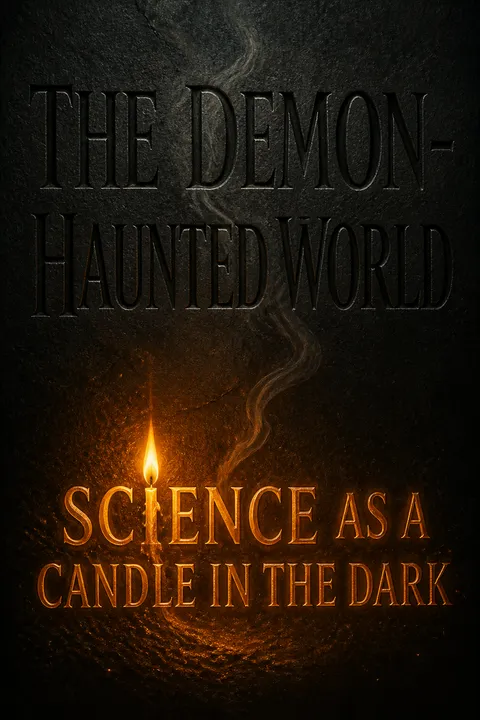
The Demon-Haunted World: Science as a Candle in the Dark is widely praised as an important defense of scientific thinking and skepticism against pseudoscience and superstition. Sagan examines topics like UFOs, alien abductions, and religion, advocating for critical thinking and evidence-based reasoning. Many reviewers found the book still relevant decades later, appreciating Sagan's clear writing and passionate arguments for science education. Some felt certain sections were dated or repetitive, but overall the book is highly recommended for its insights on the importance of scientific literacy in society.
People Also Read





Glossary
baloney detection kit
Tools for testing claimsA set of habits for assessing claims and arguments. It includes seeking independent confirmation, comparing alternative explanations, checking whether a claim can be falsified, quantifying evidence where possible, and watching for common logical fallacies. The kit is meant to help people evaluate both others’ claims and their own favored ideas.
error bars
Visible estimates of uncertaintyA range attached to a measurement or estimate that indicates how much uncertainty surrounds it. In Sagan’s account, error bars are a reminder that empirical knowledge is not perfectly precise. Smaller bars indicate greater confidence in the measurement, while larger bars signal greater uncertainty.
multiple working hypotheses
Competing explanations tested togetherA method of reasoning in which several explanations for an observation are developed and compared, rather than accepting the first plausible idea. Each explanation is tested against the evidence and, where possible, exposed to attempts at disproof. The hypothesis that best survives this comparison is more credible, though not guaranteed to be true.
sleep paralysis
Temporary immobility near sleepA sleep-related state in which a person is conscious but temporarily unable to move, often while falling asleep or waking. It can include intense anxiety and vivid sensations or images, such as a presence in the room. Sagan discusses it as one possible explanation for some reports of alien encounters, not as a universal explanation for them.
SETI
Search for extraterrestrial intelligenceThe search for evidence of intelligent life beyond Earth, including attempts to detect radio signals from other civilizations. Sagan distinguishes this systematic search from claims based on anecdotes or ambiguous sightings. A signal would require repeated detection and independent confirmation before it could responsibly be identified as extraterrestrial.
dragon in my garage
Example of an untestable claimA thought experiment about a person who claims to have a dragon but adds that it is invisible, leaves no detectable traces, and defeats every proposed test. Because no conceivable observation could count against the claim, it has no evidential value. The example distinguishes an assertion that cannot be disproved from one supported by evidence.
Roper poll
Poll cited on alien abductionsAn opinion poll of nearly 6,000 American adults, commissioned by people who accepted alien abduction claims. Respondents reported experiences such as waking paralyzed or sensing a presence, but were not directly asked whether aliens had abducted them. Sagan criticizes the conclusion that these answers established millions of abductions as an unsupported inference.
FAQ
What's The Demon-Haunted World about?
- Science vs. Pseudoscience: The book explores the conflict between scientific reasoning and pseudoscientific beliefs, emphasizing the importance of skepticism and critical thinking.
- Cultural Critique: Sagan critiques society's fascination with pseudoscience, such as UFOs and alien abductions, and how these overshadow genuine scientific inquiry.
- Personal Journey: Sagan shares personal anecdotes and reflections on his experiences with science, illustrating the wonder and beauty of scientific discovery.
Why should I read The Demon-Haunted World?
- Promotes Critical Thinking: The book encourages a skeptical mindset, urging readers to question extraordinary claims without evidence.
- Relevance to Modern Issues: Sagan addresses contemporary issues like environmental degradation and misinformation, making his insights relevant today.
- Inspiring and Accessible: Sagan's engaging writing makes complex scientific concepts understandable, inspiring readers to appreciate the universe's wonders.
What are the key takeaways of The Demon-Haunted World?
- Value of Science: Sagan argues that science is essential for understanding the world and improving the human condition.
- Skepticism is Crucial: The book emphasizes the importance of skepticism in evaluating claims, especially those related to the supernatural.
- Cultural Impact of Pseudoscience: Sagan discusses how pseudoscience can lead to widespread misinformation, highlighting the need for better science communication.
What are the best quotes from The Demon-Haunted World and what do they mean?
- "It is better to light one candle than to curse the darkness.": Emphasizes proactive engagement with science to promote understanding and knowledge.
- "Extraordinary claims require extraordinary evidence.": Highlights the need for substantial evidence to support unusual claims, guiding critical thinking.
- "We are, as I like to say, starstuff.": Reflects Sagan's belief in the interconnectedness of all life and the universe, reminding us of our shared origins.
How does Carl Sagan define science in The Demon-Haunted World?
- Science as a Method: Sagan defines science as a way of thinking involving observation, experimentation, and critical analysis.
- Error-Correcting Mechanism: He highlights science's built-in mechanisms for self-correction, essential for advancing understanding.
- Openness to New Ideas: Sagan stresses that science thrives on openness and rigorous scrutiny, fostering inquiry and discovery.
What is the significance of the "baloney detection kit" in The Demon-Haunted World?
- Critical Thinking Tools: The "baloney detection kit" is a set of tools for evaluating claims and arguments, helping discern valid information.
- Encourages Skepticism: It promotes a skeptical mindset, urging individuals to question the validity of information and seek independent confirmation.
- Framework for Analysis: Provides a structured approach to analyzing arguments, aiding in navigating complex issues and avoiding misinformation.
How does Sagan address the issue of scientific literacy in The Demon-Haunted World?
- Alarmingly Low Literacy Rates: Sagan points out the significant portion of the population that is scientifically illiterate, posing societal risks.
- Consequences of Ignorance: He warns that scientific illiteracy can lead to poor decision-making on critical issues like health and environment.
- Call to Action: Sagan advocates for improved science education and communication to empower informed choices and policy-making.
How does Sagan compare alien abductions to historical religious experiences in The Demon-Haunted World?
- Similarities in Experience: Sagan draws parallels between alien abduction accounts and historical religious experiences, suggesting psychological phenomena.
- Cultural Context: He argues that cultural context shapes interpretations, whether as divine encounters or alien abductions.
- Need for Evidence: Sagan emphasizes that both claims require scrutiny and evidence, advocating for a rational approach.
How does Sagan address the relationship between science and democracy in The Demon-Haunted World?
- Science as a Foundation: Sagan argues that a functioning democracy relies on an informed citizenry capable of critical thought.
- Skepticism and Accountability: Emphasizes skepticism as necessary for holding leaders accountable and preventing power abuse.
- Interdependence of Values: Illustrates that the values of science—such as inquiry and evidence—are also democratic cornerstones.
What role do personal anecdotes play in The Demon-Haunted World?
- Illustrating Concepts: Sagan uses personal anecdotes to make scientific ideas relatable and illustrate key concepts.
- Engaging the Reader: These anecdotes engage readers emotionally, connecting them with Sagan's experiences and insights.
- Reflecting on Society: Sagan's experiences reflect societal attitudes towards science and pseudoscience, critiquing educational and cultural beliefs.
How does The Demon-Haunted World critique religion and superstition?
- Historical Context: Sagan examines historical instances where religious beliefs led to persecution and violence, like witch hunts.
- Science vs. Dogma: Contrasts scientific inquiry's open-mindedness with dogmatic beliefs' rigidity, advocating for questioning and revising ideas.
- Call for Rationality: Urges reliance on evidence rather than faith, suggesting that embracing science leads to a more just society.
What is Sagan's vision for the future in The Demon-Haunted World?
- Hope for Enlightenment: Sagan expresses hope for greater scientific understanding and rationality in society.
- Collective Responsibility: Emphasizes individuals' responsibility to advocate for science and reason in their communities.
- Sustainable Progress: Envisions a future with widespread scientific literacy, leading to informed decision-making and sustainable progress.
About the Author


Download PDF
Download EPUB
.epub digital book format is ideal for reading ebooks on phones, tablets, and e-readers.








