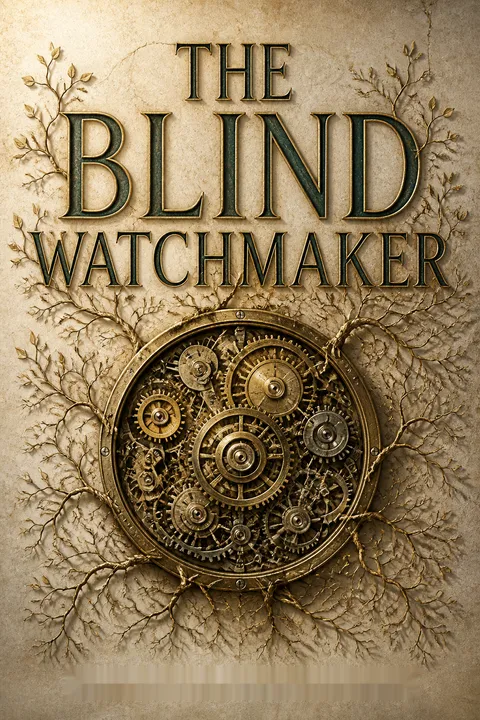


Key Takeaways
Treat natural selection as a blind watchmaker, not a conscious engineer
The design problem. William Paley argued that a watch’s intricate parts imply a maker, and that living things seem to make the same case even more strongly. An eye, for example, combines a lens, a light-sensitive surface, and many working connections. Dawkins agrees that such complexity demands explanation, but rejects Paley’s conclusion that a conscious designer supplied it.
Selection without foresight. Natural selection has no plan or purpose. Heritable variations that help organisms survive and reproduce tend to become more common; harmful ones tend to disappear. Across many generations, this filtering can produce structures that look engineered. The result is not less remarkable because no engineer intended it. The process explains how apparent design can arise without a designer.
What's striking is the distinction between recognizing function and inferring intention. Engineers routinely reverse-engineer machines by asking what a structure does, but in biology that question does not establish that anyone designed it. Natural selection supplies a causal account of how useful arrangements accumulate. The argument is strongest for traits with many interacting parts, not for every feature of every organism. Some traits are by-products, compromises, or inherited quirks rather than finely optimized solutions.
Build complex adaptations through inherited steps, not one lucky leap
Chance is not the engine. A random typist has almost no chance of producing a chosen 28-character sentence from a 27-symbol keyboard in a single attempt. Dawkins estimates the odds at roughly one in 10^40. His computer model changes the task: each new phrase is copied with small errors, then the closest variant is retained. Across test runs, the target emerged in 41 to 64 generations.
Selection has no destination. The model illustrates cumulative selection, a process in which each selected result becomes the starting point for the next round. Its preset target is only a teaching device. In nature, selection does not aim at a future eye or any other finished form. Each generation is filtered by immediate survival and reproduction, and long-term complexity can emerge from those local outcomes.
The model makes a difficult distinction tangible: random variation supplies possibilities, while cumulative filtering preserves useful changes. This resembles iterative search in computer science, where repeated local improvements can reach solutions that brute-force guessing could not. The analogy has a limit. A phrase-matching program knows its target, while natural selection has none. Dawkins flags that difference, and it matters: evolution is a historical process shaped by present conditions, not an optimization routine pursuing perfection.
Test impossibility claims by finding working intermediate forms
Fractions can function. Critics of evolution often argue that a complex organ cannot work until every part is present. Dawkins counters with vision: even crude light sensitivity can help an animal detect direction or movement. A plausible sequence runs from light-sensitive cells with a pigment screen, to a shallow cup, to a pinhole eye, and then to a lens. The modern eye need not appear in one leap.
Living examples help. Nautilus has a working pinhole eye, while related squids have lens-equipped eyes. Wings, lungs, and hearing also have plausible partial functions: a little more air-catching surface can soften a fall, and a small breathing pocket can extend time out of water. Not every imaginable intermediate must have existed, but useful intermediate designs show that gradual change is possible.
The key move is to ask what a partial structure can do, rather than judging it only by the job performed by its modern form. Evolutionary developmental biology strengthens this approach by examining how changes in development can modify existing structures, sometimes repurposing them. The argument does not prove that every proposed pathway occurred, or that every intermediate was beneficial in every environment. It replaces blanket disbelief with testable questions about function, ancestry, and changing conditions.
Read animal sophistication as evolved machinery, not conscious calculation
Bats solve a real problem. Hunting in darkness, bats use echolocation: they emit sound and interpret returning echoes to locate obstacles and prey. Some species produce ultrasonic calls too high for human hearing. A little brown bat may call about 10 times per second while cruising, then increase to as many as 200 calls per second during an insect chase.
The engineering is unconscious. Some bats briefly reduce sound transmission through their ears when emitting a loud call, then restore sensitivity in time to receive the echo. Others use changing sound frequencies or Doppler shifts to extract information about distance or motion. Birds and dolphins developed forms of echolocation independently. These animals need not understand the physics. Their inherited bodies and nervous systems perform the useful work automatically.
What's compelling is the idea of biological sensing as embodied computation. A bat need not calculate an equation any more than a person consciously solves the physics of catching a ball. The comparison also explains why unfamiliar senses can seem implausible: humans readily accept vision because they experience it directly, but have trouble imagining echo-based perception. The mechanics of echolocation are experimentally accessible; claims about what the experience feels like to a bat remain speculation.
Trace how gene-level changes reshape whole-body survival
Genes store instructions. DNA is a digital archive written in four chemical symbols. It is copied into new cells and passed to offspring, while its effects on a body are mediated through development. Dawkins emphasizes that genes are more like instructions for a process than a blueprint with one gene assigned to each body part. The same gene can have different effects depending on the cell and developmental context.
Small changes can travel far. A hypothetical beaver mutation might alter brain wiring, changing how the animal carries a log. If that behavior makes logs stick better in a dam, the dam may become more secure and the beaver may raise more offspring. The causal chain is indirect, but the gene’s effects can still influence whether copies of it reach later generations.
This account connects molecular biology to systems thinking: a small change at one level can propagate through cells, behavior, and ecology. It also avoids the misleading picture of a gene as a miniature instruction for one visible feature. Modern biology adds a further complication: gene effects depend on networks of regulation and interaction, not isolated switches. The beaver sequence is explicitly hypothetical, but it usefully shows how selection can act on consequences far removed from a gene’s first cellular effect.
Expect genes to cooperate within species and arms races between species
Cooperation builds bodies. Coadapted genotypes are groups of genes whose effects work well together. For example, genes supporting one biochemical pathway can be favored in a population where the other genes needed for that pathway are already common. Over time, such cooperation helps produce bodies whose many parts function as a coordinated whole.
Conflict can drive escalation. An evolutionary arms race occurs when changes in one lineage alter the conditions faced by another. Faster cheetahs favor faster gazelles, whose improved escape then favors better hunters. Neither side must become more successful overall. Costs also matter: longer legs, sharper senses, or greater speed require resources. The race can level off when further improvement costs more than it gains.
The paired models explain how evolution can generate both integration and escalation. Within a genome, selection can favor compatible components; between lineages, reciprocal adaptation can produce increasingly elaborate defenses and attacks. This resembles coevolutionary feedback in ecology and strategic interaction in game theory. Still, nature is rarely a clean two-player contest. Species face multiple predators, competitors, and changing habitats, so an arms-race story is most useful as a focused model, not a complete account of every adaptation.
Recognize when mate choice can turn preference into runaway ornament
Preference can reinforce itself. In sexual selection, traits can spread because they attract mates, even when they are costly for survival. Dawkins describes how genes affecting a female’s preference may be inherited alongside genes for the male trait she favors. Preference and ornament can then increase together, creating a self-reinforcing process rather than a practical improvement in the trait’s everyday function.
A field test. In an experiment with long-tailed widow birds, researchers shortened some males’ tails, lengthened others by attaching feathers, and left comparison groups unchanged or handled. Males with lengthened tails attracted nearly four times as many females as males with shortened tails. This supports female preference for longer tails in that setting, while the burden of carrying a long tail may help explain why natural tails do not grow without limit.
The example shows how a trait can be favored through social preference rather than direct usefulness. Related work on animal signaling also asks whether conspicuous traits honestly indicate health or condition, so runaway preference is not the only possible explanation for an ornament. The widow bird experiment measured mating success in a particular population; it did not, by itself, establish the entire history of tail evolution. That distinction keeps a memorable result from carrying more weight than it can bear.
Classify living things by ancestry, not superficial resemblance
A clade tracks descent. A clade is a group consisting of a common ancestor and all its descendants. This makes biological classification different from organizing library books for convenience: evolutionary relationships form nested branches. Birds and mammals share an older ancestor, but neither group is simply an intermediate between the other.
Resemblance can mislead. Unrelated animals can evolve similar forms when they face similar problems. South American litopterns resembled horses, and the marsupial thylacine resembled a wolf, despite distant ancestry. Molecular comparisons provide another line of evidence: organisms share a nearly universal genetic code, while differences in DNA and proteins help estimate relatedness. Agreement among multiple molecules can reduce the chance that one misleading resemblance determines the family tree.
The tree of life is a powerful constraint on explanation: it predicts nested patterns that a purely convenient classification need not have. Molecular phylogenetics makes those patterns testable with evidence beyond visible anatomy. Yet a single clean tree can be an approximation, especially among microbes where genetic material can move between lineages. That complication does not erase shared descent; it reminds readers that biological history can include both branching and occasional exchange.
Read fossil gaps through geography and sampling, not as instant leaps
A local record can mislead. Punctuated equilibrium is the proposal that long periods of little visible change are interrupted by relatively brief episodes of evolutionary change, often associated with the formation of new species. If a population becomes geographically isolated, it may change elsewhere while fossils from its ancestral region continue to show the old form. When the new species returns, the local record can appear to change abruptly.
Brief does not mean instantaneous. The proposed bursts still involve many generations of small changes, not one dramatic mutation. By geological standards, even tens of thousands of years can look sudden. The theory therefore does not require a supernatural leap, and it does not overturn natural selection. It emphasizes that the place where fossils are found may not be where much of the evolutionary change occurred.
This is a useful lesson in historical inference: absence of intermediate fossils can reflect where and how the record was formed, not only what happened biologically. The theory also makes a more specific claim than simply excusing every gap, since it links patterns in the record to geography and speciation. Fossil sampling is uneven, however, and gaps alone cannot establish punctuated equilibrium. Independent evidence and careful comparisons are needed to distinguish a genuine tempo pattern from missing data.
Leave life's first replicator unresolved without abandoning natural selection
Evolution needs a beginning. A replicator is an entity capable of making copies of itself. Once copying, occasional error, and differences in reproductive success exist, cumulative selection can begin. But modern DNA replication relies on elaborate cellular machinery, leaving a genuine question about how the first replicating system arose. Experiments have produced organic building blocks under simulated early-Earth conditions, but not a complete account of life’s origin.
Possible beginnings remain proposals. Dawkins discusses an organic chemical soup and Graham Cairns-Smith’s speculative idea that mineral crystals may have served as early replicators before DNA-based life took over. Neither is presented as settled fact. The distinction matters: uncertainty about the first replicator concerns abiogenesis, while natural selection explains the later accumulation of adaptations. Lamarckism and mutation alone do not explain adaptive complexity, and invoking a designer simply relocates the question of complexity.
The strongest version of the argument keeps two questions separate: how the first self-copying system began, and how heritable variation can build complex adaptations once copying exists. Evidence for the second does not settle the first, and an incomplete origin-of-life account is not itself evidence against evolution. The book’s mineral-crystal proposal is an ingenious hypothesis, not a demonstrated history. Its broader methodological point remains useful: a gap in knowledge calls for a better mechanism, not an explanation that assumes the very complexity needing explanation.
Analysis
The book’s central achievement is to make cumulative selection feel like a mechanism rather than a slogan. Dawkins repeatedly shifts the reader from an impossible one-step event to a sequence of small changes, each filtered by present consequences. The bat, eye, computer biomorph, and molecular archive are not decorative examples. Each tests a different part of the same explanation: how apparent purpose, improbable structure, and inherited information can arise without foresight.
Its argumentative strength is also its main rhetorical risk. Dawkins writes as an advocate, especially against creationist claims, and the vividness of the case can make adaptive explanation seem more complete than it is. Natural selection explains the spread of heritable variants, but the origin of variation, developmental constraints, historical contingency, and traits with multiple or changing functions require additional accounts. The book recognizes some of these limits, particularly in its discussion of life’s origin and embryology, yet its polemical energy sometimes leaves less room for uncertainty than a contemporary technical treatment would.
The distinction between chance and selection remains essential. Mutation is not a plan, but neither is every possible mutation equally accessible. Development determines which forms can arise; selection filters among those forms. Modern evolutionary developmental biology deepens this picture by studying how changes in gene regulation can modify existing developmental pathways. It complements rather than displaces the book’s central argument.
The book is also strongest when it treats design as an appearance to be explained, not as proof that organisms are perfect. Reversed wiring in the vertebrate retina and the twisted skull of flatfish make evolutionary history legible through awkward design. Those examples resist both simplistic engineering metaphors and the assumption that every trait was selected for its current use. The lasting lesson is methodological: seek a plausible causal history, identify what evidence could distinguish alternatives, and keep uncertainty about origins separate from evidence about evolutionary change.
Review Summary
The Blind Watchmaker receives mostly positive reviews for its clear explanation of evolutionary theory and natural selection. Readers appreciate Dawkins' articulate writing style and logical arguments against creationism. Many find the book enlightening and praise its ability to convey complex scientific concepts to a general audience. Some criticize certain sections as dry or outdated. Overall, reviewers consider it an important work for understanding evolution, though some religious readers remain unconvinced by Dawkins' atheistic conclusions.
People Also Read




Glossary
Blind watchmaker
Selection without foresightDawkins’s metaphor for natural selection. Unlike a human watchmaker, natural selection has no mind, plan, or future goal. Heritable variations that improve survival or reproduction tend to spread, and repeated filtering can produce organisms that appear purposefully designed.
Cumulative selection
Repeated filtering of variationA process in which each selected result becomes the starting point for another round of variation and selection. Small changes can therefore build on earlier changes. Dawkins contrasts this with single-step selection, in which each outcome is an independent event with no accumulation.
Biomorph
Computer-generated evolving formA branching, often organism-like figure produced by Dawkins’s computer program. Its shape is controlled by numerical genes that influence development. A user selects among mutated offspring, demonstrating how cumulative selection can explore a large range of forms without the programmer specifying the final result.
Replicator
Entity that makes copiesAny entity capable of producing copies of itself. In Dawkins’s account, replication, occasional copying errors, and differences in success are the minimal conditions for cumulative selection. Modern life relies mainly on DNA, but the earliest replicators may have been simpler and chemically different.
Clade
Ancestor and all descendantsA group consisting of a common ancestor and every lineage descended from it. Cladistic classification uses these branching relationships to organize organisms. A clade is distinct from a group assembled only because its members look alike or serve similar purposes.
Punctuated equilibrium
Stasis interrupted by changeA theory proposing that species often show long intervals of little visible evolutionary change, interrupted by comparatively brief periods of change associated with speciation. The transitions still involve many generations of gradual change. Their apparent suddenness can result from the geological timescale and from where fossils are found.
Red Queen effect
Improvement just to keep paceAn evolutionary pattern in which interacting lineages improve in response to one another, such as predators and prey. Each side may become better equipped without gaining a lasting advantage, because the other side is changing too. The name comes from a character in Lewis Carroll’s Through the Looking-Glass.
Neutralist theory of evolution
Molecular change without selectionThe view that many changes in DNA or protein sequences do not affect an organism’s success and therefore spread through random processes rather than natural selection. Dawkins distinguishes this claim about molecular change from explanations of adaptation, which still require natural selection.
FAQ
What's The Blind Watchmaker about?
- Explaining complexity in biology: Richard Dawkins explores how complex biological structures can arise through natural processes, specifically through natural selection, without the need for a conscious designer.
- Natural selection as a mechanism: The book presents natural selection as a "blind watchmaker" that operates without foresight, gradually leading to the evolution of complex organisms from simpler ancestors.
- Countering creationist arguments: Dawkins refutes creationist views by illustrating how evolutionary theory provides a robust explanation for the diversity of life, using examples like the eye and echolocation in bats.
Why should I read The Blind Watchmaker?
- Clear and engaging writing: Dawkins presents complex scientific ideas in an accessible manner, making it suitable for both lay readers and those with a scientific background.
- Defending Darwinism: The book offers a vigorous defense of Darwinian evolution, equipping readers with the knowledge to engage in discussions about evolution and creationism.
- Inspiring wonder about nature: Dawkins conveys a sense of awe regarding the complexity of life, encouraging readers to appreciate the beauty of biological systems.
What are the key takeaways of The Blind Watchmaker?
- Natural selection is nonrandom: While mutations may occur randomly, natural selection systematically favors traits that enhance survival and reproduction.
- Complexity arises from simplicity: Dawkins illustrates how complex structures evolve from simple beginnings through small, cumulative changes, essential for understanding life's evolution.
- Importance of intermediate forms: Every complex organ can be traced back through intermediate forms that provided survival advantages, supporting the plausibility of evolutionary theory.
What are the best quotes from The Blind Watchmaker and what do they mean?
- "The only watchmaker in nature is the blind forces of physics.": This quote highlights that natural selection, not a conscious designer, is responsible for life's complexity.
- "If it can be said to play the role of watchmaker in nature, it is the blind watchmaker.": It emphasizes that natural selection shapes life without foresight or intention.
- "Evolution — The Greatest Show on Earth — The Only Game in Town!": Reflects Dawkins' enthusiasm for evolutionary theory as the most compelling explanation for life's diversity.
How does Dawkins explain the concept of cumulative selection in The Blind Watchmaker?
- Cumulative vs. single-step selection: Dawkins distinguishes between random single-step selection and cumulative selection, where each change builds on previous successes.
- Example of the monkey typing: He uses this analogy to illustrate the improbability of achieving complex phrases without cumulative selection, highlighting the power of gradual improvements.
- Real-world implications: Cumulative selection is crucial for understanding how complex traits evolve, showing that small, beneficial changes can accumulate over time.
How does Dawkins address the argument from design in The Blind Watchmaker?
- Critique of Paley's analogy: Dawkins critiques the argument that complexity implies a designer, explaining that natural selection can account for the appearance of design.
- Blind forces of nature: He emphasizes that the "blind forces of physics" are responsible for the complexity in living organisms, challenging the need for a conscious designer.
- Natural selection as a mechanism: Dawkins presents natural selection as a robust mechanism that can explain intricate designs found in nature.
What is the concept of "selfish genes" in The Blind Watchmaker?
- Genes as units of selection: Dawkins introduces the idea that genes are the primary units of natural selection, acting in their own interest to ensure survival and replication.
- Influence on behavior: The "selfish gene" concept suggests that behaviors can be understood as strategies to maximize gene replication, even if they appear altruistic.
- Cultural implications: This idea extends beyond biology, influencing discussions in sociology and psychology about how behaviors are shaped by genetic imperatives.
How does Dawkins explain the relationship between evolution and complexity in The Blind Watchmaker?
- Gradual accumulation of changes: Complexity arises through the gradual accumulation of small, beneficial changes over time, rather than sudden leaps.
- Role of natural selection: Natural selection favors traits that enhance survival and reproduction, leading to increasingly complex adaptations.
- Digital information in DNA: The digital nature of genetic information allows for precise changes that can lead to complex traits, akin to how computer programs evolve.
What is the significance of "arms races" in evolution as discussed in The Blind Watchmaker?
- Predator-prey dynamics: Dawkins uses arms races to illustrate how evolutionary pressures between predators and prey lead to adaptations enhancing survival.
- Positive feedback mechanism: As one side evolves better defenses or strategies, the other must adapt, creating a cycle of continuous improvement.
- Examples in nature: The book provides examples of arms races, highlighting their role in contributing to life's complexity and diversity.
How does Dawkins use the analogy of the "blind watchmaker" throughout The Blind Watchmaker?
- Metaphor for evolution: The "blind watchmaker" serves as a metaphor for natural selection, emphasizing that evolution is an unguided process.
- Contrast with intelligent design: Dawkins contrasts evolutionary processes with intelligent design, arguing that natural selection explains complexity without divine intervention.
- Illustrating complexity: The analogy conveys that while evolutionary outcomes may appear designed, they result from random mutations filtered through natural selection.
What is the "Red Queen effect" mentioned in The Blind Watchmaker?
- Continuous evolutionary pressure: The Red Queen effect describes the need for species to constantly adapt to maintain their status amid evolving competitors.
- Metaphor from Lewis Carroll: Derived from Through the Looking Glass, it illustrates the relentless nature of evolutionary pressures.
- Implications for evolution: This concept highlights the dynamic nature of evolution, where species are in a constant race to keep up with environmental and competitive changes.
How does Dawkins address the concept of "macromutation" in The Blind Watchmaker?
- Definition of macromutation: Dawkins defines macromutations as large-scale mutations that could lead to significant evolutionary changes in a single generation.
- Critique of macromutation theories: He argues against their significance, stating that most beneficial changes are small and gradual, with large mutations often being harmful.
- Examples of macromutations: Dawkins references specific examples to demonstrate that while macromutations can occur, they rarely contribute positively to evolution.
About the Author
Other books by Richard Dawkins



Download PDF
Download EPUB
.epub digital book format is ideal for reading ebooks on phones, tablets, and e-readers.








