

Key Takeaways
Follow the gene's effects beyond the body that carries it.
The body is not the boundary. Dawkins proposes the extended phenotype: a gene's effects on the world can matter to natural selection even when they occur outside the body containing that gene. A caddis larva's genes influence the stones it selects for its shelter; a spider's genes influence the web that catches prey. A beaver's genes can shape a dam and the pond it creates, changing the animal's foraging environment.
Trace effects to their payoff. These structures count as extended phenotypes not merely because genes help produce them, but because their consequences can affect the genes' chances of being copied. The book presents this as a new perspective on familiar facts, like turning a visual illusion to see a second interpretation, not as a separate theory that replaces natural selection.
What's striking is how the idea makes a familiar research question more precise: instead of stopping at an animal's skin, investigators can trace a causal chain through behavior, artifacts, and their consequences. The payoff is not that every footprint or altered patch of ground becomes biologically important. Dawkins's functional criterion keeps the concept useful: an effect matters to this argument when it can influence the replication success of the genes involved. The boundary of an organism remains practical, but it need not define the boundary of causal influence.
When behavior looks self-defeating, check for a hidden manipulator.
Behavior can serve another lineage. A brood-parasitic cuckoo can trigger a host bird's feeding response, channeling food to the cuckoo's chick. An angler fish uses a lure to draw prey close enough that the prey's own muscles complete the final approach. In both cases, one animal's behavior can be useful to another animal's genes while harming the actor's prospects.
Resistance has a price. Dawkins argues that manipulation can persist when the costs of resisting outweigh the risk of being exploited. An angler fish may be rare, so a prey fish that invests in elaborate discrimination could lose more by rejecting real food than it gains by avoiding lures. This asymmetry is part of an evolutionary arms race: lineages adapt to exploit or resist one another, but neither side is guaranteed to win.
This section redirects attention from apparent intention to evolutionary payoff. The host bird is not choosing to help the parasite in any reflective sense, and the parasite need not plan; inherited traits can produce the appearance of strategic control. The asymmetry also usefully distinguishes individual harm from population-level pressure: a rare exploit may be disastrous for a particular victim yet too uncommon to justify costly defenses across the whole host population. The argument invites investigation, but the label manipulation alone does not establish that a behavior evolved for that purpose.
Treat adaptation as a constrained bargain, not a perfect design.
Evolution has no clean slate. Natural selection works with available variations and inherited developmental systems. The recurrent laryngeal nerve takes a long detour in mammals, especially conspicuously in giraffes, because it follows an ancestral route that lengthened as necks evolved. A redesign might be better in isolation, but intermediate changes must also remain viable.
Every gain spends something. A bird investing resources in wing muscles has fewer resources for eggs; an oversized shell may protect a snail but cost energy and mobility. Environments also change faster than genes can always track. Gannets can raise an experimentally added second egg, yet their usual clutch of one may reflect older conditions. Dawkins calls the result better-than-before rather than globally perfect: evolution improves from what is currently available.
The engineering analogy is valuable because it separates a design's performance from its production history. A biological structure is not judged against every imaginable alternative, but against the options that could arise and persist in a lineage. This also makes adaptive explanations more disciplined: a proposed advantage should be weighed against costs, developmental limits, and historical conditions. The danger is that these constraints can become convenient excuses after a prediction fails. The section's strongest methodological demand is therefore to specify constraints in ways that can be examined, rather than invoking them as an all-purpose rescue.
A gene for a trait signals influence, not destiny.
Genes act in context. In this book, a gene "for" a trait means that genetic differences contribute to differences in that trait within a specified population and environment. It does not mean a gene dictates an inevitable outcome. Genes interact with other genes and with conditions such as upbringing, diet, and social custom; those conditions can amplify, weaken, or even reverse an effect.
Evolution requires past variation. The antlion's pit-digging behavior is treated as an adaptation because natural selection could have shaped it only if inherited variation in digging existed at some point. That does not imply that the same variation remains today. Selection can use up the variation it depends on. Dawkins's distinction is between gene selectionism, an account of evolutionary change, and genetic determinism, the mistaken claim that genetically influenced traits cannot be changed.
The distinction matters because causal explanation and inevitability are not the same claim. A genetic contribution can be statistically real while remaining sensitive to environment, and an environmental influence can be just as difficult to alter as a genetic one. This framing helps prevent both fatalism and the opposite mistake of assuming that biology is irrelevant whenever change is possible. It also places a burden on adaptation claims: the existence of a trait today does not reveal which genes shaped it, and evolutionary history is not evidence that current individuals differ genetically in the same way.
Measure competing strategies, not only the individuals running them.
The wasp's choice was the unit. Female digger wasps could dig a burrow or enter one another had made. Either choice could lead to different outcomes, including an empty nest, a fight, or sharing a nest. Dawkins and colleagues compared the egg-laying returns of these behavioral options across wasps, rather than sorting each wasp into a permanent type. Individuals often used both options.
Equilibrium predicts balance. An evolutionarily stable strategy, or ESS, is a strategy that cannot be displaced when common because alternatives do no better against it. The model predicted an entering frequency of 0.44 in the New Hampshire population; the observed frequency was 0.41. Average success from digging and entering was also similar. The method worked because the researchers measured returns per time invested, while recognizing that other cases may require accounting for additional costs.
The case shows why the unit of measurement should fit the mechanism being tested. If behavior varies within the same animal, comparing lifetime reproductive totals between supposedly different types can blur the relevant difference. Measuring strategy payoffs instead makes the comparison cleaner, much like testing two treatments across many plots rather than comparing whole fields that received different mixtures. This is not a universal replacement for individual-level analysis. The method depends on whether costs are adequately captured by the chosen measure, such as time, and on whether one behavioral episode affects later success.
Distinguish copied information from the bodies that carry it.
Replicators and vehicles differ. A replicator is an entity that makes copies of itself; a vehicle is a temporary structure that carries replicators and helps them propagate. Genes are the central biological replicators in Dawkins's account. Organisms are vehicles, not copied templates: a lost leg is not inherited as a genetic change, while a mutation in the germ line can be passed on.
The distinction reaches beyond bodies. Dawkins also proposes memes, cultural units of information that spread through communication and imitation. A catchy tune or an idea can be copied even when its spread does not benefit its carrier's genes. He separates this from species selection, in which differences among lineages may help explain some broad, simple trends, but are unlikely, in his analysis, to build complex adaptations as effectively as gene-level selection.
Separating the thing copied from the thing that carries it prevents a common category error: a successful carrier is not necessarily a replicator. The framework also allows more than one kind of copying process to be studied without assuming that cultural success serves genetic interests. Its strongest use is analytical, not a claim that organisms or institutions are unimportant. A limitation is that the more loosely a replicator is defined, the harder it can be to identify its boundaries and measure copying. The book recognizes this for genes and memes, though the challenge is especially acute for cultural information.
Expect genes to cheat the organism they inhabit.
Not every gene serves the body. An outlaw gene is one favored at its own genetic location despite harming the organism or other genes in its genome. Meiotic-drive genes provide a clear example: they can bias the production of gametes so that they enter more than half of them, gaining a transmission advantage even if they damage the body.
DNA can exploit its own cell. Dawkins describes selfish DNA as genetic material that spreads through genomes without necessarily helping build the organism. Some DNA is not translated into protein, and may persist because it copies or inserts itself effectively. Other genes can act as modifiers that suppress harmful effects, creating conflict within the genome. The organism is therefore not always a perfectly unified team; its apparent coherence can be an outcome of competing replicators with partly aligned interests.
The idea of internal conflict expands the study of evolution into places where organism-level explanations can miss the action. A gene that spreads by transmission advantage may be harmful to its carrier, so the usual assumption that every inherited trait benefits the body is unsafe. At the same time, calling DNA selfish is a metaphor for differential replication, not evidence of intent. The important empirical questions concern mechanism, costs, and countermeasures. This perspective is most illuminating when a specific conflict can be shown, rather than used as a blanket description of all genomic activity.
Explain cooperation through shared inheritance, not group virtue.
Compatibility can emerge from competition. Genes often succeed in the company of other genes that are already common in a population. For example, an enzyme is useful only when the rest of a biochemical pathway is present. The resulting cooperation does not require selection to favor a harmonious group as a unit; individual genetic variants can be favored because they work well in the prevailing genetic context.
Routes of inheritance shape conflict. Genes in a snail and genes in a parasitic fluke may both influence shell thickness, but their interests can diverge because they pass to future generations through different routes. When replicators share a route of inheritance, their interests may align more closely. Dawkins uses this logic to reject explanations that treat ecosystems as naturally selfless teams: apparent coordination can arise from local selection, while the benefits and costs remain unevenly distributed.
This account makes cooperation a relationship that needs explanation, not a moral property of a group. It also connects genetic interaction within one body to interaction among organisms: in both cases, success depends partly on the surrounding population. That is a useful antidote to stories in which a system's apparent balance is mistaken for evidence that it evolved for everyone's benefit. The caution is that shared inheritance is not sufficient to guarantee harmony. Conflicts can remain among replicators that travel together, and cooperation depends on the specific payoffs and constraints.
Organisms enable complexity by restarting development each generation.
A body is more than a container. Dawkins ends by asking why replicators became organized into cells and multicellular organisms at all. One answer is that organisms have recurring life cycles, often beginning from a single cell. Each new cycle creates an opportunity for inherited changes to alter development from its earliest stages, making new complex structures possible.
Growth alone is different. Imagine a simple living sheet that only expands at its edges. Its cells may change, but the structure does not repeatedly return to a developmental beginning. A reproducing organism does. This recurring cycle allows complex arrangements to evolve across generations. It also concentrates many cells' activities around a shared germ line, helping explain both organismal coordination and why the individual body remains such a powerful unit of biological action, even if it is not the ultimate unit of selection.
The ending corrects a possible overreading of the gene's-eye perspective. Organisms are not dismissed; their coordination, boundaries, and developmental cycles are phenomena that need explanation in their own right. The developmental bottleneck offers a specific reason complexity can accumulate: each generation can rebuild a body through a repeatable process that variation can modify. The argument is a proposed direction of explanation rather than a complete account of why multicellularity arose. Its value is in turning the organism from biology's unquestioned starting point into an evolutionary achievement worth explaining.
Analysis
The book's most important move is not simply to replace organism-centered language with gene-centered language. It separates three questions that are often blurred: what gets copied, what carries copies, and where a copied entity's effects appear. Once these are distinct, a beaver dam, a cuckoo's influence on a host, and a gene inside a chromosome can be analyzed through the same logic of differential replication, without pretending they are the same kind of object.
The extended phenotype is therefore both a biological proposal and a discipline for asking questions. It loosens the organism boundary as a limit on causal explanation, while preserving the need to show that a trait affects replication. This guardrail matters. Without it, any consequence of an organism could be redescribed as a gene's phenotype, making the idea too broad to guide research. With it, the concept directs attention toward testable chains of influence, such as a parasite-induced behavioral change that increases transmission.
The book is strongest when it distinguishes evolutionary advantage from bodily benefit. Meiotic drive, parasitic manipulation, and selfish DNA show why selection need not produce a unified organismal interest. Its weaker moments arise where a plausible adaptive story risks outrunning the available evidence. Dawkins repeatedly warns against this, but vivid examples can still make proposed functions feel more established than they are. The proper lesson is not to suspect every behavior of hidden manipulation, but to compare that possibility against alternatives and identify evidence that could discriminate among them.
Finally, the return to the organism prevents the gene's-eye view from becoming a crude reductionism. Organisms are coordinated developmental systems, and their recurring life cycles enable complex adaptation. The book's deeper claim is thus relational: genes explain evolution through their effects, but those effects depend on organisms, other genes, parasites, environments, and inherited histories. The body is neither the whole story nor an illusion. It is a consequential structure built by replicators, and one of the structures that makes their long-term success possible.
Review Summary
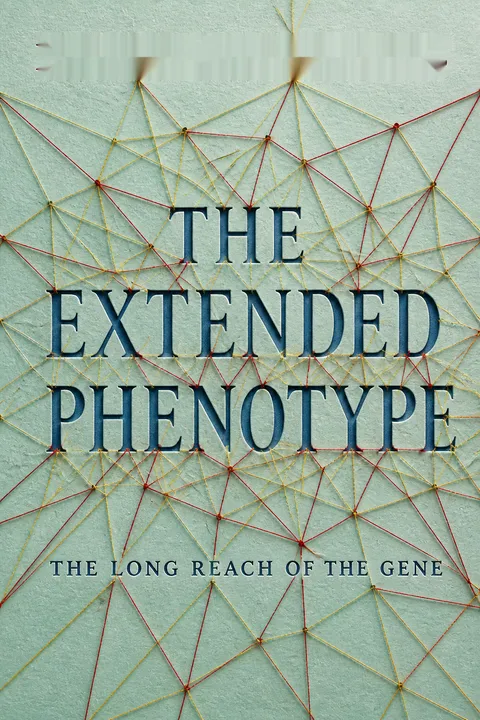
The Extended Phenotype by Richard Dawkins is a challenging but rewarding read that expands on concepts from The Selfish Gene. It explores how genes influence not just an organism's body, but also its behavior and environment. Many readers found it intellectually stimulating, praising Dawkins' clear writing and revolutionary ideas. However, some struggled with its technical nature and dense scientific content. The book is considered Dawkins' most significant contribution to evolutionary biology, offering a gene-centric view of evolution that challenges traditional perspectives.
People Also Read








Glossary
Extended phenotype
Gene effects beyond bodiesThe effects of a gene on the world, considered in comparison with the effects of its alternatives. The term is especially useful when those effects influence the gene's chance of being copied, even if they occur outside the body containing it. Animal-built structures and parasite-induced changes in host behavior are examples.
Replicator
An entity that gets copiedAny entity of which copies are made. In evolutionary biology, a replicator is important when its variants differ in how successfully they are copied and when copying preserves enough structure for differences to persist. Genes are biological replicators; Dawkins also considers cultural information, such as memes, as a possible kind.
Vehicle
A carrier of replicatorsA relatively discrete entity that houses replicators and helps them survive or reproduce. An organism is the archetypal vehicle: its structure and behavior can aid the genes it carries. A vehicle is not itself necessarily copied with the same fidelity as its replicators, so its success is measured by how well it propagates them.
Active germ-line replicator
A heritable, effect-shaping copierA replicator whose effects influence its chance of being copied and that can potentially begin an indefinitely long line of descendants. Such replicators can accumulate evolutionary change because their effects alter future copying success. Dawkins treats genetic fragments with heritable phenotypic effects as the central examples.
Evolutionarily stable strategy
A strategy resistant to invasionA behavioral rule that, when common in a population, cannot be displaced by a rare alternative that does better against it. The concept comes from game theory applied to evolution. It describes a stable population outcome, not necessarily the behavior that is best for an isolated individual in every circumstance.
Outlaw gene
A gene that cheats its genomeA gene favored at its own genetic location despite harmful effects on the organism or on other genes it shares a body with. Meiotic-drive genes can qualify by biasing gamete production in their own favor. Other genes may evolve to modify or suppress the outlaw's effects.
Selfish DNA
DNA that spreads itselfGenetic material that becomes more numerous because it is effective at copying or inserting itself, rather than because it benefits the organism. The term includes DNA that may not be translated into protein. Its spread can create conflict with other genetic material and with the organism's overall functioning.
Meme
A cultural information replicatorA unit of information that resides in a brain and can spread through communication or imitation. Its outward effects may include a tune, an idea, a style, or a behavior that helps it reach other minds. A meme's success at spreading need not improve the genetic success of the person carrying it.
Fitness
A measure of evolutionary successA technical term with several meanings in the book, including the reproductive success of an individual, the relative success of a genotype, and inclusive fitness, which tracks an individual's effects on relatives' reproduction. Dawkins stresses that these measures are not interchangeable and that confusion among them can obscure which entity or effect is being analyzed.
FAQ
What's The Extended Phenotype by Richard Dawkins about?
- Gene-Centered Evolution: The book explores the gene-centered view of evolution, emphasizing how genes extend their influence beyond the individual organism.
- Extended Phenotype Concept: Dawkins introduces the idea that genes can affect the environment and other organisms, not just the individual body.
- Gene Selection Advocacy: It argues for prioritizing the gene as the primary unit of selection, challenging traditional views focused on individual organisms or species.
Why should I read The Extended Phenotype by Richard Dawkins?
- Unique Evolutionary Perspective: The book offers a fresh lens on evolutionary biology, encouraging readers to reconsider adaptations and the role of genes.
- Accessible Writing: Dawkins is known for his engaging prose, making complex scientific concepts accessible to a broad audience.
- Influential Ideas: The concepts have significantly influenced ethology, ecology, and evolutionary biology, making it foundational for understanding modern evolutionary theory.
What are the key takeaways of The Extended Phenotype by Richard Dawkins?
- Gene as Selection Unit: Dawkins posits that genes are the primary agents of evolution, with adaptations as strategies for gene survival.
- Extended Gene Effects: The book emphasizes that genes can influence the environment and ecosystems, referred to as the "extended phenotype."
- Critique of Group Selection: Dawkins challenges group selection, arguing that natural selection acts at the level of the individual and the gene.
What is the concept of the "extended phenotype" in The Extended Phenotype by Richard Dawkins?
- Definition: The extended phenotype includes all effects a gene has on the environment, influencing survival beyond the individual.
- Examples: Dawkins cites nests built by birds and parasite manipulation of hosts as examples of genes affecting the world beyond the organism.
- Evolutionary Implications: This concept suggests that a gene's success includes its impact on the broader ecological context.
How does Richard Dawkins define "replicators" in The Extended Phenotype?
- Replicators Defined: Replicators are entities that can make copies of themselves, with genes as the primary example in biology.
- Active vs. Passive: Active replicators influence their survival through phenotypic effects, unlike passive ones.
- Germ-Line Importance: Active germ-line replicators (genes) are crucial for understanding natural selection, as they persist through generations.
What is the "life/dinner principle" in The Extended Phenotype by Richard Dawkins?
- Principle Definition: It posits that stakes in an evolutionary arms race are asymmetrical; prey has more to lose than predators.
- Evolutionary Strategy: Prey species evolve stronger defenses compared to predator adaptations due to higher survival stakes.
- Natural Example: This principle explains why prey animals prioritize survival, leading to evolutionary advantages in avoiding predation.
How does Richard Dawkins differentiate between "vehicles" and "replicators" in The Extended Phenotype?
- Vehicles Defined: Vehicles are organisms that carry replicators (genes) and provide an environment for their survival.
- Role of Replicators: Replicators are genetic entities subject to natural selection, influencing vehicle traits and behaviors.
- Natural Selection Implications: This distinction highlights that while organisms exhibit adaptations, the driving force is replicator survival.
What are "outlaw genes" and how do they function in The Extended Phenotype by Richard Dawkins?
- Outlaw Genes Defined: These genes benefit themselves at the expense of the organism or other genes.
- Types of Outlaws: Allelic outlaws have positive effects at their locus but are suppressed by other loci modifiers.
- Evolutionary Impact: Outlaw genes create genome conflicts, leading to selection pressures for suppressive modifier genes.
How does The Extended Phenotype by Richard Dawkins address the concept of "kin selection"?
- Kin Selection Overview: It suggests individuals increase genetic success by helping relatives, ensuring shared gene survival.
- Inclusive Fitness: Dawkins emphasizes considering both individual and relative reproductive success for understanding altruism.
- Critique of Individual Focus: The book argues kin selection highlights genetic relationships' importance, encouraging deeper exploration of gene-influenced behavior.
What role do animal artifacts play in the extended phenotype in The Extended Phenotype by Richard Dawkins?
- Animal Artifacts Defined: Structures like nests or dams created by animals serve specific functions and are phenotype extensions.
- Examples: Beaver dams and spider webs illustrate how structures enhance survival and reflect genetic influence.
- Evolutionary Understanding: Considering artifacts as part of the extended phenotype broadens the view of evolution, including gene effects on the environment.
How does The Extended Phenotype by Richard Dawkins challenge traditional views of evolution?
- Gene Focus Over Individuals: Dawkins argues evolution should be understood in terms of genes, not individual organisms.
- Critique of Individual Selection: The book highlights conflicts from outlaw genes, encouraging a nuanced understanding of genetic interactions.
- Broader Biological Implications: Expanding phenotype concepts to include environmental effects challenges traditional adaptation and survival views.
What are the best quotes from The Extended Phenotype by Richard Dawkins and what do they mean?
- "The phenotypic effects of a gene are the tools by which it levers itself into the next generation.": Emphasizes genes' influence beyond the organism for survival.
- "It is legitimate to speak of adaptations as being ‘for the benefit of’ something, but that something is best not seen as the individual organism.": Challenges adaptation views, arguing genes are the true beneficiaries.
- "Natural selection is the process by which replicators change in frequency in the population relative to their alleles.": Defines natural selection, highlighting replicator and allele dynamics in evolution.
About the Author
Other books by Richard Dawkins






Download PDF
Download EPUB
.epub digital book format is ideal for reading ebooks on phones, tablets, and e-readers.








