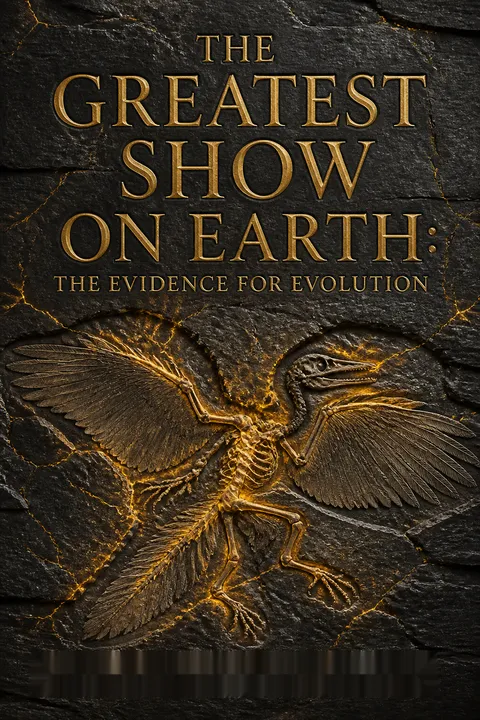


Key Takeaways
Treat evolution as a fact established by converging evidence, not eyewitnesses
Theory does not mean guess. In science, a theory can be a tested explanation that accounts for many observations. Evolution, the claim that living things share ancestors and have changed over time, has that standing. The mechanisms driving change remain open to study, but common descent is supported by evidence from fossils, anatomy, genetics, and geography.
Inference can beat eyesight. In a famous experiment, people counting basketball passes often failed to notice a person in a gorilla suit crossing the scene. Direct observation is not automatically reliable. Evolution is mostly too slow for a human witness, so scientists reconstruct it from traces, much as investigators infer a past event from fingerprints and DNA. The strength lies in independent clues converging on the same history.
What's striking is the distinction between confidence and certainty. Science does not require mathematical proof for claims about the physical world; it builds confidence when different methods, with different vulnerabilities, point to the same conclusion. The gorilla experiment is a useful reminder that perception is selective, not a neutral recording device. Still, calling a conclusion a fact should not imply that every detail is settled. Common descent is exceptionally well supported, while particular mechanisms, timings, and relationships remain open to refinement.
Use inherited variation as raw material; selection can reshape populations
Breeding shows the mechanism. In a few centuries, breeders transformed wolves into dog breeds with strikingly different bodies and behaviors. Gardeners shaped wild cabbage into broccoli, cauliflower, kale, and Brussels sprouts. These changes do not require a new kind of material. Breeders repeatedly choose which individuals reproduce, changing the frequency of inherited traits in a population.
Genes do not blend away. A gene pool is the set of hereditary variants circulating in a population. Inheritance preserves variants through generations, while reproduction reshuffles them. Selection changes their relative frequency. Artificial selection makes the choosing visible, but the underlying process can occur without a human plan. The examples establish that substantial change is possible; they do not, by themselves, explain every detail of evolution in nature.
Domestication makes an abstract claim concrete: selection can produce large changes when variation is heritable and reproduction is uneven. It also highlights the role of human preferences. A breeder can pursue one visible trait and tolerate consequences elsewhere, while natural selection reflects the combined pressures an organism faces. The analogy is powerful precisely because it isolates a mechanism, but it should not be mistaken for a complete model of wild evolution, where environments shift and reproductive success has many causes.
Selection needs no selector; survival itself can do the breeding
Flowers and insects make the bridge. A flower that attracts pollinators is more likely to have its pollen carried to another flower of the same species. Over generations, pollinators favor traits that draw them in, while flowers favor pollinators that transport pollen effectively. Orchids can make this relationship precise: some resemble female insects closely enough to lure males into attempted mating.
No conscious choice is required. Natural selection occurs when inherited differences cause some individuals to leave more offspring than others. A predator that catches prey more effectively may reproduce more; a prey animal that escapes may do the same. The result resembles deliberate breeding, but there is no breeder. The environment filters variation through survival and reproduction, often producing adaptations that look designed.
This account clarifies a common trap in language. Saying that nature “selects” can suggest intention, but selection here is a statistical outcome: some inherited variants persist more often than others. The flower examples also show that adaptations are relational. A trait can be useful because another species responds to it, and the response can reshape both sides. Such mutual dependence need not be harmonious. The same evolutionary logic covers cooperation, deception, and conflict without assigning nature a purpose.
Trust deep time when independent clocks agree across vastly different scales
Different processes keep different time. Tree rings can date some wood to the year by matching patterns of wide and narrow growth rings. Carbon-14 dates relatively recent organic remains, while other radioactive isotopes measure much older rocks. Radioactive clocks rely on predictable decay and are reset when molten rock cools and crystallizes.
The clocks cross-check one another. Fossils are usually found in sedimentary rock, which cannot itself be dated reliably by radioactive decay. Geologists date nearby igneous rocks and use the established order of rock layers to locate the fossils in time. Multiple dating methods converge on an Earth about 4.6 billion years old. That timescale gives gradual evolutionary change enough generations to accumulate into profound differences.
The strength of this evidence comes from methodological independence. Tree growth, isotope decay, and the ordering of strata are not variations of one measurement, so agreement among them is harder to dismiss as a shared technical error. This is a general lesson in measurement science: calibration and cross-checking matter more than the apparent precision of a single instrument. The dates still carry margins of error, especially over billions of years, but those margins are nowhere near large enough to make a young Earth plausible.
Watch evolution happen in bacteria, lizards, and guppies
Rapid change is observable. Lizards moved to a Croatian island shifted toward a plant-heavy diet in about 37 years, with changes in jaw strength and gut anatomy. Guppies in John Endler's experiments changed their color patterns as predation and mate preferences varied. These cases show that selection can alter populations on human timescales.
Lenski's bacteria reveal the steps. Twelve lines of E. coli were raised separately in similar conditions. Across tens of thousands of bacterial generations, all adapted to use glucose more effectively, though they followed different genetic routes. One line also evolved the ability to use citrate in the experimental conditions. Frozen samples let researchers compare descendants with living ancestors and test how earlier mutations affected later changes.
These studies do more than show that organisms change. Their controlled comparisons link environmental conditions to shifts in inherited traits, while archived bacterial samples make the past experimentally accessible. That combination is unusually strong because it connects observation with causal tests. There is also an important scale distinction: a new metabolic ability in bacteria is evolutionary novelty, but it is not a miniature replay of every major transition in life's history. Different questions require evidence at different scales.
Read the fossil record as an ordered history, not a demand for perfection
The order carries the evidence. Fossils occur in a consistent sequence through geological layers. Mammals do not appear in Devonian rocks, and trilobites do not turn up in younger layers above their known extinction. A fossil in the wrong stratum would seriously challenge evolutionary history; despite extensive searching, no authenticated example has done so.
Intermediate forms are expected. Tiktaalik, a roughly 375-million-year-old animal, combines fishlike features with traits associated with land vertebrates. Human fossils likewise document a sequence from small-brained, upright-walking australopiths through several Homo forms. Species names impose boundaries on gradual change, so researchers may disagree over whether a fossil belongs in one group or another. That naming dispute does not erase the anatomy between groups.
A fossil record is necessarily incomplete because fossilization is rare and preservation favors some bodies and settings over others. Completeness is not the relevant test. The revealing pattern is that fossils appear in a temporal order that matches predictions from common ancestry, with transitional combinations where lineages diverge. The book's case is strongest when it treats fossils as one evidence stream among several, rather than making any single celebrated specimen carry the entire argument.
Use islands and continents to see how isolation generates species
Separation lets populations diverge. Speciation is the formation of distinct species, often after populations are geographically isolated long enough to stop exchanging genes. A hurricane once carried iguanas on driftwood from one Caribbean island to another. Rare dispersal can found a new population; if movement between populations remains limited, their evolutionary paths can separate.
Geography preserves the branching pattern. Galapagos species resemble South American relatives, yet many differ among islands. Australia holds a distinctive marsupial fauna, while Madagascar's lemurs are found nowhere else. Plate tectonics adds a deeper history: ancient continents split and carried their populations apart. These distributions make sense as records of ancestry, dispersal, isolation, and change, rather than as unrelated placements of separately created species.
Biogeography functions like a map of historical constraints. It explains not only where species live, but why close relatives cluster in particular regions and why isolated places develop distinctive forms. The argument becomes especially compelling when geography, fossils, and genetic relationships agree. Yet isolation is not the only route to speciation, and an island is not a sealed laboratory. Migration, changing climates, and ecological interactions complicate the history, making precise local explanations more nuanced than the broad pattern.
Compare anatomy and DNA; nested similarities reveal shared ancestry
Bodies preserve common architecture. Human arms, bat wings, and horse forelegs differ in shape and function, yet their bones connect in the same basic order. This is homology: similarity in underlying structure that makes sense as inherited modification from a shared ancestor. Similar lives can also produce lookalikes independently, as with dolphins and fish, so details matter more than surface resemblance.
Molecules strengthen the family tree. DNA comparisons produce nested patterns of similarity: humans and chimpanzees are close, while more distant species share fewer sequences. Different genes generally support a compatible branching tree. The genetic code itself is nearly universal across life. Neutral mutations, which do not affect reproductive success, can accumulate and help estimate how long lineages have been separate.
The force of molecular evidence lies in its scale and consistency. A family tree inferred from one gene could mislead, but agreement across many regions of DNA is much harder to explain as coincidence. Anatomy offers an independent check, including structures that make little sense as fresh designs but fit inheritance. Similarity alone is not proof of close kinship, because convergence can produce lookalikes. The strongest inference comes from a detailed, branching pattern across many traits.
Understand bodies as self-assembled processes, not miniature blueprints
Embryos build through local interactions. DNA is not a blueprint that maps each line to a body part. It helps regulate an unfolding process in which cells divide, signal, stick together, and change their behavior. The analogy is closer to a recipe or a set of local rules than to a finished architectural drawing. In starling flocks, simple responses by individual birds can create coordinated movement without a leader; developing tissues also produce larger patterns through many local interactions.
Small changes can scale up. A gene can alter a protein's shape, which changes a chemical reaction in a cell, which affects tissue growth, and ultimately changes an adult trait. Haldane's reply to a skeptic was that a human body develops from one cell in nine months. Embryology makes that process understandable in principle, even when its full detail remains complex.
This account replaces a misleading machine metaphor with a process model. In biology, order often emerges from interactions among parts rather than from a central designer issuing complete instructions. Developmental biology and computer simulations both show how local rules can generate organized forms. The comparison should not imply that embryos are simple or fully understood. Their feedback loops and chemical signals are intricate, and the book's point is narrower: complexity need not be encoded as a miniature adult or a one-to-one diagram.
Inherited history leaves design flaws that evolution can only patch
Evolution modifies what already exists. A dolphin breathes air through a blowhole, and whales retain small pelvic bones from land-dwelling ancestors. The human retina is wired in a way that creates a blind spot. Most strikingly, the recurrent laryngeal nerve travels down into the chest, loops around an artery, then returns up the neck. In a giraffe, that detour stretches for many feet.
History explains the awkward route. The nerve's path follows a developmental arrangement inherited from fish ancestors, whose gill structures lay near the relevant vessels. Evolution can favor incremental improvements, but it cannot simply redraw the body from scratch. The result is a workable structure carrying traces of its past, often with later adjustments compensating for earlier constraints.
These examples turn imperfection into positive evidence. A poor route can be more informative than a polished adaptation because it reveals the sequence of inherited changes. Engineering design usually begins with a target and can replace a component; evolution works through viable intermediates and inherited development. Still, the argument is not that every awkward feature proves ancestry. Specific claims require anatomical and developmental evidence, and some apparent flaws may have functions that are not yet understood.
Expect arms races to waste resources because selection rewards local winners
Competition escalates without a planner. Predators become better at catching prey, while prey become better at escaping. Cheetahs and gazelles both evolved exceptional speed, but neither necessarily gains a lasting advantage because the other side changes too. Trees compete for light in the same way: each can benefit by growing taller, even though a forest collectively spends enormous resources building trunks.
Fitness is not welfare. Natural selection favors inherited variants that leave more descendants, not choices that optimize an ecosystem or reduce suffering. A predator that hunts more may out-reproduce a restrained rival, even if overhunting eventually damages the whole population. This also helps explain why nature contains disease, predation, and painful deaths without a mechanism designed to minimize them.
The arms-race model clarifies why individually advantageous behavior can produce collectively wasteful outcomes. It resembles a coordination problem: everyone could benefit from restraint, but a unilateral defector gains an immediate edge. Unlike people, genes and animals do not negotiate a binding agreement or plan for distant consequences. The framework also has limits. Not every interaction is escalating competition; mutualism and ecological feedback can stabilize relationships. Selection explains incentives, not a universal march toward greater aggression.
Evolution explains life's complexity, while its first origin remains uncertain
The start is a separate problem. Evolution by natural selection requires heritable variation and differential reproduction. Before either existed, a self-replicating system had to arise. The book presents the RNA World as a plausible proposal because RNA can carry information and, in some cases, catalyze reactions. It might have preceded the division of labor now seen between DNA, which stores information, and proteins, which perform many chemical tasks.
A plausible account is not settled proof. Experiments have produced biological building blocks under proposed early-Earth conditions, but the book stresses that there is no decisive account of life's beginning. That uncertainty does not undermine the extensive evidence for evolution after life existed. The larger conclusion is that natural selection can accumulate small, heritable improvements into extraordinary diversity, powered by energy flowing from the sun.
Separating life's origin from life's diversification is a crucial act of intellectual bookkeeping. A gap in knowledge about the first replicator does not cancel evidence from fossils, genetics, and observed adaptation. At the same time, the RNA proposal is a research direction, not a completed historical reconstruction. The book's broader insight is methodological: explanations should be strong where evidence is strong and provisional where evidence is incomplete. That distinction protects scientific confidence from becoming either dogma or false modesty.
Analysis
The book's central achievement is not simply defending evolution, but showing how different kinds of evidence constrain one another. Selection experiments explain how inherited differences can spread. Deep-time dating supplies the scale on which gradual change becomes consequential. Fossils supply a chronological sequence, while anatomy, molecular comparisons, and biogeography reveal relationships that would remain evident even if the fossil record were sparse. The cumulative argument is stronger than any single example because its evidence streams are partly independent.
Its most useful conceptual correction is to replace a ladder of progress with a branching history. Species are cousins, not rungs, and living forms are not unfinished versions of one another. That reframing also corrects a common misunderstanding of adaptation: evolution has no foresight and does not optimize for a species, an ecosystem, or human moral preferences. It changes populations through unequal reproductive success, constrained by inherited development and competing costs.
The book's polemical urgency reflects its concern with science education, but that tone can obscure a valuable distinction. The fact of common descent is far more secure than every claim about the relative importance of particular mechanisms or the history of a particular trait. Likewise, the origin of the first replicating system remains an open scientific problem, not a weakness in evidence for subsequent evolution. The clearest reading preserves both confidence and boundaries: evolution is established history, while its detailed reconstruction remains an active scientific enterprise.
People Also Read


Glossary
theorum
well-supported scientific theoryDawkins's deliberately altered spelling for a scientific theory that has been repeatedly confirmed and explains many observations. He uses it to distinguish this sense of theory from an informal guess or tentative hypothesis. It is a rhetorical term specific to the book, not standard scientific vocabulary, and it does not mean mathematical proof.
population thinking
variation within populationsA way of understanding species as populations of variable individuals rather than imperfect copies of an ideal type. In this view, inherited differences are real and consequential, and the typical form of a population can shift across generations. It contrasts with essentialism, which assumes each species has a fixed underlying essence.
gene pool
hereditary variants in a populationThe collection of hereditary variants present in a reproducing population. Individuals inherit a sample of this variation, and reproduction reshuffles it across generations. Evolution, in this framework, occurs when the frequency of inherited variants changes over time, through processes such as natural selection, mutation, and chance.
natural selection
unequal reproductive successA process in which inherited differences affect survival or reproduction, causing some variants to become more common than others. It requires no conscious selector or plan. The environment influences which organisms leave more descendants, and the traits that contributed to their success can become more frequent in the population.
speciation
formation of distinct speciesThe process by which one ancestral population gives rise to separate species. Geographic separation often limits the exchange of genes between populations, allowing them to diverge through selection and other evolutionary changes. If they become unable to interbreed successfully, biologists generally classify them as distinct species.
homology
shared inherited structureA correspondence between structures in different organisms, such as the bones in a human arm and a bat wing. Their shapes and functions may differ, but their underlying arrangement is similar. In evolutionary biology, such patterns are explained by inheritance from a common ancestor, followed by modification in different lineages.
molecular clock
genetic change used to estimate timeA method for estimating when lineages diverged by comparing genetic changes that accumulate at a roughly predictable rate. Many useful changes are neutral, meaning they do not affect reproductive success and are not strongly filtered by natural selection. The clock must be calibrated against other evidence, including dated fossils.
self-assembly
order from local interactionsThe formation of organized structures through local interactions among components, without a complete external blueprint directing every step. In embryonic development, cells divide, signal, adhere, and change behavior in ways that generate tissues and body structures. The resulting organization can be highly complex even though no cell contains a miniature adult.
neutral theory
many mutations are selectively neutralThe view that many genetic changes have little or no effect on an organism's reproductive success. Such changes can spread through populations by chance rather than because they improve adaptation. Their accumulation can help researchers estimate evolutionary relationships and times, while natural selection remains important for traits that affect survival or reproduction.



Download PDF
Download EPUB
.epub digital book format is ideal for reading ebooks on phones, tablets, and e-readers.








