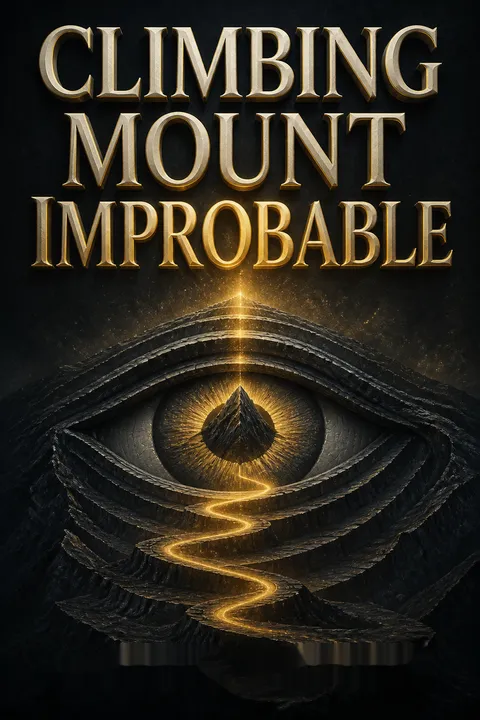


Key Takeaways
Treat apparent design as evidence of a process, not proof of a designer.
Three kinds of appearance. A rock that vaguely resembles a face may be chance. Mount Rushmore, with four recognizable presidential portraits, is deliberate human design. Living things belong to a third category Dawkins calls designoid: they look purposefully made, but their fit comes from evolution, not conscious planning. An ant-mimicking beetle, a leafy sea dragon hidden among seaweed, and a pitcher plant that traps insects all show how convincing the illusion can be.
Function matters. A natural hollow stone can hold water, but it is a poor pot compared with a shaped vessel. Living structures, by contrast, can be exquisitely fitted to tasks because useful inherited variations accumulate over generations. The first question is not whether something looks designed, but what process could have shaped it.
What's striking is how the examples expose a weakness in human pattern recognition. People readily see faces in clouds, then mistake the resulting impression for evidence. The comparison also offers a practical test: resemblance alone is weak evidence, while repeated, context-specific performance demands a causal explanation. Engineering analysis can reveal what a structure does, but function alone does not establish how it arose. History and inheritance supply that missing account.
Heredity turns tiny useful accidents into adaptations no single accident could build.
Selection accumulates. Dawkins calls this process cumulative finding. A sharp reed leaf might arise without being useful, but if sharper plants leave more offspring, and their offspring inherit that tendency, later generations can build on the difference. Humans used the same principle to produce many forms of cabbage from wild cabbage, and to breed dog varieties from wolf ancestors.
Chance is only half. Mutation supplies variation, often without regard to what an organism needs. Natural selection is the non-random filter: individuals with inherited traits that improve survival or reproduction tend, on average, to leave more descendants. The improvement is stored in genes, not learned afresh by each generation. Without heredity, favorable accidents cannot accumulate; with it, small changes can produce adaptations that seem wildly improbable when viewed all at once.
This is a powerful distinction between generating possibilities and retaining results. It resembles learning systems in which noisy attempts become useful only when feedback preserves better outcomes. The analogy has limits: biological selection has no explicit goal, and what counts as an advantage changes with the environment and competing organisms. A trait can be beneficial in one setting and costly in another. The enduring insight is not that evolution always improves, but that inherited differences can accumulate without foresight.
Study a web as a sequence of solved problems, not a finished object.
Silk buys reach. A spider can cover far more hunting area with lightweight silk than with muscular limbs. Orb-weavers solve a chain of practical problems: getting an initial thread across a gap, anchoring a frame, laying radiating spokes, and adding a sticky capture spiral without collapsing the unfinished web. They use a temporary, non-sticky spiral as scaffolding, then remove it as the final spiral goes in.
The web keeps changing. Silk can stretch to many times its resting length and recoil slowly, helping absorb an insect's impact without bouncing it free. Spiders also vary their tactics: some use loose threads that detach at one end, while others spring a partly slack web over prey. The NetSpinner computer model tested variations by weighing flies caught against silk used, showing how selection can favor economical designs.
The web is a useful case study in systems engineering: each solution creates a new constraint, so the finished structure emerges from linked trade-offs rather than a single master plan. Computational models make those trade-offs explicit, but their scorekeeping depends on choices programmers make about costs and benefits. That limitation is informative, not fatal. It shows why a model can illustrate a plausible selection process while still failing to reproduce the full ecology that shaped real spiders.
Climb biological heights by gradual paths, not impossible leaps.
Take the long route. Mount Improbable is Dawkins's metaphor for the apparent difficulty of evolving a highly complex feature. Its sheer face represents a sudden jump from simple beginnings to a finished eye or wing. The gentler route represents many small inherited improvements, each useful in its own generation. Natural selection does not need to assemble a finished structure in one lucky throw.
Intermediate forms can work. Flight may have emerged through gliding, leaping, or other stages that already helped their possessors cross gaps or escape predators. Small insects may have benefited from wing-like projections as solar collectors before those structures aided flight. Such possibilities are examples of pre-adaptation, when a feature first useful for one role becomes available for another. The precise history of flight remains debated, but gradual routes are biologically plausible.
The mountain metaphor corrects a common reasoning error: comparing a partial structure with a modern structure while ignoring what the partial structure can already do. This resembles the logic of evolutionary innovation in technology, where existing components gain new uses. Still, a plausible route is not automatically the historical route. Evidence from fossils, living species, and developmental biology is needed to distinguish among competing paths, especially when several routes could reach similar outcomes.
The eye is many evolutionary solutions, not one miraculous invention.
Vision has many footholds. Dawkins reports estimates that eyes evolved independently at least 40 times, and perhaps more than 60. Some animals detect only light and dark; others have cup-shaped eyes that register direction, pinhole eyes, camera eyes with lenses, or compound eyes built from many small units. Each can be useful for its owner's way of life. A modern snail eye is not a failed human eye, but a workable design with different costs and capabilities.
A route can be tested. In a computer model, biologists Dan Nilsson and Susanne Pelger traced gradual changes from a light-sensitive surface toward a camera-style eye. Under conservative assumptions, their model required about 364,000 generations to produce a good fish-like eye. That estimate does not include every feature of a modern visual system, but it shows that the basic optical structure need not demand geological ages.
The model's importance lies in demonstrating a continuous path, not proving that a particular lineage followed it. That distinction is central to computational biology: a successful simulation establishes possibility under stated rules, while historical evidence is needed to establish what actually happened. The diversity of eye designs also illustrates a general principle of convergent evolution. Similar problems can yield similar solutions, while different environments and inherited starting points preserve very different ones.
Do not assume evolution can backtrack to the better design.
History limits options. Natural selection usually cannot favor a temporary loss of fitness just because a better destination might lie beyond it. Whales returned to life in water but kept lungs, inherited from land-dwelling ancestors. Their air-breathing arrangement is not necessarily ideal in every respect, yet changing the whole system to gills would require a viable route through intermediate stages.
Starting points matter. Flatfish such as plaice evolved by settling on one side and shifting an eye toward the upper surface. Rays, whose ancestors were already flattened, evolved a different, more symmetrical arrangement. Both lineages adapted to life on the sea floor, but their different histories made different routes accessible. Evolution can sometimes change direction when selection relaxes or genes move between populations, but it is not free to take any route that looks better from the summit.
This is a biological version of path dependence: earlier decisions, or in this case inherited structures, shape what can be done next. The same idea appears in economics and technology, where established systems make some innovations cheaper than others. The metaphor should not suggest that every lineage is trapped forever. Environmental shifts, gene flow, and developmental changes can open routes that were previously unavailable. But a superior endpoint has no power to guide evolution unless intermediate steps can persist.
Developmental rules can limit variation while making useful change easier.
Forms occupy a space. Dawkins's Museum of All Possible Shells imagines every conceivable coiled shell arranged near similar ones. Three measurements describe much of shell form: how quickly the coil expands, how thick the tube is relative to the coil, and how much the spiral rises into a cone. Many theoretical shapes have no living examples, raising a question: were they unavailable to mutation, or simply poor designs?
Rules shape variation. Kaleidoscopic embryology is development that repeats changes across matching body parts, as symmetry does across an animal's two sides or segmentation does along an arthropod's body. This can restrict the forms produced by mutation, while making a useful change appear in several places at once. The idea that such developmental rules can improve evolvability is suggestive, but not a replacement for natural selection.
The museum metaphor helps distinguish what can be imagined from what can be reached through actual development. Modern evolutionary developmental biology similarly asks how gene networks and body-building processes bias the variation available to selection. A constraint can be productive when it channels change into coordinated forms, but it can also block alternatives. Empty regions of theoretical form cannot, by themselves, reveal which explanation is correct. Functional tests and evidence about development are needed.
Organisms are elaborate vehicles built to keep replicating information in circulation.
Copying needs machinery. Dawkins describes genes as instructions whose persistence depends on being copied. A simple self-copying program can exploit ready-made machinery, like a virus using a host cell. A more ambitious program must first build the machinery that copies it. He calls this a Total Replication of Instructions Program, or TRIP. Organisms fit the idea: they gather resources, grow, and reproduce through bodies built under genetic instructions.
Small beginnings scale up. Cells multiply by local doubling. Under ideal conditions, just 57 rounds of doubling could produce the roughly 100 quadrillion cells of a blue whale. Real development is more complex, with different cell lineages dividing for different lengths of time, but exponential growth explains how small genetic changes in development can alter large structures. The book presents the origin of the first self-copying molecule as an unresolved, speculative step, not a known event.
This perspective connects biology to information theory: genetic sequences persist because cellular processes copy and interpret them. It also reframes bodies as outcomes of replication rather than as evolution's final purpose. The framing is powerful, but it should not erase the organism's own physiology or imply genes act alone. Development depends on cells, environments, and interactions among many genes. Replication is the organizing thread, not a complete account of every biological level.
Stop treating nature as humanity's pantry or a benevolent community.
Change the viewpoint. Flowers are not primarily decorations for people. Bees see ultraviolet patterns invisible to us, and many flowers use color, scent, and nectar to attract pollinators. A bee may visit millions of blossoms to produce a pound of clover honey. From the plant's perspective, the bee is a way to carry pollen to another flower; from the bee's perspective, the flower offers food.
Cooperation has costs. Ants cultivate fungi, and some plants house ants that defend them from herbivores. These partnerships can benefit both sides without either acting for the good of a larger community. Grass may survive grazing better than competing plants, but an individual grass plant would still benefit from not being eaten. Ecological outcomes can be shared even when the participants' interests are local.
Seeing the world from a pollinator's sensory perspective is a compact lesson in scientific humility: human perception is not a neutral map of what matters. The account also clarifies how cooperation can emerge from aligned incentives rather than goodwill. Yet a gene-centered view should not be mistaken for a claim that every relationship is neatly reciprocal. Ecological networks include conflict, dependence, and changing balances of benefit, all of which demand attention to context.
In the fig, selfish partners enforce cooperation without foresight or goodwill.
A hidden garden. A fig is an enclosed structure lined with tiny flowers. Its specialized wasp pollinators enter to lay eggs and carry pollen between figs. In some species, male trees produce flowers that feed wasp larvae, while female trees produce flowers that can make seeds but cannot nourish wasp young. Wasps that enter female figs may pollinate the tree, but leave no descendants of their own.
Incentives police behavior. Male figs benefit from wasps that can pollinate female figs, so they may effectively screen wasps by allowing larvae to develop only in pollinated flowers. This is vicarious selection: one organism's traits are filtered through their effects on another organism's success. Female figs may resemble male figs, making them harder for wasps to avoid. The intricate partnership persists not through planning, but through adaptations that counter each side's opportunities to exploit the other.
The fig partnership is a vivid case of evolutionary game theory: stable cooperation can arise when each participant's selfish strategy is constrained by the other's response. Vicarious selection is especially useful because it explains how a trait can be favored through its effects on a partner's performance. The account is also a reminder that elegant explanations need empirical testing. The proposed strategies depend on detailed claims about development, behavior, and reproductive success, not merely on the apparent cleverness of the system.
Analysis
Climbing Mount Improbable is best understood as an argument about explanation. Dawkins takes structures that seem to require a leap of extraordinary luck and asks instead whether they could be assembled through a sequence of inherited, locally useful changes. The argument gains force from its variety of examples: a spider solving construction problems, an eye assembled along an optical gradient, and a fig-wasp partnership shaped by reciprocal selection. Computer models make the central logic more tangible by showing how selection can find improvements without a designer specifying the finished result.
The book's most important distinction is between random variation and non-random filtering. That distinction remains essential in public discussions of evolution, where cumulative change is often confused with chance assembly. Equally valuable is the attention to historical constraints. Natural selection can produce impressive fit, but it works with inherited structures and available variations, not with a blueprint of the ideal organism. This makes the book more nuanced than a simple claim that selection can produce anything.
Some claims are illustrations of possibility rather than reconstructions of actual history. The eye model demonstrates a plausible route under defined assumptions, not the precise ancestry of any living eye. The origin of the first replicator remains open, and the book does not treat natural selection as an explanation for how that first copying system arose. Its treatment of development also points toward a productive question, how the architecture of variation affects evolutionary outcomes, while acknowledging that the evidence is less settled than the basic case for selection.
The book's deeper achievement is to join scientific explanation with a shift in perspective. Nature is neither a collection of accidents nor a designed service for humans. It is a historical process in which heredity, variation, selection, and constraint generate forms that can look astonishingly purposeful. That process is powerful precisely because it has no foresight.
Review Summary
Climbing Mount Improbable receives mostly positive reviews for its clear explanations of evolution and natural selection. Readers appreciate Dawkins' engaging writing style and use of examples to illustrate complex concepts. Many find the book fascinating and enlightening, particularly the chapters on eyes, wings, and fig wasps. Some criticize Dawkins' arrogance and repetitiveness. Overall, reviewers recommend it as an accessible introduction to evolutionary biology, though a few find certain sections challenging or outdated.
People Also Read









Glossary
designoid
Design-like, but not designedDawkins's term for living bodies and their products that appear designed because they are well fitted to particular tasks, although they were not consciously planned. Their functional fit results from cumulative evolutionary processes, especially natural selection. A pitcher plant, for example, can function as an insect trap without having been deliberately fashioned.
cumulative finding
Inherited improvements accumulateA process in which useful variations are repeatedly retained across generations, allowing later generations to build on earlier changes. Unlike simply searching for a fortunate object, cumulative finding depends on heredity: selected traits are passed on and can be improved. Dawkins uses selective breeding of dogs and plants as familiar examples.
Mount Improbable
A metaphor for gradual adaptationDawkins's metaphor for the apparent improbability of complex biological adaptations. A sheer cliff represents an impossible-seeming jump from simple beginnings to a finished structure. The opposite slope represents a gradual route made of small steps that can each be useful to their bearers. The metaphor also allows for multiple peaks, or different solutions to a problem.
pre-adaptation
An old feature gains a new roleA feature that evolves or exists for one function and is later recruited for a different function. Dawkins uses examples such as hairs becoming defensive quills and a structure useful in an early stage of evolution later taking on a new task. The term helps explain how complex adaptations can begin with materials already serving another purpose.
Museum of All Possible Shells
A map of possible shell formsDawkins's visualization of the space of conceivable coiled shells. Shells are arranged near forms that resemble them, with dimensions corresponding to measurable properties such as coil expansion, tube thickness, and the rise of the spiral. The museum includes both real shells and theoretical forms that have no known living examples.
kaleidoscopic embryology
Development repeats useful variationsA developmental organization in which a change can be repeated across matching parts of an organism. Symmetry mirrors changes across body regions, while segmentation can repeat or coordinate changes along a body. Dawkins argues that such rules restrict the range of possible forms but may also make coordinated, evolutionarily useful variations easier to produce.
Total Replication of Instructions Program
Instructions that build copying machineryDawkins's hypothetical program for complete self-replication. Unlike a simple instruction to copy itself, it must also direct the gathering of raw materials, construction of components, and assembly of the machinery needed to copy the instructions. He uses the concept to compare organisms with complex self-reproducing robots.
vicarious selection
Traits filtered through a partnerA process in which one organism's features affect which traits succeed in another organism. In the fig and wasp example, a fig's flowers may allow wasp larvae to develop only when the wasp has pollinated them. This can favor wasp traits useful to the fig, even though the selection operates through the wasp's reproductive success.
NetSpinner
A simulated evolving spider webA computer program described by Dawkins that models spiders building webs and catching simulated flies. Variations in web-building behavior are inherited and mutated, while webs are evaluated by the flies caught relative to the silk used. The program illustrates how selection can favor more efficient webs without a human choosing each improvement.
Nilsson and Pelger model
A modeled route to camera visionA computer-based analysis by biologists Dan Nilsson and Susanne Pelger that tested whether gradual changes could improve a simple light-sensitive structure into a camera-style eye. With deliberately conservative assumptions, the model estimated roughly 364,000 generations for a good fish-like eye. It demonstrates a plausible route, not the exact historical sequence followed by a particular lineage.
FAQ
What's Climbing Mount Improbable about?
- Exploration of Evolution: Richard Dawkins explores evolutionary concepts, focusing on how complex biological structures evolve through gradual changes.
- Mount Improbable Metaphor: The metaphor illustrates that seemingly improbable evolutionary outcomes can be achieved through small, incremental steps.
- Designoid Objects: Dawkins discusses living beings that appear designed but are actually the result of natural selection, contrasting them with truly designed objects.
Why should I read Climbing Mount Improbable?
- Understanding Evolution: The book provides a clear explanation of evolutionary biology, making complex concepts accessible to a general audience.
- Challenging Misconceptions: Dawkins addresses misconceptions about evolution, emphasizing the role of natural selection over chance.
- Rich Examples: Filled with vivid examples and illustrations, the book helps readers visualize and understand evolutionary processes.
What are the key takeaways of Climbing Mount Improbable?
- Natural Selection vs. Chance: Evolution is driven by natural selection acting on random mutations, not by chance alone.
- Gradualism in Evolution: Complex structures evolve through gradual changes, not sudden leaps, as illustrated by the evolution of the eye.
- Multiple Evolutionary Paths: There are diverse evolutionary paths, represented by different peaks on Mount Improbable, highlighting adaptation diversity.
What are the best quotes from Climbing Mount Improbable and what do they mean?
- “The sheer height of the peak doesn’t matter...”: This quote emphasizes that evolution is a gradual process achieved through small steps.
- “Designoid objects are not accidental.”: It highlights that living organisms' complexity arises from evolutionary processes, not intentional design.
- “Natural selection is a non-random force...”: This underscores the role of natural selection in shaping species evolution, countering the misconception of randomness.
How does Richard Dawkins explain the evolution of the eye in Climbing Mount Improbable?
- Multiple Evolutions: Eyes have evolved independently at least forty times, showcasing evolutionary versatility.
- Gradual Development: The eye evolved through small, beneficial changes, allowing for functional intermediate forms.
- Computer Simulation: Dawkins references a simulation showing that complex eyes could evolve from simple beginnings in 364,000 generations.
What is the metaphor of Mount Improbable in Climbing Mount Improbable?
- Symbol of Evolution: Mount Improbable represents the gradual journey of evolution, where organisms adapt over time.
- Cliffs and Slopes: Steep cliffs symbolize impossible leaps, while gentle slopes represent gradual evolutionary steps.
- Encouragement for Understanding: The metaphor encourages appreciation of evolution's complexity and diverse adaptation paths.
What are designoid objects according to Climbing Mount Improbable?
- Definition: Designoid objects are organisms that appear designed due to complexity but result from evolutionary processes.
- Contrast with Designed Objects: Unlike intentionally designed objects, designoid objects arise from natural selection acting on mutations.
- Examples in Nature: Dawkins provides examples like the eye to illustrate complexity arising without a designer.
How does Climbing Mount Improbable challenge creationist views?
- Countering Misconceptions: Dawkins explains evolution mechanisms and evidence, emphasizing it is not a theory of chance.
- Emphasis on Evidence: The book presents evidence from genetics and paleontology supporting evolution.
- Understanding Natural Selection: By clarifying natural selection's role, Dawkins challenges the notion of a designer for complex life forms.
How does Richard Dawkins address the argument of "irreducible complexity" in Climbing Mount Improbable?
- Critique of Irreducible Complexity: Dawkins argues it misunderstands evolution's gradual nature, where complex systems evolve from simpler forms.
- Intermediate Forms: He provides examples of functional intermediate forms, countering the idea of non-gradual evolution.
- Natural Selection's Role: The book emphasizes natural selection favoring beneficial intermediate forms, allowing complex system development.
What role do mutations play in evolution as described in Climbing Mount Improbable?
- Source of Variation: Mutations provide genetic variation for natural selection to act upon.
- Randomness and Selection: While mutations are random, natural selection is non-random, selecting beneficial traits.
- Cumulative Effect: Beneficial mutations accumulate over generations, leading to significant evolutionary changes.
What is the significance of the title Climbing Mount Improbable?
- Metaphor for Evolution: The title represents the gradual and challenging process of evolution, with each step as a small adaptation.
- Overcoming Improbability: It suggests that improbable outcomes can be achieved through incremental changes over time.
- Journey of Discovery: The title reflects the scientific journey of understanding evolutionary biology's intricacies.
How does Richard Dawkins use computer models in Climbing Mount Improbable?
- Simulating Evolution: Dawkins uses computer models to simulate evolutionary processes, particularly eye evolution.
- Visualizing Concepts: Simulations help visualize abstract evolutionary concepts, making them accessible to readers.
- Testing Hypotheses: Models test evolutionary hypotheses, providing a framework for understanding natural selection dynamics.
About the Author
Other books by Richard Dawkins




Download PDF
Download EPUB
.epub digital book format is ideal for reading ebooks on phones, tablets, and e-readers.








