

Key Takeaways
Ask why your inherited god deserves belief when other cultures' gods don't.
Faith follows geography. Across history, people have worshipped thousands of gods, often believing the religion of their family and place. Dawkins asks why a person should regard the local god as more credible than Zeus, Thor, or the deities of other traditions. Christianity and Islam share roots with Judaism, while the spread of religions has also followed political power and conquest. These histories make religious identity look less like a discovery made independently by each child and more like an inheritance.
Belief needs a reason. Atheism, as used here, means not believing in gods, not claiming to have proved that none exist. Bertrand Russell's orbiting teapot illustrates the distinction: a claim can be impossible to disprove without becoming reasonable to believe. The practical question is not whether a god can be ruled out with absolute certainty, but whether evidence supports believing in one.
What's striking is the book's shift from asking whether faith feels meaningful to asking how a belief was acquired. That is a useful move in epistemology, the study of how people know what they know: confidence and social transmission are not evidence of truth. Still, geographical inheritance alone cannot disprove a religion. People inherit languages, too, without every sentence being false. The stronger lesson is symmetrical scrutiny: apply the same evidentiary standards to one's own tradition that one would apply to a distant, unfamiliar one.
Demand evidence in proportion to the extraordinary claim.
Claims need different proof. The book separates the modest claim that a preacher named Jesus existed from claims that he was born of a virgin or returned from death. Many historians think Jesus probably existed, while the supernatural claims require much stronger evidence. The earliest Christian writings, Paul's letters, offer little biography; the gospels were written decades after Jesus's death, and historians debate their reliability. Dawkins argues that later testimony, retelling, and religious commitment leave ample room for distortion.
Compare explanations. Philosopher David Hume's approach to miracles asks whether a reported event is more likely than the possibility of error, exaggeration, or deception. At Fatima in 1917, witnesses said the sun moved dramatically. If it had, the effect should have been visible far beyond Portugal. The conflict with ordinary astronomical evidence makes mistaken perception or a spreading report more plausible than a cosmic event.
The central discipline here is calibrated skepticism, not blanket distrust of witnesses. Testimony is indispensable in history, but its strength depends on proximity, independence, consistency, and corroboration. A large crowd does not necessarily provide many independent observations if people influence one another, especially during a charged event. Hume's comparison is powerful when it forces alternatives into view, though it does not by itself settle every case. The practical habit is to ask what evidence would distinguish a miracle from ordinary processes of perception and transmission.
Treat scripture as ancient testimony, not self-authenticating history.
Texts have histories. The gospels are not signed eyewitness accounts in the modern sense. Their traditional names do not establish authorship, and the earliest, Mark, is generally dated decades after Jesus's death. Matthew and Luke draw heavily on Mark, and the accounts differ on details such as genealogies and the circumstances of Jesus's birth. Dawkins argues that the writers' interest in fulfilling older prophecies may have shaped the stories they told.
Canons are choices. The biblical books were not delivered as one finished volume. Early Christian communities circulated different writings, and later authorities defined which would count as scripture. The book uses this history to question why familiar gospels should be treated as uniquely reliable while other early Christian accounts are dismissed. A text's eventual sacred status tells readers about its influence and acceptance, not automatically about the accuracy of every event it describes.
The historical method asks who wrote a text, when, for whom, and with what sources. That makes scripture legible as a human artifact without denying its cultural or spiritual importance. One detail deserves care: the Council of Nicaea did not simply select the biblical canon or settle the list of books in the way the book's account can suggest. Canon formation was a longer process. That correction does not erase the broader point: institutions and communities shaped which writings became authoritative.
Trace a sacred story's mutations before mistaking it for a record.
Stories change in transit. Before writing and archaeology, communities passed accounts down by word of mouth. Each retelling could add, remove, or reshape details. Dawkins compares this to the party game in which a whispered message changes as it travels along a line. The biblical flood story, for example, resembles an older Mesopotamian account about Utnapishtim, including a great flood, a boat, animals, and birds sent to look for land.
Modern myths offer clues. During the Second World War, Pacific islanders saw military cargo arrive by plane and built imitation runways and control towers after supplies stopped. Some expected a return of the abundance. The example shows how recent events can acquire religious meaning quickly. Myths can be imaginative, beautiful, or morally useful, Dawkins argues, without being reliable histories. Their appeal and persistence do not establish that their supernatural events occurred.
The cargo cult example makes cultural transmission unusually visible: people explain unfamiliar technology through the concepts already available to them. This connects to cultural evolution, the study of how ideas spread, change, and persist through groups. A myth can survive because it binds a community, explains uncertainty, or offers identity, even if its factual claims are weak. That distinction matters. Calling a narrative a myth need not mean it is worthless; it means its historical status must be assessed separately from its symbolic or social role.
Judge holy books by moral standards they cannot supply themselves.
Scripture contains conflicting models. The Bible's stories include the suffering of Job, Abraham's near-sacrifice of Isaac, and commands to destroy rival peoples. Its Ten Commandments include prohibitions on murder and theft, but also rules centered on worship and the Sabbath. Dawkins asks whether a book can be the final authority on right and wrong when readers already have to decide which passages are admirable and which are cruel.
Moral judgment changes. Slavery was accepted by many societies and is not plainly condemned in the cited biblical passages. Modern opposition to slavery reflects moral change that came through argument, activism, law, and changing social expectations, not simply obedience to scripture. The same independent judgment lets readers value the Golden Rule while rejecting vengeance or treating women as property. For Dawkins, moral evaluation has to come from standards beyond the text being evaluated.
This is a strong argument against using a scripture as its own moral referee: selecting the humane passages already assumes a standard for judging them. The historical examples also show that moral consensus is not fixed. Yet the idea of moral progress needs humility. Societies can extend rights in one area while retreating in another, and people disagree about what counts as progress. The book's useful challenge is not that every modern instinct is correct, but that inherited authority should remain open to reasoned criticism.
Build goodness on empathy and accountability, not fear of divine surveillance.
Goodness has human sources. Dawkins challenges the claim that people need a god watching them to behave well. In a university coffee room experiment, researcher Melissa Bateson found that people paid more into an honesty box when a picture of eyes appeared above the price list than when flowers appeared. The image could not actually see them, suggesting that cues of being watched can affect behavior. The result may explain why divine surveillance feels persuasive, but it does not show that religion is required for decency.
Ethics can be reasoned through. The book contrasts absolutism, which treats certain rules as binding regardless of outcomes, with consequentialism, which considers who is helped or harmed. Both approaches face difficult cases, and moral philosophers debate their limits. Dawkins's broader point is that people can argue about suffering, fairness, and responsibility without appealing to a sacred rulebook. Religious belief may motivate some people, but it is not the only foundation for generosity or moral conduct.
The eyes experiment connects moral behavior to social psychology: people respond not only to actual monitoring, but to cues that activate a sense of accountability. That does not reduce morality to fear. Empathy, trust, identity, and shared norms also guide conduct, and religious communities can provide strong institutions for care. The important distinction is between a reason to behave well and a reason to believe a god exists. A practice might influence behavior without proving the metaphysical claim used to support it.
Explain religious instincts without confusing survival value with truth.
Minds detect agents. On an ancestral savanna, mistaking wind in the grass for a predator cost time; mistaking a predator for wind could cost a life. A tendency to suspect purposeful agents could therefore be useful, even when it sometimes produced false alarms. Dawkins connects this bias to belief in spirits and gods. Pattern-seeking can also create superstition: B. F. Skinner's pigeons developed repetitive habits when food arrived unpredictably, as if their actions caused it. Human religious practices may likewise grow from mistaken links between actions and outcomes.
Cooperation has roots. Natural selection can favor care for relatives because relatives are more likely to carry shared genes. Dawkins also describes reciprocal altruism, in which individuals help one another in ways that can be repaid over time. Vampire bats, for example, share food with familiar roost-mates that have failed to feed. Such tendencies may help explain both religious belief and human niceness, but explaining a belief's origin does not settle whether it is true.
The section draws on two distinct fields: cognitive science explains why certain beliefs feel intuitive, while evolutionary biology explains how cooperation can persist. A key caution is the difference between an origin story and a refutation. Showing that a belief could arise from agency detection or pattern-seeking does not prove that every religious claim is false, just as explaining vision's evolution does not make visible objects unreal. The account is strongest as a hypothesis about psychological tendencies, not as a complete explanation of every religion or believer.
Natural selection turns tiny random changes into astonishing adaptations.
Small steps accumulate. Natural selection is the process by which heritable variations that improve survival or reproduction become more common across generations. Mutations arise without aiming at improvement; selection is not random, because some variants leave more descendants than others. A cheetah with a slight advantage in running might catch more prey and pass on the relevant genes. Small changes can accumulate without requiring a fully formed eye, heart, or hunting strategy to appear in one lucky leap.
Selection is visible. Humans have bred wolves into many dog breeds and transformed wild cabbage into vegetables such as cauliflower and Brussels sprouts. This artificial selection demonstrates how repeated choices can reshape populations. In nature, environmental pressures do the selecting. The result can look designed because adaptations fit their functions. But a designer would raise a further question: how did such a complex designer arise? Evolution offers a gradual process rather than a complete organism appearing by chance at once.
The crucial conceptual distinction is between random variation and nonrandom filtering. Evolution is not a claim that complex organisms assemble from a single improbable shuffle; it is a cumulative process in which each generation inherits workable structures. This mechanism is supported by converging evidence from genetics, fossils, and comparative anatomy, not just by analogy with dog breeding. At the same time, explanations of particular adaptations require evidence. An appealing story about why a trait helps is a hypothesis to test, not proof by itself.
Read biological flaws as ancestry's fingerprints, not a designer's mistakes.
Bodies preserve history. Flatfish such as flounders rest on one side, so one eye would face the sea floor. Their skulls twist as the eye migrates to the upward-facing side. This awkward arrangement makes sense as a modification of an earlier, symmetrical fish body, not as an obvious first-choice design. The vertebrate retina is also wired with light-sensitive cells facing away from incoming light, creating a blind spot where nerves pass through.
Detours reveal descent. The recurrent laryngeal nerve travels down the neck, loops around an artery near the heart, then returns to the voice box. In a giraffe, that route becomes strikingly long. Its path is understandable if inherited from fish ancestors, where the nerve served a gill and passed behind an artery. These examples do not prove evolution individually, but they are the kind of historical constraint expected when species inherit and modify existing structures.
The argument gains force from converging clues: anatomy, development, and the fossil record can each preserve different parts of evolutionary history. A suboptimal structure is not automatically evidence against design, since engineers sometimes accept trade-offs or constraints. But the specific patterns described here are especially informative because they match the sequence of descent predicted by evolutionary biology. The broad lesson is to treat biological oddities as data. A design explanation that only labels a feature purposeful may miss the historical question of why it took this particular route.
Follow complexity from chemistry upward, without inventing a master planner.
Order can assemble itself. Self-assembly is the formation of organized structures through local interactions, without a separate builder arranging each part. Crystals grow as molecules settle into repeating patterns. In cells, proteins fold into shapes that help them act as enzymes, and DNA carries instructions that influence which proteins are made. DNA is not a miniature map of a finished body; it helps guide a developmental process in which cells divide and respond to local conditions.
Local rules scale up. Termites following simple behaviors can build elaborate mounds, and individual starlings following nearby birds can form coordinated flocks. Neither requires a termite architect or a master bird directing every turn. Embryos also develop through interactions among cells, rather than by a tiny blueprint being unfolded. Such bottom-up processes show how large-scale structure can emerge from many small interactions, while still depending on physical laws and biological constraints.
Emergence is a powerful idea across biology, physics, and computer science: collective order can arise from local interactions without a central command. The examples make that principle concrete, but they do not make every detail of development simple. The underlying rules, chemical conditions, and inherited structures constrain what can emerge. Bottom-up explanation is not the same as saying anything can happen spontaneously. Its value is that it replaces an unexplained planner with mechanisms that can be observed, modeled, and tested.
Let science unsettle intuition instead of plugging each mystery with God.
Common sense can mislead. Galileo's claim that a feather and a cannonball fall at the same rate in a vacuum, and the idea that continents drift, once sounded absurd. Evidence changed the picture. Dawkins argues that the same intellectual courage is needed when considering life's apparent design. Julia Sweeney, a former Catholic, describes the initial disorientation of losing belief, then finding that gravity and ordinary science made the world intelligible without a supernatural supervisor.
Open questions remain open. Some people invoke God to explain the origin of life, the universe, or the laws of physics. Dawkins warns that inserting a complex creator does not explain where that creator came from. He discusses fine-tuning and the anthropic principle: observers can only exist in a universe compatible with their existence. A multiverse might help explain why a life-permitting universe is observed, but the book presents this as an unfinished scientific possibility, not a settled answer.
The book's strongest closing principle is methodological: a gap in current knowledge is not evidence for whichever answer feels familiar. That is a good antidote to premature certainty, but intellectual courage must be paired with disciplined testing. A proposed multiverse, for example, is not established merely because it can answer a fine-tuning puzzle. Nor does science guarantee that every ultimate question will receive a final answer. The more defensible position is to distinguish what is known, what is plausible, and what remains speculative.
Analysis
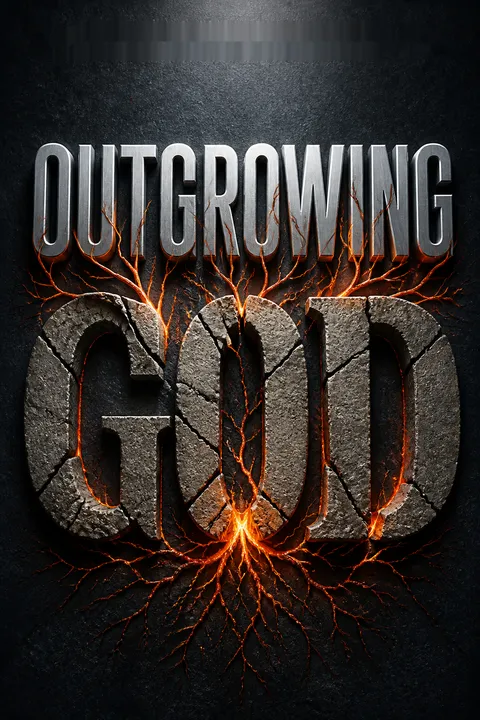
Outgrowing God is built as a two-part argument. First, it loosens the authority of inherited religion by examining plural belief, the historical limits of scripture, the changing shape of myth, and the gap between sacred rules and contemporary moral judgment. Then it replaces the apparent need for a creator with evolutionary explanations of adaptation, biological development, and religious psychology. The progression matters: readers are asked not merely to reject a conclusion, but to change the standards by which conclusions are accepted.
The book's central intellectual achievement is separating three questions that are often blended together: whether a religious claim is true, why people believe it, and whether belief helps people behave well. Historical transmission can weaken confidence in a text without settling every theological question. An evolutionary account of religious intuition can explain its appeal without disproving every religious proposition. Likewise, the possibility that religious institutions encourage generosity does not establish the existence of the gods they describe. Keeping these categories distinct makes the case more rigorous than a simple conflict between science and faith.
The most powerful explanatory engine is cumulative selection. Darwinian evolution shows how adaptations can be improbable as finished products yet achievable through small, inherited variations filtered across generations. The book then extends the broader lesson of emergence: crystals, cells, organisms, and coordinated groups need not be arranged by a visible central planner. This does not eliminate difficult questions about life's earliest origins or the laws of physics. The author is most persuasive when treating those gaps as open problems rather than proof of a supernatural answer.
The polemical style gives the book energy and accessibility, especially for readers who have been taught not to question. It can also compress scholarly disagreements and make some historical claims sound more settled than they are. Its lasting value lies less in any single accusation than in its invitation to compare explanations, inspect evidence, and resist confusing comfort, cultural inheritance, or moral usefulness with truth.
Review Summary
Outgrowing God: A Beginner's Guide receives mixed reviews. Many praise its clear arguments against religion and accessible explanations of evolution, calling it an excellent introduction to atheism. Some find it less provocative than Dawkins' previous works, making it more likely to convince believers. Critics argue it lacks depth and relies on weak arguments. Supporters appreciate Dawkins' passion for science and logical reasoning, while detractors find his approach condescending. The book is seen as particularly valuable for young people questioning their faith, though some doubt its ability to change minds.
People Also Read





Glossary
Natural selection
Heritable traits spreadThe process by which inherited variations that improve survival or reproduction tend to become more common in a population over generations. Variations arise without foresight, but their consequences are filtered by conditions in the environment. Over long periods, this cumulative process can produce complex adaptations without requiring an organism to appear fully formed.
Byproduct theory
A trait emerges incidentallyAn explanation in which a feature persists not because it was directly selected for its present role, but because it arose as a consequence of other traits that were useful. Dawkins applies this idea to religious belief: pattern-seeking, sensitivity to agents, and children's tendency to trust caregivers may have useful functions, while superstition and religious ideas can arise as side effects.
Reciprocal Altruism
Help exchanged over timeA pattern of cooperation in which one individual helps another and may receive help in return on a future occasion. It can be favored when individuals encounter one another repeatedly and can recognize or remember partners. Dawkins illustrates the idea with vampire bats that share food with familiar roost-mates that have gone without a meal.
Bottom-up
Order from local rulesA way of producing complex patterns through many individual parts following relatively local rules, without a central designer directing the whole result. The book uses termite mounds, flocking starlings, and embryonic development as examples. The large-scale organization emerges from interactions among components rather than from a complete plan held by any one component.
Self-assembly
Structure forms through interactionThe spontaneous formation of an organized structure as components interact according to their physical or chemical properties. Crystals provide a clear example: molecules or ions join an existing structure in regular positions. The book uses this idea to introduce organization in living systems, including the formation of proteins and the assembly of virus parts.
False positives and false negatives
Two errors in pattern detectionA false positive occurs when someone perceives a pattern that is not actually present, such as believing a ritual caused rain that would have arrived anyway. A false negative occurs when someone misses a real pattern, such as failing to connect mosquitoes with malaria. The book argues that human pattern-seeking can produce both errors.
Anthropic principle
Observers require compatible conditionsThe observation that any universe in which observers exist must have conditions compatible with the emergence of those observers. The principle helps explain why people find themselves in a life-permitting environment without automatically showing that the environment was designed for them. Dawkins discusses its possible relevance to fine-tuning and the speculative idea of many universes.
Fundamental constants of physics
Measured values in physical lawsPhysical quantities, such as the gravitational constant and the speed of light, whose measured values appear in the laws describing the universe. Scientists know their values with considerable precision but do not necessarily know why they have those particular values. The book discusses claims that small changes could produce a very different universe, potentially unable to support life.
Categorical Imperative
Universal rule for actionImmanuel Kant's principle that a person should act only on a rule that could consistently be adopted as a universal law. The book uses it as an example of a nonreligious, rule-based approach to morality. A rule that depends on others being honest while permitting oneself to deceive, for example, undermines the conditions that make the rule useful.
FAQ
What's Outgrowing God: A Beginner’s Guide about?
- Exploration of belief systems: Richard Dawkins examines various gods worshipped throughout history, questioning the validity of these beliefs, with a focus on the Abrahamic religions.
- Critique of religious texts: Dawkins critically analyzes the Bible and other holy texts, questioning their historical accuracy and moral teachings.
- Science vs. religion: The book emphasizes the importance of scientific understanding, particularly evolution, in explaining the natural world.
Why should I read Outgrowing God: A Beginner’s Guide?
- Thought-provoking arguments: Dawkins presents compelling arguments that challenge traditional religious beliefs, encouraging critical thinking.
- Accessible writing style: His clear and engaging writing makes complex ideas understandable for a general audience.
- Encourages self-reflection: The book prompts readers to consider their own beliefs and the origins of those beliefs.
What are the key takeaways of Outgrowing God: A Beginner’s Guide?
- Doubt historical accuracy: Dawkins emphasizes that many biblical stories lack historical evidence and should be viewed as myths.
- Morality independent of religion: The book argues that moral values can exist without belief in a deity.
- Importance of science: Dawkins highlights the significance of scientific understanding, particularly evolution, in shaping our worldview.
How does Richard Dawkins define atheism in Outgrowing God: A Beginner’s Guide?
- Atheism explained: Dawkins defines atheism as a lack of belief in gods, contrasting it with theism.
- Comparison with agnosticism: He distinguishes atheism from agnosticism, which he describes as uncertainty about the existence of gods.
- Rational approach: Dawkins emphasizes that atheism is a rational position based on the absence of evidence for gods.
What role does evolution play in Outgrowing God: A Beginner’s Guide?
- Foundation of understanding: Dawkins argues that evolution provides a comprehensive explanation for the diversity of life on Earth.
- Challenge to creationism: The book critiques creationist beliefs that contradict evolutionary science.
- Implications for morality: Dawkins suggests that our moral instincts have evolved alongside our species, independent of religious teachings.
How does Richard Dawkins address the concept of morality in Outgrowing God: A Beginner’s Guide?
- Morality without religion: Dawkins argues that moral values do not require a divine source.
- Evolutionary basis for morality: He suggests that our sense of morality has evolved as a social trait beneficial for cooperation and survival.
- Critique of biblical morality: Dawkins critiques the moral teachings found in the Bible, arguing that many are outdated or harmful.
What myths does Richard Dawkins discuss in Outgrowing God: A Beginner’s Guide?
- Biblical myths: Dawkins examines various biblical stories, such as the creation narrative and the flood, arguing they are myths rather than historical accounts.
- Cultural myths: He discusses myths from other cultures, comparing them to biblical narratives to illustrate common themes in human storytelling.
- Impact of myths on belief: Dawkins argues that these myths have shaped religious beliefs and moral values throughout history.
How does Richard Dawkins critique the Bible in Outgrowing God: A Beginner’s Guide?
- Historical inaccuracies: Dawkins highlights the lack of historical evidence for many biblical events.
- Moral contradictions: He critiques the moral teachings in the Bible, pointing out contradictions and outdated values.
- Role of interpretation: Dawkins discusses how religious leaders often reinterpret biblical texts to fit modern values.
How does Richard Dawkins explain the complexity of the eye in Outgrowing God: A Beginner’s Guide?
- Camera analogy: Dawkins compares the vertebrate eye to a camera, explaining its function with a lens and retina.
- Evolutionary development: He argues that the eye's complexity arose through natural selection.
- Flaws in design: Dawkins points out the "backward wiring" of the retina as a flaw suggesting evolution rather than intelligent design.
What is the anthropic principle discussed in Outgrowing God: A Beginner’s Guide?
- Existence of life: The anthropic principle states that the universe must be compatible with the conscious beings that observe it.
- Fine-tuning argument: Dawkins suggests that the specific conditions of our universe do not necessitate a creator.
- Implications for understanding: The principle challenges readers to consider the implications of our existence in a universe that appears tailored for life.
How does Richard Dawkins use examples from nature to support his arguments in Outgrowing God: A Beginner’s Guide?
- Animal behavior: He uses examples like the cheetah and gazelle to illustrate the arms race of evolution.
- Camouflage and adaptation: Dawkins discusses the remarkable adaptations of animals, such as the chameleon’s color-changing ability.
- Human evolution: He references human traits and behaviors, arguing that our moral and social instincts have evolutionary roots.
How does Outgrowing God: A Beginner’s Guide challenge the idea of a creator?
- Improbability of design: Dawkins argues that the complexity of life can be explained through natural processes rather than requiring a divine creator.
- Historical evidence: He presents historical and scientific evidence that contradicts the notion of a creator.
- Encouragement of rational thought: The book encourages readers to adopt a rational, evidence-based approach to understanding existence.
About the Author
Other books by Richard Dawkins




Download PDF
Download EPUB
.epub digital book format is ideal for reading ebooks on phones, tablets, and e-readers.








